Question 29
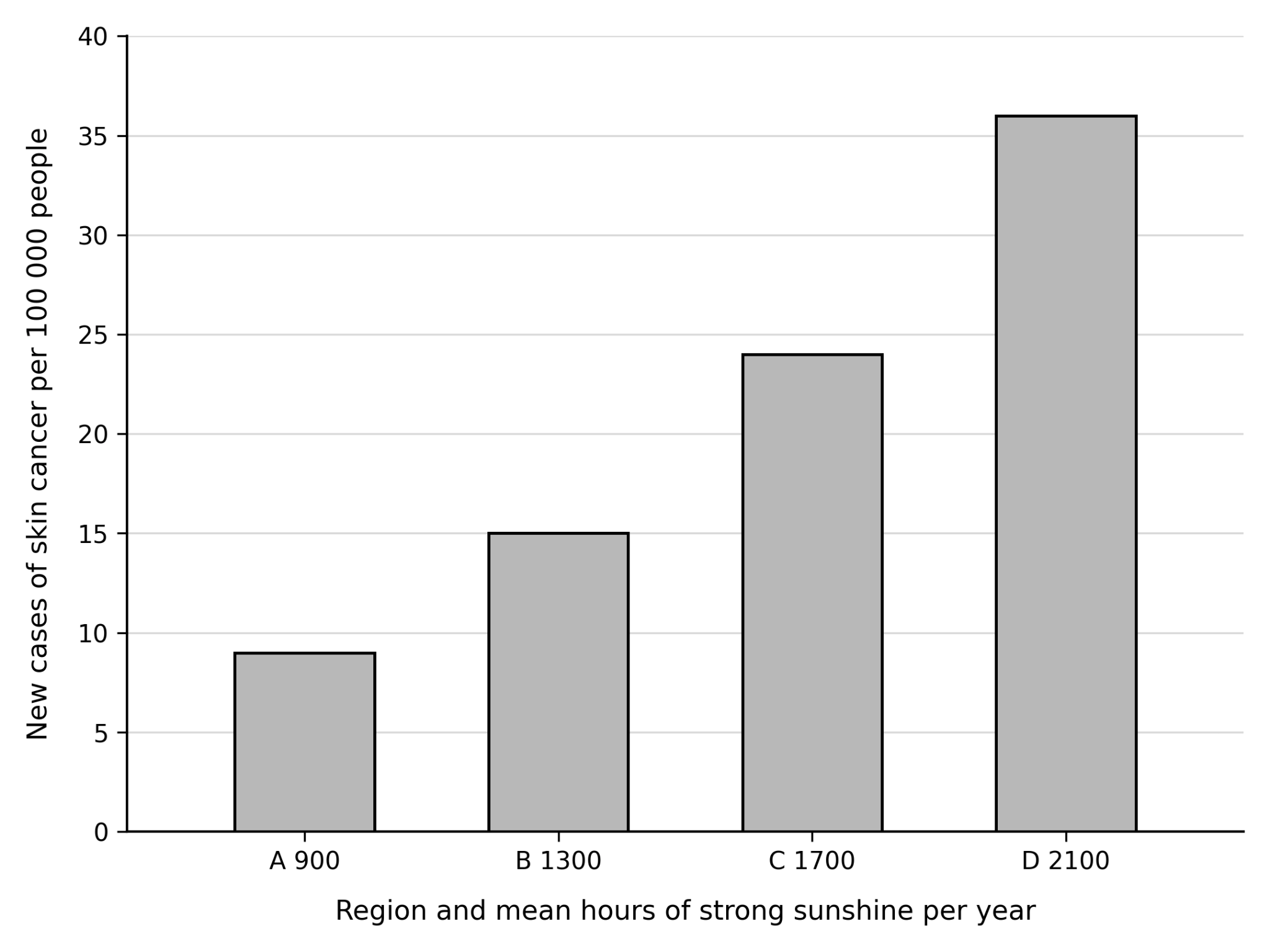
FA scientist recorded the number of new cases of skin cancer per 100 000 people in four regions, A, B, C and D, of one country. The regions receive different mean numbers of hours of strong sunshine per year. The figure shows the results.
Figure: The number of new cases of skin cancer per 100 000 people in four regions receiving different mean numbers of hours of strong sunshine per year
a.[1]
Give the number of new cases of skin cancer per 100 000 people in region C.
b.[1]
Describe the relationship between the mean number of hours of strong sunshine and the number of new cases of skin cancer.
c.[1]
Suggest one way, other than moving to a different region, that a person living in region D could reduce their risk of skin cancer.
2.2 Animal tissues, organs and organ systems Questions
179 exam-style questions on AQA GCSE Biology 2.2 Animal tissues, organs and organ systems, covering 2.2.1 The human digestive system, 2.2.2 The heart and blood vessels, 2.2.3 Blood, 2.2.4 Coronary heart disease: a non-communicable disease, 2.2.5 Health issues, 2.2.6 The effect of lifestyle on some non-communicable diseases, and 2.2.7 Cancer. Each one has a worked solution and a mark scheme showing where the marks go.