Question 14
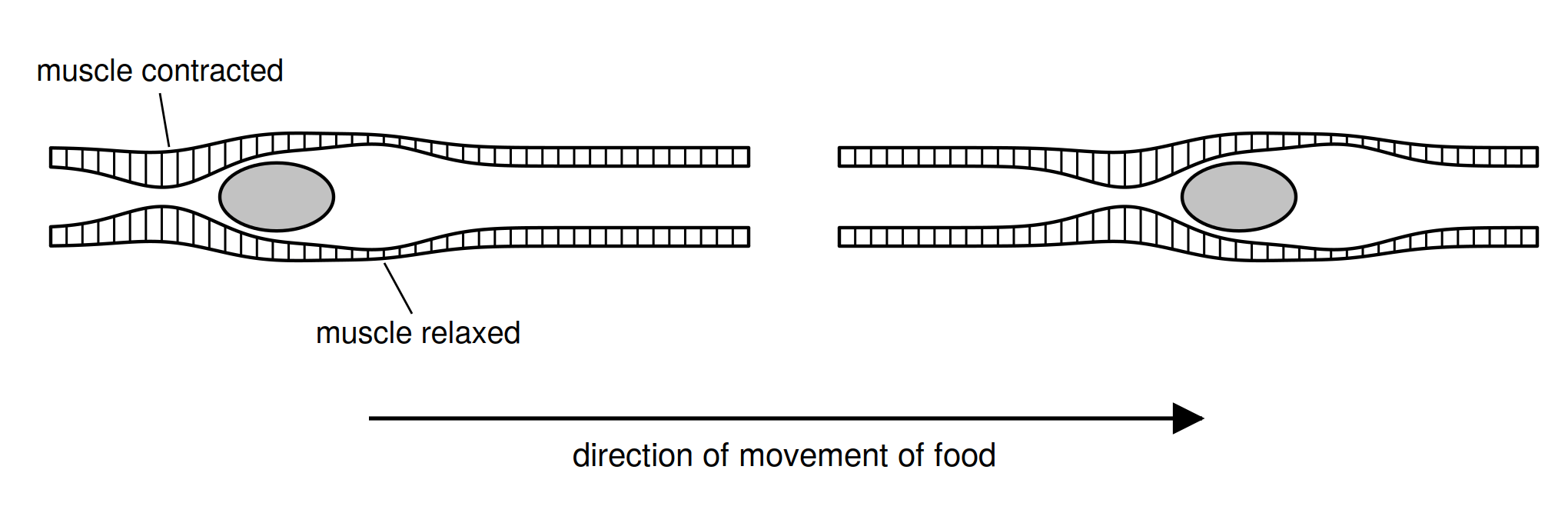
FThe figure shows a section through the oesophagus as a ball of food is moved along it.
Figure: A section through the oesophagus showing the muscle in the wall behind and in front of a ball of food
a.[2]
Use Figure to describe how the ball of food is moved along the oesophagus.
b.[2]
An astronaut in zero gravity is still able to swallow food and move it to the stomach. Explain why.
c.[1]
The oesophagus contains muscular tissue and epithelial tissue. Explain why the oesophagus is described as an organ and not as a tissue.
2.2 Animal tissues, organs and organ systems Questions
179 exam-style questions on AQA GCSE Biology 2.2 Animal tissues, organs and organ systems, covering 2.2.1 The human digestive system, 2.2.2 The heart and blood vessels, 2.2.3 Blood, 2.2.4 Coronary heart disease: a non-communicable disease, 2.2.5 Health issues, 2.2.6 The effect of lifestyle on some non-communicable diseases, and 2.2.7 Cancer. Each one has a worked solution and a mark scheme showing where the marks go.