Question 17
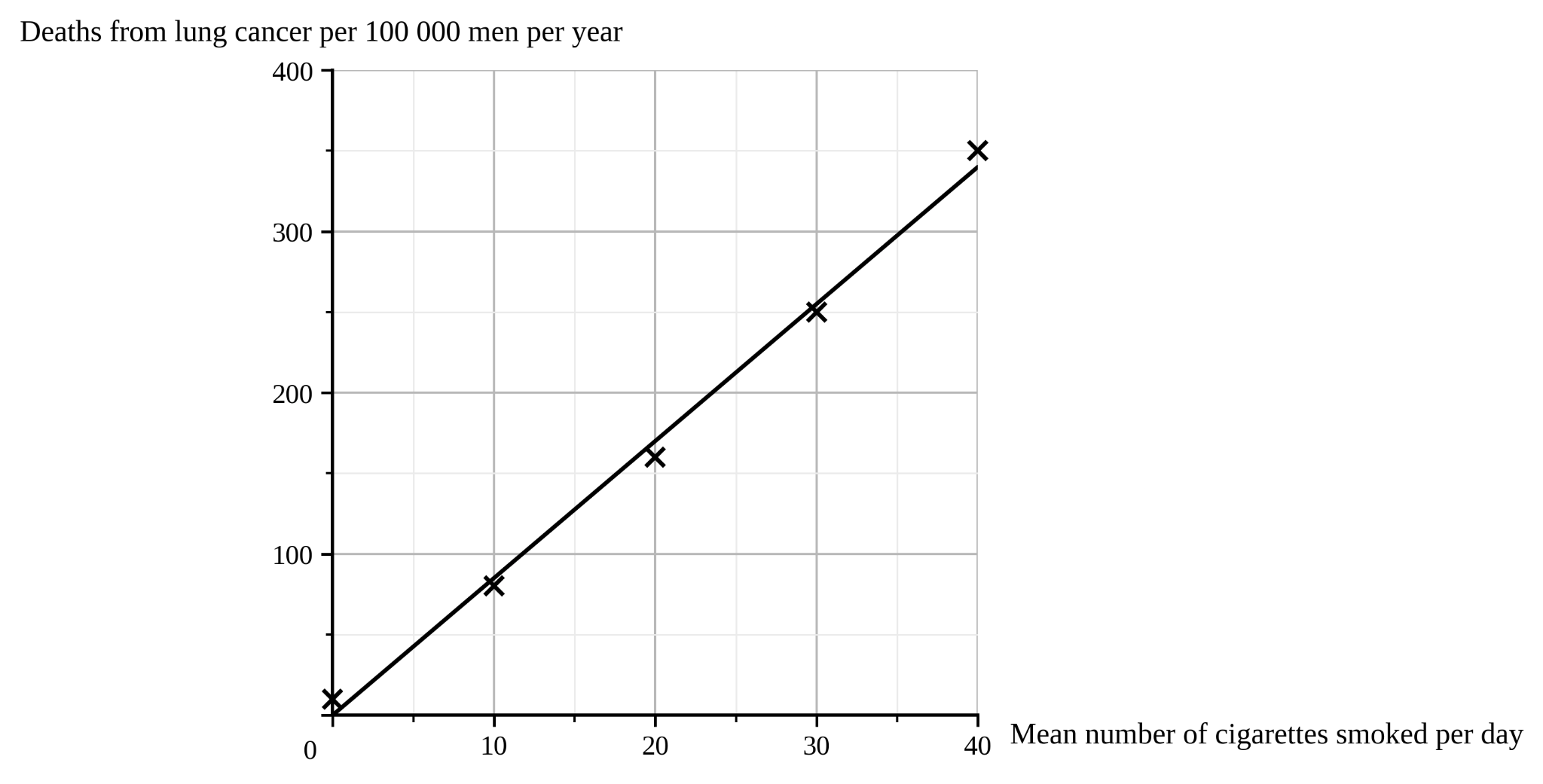
FDoctors recorded the number of men who died from lung cancer in groups of men who smoked different numbers of cigarettes each day.
Figure: The number of deaths from lung cancer each year, per 100 000 men, plotted against the mean number of cigarettes smoked each day
a.[2]
Describe the relationship shown in the graph. Use data from the graph in your answer.
b.[2]
A student concluded that smoking 20 cigarettes a day causes lung cancer in every man who smokes. Give two reasons why this conclusion is not correct.
c.[2]
Explain how the tar in cigarette smoke can lead to lung cancer.
2.2 Animal tissues, organs and organ systems Questions
179 exam-style questions on AQA GCSE Biology 2.2 Animal tissues, organs and organ systems, covering 2.2.1 The human digestive system, 2.2.2 The heart and blood vessels, 2.2.3 Blood, 2.2.4 Coronary heart disease: a non-communicable disease, 2.2.5 Health issues, 2.2.6 The effect of lifestyle on some non-communicable diseases, and 2.2.7 Cancer. Each one has a worked solution and a mark scheme showing where the marks go.