Question 59
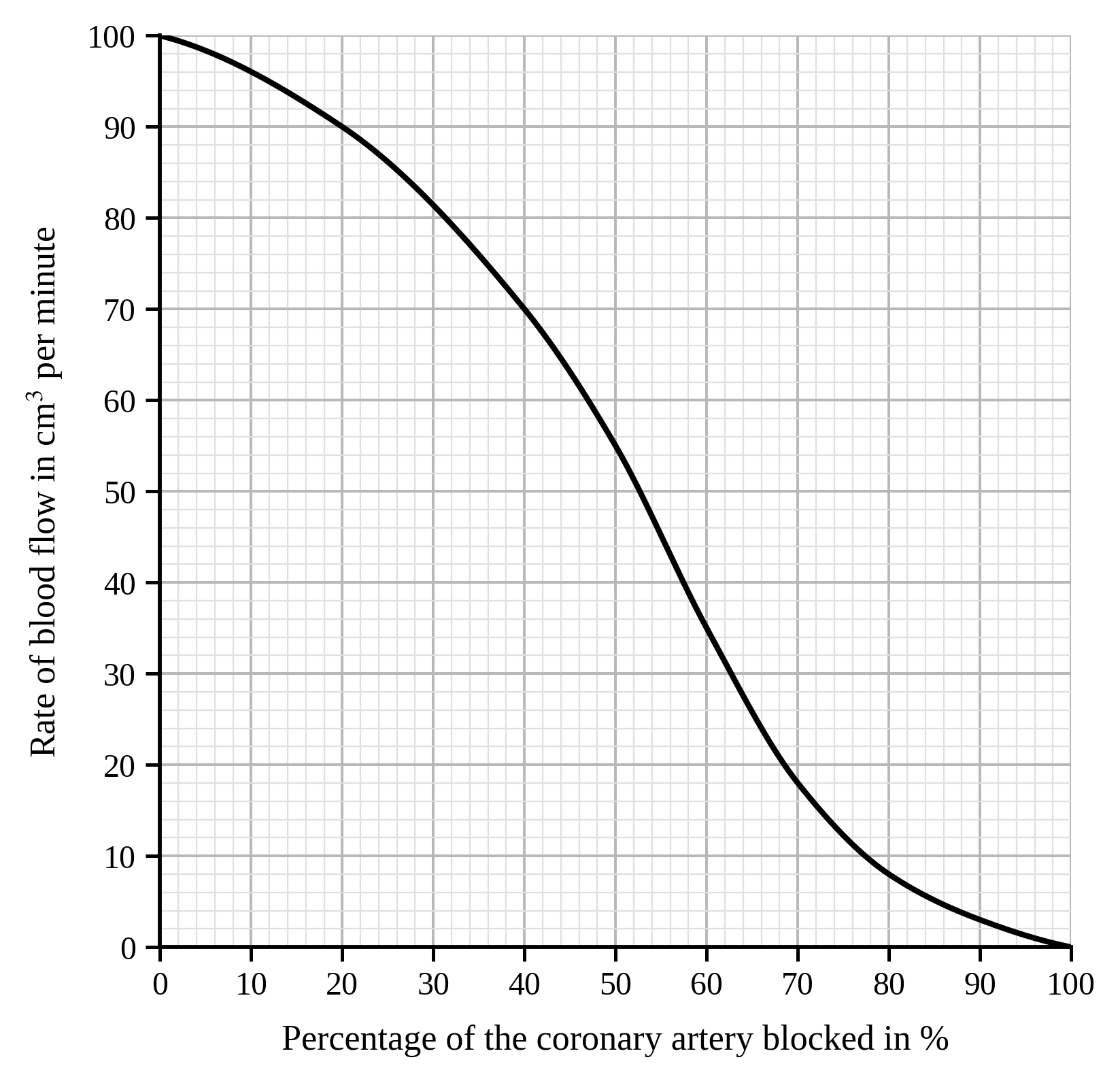
HThe figure shows how the rate of blood flow through a coronary artery changes as the percentage of the artery blocked by fatty material increases.
Figure: The rate of blood flow through a coronary artery at different percentages of blockage by fatty material
a.[1]
Use the figure to determine the rate of blood flow when 60 % of the coronary artery is blocked.
b.[2]
Use the figure to determine the percentage blockage at which the rate of blood flow has fallen to half of its value in an unblocked artery.
c.[2]
A patient has a coronary artery that is 20 % blocked and has no symptoms. Use the figure to explain why.
d.[2]
Doctors usually fit a stent only once a coronary artery is more than 70 % blocked. Use the figure to suggest why.
2.2 Animal tissues, organs and organ systems Questions
179 exam-style questions on AQA GCSE Biology 2.2 Animal tissues, organs and organ systems, covering 2.2.1 The human digestive system, 2.2.2 The heart and blood vessels, 2.2.3 Blood, 2.2.4 Coronary heart disease: a non-communicable disease, 2.2.5 Health issues, 2.2.6 The effect of lifestyle on some non-communicable diseases, and 2.2.7 Cancer. Each one has a worked solution and a mark scheme showing where the marks go.