The industrial manufacture of methanol is represented by the following chemical equation:
CO(g)+2H2(g)⇌CH3OH(g) \text{CO}\text{(g)} + 2\text{H}_2\text{(g)} \rightleftharpoons \text{CH}_3\text{OH}\text{(g)} CO(g)+2H2(g)⇌CH3OH(g)Identify the source from which each reactant is obtained:
The graph shows the equilibrium yield of methanol at different temperatures and pressures.
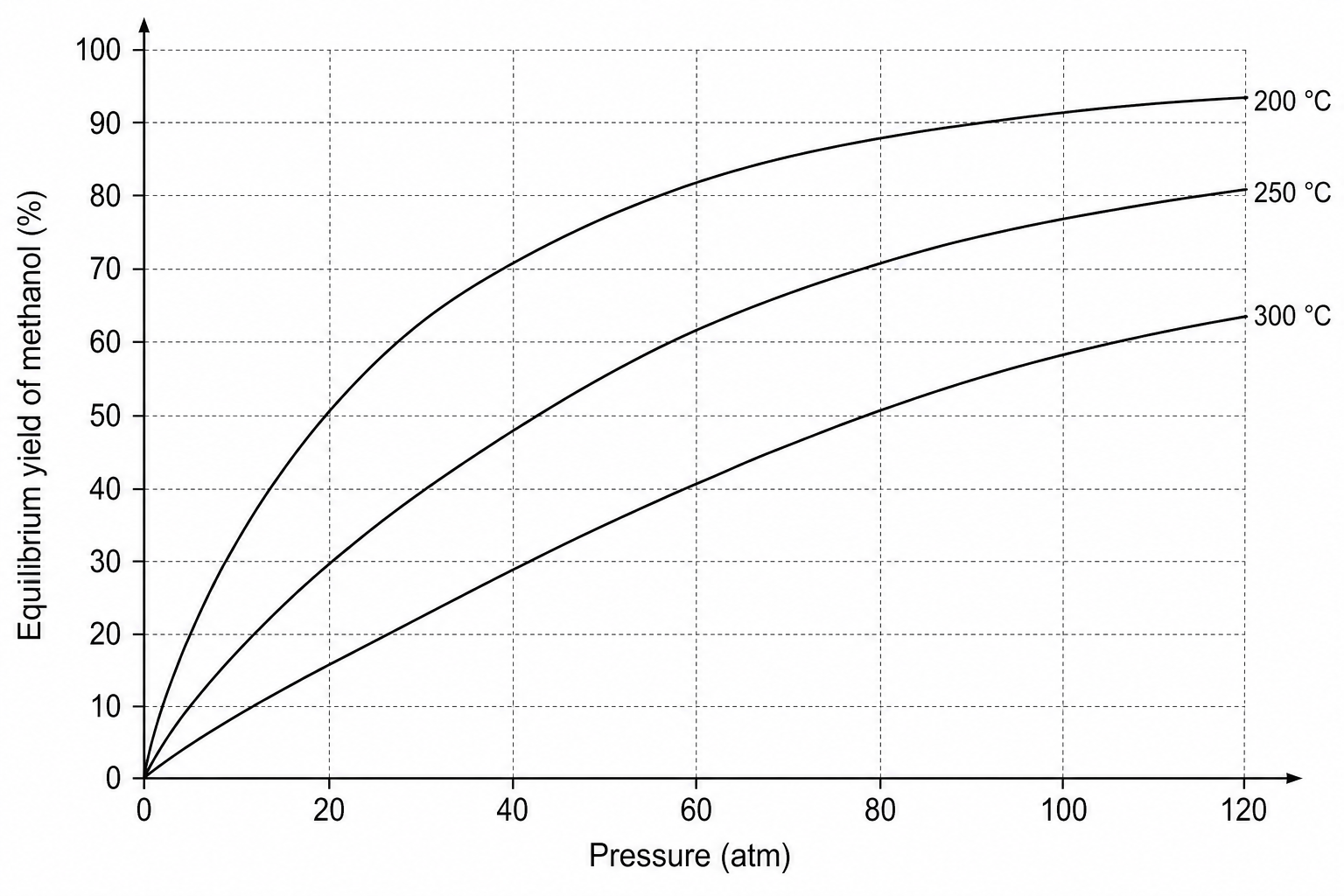
State the conditions of temperature and pressure from those shown on the graph that produce the largest equilibrium yield of methanol.
Find the percentage yield of methanol at equilibrium at a pressure of 60 atm60\text{ atm}60 atm and a temperature of 250 ∘C250\ ^\circ\text{C}250 ∘C.
Suggest why, in the actual industrial process, the percentage yield of methanol is significantly lower than the equilibrium percentage yield at these conditions.

