When nitrogen monoxide gas (NO\text{NO}NO) and oxygen gas (O2\text{O}_2O2) are placed in a sealed flask, they react to form nitrogen dioxide gas (NO2\text{NO}_2NO2).
The equation for the reaction is:
2NO(g)+O2(g)⇌2NO2(g) 2\text{NO}(\text{g}) + \text{O}_2(\text{g}) \rightleftharpoons 2\text{NO}_2(\text{g}) 2NO(g)+O2(g)⇌2NO2(g) colourless gases⇌brown gas \text{colourless gases} \rightleftharpoons \text{brown gas} colourless gases⇌brown gasA mixture of pure NO\text{NO}NO and O2\text{O}_2O2 in a 2:1 molar ratio is placed in a sealed flask at 25∘C25^\circ\text{C}25∘C. The flask is left until a dynamic equilibrium is reached.
For a reaction that is in dynamic equilibrium, the forward and backward reactions occur at the same time.
State two other features of a reaction that is in dynamic equilibrium.
At equilibrium, there is more NO2\text{NO}_2NO2 than NO\text{NO}NO.
The graph shows how the number of moles of NO\text{NO}NO in the sealed flask changes with time.
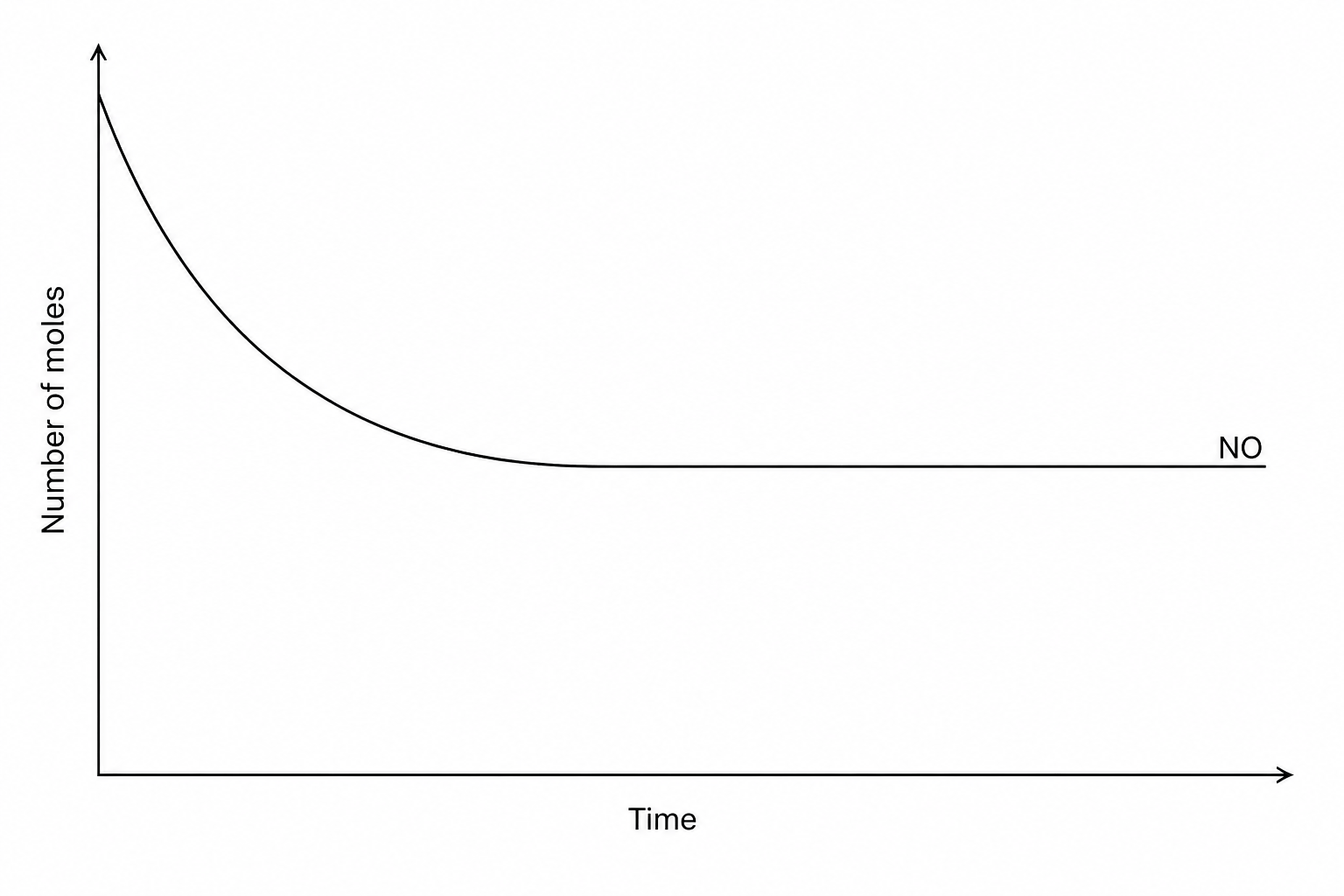
If you were to draw a cross (×\times×) on the graph to show the point where the reaction reaches equilibrium, describe where it should be placed.
Describe the start point, shape, and final level of the curve you would draw on the same graph to show how the number of moles of NO2\text{NO}_2NO2 in the sealed flask changes over the same time period.
The sealed flask containing the equilibrium mixture is placed in a beaker of ice water at 0∘C0^\circ\text{C}0∘C. The mixture becomes darker brown in colour.
Explain what this observation shows about the forward reaction.

