A student prepares a solution of the soluble salt potassium sulfate, using the neutralization reaction between sulfuric acid and the alkali potassium hydroxide.
To make sure that she obtains a pure solution of the salt, she first carries out a titration to find the volumes of sulfuric acid and potassium hydroxide that react exactly together.
She uses this method in the titration:
The diagram shows the burette readings in the experiment before and after adding the potassium hydroxide solution.
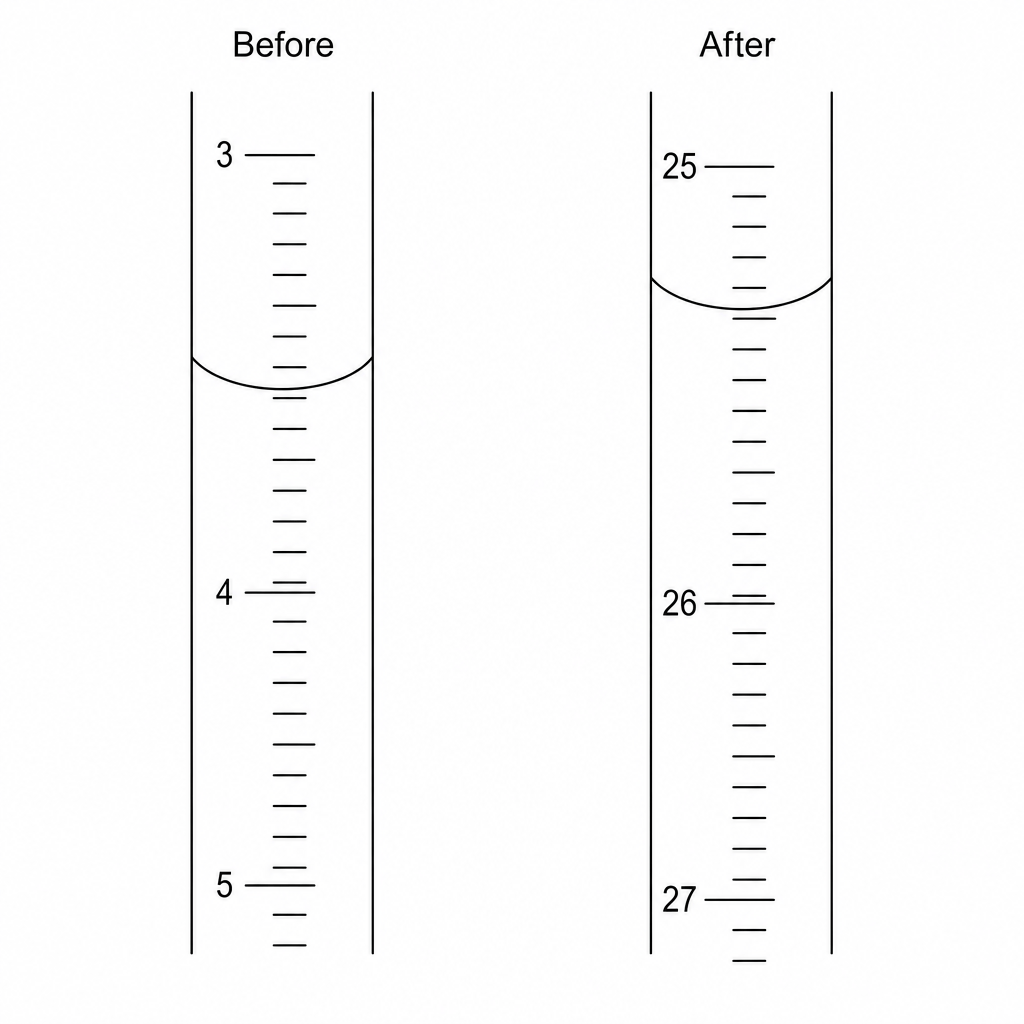
Use these readings to complete the following:
The student repeats the experiment using a different concentration of sulfuric acid. The table shows her results.
| Titration 1 | Titration 2 | Titration 3 | Titration 4 | |
|---|---|---|---|---|
| Burette reading in cm3\text{cm}^3cm3 after adding alkali | 24.6524.6524.65 | 24.7024.7024.70 | 24.5024.5024.50 | 25.1525.1525.15 |
| Burette reading in cm3\text{cm}^3cm3 before adding alkali | 0.500.500.50 | 1.201.201.20 | 0.650.650.65 | 1.401.401.40 |
| Volume in cm3\text{cm}^3cm3 of alkali added | 24.1524.1524.15 | 23.5023.5023.50 | 23.8523.8523.85 | 23.7523.7523.75 |
The average (mean) volume of alkali should be calculated using only concordant results. Concordant results are those volumes that differ from each other by 0.20 cm30.20\text{ cm}^30.20 cm3 or less.
(i) Identify which titration results should be used by selecting the appropriate columns. (ii) Use the appropriate titration results to calculate the average (mean) volume of alkali added.
In a titration using solutions of the same acid and alkali but of different concentrations, she recorded these results:
The equation for the reaction is:
2KOH+H2SO4→K2SO4+2H2O 2\text{KOH} + \text{H}_2\text{SO}_4 \rightarrow \text{K}_2\text{SO}_4 + 2\text{H}_2\text{O} 2KOH+H2SO4→K2SO4+2H2O(i) Calculate the amount, in moles, of H2SO4\text{H}_2\text{SO}_4H2SO4 in 25.0 cm325.0\text{ cm}^325.0 cm3 of 0.120 mol/dm30.120\text{ mol/dm}^30.120 mol/dm3 sulfuric acid. (ii) Calculate the amount, in moles, of KOH\text{KOH}KOH in the 24.00 cm324.00\text{ cm}^324.00 cm3 of potassium hydroxide solution. (iii) Calculate the concentration, in mol/dm3\text{mol/dm}^3mol/dm3, of KOH\text{KOH}KOH in the potassium hydroxide solution.
To prepare the solution of potassium sulfate, the student mixes together the volumes of acid and alkali obtained from the titration results. She then tests a sample of the potassium sulfate solution formed by adding a few drops of barium chloride solution (acidified with hydrochloric acid).
(i) Describe the observation she makes. (ii) State the name of the substance responsible for this observation.

