An experiment is performed to find the volume of nitric acid (HNO3\text{HNO}_3HNO3) required to neutralise a solution of potassium hydroxide (KOH\text{KOH}KOH).
What name is given to this analytical method?
Which piece of apparatus should be used to measure exactly 25.0 cm325.0\text{ cm}^325.0 cm3 of the potassium hydroxide solution into the reaction flask?
State the colours that are seen if methyl orange is used as the indicator in this neutralisation reaction:
A student carries out the experiment. Their initial and final burette readings are shown below:
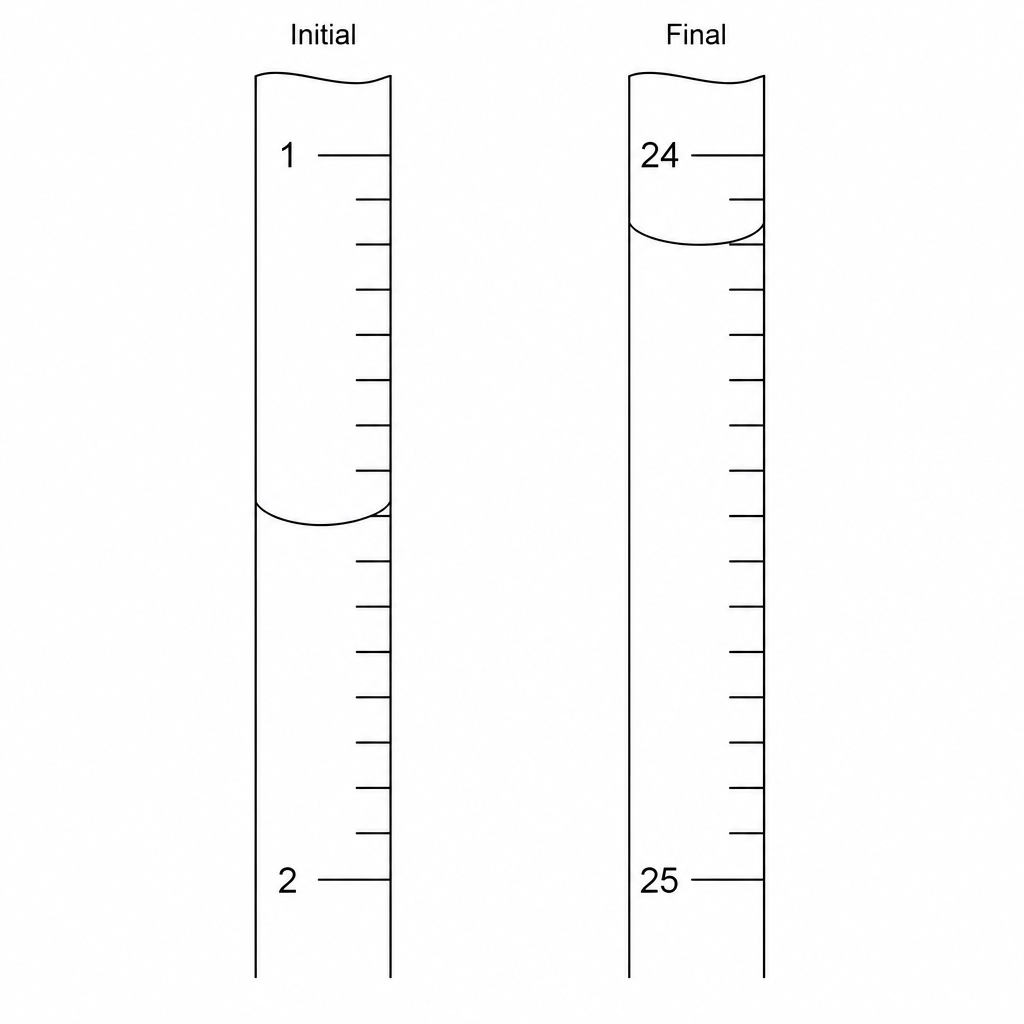
Use the descriptions and diagram to complete the following readings to the nearest 0.05 cm30.05\text{ cm}^30.05 cm3:
A second student repeated the titration four times, using a different concentration of potassium hydroxide. The table shows their results:
| Run | 1 | 2 | 3 | 4 |
|---|---|---|---|---|
| Volume of acid added (cm3\text{cm}^3cm3) | 21.85 | 21.30 | 21.40 | 21.35 |
Concordant results are those within 0.20 cm30.20\text{ cm}^30.20 cm3 of one another. (i) Identify which runs are concordant with one another.
Use your chosen concordant results to calculate the average (mean) volume of acid added.

