Skip to content
MathsGenie logo
Quick links
Open app

Course home

  1. IGCSE
  2. Chemistry Edexcel
  3. Question bank

Acids, alkalis and titrations

EasyMedium
123456789101112131415161718192021222324252627282930313233343536373839404142434445464748495051525354
Question 52

An experiment is performed to find the volume of hydrochloric acid (HCl\text{HCl}HCl) required to neutralise a solution of sodium hydroxide (NaOH\text{NaOH}NaOH).

a.

What name is given to this analytical method?

[1]
b.

Which piece of apparatus should be used to measure exactly 25.0 cm325.0\text{ cm}^325.0 cm3 of the sodium hydroxide solution into the reaction flask:

  • A. beaker
  • B. measuring cylinder
  • C. pipette
  • D. syringe
[1]
c.

State the colours that are seen if phenolphthalein is used as the indicator in this neutralisation reaction:

  • Colour before adding the acid:
  • Colour after the sodium hydroxide is neutralised:
[2]
d.

A student carries out the experiment. Their initial and final burette readings are shown below:
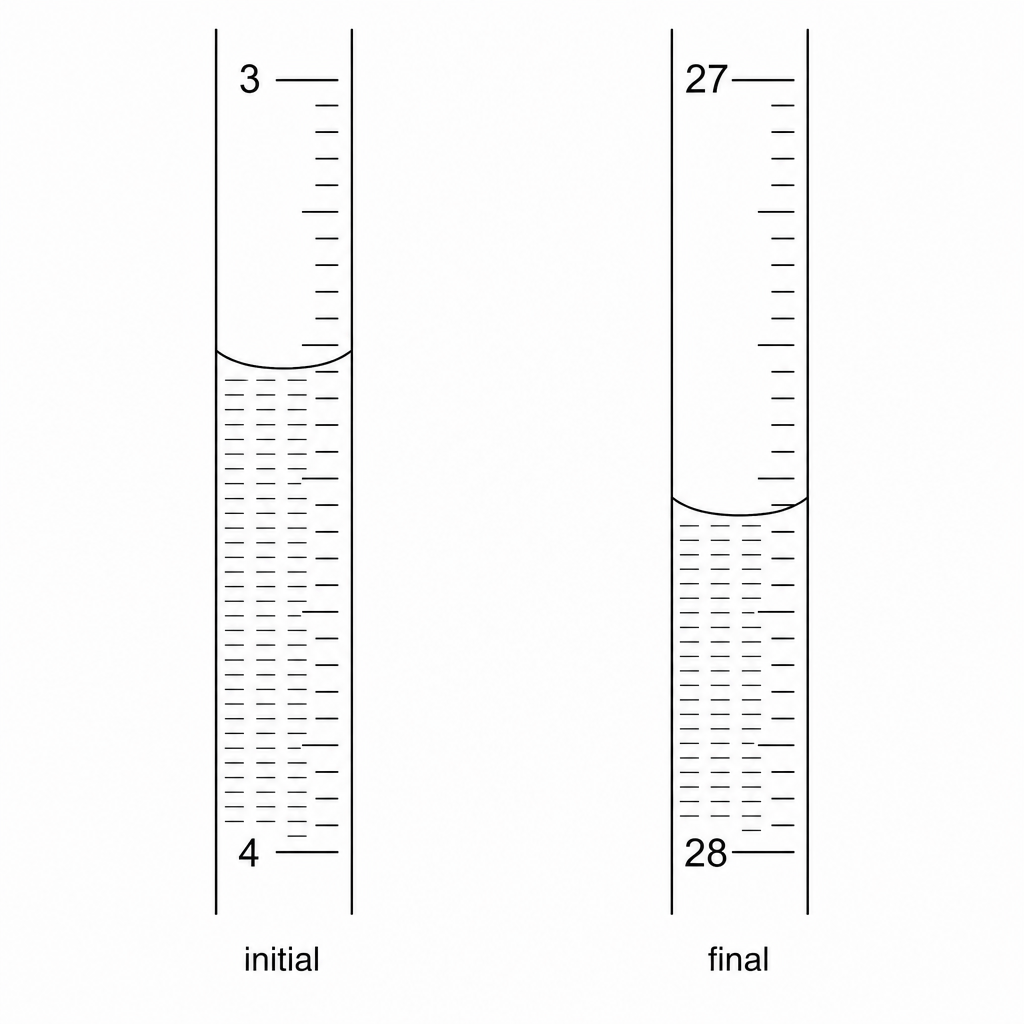
Two vertical burette scales labeled 'initial' and 'final', with graduation lines reading downwards. On the 'initial' burette, the number 3 is at the top and 4 is at the bottom, with 10 graduation subdivisions of 0.1 cm³ each. The bottom of the curved meniscus of the liquid is exactly halfway between the fourth and fifth subdivisions below 3, showing a reading of 3.45 cm³. On the 'final' burette, the number 27 is at the top and 28 is at the bottom, and the bottom of the meniscus is exactly on the eighth subdivision below 27, showing a reading of 27.80 cm³

Use the descriptions and diagram to complete the following readings to the nearest 0.05 cm30.05\text{ cm}^30.05 cm3:

  • Burette reading after adding the acid (cm3\text{cm}^3cm3)
  • Burette reading before adding the acid (cm3\text{cm}^3cm3)
  • Volume of acid added (cm3\text{cm}^3cm3)
[3]
e.

A second student repeated the titration four times, using a different concentration of sodium hydroxide. The table shows their results:

Run1234
Volume of acid added (cm3\text{cm}^3cm3)23.6523.1523.2523.20

Concordant results are those within 0.20 cm30.20\text{ cm}^30.20 cm3 of one another. Identify which runs are concordant with one another.

[1]
f.

Use your chosen concordant results to calculate the average (mean) volume of acid added.

[2]

Acids, alkalis and titrations Questions

  1. IGCSE
  2. /Chemistry
  3. /Acids, alkalis and titrations
