A student made a solution of sodium hydroxide by dissolving 16.0 g16.0\text{ g}16.0 g of solid sodium hydroxide in distilled water to make 800 cm3800\text{ cm}^3800 cm3 of solution.
Calculate the amount, in moles, of NaOH\text{NaOH}NaOH in 16.0 g16.0\text{ g}16.0 g of sodium hydroxide. (Relative atomic masses: Na=23\text{Na} = 23Na=23, O=16\text{O} = 16O=16, H=1\text{H} = 1H=1)
Calculate the concentration, in mol/dm3\text{mol/dm}^3mol/dm3, of this solution of sodium hydroxide.
The student uses the sodium hydroxide solution to find the concentration of a solution of hydrochloric acid. He uses this method:
The diagram shows his burette readings.
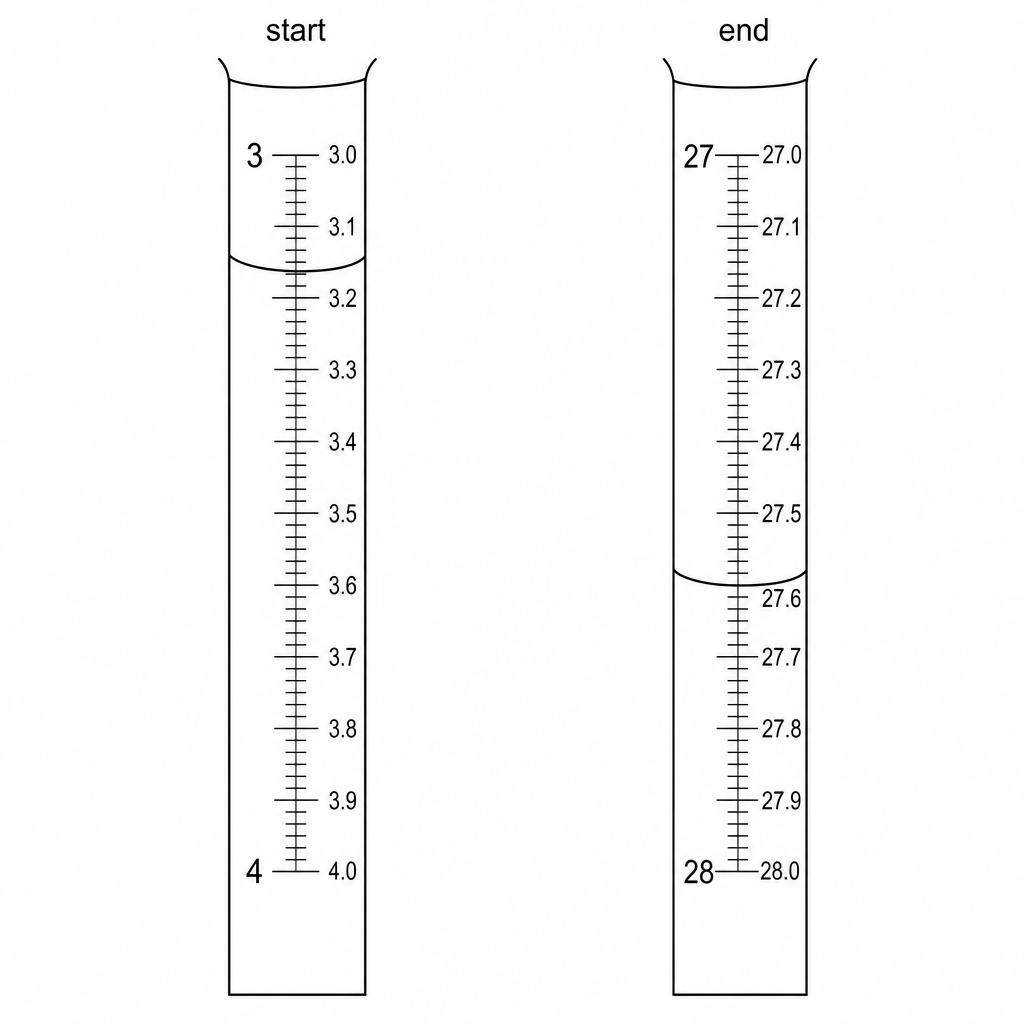
Complete the table, giving all values to the nearest 0.05 cm30.05\text{ cm}^30.05 cm3.
| Measured Parameter | Volume (cm3\text{cm}^3cm3) |
|---|---|
| burette reading at end in cm3\text{cm}^3cm3 | |
| burette reading at start in cm3\text{cm}^3cm3 | |
| volume of alkali added in cm3\text{cm}^3cm3 |
State the colour of the phenolphthalein at the start and at the end of the experiment.
Why is a burette used instead of a pipette for adding the alkali?
Sodium hydroxide reacts with carbon dioxide.
The equation for this reaction is
2NaOH+CO2→Na2CO3+H2O 2\text{NaOH} + \text{CO}_2 \rightarrow \text{Na}_2\text{CO}_3 + \text{H}_2\text{O} 2NaOH+CO2→Na2CO3+H2OA solution of sodium hydroxide of concentration 1.60 mol/dm31.60\text{ mol/dm}^31.60 mol/dm3 is used.
Calculate the amount, in moles, of sodium hydroxide in 250 cm3250\text{ cm}^3250 cm3 of this solution.
Deduce the maximum mass, in grams, of carbon dioxide that can react with this solution of sodium hydroxide. (Relative formula mass: CO2=44\text{CO}_2 = 44CO2=44)

