YouTube Channels GCSE Chemistry: Are They Enough?
YouTube channels GCSE Chemistry: discover why videos alone are risky and how questions, practical knowledge and maths build a reliable route to a pass.
A video can make electrolysis feel obvious. The animation moves, the ions travel to the correct electrodes and, for ten reassuring minutes, everything makes sense. Then you open an exam question and cannot decide what to write.
That gap explains the honest answer to whether YouTube channels GCSE Chemistry students use are enough on their own: possibly, but not reliably. Videos can teach and clarify the course, yet passing also requires retrieval, practical understanding, mathematical fluency and experience answering exam-board questions. Watching is useful. Producing a mark-worthy answer without prompts is the real test.
This matters whether you take separate GCSE Chemistry or the chemistry component of Combined Science with AQA, Edexcel, OCR or Eduqas. Your precise content and paper structure depend on your specification, so always check your exam board and tier.
The short answer: what you actually need
A dependable GCSE Chemistry revision system contains five parts:
- Specification coverage: every required topic for your board and tier.
- Clear explanations: videos, lessons, notes or teacher support.
- Active recall: retrieving facts, equations and processes without prompts.
- Exam practice: applying knowledge to unfamiliar questions and data.
- Feedback: marking answers, identifying lost marks and trying again.
YouTube is strongest at the second part. Some channels also support recall or demonstrate practicals, but the platform cannot answer questions on your behalf, mark your written explanations or prove that you can perform under timed conditions.
The better question is not, “Did I watch the topic?” It is, “Can I answer a new question on it without the video?”
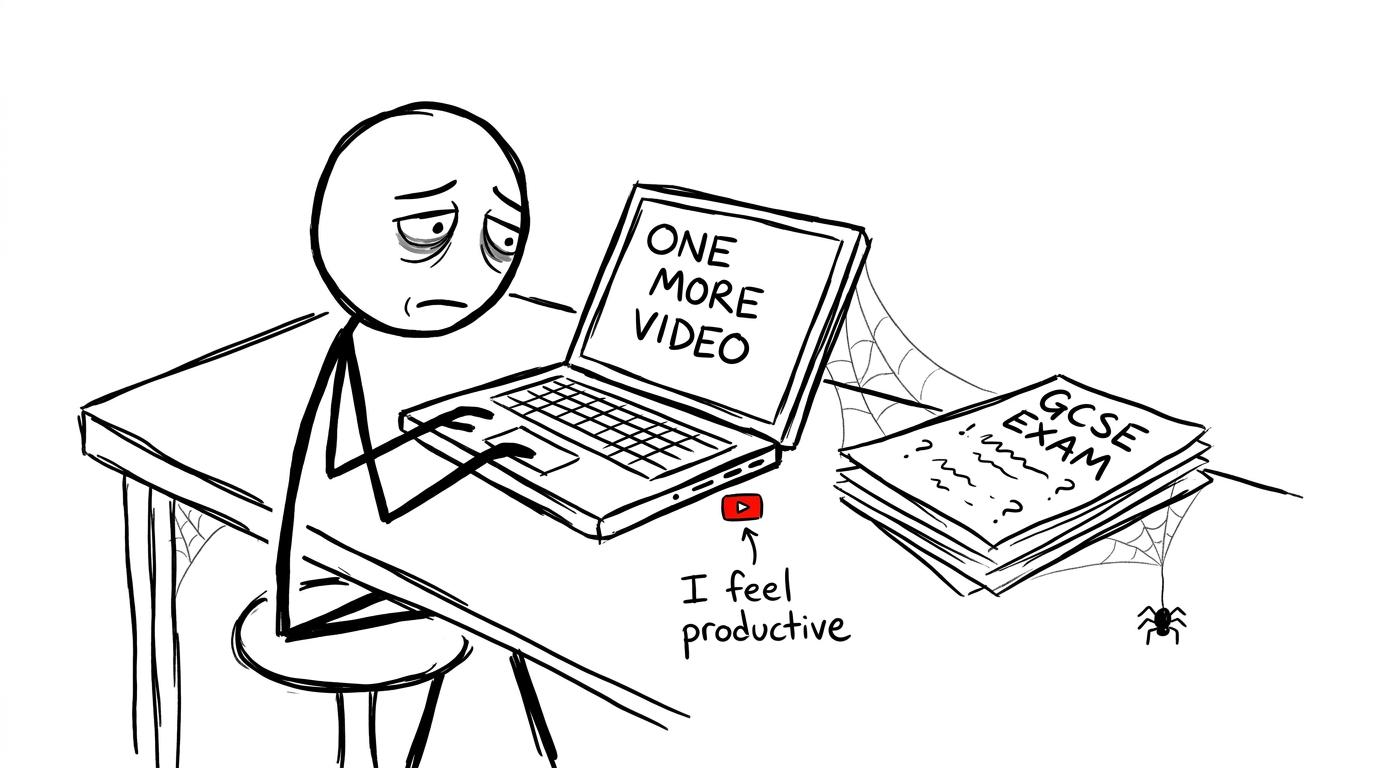 A student watches one more revision video while an exam paper gathers cobwebs
Why videos feel more effective than they sometimes are
Good teaching reduces confusion. That is valuable, particularly for abstract ideas such as bonding, equilibrium and moles. The danger is that recognition can imitate mastery.
When a presenter explains each step, the next idea feels familiar. In an examination, those prompts disappear. You must identify the topic, select relevant knowledge, interpret the command word and construct the answer yourself.
This is the difference between input and output. Videos provide input. GCSE papers assess output.
A useful check after every video is to close it and, from memory:
- write the central idea in two or three sentences;
- list the key terms that a mark scheme might require;
- sketch the practical method if relevant;
- answer several exam-style questions;
- revisit anything you could not retrieve.
If you cannot complete those tasks, the video has shown you what to learn. It has not yet secured the learning.
GCSE Chemistry assesses more than recall
Across regulated GCSE Chemistry specifications, the assessment objectives broadly divide marks between demonstrating knowledge, applying knowledge and analysing or evaluating information. For example, AQA gives approximate overall weightings of 40%40\%40% for AO1, 40%40\%40% for AO2 and 20%20\%20% for AO3.
That structure reveals why passive viewing is risky. Even perfect recall would not cover the whole job. Students must also apply ideas in unfamiliar settings, interpret evidence, make judgements, draw conclusions and evaluate experimental procedures.
Exam papers may include multiple-choice items, short responses, calculations, extended writing and questions based on practical or unfamiliar contexts. The wording matters too. “State”, “describe”, “explain”, “calculate” and “evaluate” require different forms of response.
A channel can explain those distinctions. Only practice reveals whether you can act on them.
Practical knowledge cannot be watched into existence
Practical work sits at the heart of GCSE science. Written examinations assess students’ understanding of apparatus, methods, variables, hazards, accuracy, observations and data. For AQA GCSE Chemistry, questions drawing on practical work account for at least 15%15\%15% of the qualification. Other boards also embed practical skills and specified activities in their courses.
A demonstration video can be excellent preparation. It lets you see unfamiliar apparatus before a lesson and replay a process afterwards. But it cannot fully reproduce decisions made at the bench: reading a scale, controlling a variable, noticing an observation or understanding why one procedure produces more reliable evidence.
Use videos to support the practical work provided by your school, not to replace it. For each required or core practical on your specification, make sure you can identify:
- the purpose and independent, dependent and control variables;
- the apparatus and sequence of the method;
- relevant hazards and suitable precautions;
- expected observations and measurements;
- sources of random or systematic error;
- improvements to accuracy, precision or reliability;
- an appropriate table, graph or conclusion.
These are not side details. They are examinable chemistry.
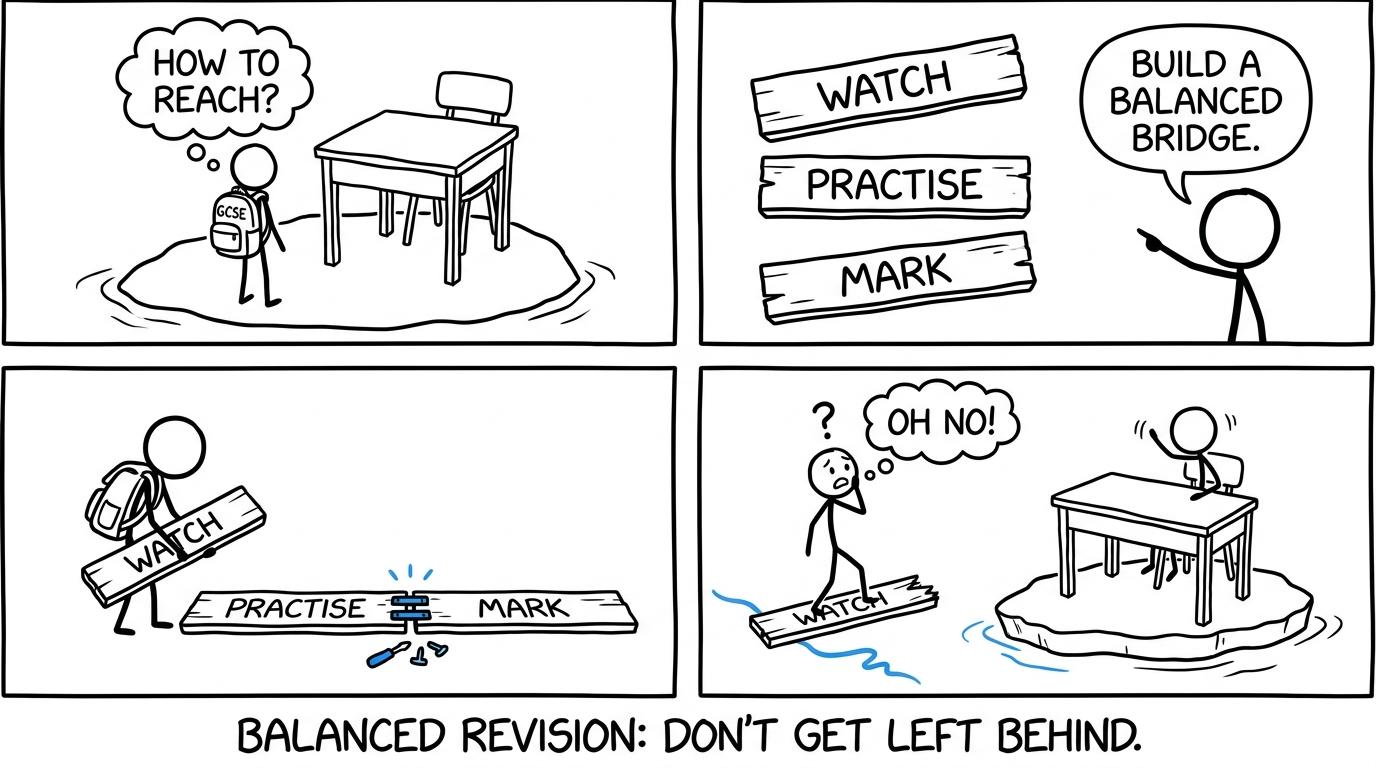 A revision bridge needs watch, practise and mark planks
Do not overlook the maths in GCSE Chemistry
Chemistry questions regularly use arithmetic, percentages, ratio, standard form, significant figures, algebra and graphs. The exact level of demand differs between foundation and higher tier, but mathematical fluency can turn scientific understanding into marks.
Relevant skills include:
- ratios, fractions and percentages for yield, atom economy and composition;
- standard form for particle-scale quantities;
- substituting into and rearranging equations;
- converting between units such as cm3\mathrm{cm^3}cm3 and dm3\mathrm{dm^3}dm3;
- calculating means and selecting significant figures;
- interpreting straight-line and curved graphs;
- finding gradients and using tangents to estimate rates;
- working with area and volume in experimental contexts.
YouTube can model these processes, but you need to carry them out independently. MathsGenie’s guide to GCSE Maths topics by exam board and tier helps you identify the underlying number, algebra and graph skills. If several foundations feel uncertain, follow the best order for learning GCSE Maths topics rather than jumping randomly between videos.
Students taking A Level Chemistry later will meet more demanding quantitative work, making these habits even more valuable.
How to choose useful GCSE Chemistry videos
Not every clear video is suitable for your examination. Before committing to a playlist, check that it:
- names the specification or clearly maps content to AQA, Edexcel, OCR or Eduqas;
- distinguishes separate Chemistry from Combined Science where necessary;
- identifies higher-tier-only material accurately;
- uses current terminology and specification content;
- covers practical methods as well as scientific facts;
- explains why an answer earns marks rather than merely displaying it;
- separates essential content from interesting material beyond the course.
Production quality is not the same as syllabus accuracy. A polished video may omit a required detail, include material from another board or simplify an explanation too far. Keep your specification or a school checklist beside you and tick content only after you can retrieve and apply it.
It is also wise to use one main source for continuity, then another only when an explanation has not clicked. Collecting ten explanations can become a comfortable substitute for answering ten questions.
A revision loop that makes YouTube effective
A strong session moves through four stages.
Learn briefly
Watch one focused video or review one lesson. Pause to predict explanations rather than letting the presenter do all the thinking. Keep notes selective: definitions, conditions, observations and connections.
Retrieve without support
Close the video. Write what you remember, label a blank diagram or explain the process aloud. This exposes gaps immediately.
Practise exam questions
Answer questions from your own exam board. Include calculations, practical contexts and extended responses rather than practising recall alone. The same evidence-led approach is explained in MathsGenie’s guide to finding your weakest GCSE topics.
Mark, fix and retest
Compare your response with the mark scheme. Record whether each lost mark came from missing chemistry, weak maths, an ignored command word or an imprecise answer. Then repeat a similar question later without notes.
This resembles effective maths revision: learn the method, practise it, inspect errors and return to the weakness. The MathsGenie guide to efficient GCSE Maths revision explains how to make that loop manageable.
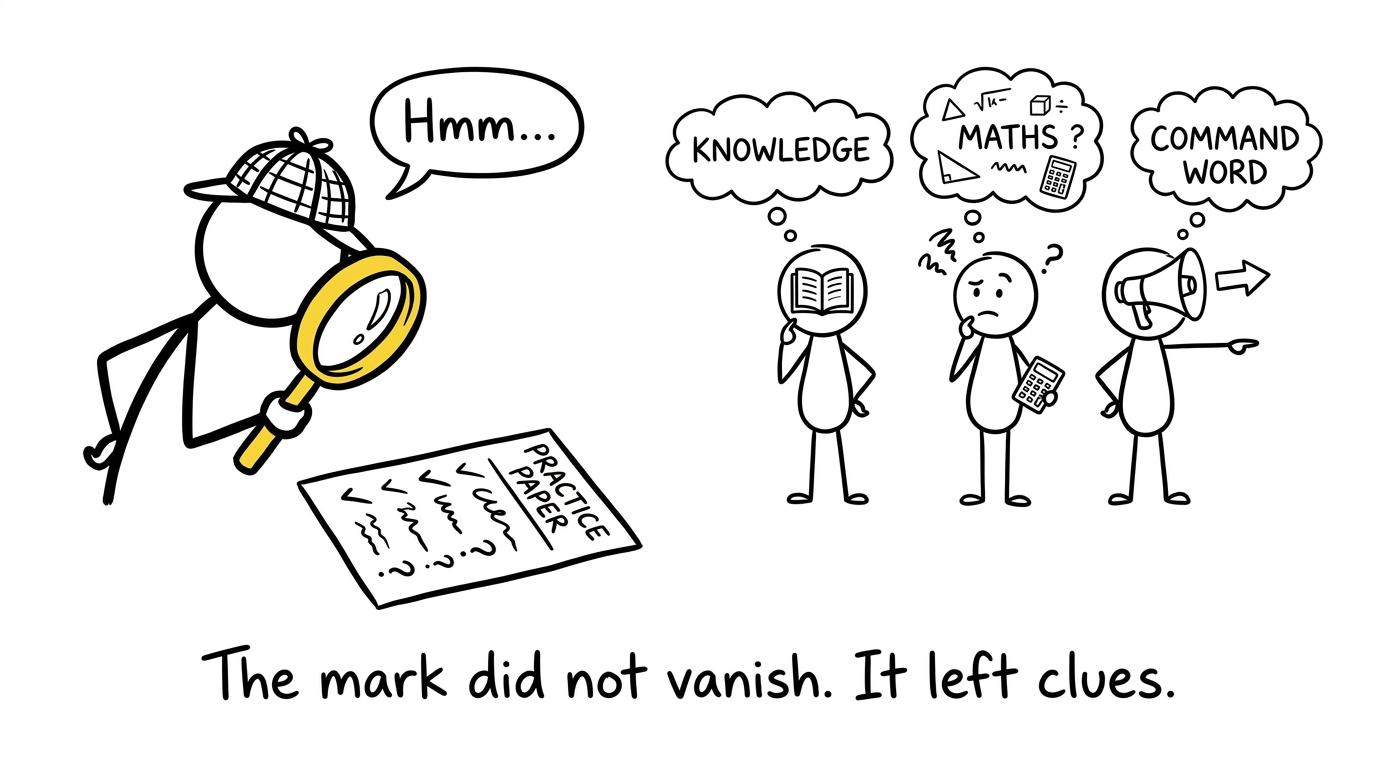 A revision detective investigates where lost marks went
When to move from videos to papers
Do not wait until every topic feels perfect. Begin with short exam-style sets while learning, then introduce timed sections and full papers once most of the specification has been covered.
A paper is not merely a final test. It is a diagnostic tool. It reveals whether you can switch between topics, manage time and interpret unfamiliar information. Maths students can use the same progression described in when to start GCSE past papers: start small, mark carefully and increase timed practice as the examination approaches.
If time is limited, use a structured plan instead of watching an entire playlist from the beginning. The one-week GCSE revision plan provides a useful model for balancing diagnosis, topic repair and paper practice. Adapt the subjects and resources to Chemistry.
Common mistakes when revising Chemistry with YouTube
Measuring progress in hours watched
Time spent is not the same as knowledge retained. Measure questions completed, errors corrected and topics successfully recalled instead.
Copying the presenter’s notes word for word
Transcription keeps your hand busy while the presenter does the thinking. Pause, summarise and organise the idea in your own words.
Avoiding calculations
Students sometimes label a difficulty “chemistry” when the real weakness is ratio, unit conversion or rearranging a formula. Repair the underlying maths directly.
Ignoring practical and data questions
Animations make concepts memorable, but exams also require methods, variables, graphs and evaluation. Include these every week.
Watching several explanations instead of practising
A second explanation may help. A fifth often delays the moment when you must attempt the question yourself.
Using the wrong board or tier
Check every playlist against your current specification. Foundation, higher, separate Chemistry and Combined Science are not interchangeable.
Build a revision system, not a watch history
Free GCSE Chemistry videos can be an excellent teacher in your pocket. They can slow down difficult explanations, make invisible particle models visible and help you return to a topic without embarrassment. But no channel can supply the independent recall, written precision, practical judgement and timed decision-making that the examination demands.
Use YouTube to learn. Use questions to prove that you have learnt. Then use marking and retesting to close the gap.
For the mathematical side of Chemistry, make MathsGenie your free revision base. Use the revision lessons and practice questions to strengthen percentages, ratio, standard form, equations and graphs. Add mini tests for quick feedback, then use past papers, predicted papers, mark schemes and video solutions to make your methods dependable. If an examination is close, the GCSE maths night-before plan can also help you choose focused practice without turning the evening into a video marathon.
The goal is not to watch everything. It is to become able to answer when nothing is playing.