

Should You Read the GCSE Arabic Specification?
Read GCSE Arabic specification advice: discover what the official document reveals, which sections matter and how to turn its detail into focused revision.
A specification can look like the least inviting document in your revision folder. It is long, formal and written for teachers as much as students. Yet it also contains something many revision guides cannot offer: the exam board's exact account of what may be assessed.
So, is it worth taking the time to read GCSE Arabic specification material yourself? Yes, but selectively. You do not need to memorise every page. Read the sections covering assessment structure, themes, grammar, tier rules and task requirements, then use a clear guide, lessons and exam questions to do the real learning.
That distinction matters. The specification is a map, not the journey.
The short answer: what should you read?
Use this checklist before opening the document:
- Confirm that it is the specification for your exact qualification.
- Check the issue date and qualification code on the cover.
- Read the assessment overview for every paper.
- Highlight the themes, topics and grammatical requirements.
- Compare foundation and higher tier expectations.
- Note the language used for questions and responses.
- Ignore administrative material that applies mainly to teachers and exam centres.
- Turn useful details into a one-page revision checklist.
- Verify arrangements with your Arabic teacher if anything is unclear.
For the Pearson Edexcel GCSE in Arabic, the current specification located during research is qualification code 1AA0, Issue 5, dated October 2022. Pearson's information for the 2025/26 examination year continues to list foundation and higher entries for this qualification. Always check the cover of the latest document supplied by your school, because specifications and supporting assessment materials can be amended.
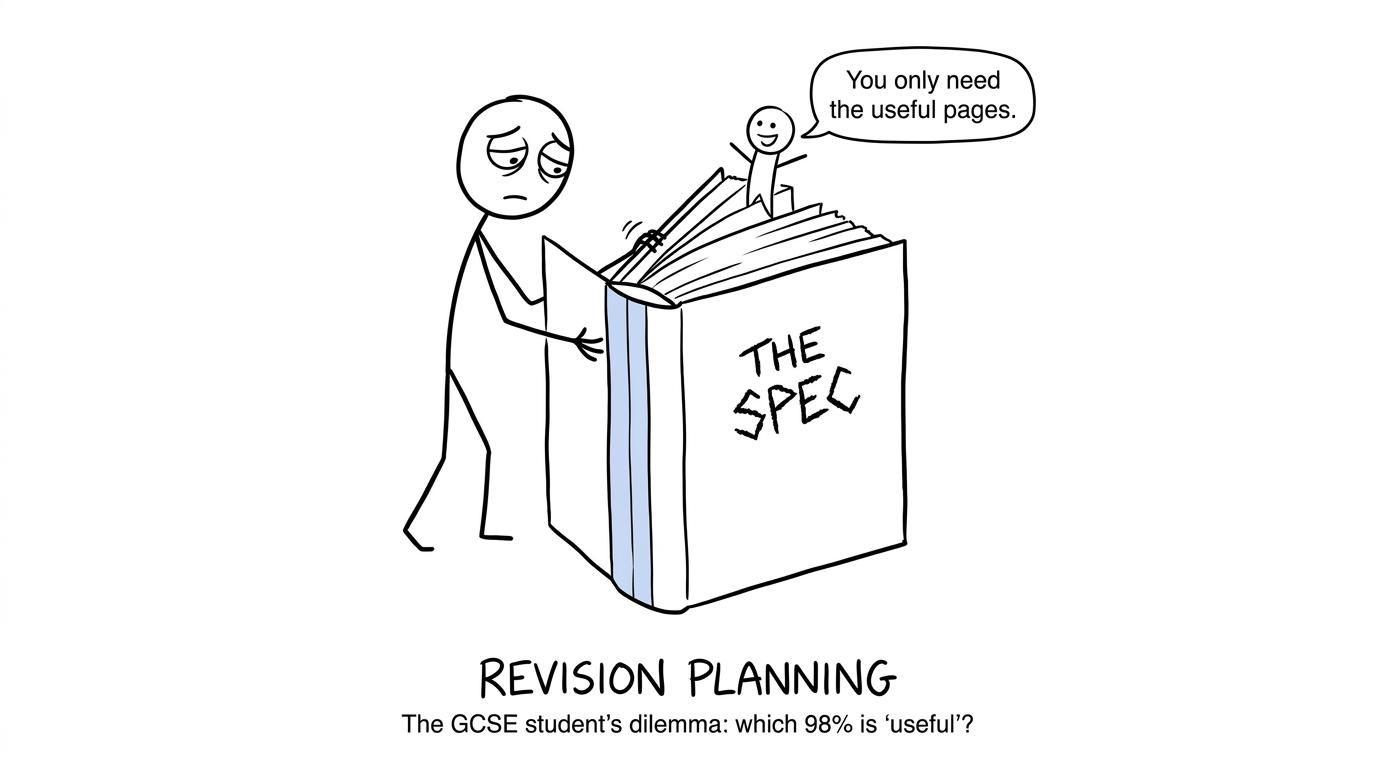 A student discovers that the useful part of a large specification can be marked with a small bookmark
What the official specification gives you that a guide may not
A good guide translates a course into student-friendly language. That is valuable. But translation always involves selection: somebody decides what to emphasise, simplify or leave out.
The official specification sits closer to the source. It tells teachers what must be taught and explains how Pearson intends to assess it. Reading the relevant pages gives you several practical advantages.
The exact assessment structure
The Pearson Edexcel GCSE Arabic specification divides assessment across four skills:
- listening;
- speaking;
- reading;
- writing.
Each assessment objective contributes 25%25\%25% of the qualification. That balance is useful because it prevents a common revision error: spending nearly all your time on the skill that feels most comfortable.
A student who enjoys writing may quietly avoid listening practice. Another may speak Arabic confidently at home but underestimate the demands of accurate formal writing. The specification makes the balance visible. Natural confidence in one skill does not remove the need to prepare for the other three.
It also explains the form of each assessment. For example, the speaking assessment includes a role play, a picture-based task and a conversation. The reading paper includes comprehension and translation from Arabic into English, while the writing paper assesses written communication and translation into Arabic. Those details help you choose revision activities that resemble the actual tasks.
The complete set of themes and topics
The specification organises content into five broad themes:
- identity and culture;
- local area, holiday and travel;
- school;
- future aspirations, study and work;
- international and global dimension.
A short guide may summarise these headings accurately but devote more attention to popular topics. The specification lets you inspect the complete set of topics and sub-topics for yourself.
That does not tell you which precise questions will appear. It tells you the boundaries of the course. This is especially useful when building a vocabulary audit: can you understand and communicate ideas across every listed area, rather than only discussing family, school and holidays?
The difference between knowing Arabic and meeting GCSE requirements
Language ability is broader than an examination specification. A fluent speaker may communicate naturally but still need to practise standard written Arabic, translation, formal accuracy and responses shaped around a mark scheme.
The official document clarifies that students are assessed through particular skills and task formats. It also sets out grammar and structures expected at different levels. Reading these sections can reveal gaps that ordinary conversation does not expose, such as control of different time frames, accurate agreement or the ability to justify an opinion in a structured response.
Ofqual's requirements for modern foreign language GCSEs also place explicit weight on listening, speaking, reading and writing. Within speaking and writing, part of the available credit must reward knowledge and accurate application of grammar and structures. Accuracy is therefore not an optional extra added by a cautious teacher. It is built into the assessment framework.
Why reading every page is usually poor revision
The full document contains material designed for several audiences. Some pages help students directly; others explain administration, access arrangements, assessment conduct or responsibilities within an exam centre.
Reading all of it in sequence can create the feeling of productive work without producing much retrievable knowledge. You may finish several pages knowing more about how the qualification is managed but no better able to understand a recording or write an accurate response.
This is the same trap students encounter in maths. Reading a specification can confirm that algebraic reasoning is required, but it cannot develop algebraic reasoning. That comes from explanation, practice, feedback and repetition.
MathsGenie's GCSE maths revision hub is organised around that practical progression: learn a method, answer questions, check the solution and return to weaknesses. The principle transfers neatly to Arabic. Use the specification to decide what belongs in your plan, then spend most of your time retrieving vocabulary, applying grammar and completing assessment-style tasks.
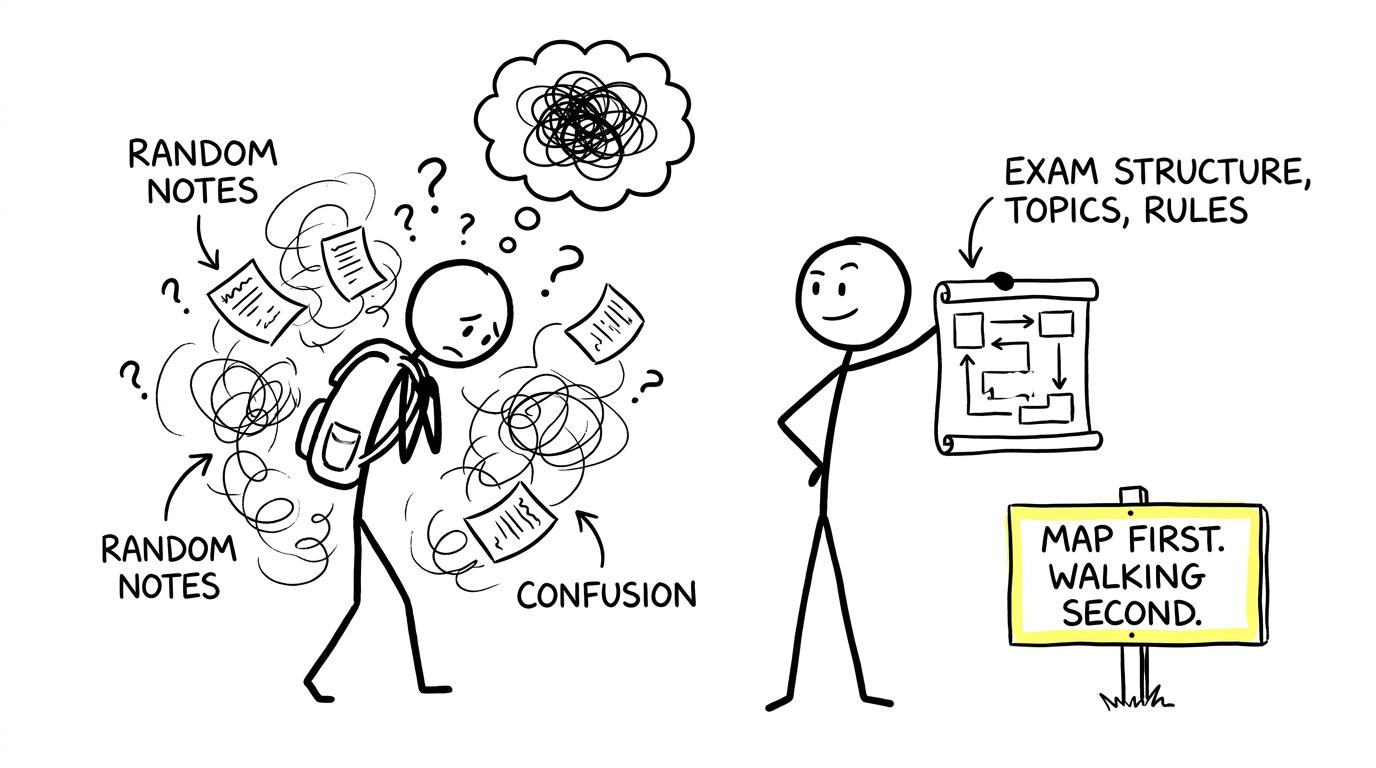 One student follows an exam map while another wanders through random revision notes
How to read the GCSE Arabic specification efficiently
A useful specification review should take one focused session, followed by brief checks later. It should not become a week-long reading project.
Start by confirming the qualification
Check the cover, qualification title and code. Do not confuse the UK GCSE in Arabic with an International GCSE in Arabic (First Language). Pearson's International GCSE qualification has a different code, content structure and assessment model.
Do not assume that the exam board used for your maths GCSE is also your Arabic exam board. A school might use AQA, OCR or Eduqas for maths while entering Arabic through Pearson Edexcel. Ask your teacher or examinations officer if you are uncertain.
This habit is useful across subjects. On MathsGenie, students are prompted to choose the correct board before using GCSE maths papers and revision resources, because a familiar-looking paper from the wrong qualification can still give misleading information about structure and timing.
Read in layers
On the first pass, read only the contents page and assessment overview. Your goal is orientation: what papers exist, what each assesses and how the qualification is weighted.
On the second pass, study the themes, topics and grammar. Convert them into three labels:
- secure;
- needs practice;
- not yet covered.
On the final pass, inspect instructions about task format, tier and permitted responses. These small details influence how you should practise.
This layered approach resembles an effective GCSE maths revision timetable: diagnose first, prioritise genuine weaknesses and then schedule active work. It is more reliable than moving through a document simply because page one comes before page two.
Build a specification-to-practice checklist
Do not copy whole paragraphs. Rewrite each useful requirement as an action.
For a topic, the action might be to test relevant vocabulary without notes. For a speaking requirement, it might be to practise responding spontaneously rather than memorising one perfect script. For translation, it might be to complete short passages in both directions and inspect errors in tense, agreement and word choice.
Keep the checklist short enough to use. A specification is comprehensive; a revision plan must be selective and workable.
The same distinction explains why MathsGenie's topic-by-topic GCSE revision guides are paired with questions. A list tells you what exists. Practice shows whether you can use it.
What you will not gain from the specification
The document cannot tell you the exact questions in your examination. It does not replace vocabulary learning, regular listening, spoken interaction or marked writing. Nor does it guarantee that a topic receiving several lines in the document will receive proportionally more marks in your paper.
Most importantly, recognition is not mastery. Seeing a grammatical structure on a list may feel familiar, but the examination asks you to understand or produce language under pressure.
For maths revision, Target Tests and mini tests expose the same gap between recognition and performance. You only discover whether knowledge is secure when you attempt something without support. Arabic revision needs that same honest test.
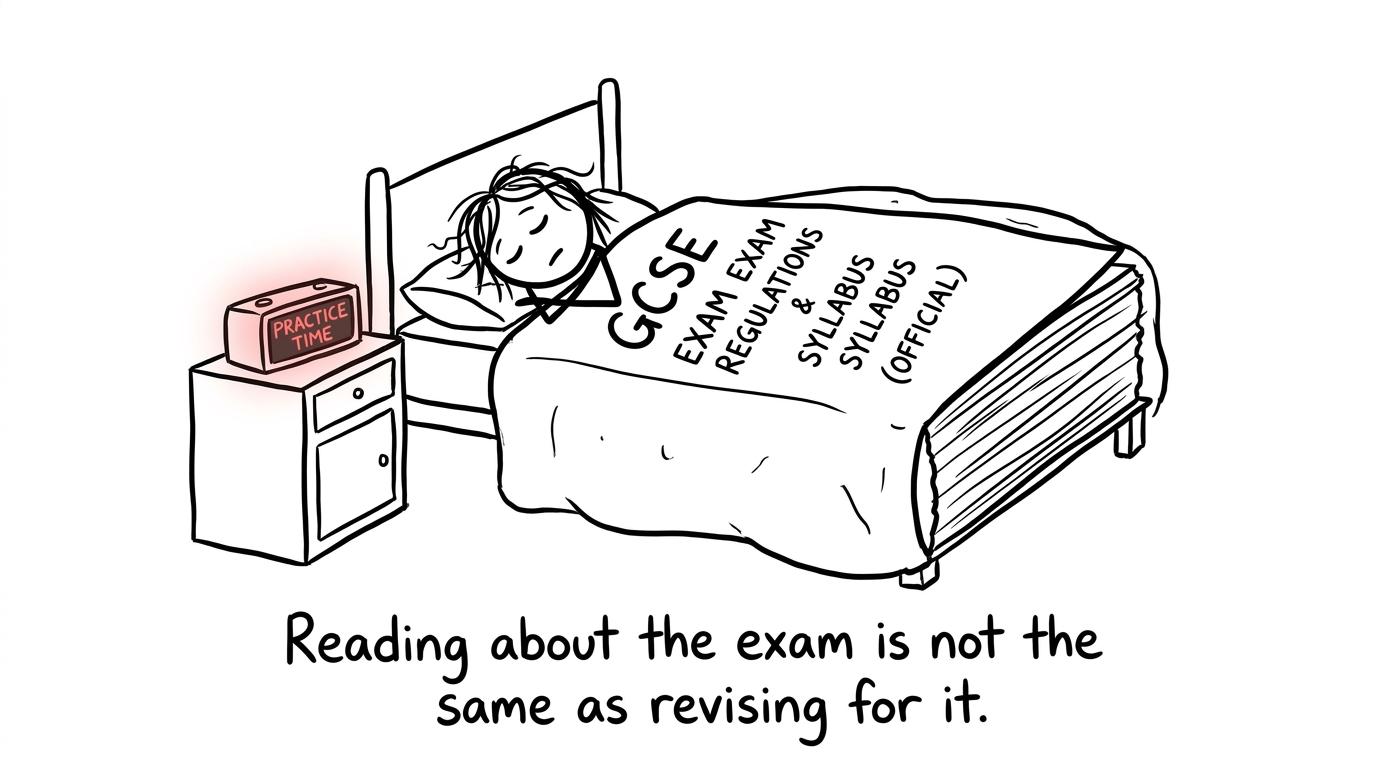 A student attempts to use an official document as a pillow instead of doing active practice
A sensible way to divide your revision time
Treat specification reading as planning, not the main event. After your initial review, most sessions should contain active recall or examination practice.
A balanced cycle could look like this:
- choose one specification theme or skill;
- recall vocabulary and grammar without notes;
- complete a listening, reading, speaking or writing task;
- check the response using teacher feedback or an official mark scheme;
- record one specific weakness;
- revisit it in a later session.
Past papers become especially useful once you understand the course structure. They show how broad requirements are turned into real questions. Maths students can see this process through the guide to using Edexcel GCSE maths past papers properly, while the advice on when to start GCSE past papers explains why papers work best as part of a longer learning cycle.
Predicted papers have a different role. They provide fresh, unseen practice, but they are not promises about what will appear. Whether you are revising Arabic or maths, broad specification coverage should come before prediction.
Common mistakes when using an official specification
Reading the wrong qualification
GCSE Arabic and International GCSE Arabic (First Language) are not interchangeable. Check the complete title and code rather than relying on the word “Arabic”.
Treating the topic list as revision itself
Highlighting “school” or “global issues” does not improve your ability to communicate about them. Every highlighted area needs a practical follow-up task.
Ignoring the assessment overview
Students sometimes jump straight to vocabulary lists. The assessment pages explain what you must do with that vocabulary, including translation, comprehension, interaction and extended communication.
Assuming fluency guarantees high marks
Everyday spoken fluency is valuable, but GCSE assessment also rewards task completion, comprehension, written accuracy, grammar and appropriate communication. Prepare for the qualification you are actually taking.
Spending longer reading than practising
Once the specification has identified your targets, close it. The document should send you towards useful work, not become a hiding place from it.
The verdict: read it once, then make it work
It is worth reading the official GCSE Arabic specification because it gives you the authoritative structure of the qualification: the assessed skills, weighting, themes, grammar and task formats. A guide may explain those points more clearly, but the specification lets you check that nothing important has disappeared in the summary.
You do not need to read every administrative page. Extract what changes your revision decisions, build a concise checklist and return to the document only when you need to verify something.
Then practise. Maps matter because they stop you walking in the wrong direction, but progress still comes from taking the steps.
For your maths preparation, begin with MathsGenie's free GCSE maths revision resources. Use revision lessons and practice questions to repair individual topics, mini tests to check recall, and past papers with mark schemes and video solutions to develop exam technique. Near the examinations, add predicted papers for fresh practice. If you are already thinking beyond GCSE, the A Level maths revision hub provides the same clear route into the next stage.










