

GCSE Arabic Examiner Reports: What They Really Say
GCSE Arabic examiner reports reveal recurring mistakes in speaking, reading and writing. Learn how to turn examiner feedback into smarter revision.
The frustrating thing about examiner reports is that they often arrive after the exam. They can feel like a detailed weather forecast published once the rain has stopped.
Yet GCSE Arabic examiner reports are useful precisely because the same broad warnings return: answer the exact task, communicate clearly, control who is doing the action, use the appropriate tense and avoid replacing a conversation with a memorised speech.
For students also preparing for GCSE maths, there is a wider lesson here. Examiner feedback is not merely a record of what previous candidates did wrong. It is a guide to what the assessment rewards, and therefore a way to revise with greater precision.
What the reports tell you at a glance
The current Pearson Edexcel GCSE Arabic qualification assesses four skills: listening, speaking, reading and writing. Each contributes one quarter of the qualification, and each is available at foundation and higher tier.
Across examiner feedback, specifications and assessment criteria, the practical messages can be reduced to this checklist:
- follow every instruction and address every required detail;
- communicate meaning before trying to sound elaborate;
- distinguish standard Arabic from informal dialect where the task requires it;
- control verb tense, person and agreement;
- give developed but relevant answers;
- treat speaking as an interaction, not a prepared monologue;
- practise under the actual format and time constraints;
- use mark schemes and examiner comments to diagnose patterns.
That final point matters. Reading a report once is interesting. Changing your next revision session because of it is useful.
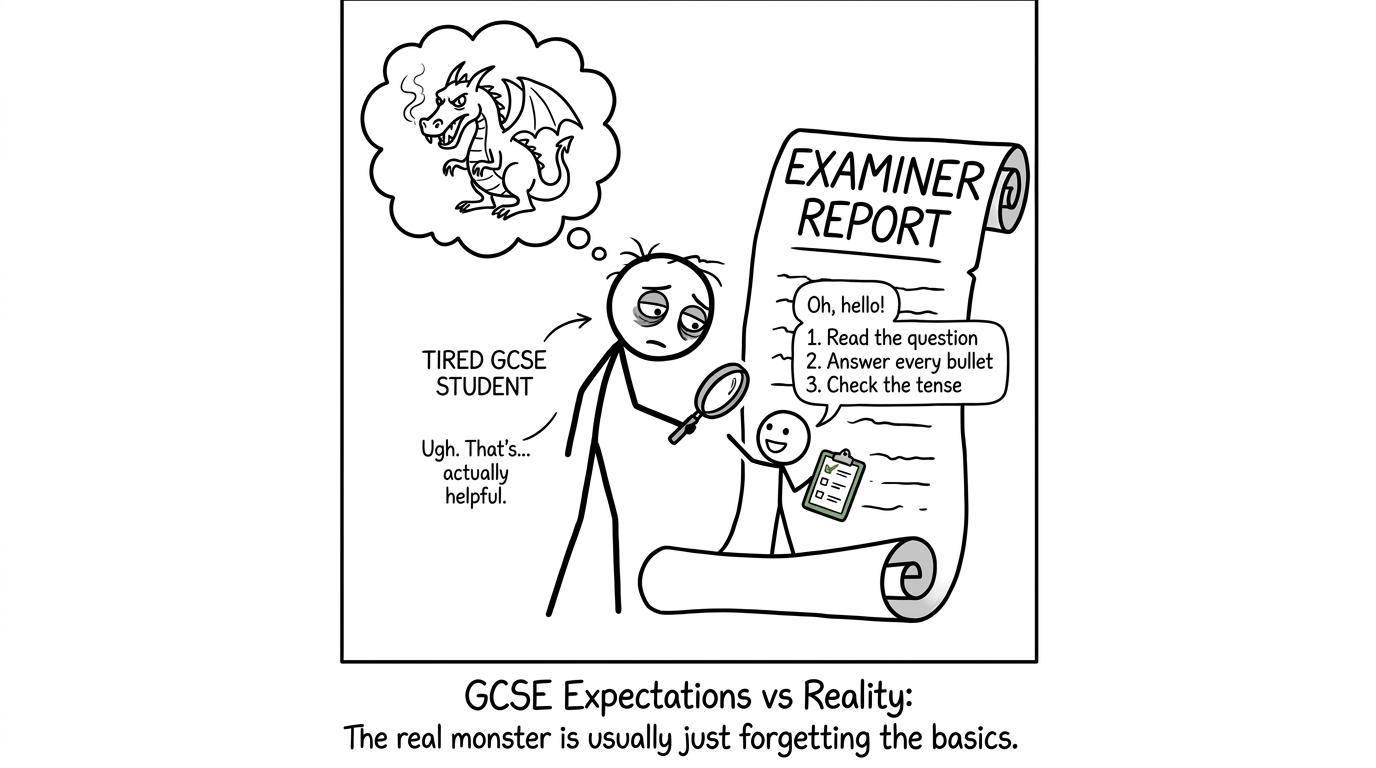 A student discovers that the intimidating examiner report contains a small practical checklist
What GCSE Arabic examiner reports say about speaking
Pearson's Summer 2023 higher-tier speaking report gives unusually practical advice. It notes that the assessment should sound like a conversation rather than a speech and encourages students to vary their vocabulary and structures. At higher tier, opinions should be supported through a broader range of language rather than repeated with the same familiar adjectives.
Several details are specific to the speaking format.
Role-play instructions must be followed precisely
Students may be required to ask a question during the role-play. Forgetting that requirement can lose an accessible communication mark. The teacher-examiner must also follow the prescribed script; an altered prompt cannot simply be treated as though the original task had been completed.
For the student, the revision lesson is straightforward: learn the function of each symbol or prompt, identify where you must ask rather than answer, and practise responding without waiting for extra help.
A photo-card answer should be relevant, not endless
In the photo-card task, all prescribed questions need to fit within the permitted time. Very long answers can create a new problem: the final question may never be reached.
Development is valuable, but length is not the same as quality. A strong response answers the question, adds a reason or detail, and then stops. This is similar to GCSE maths: three pages of unfocused calculation are not automatically better than a short, valid method.
General conversation should remain a conversation
Memorised material can provide useful vocabulary and structures, but a rigid speech may not respond to the question actually asked. Examiners are listening for communication, interaction and linguistic control.
A better practice routine is to prepare flexible language around each specification theme, then ask someone to vary the wording and order of questions. That tests whether you can retrieve and adapt language rather than merely recite it.
What the feedback implies for reading and listening
Reading and listening papers reward accurate comprehension, not the ability to spot one familiar word. This distinction is easy to miss.
A candidate may hear a recognisable place, activity or opinion and select an answer too quickly. But the decisive information might be a negative expression, a change of speaker, a time reference or a contrast later in the sentence.
Smarter revision therefore needs three habits.
Read the response instructions before the source
Check whether the answer must be in English or Arabic, whether more than one option is needed and how many details the mark allocation suggests. Correct understanding can still be poorly communicated if the response does not follow the required format.
Listen and read for relationships between words
Vocabulary lists matter, but comprehension depends on connections: who did what, when it happened, whether an opinion is positive or negative, and whether a later phrase changes the meaning.
This is why verbs, pronouns, connectives and time expressions deserve as much attention as topic nouns. Knowing the Arabic word for a holiday destination helps. Recognising that the speaker used to dislike it but now recommends it is what answers the question.
Review distractors, not just wrong answers
When marking practice, do not write only “wrong”. Record what pulled you towards the wrong option. Was it a familiar word? A missed negative? Confusion between two people? An answer copied directly from the passage without checking its relevance?
That approach mirrors the error analysis used in MathsGenie's guide to finding weak GCSE topics. A mistake becomes useful when it receives a specific label.
What examiners reward in GCSE Arabic writing
Writing can tempt students into a risky bargain: use the most complicated language possible and hope sophistication outweighs uncertainty. Examiner criteria suggest a calmer strategy.
Complexity matters, particularly at higher tier, but communication remains central. An ambitious sentence that obscures who performed the action may be less effective than a controlled sentence that communicates the intended message accurately.
Cover every bullet point
Before writing, turn the prompt into a small checklist. A polished paragraph cannot compensate fully for an omitted requirement. During the final check, return to the task itself rather than simply rereading your answer from the beginning.
Make tense and person visible
Pearson's assessment guidance distinguishes errors that merely hinder clarity from errors that prevent the message being conveyed. Using the wrong person of a verb can make it unclear who carried out an action. An inappropriate tense can change when the event occurred.
A productive checking order is:
- identify the subject of each main verb;
- check whether the event is past, present or future;
- check agreement and possessive forms;
- inspect high-frequency spellings;
- confirm that connectives preserve the intended meaning.
This is more useful than the vague instruction to “check your grammar”.
Treat translation as meaning, not word replacement
Translation requires the message to survive. A literal rendering may fail when languages organise an idea differently. If one word is uncertain, preserve the essential meaning with language you can control rather than abandoning the whole sentence.
The principle is familiar in maths revision: the goal is not to reproduce the surface appearance of a model solution. It is to understand the method well enough to use it when the question changes.
How to turn examiner feedback into smarter revision
Examiner reports become powerful when paired with a paper, a mark scheme and your own response. Use this four-stage cycle.
Attempt
Complete one speaking task, reading section, listening activity or writing question without notes. Match the tier and timing you will face.
Compare
Use the mark scheme, assessment criteria and relevant examiner report. Look beyond the total mark. Ask what the examiner expected that your answer did not yet provide.
Classify
Place each lost mark into one of four categories:
- task error: a bullet point or instruction was missed;
- language error: vocabulary, grammar, tense or agreement failed;
- comprehension error: the source was misunderstood;
- exam-process error: timing, checking or response format caused the loss.
Repair and retest
Choose the most frequent category and practise it in a short, focused session. Then attempt a different question with the same demand. Improvement is demonstrated by the retest, not by how long you spent reviewing the original mistake.
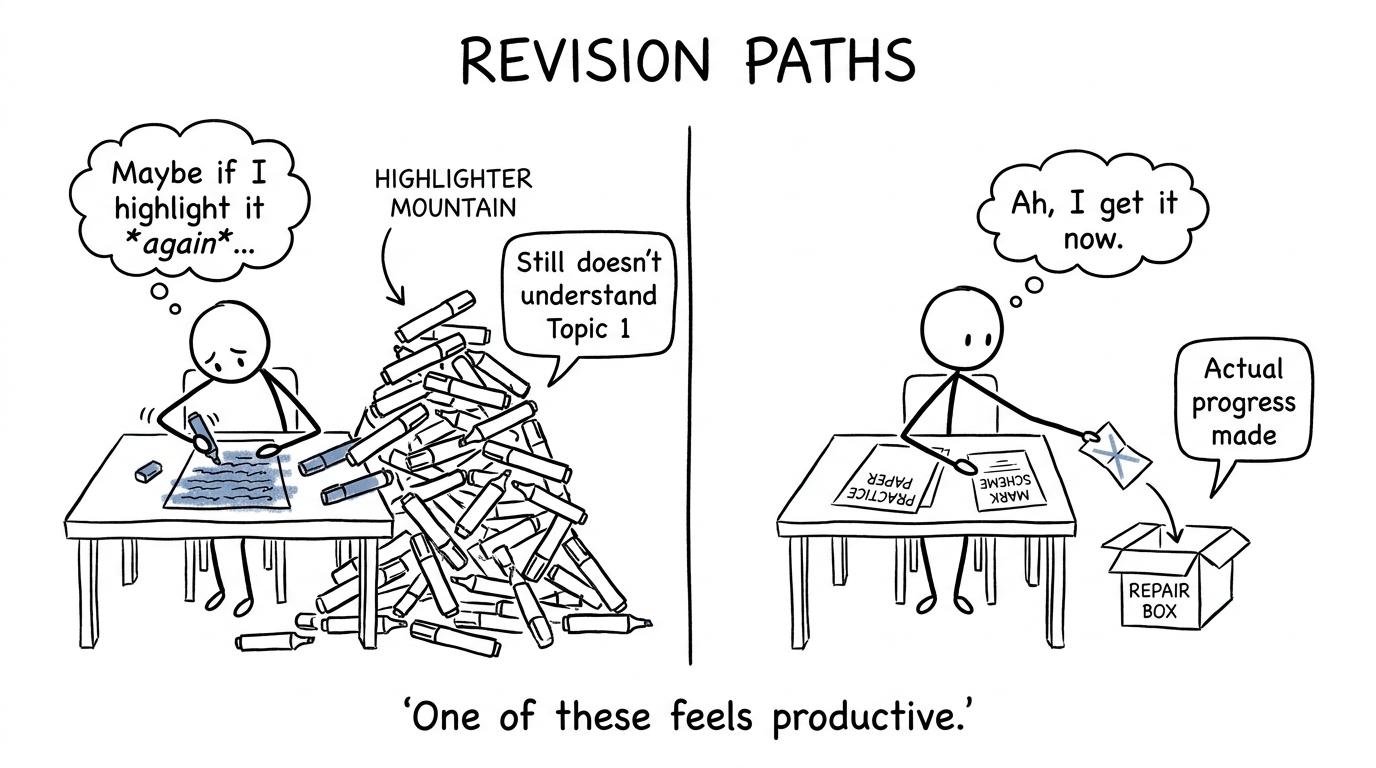 One student highlights endlessly while another repairs a specific mistake after checking the mark scheme
The lesson for students revising GCSE maths too
MathsGenie does not host GCSE Arabic examiner reports, but the revision method transfers directly to maths. Edexcel, AQA, OCR and Eduqas papers differ in presentation, yet all reward careful reading, valid method and accurate communication.
Start at the GCSE maths revision hub and choose your board and tier. If you take Edexcel, use the Edexcel GCSE maths past papers with their mark schemes and available solutions.
After marking, apply the same classification system. Did you misunderstand the task, forget the mathematical method, make an accuracy error or run out of time? The guide to using Edexcel past papers properly explains how to turn those findings into targeted practice.
Nearer the exams, Edexcel GCSE maths predicted papers can provide unseen practice, but they should not replace full specification coverage. A predicted paper is a rehearsal, not a promise about what will appear.
If revision feels difficult to organise across Arabic, maths and your other GCSEs, adapt the weekly rhythm in the MathsGenie one-month revision plan: diagnose, practise, mark, repair and revisit.
Common mistakes when using examiner reports
Reading comments without attempting the paper
Advice feels obvious when someone else has already explained it. Attempting the task first reveals whether you can apply that advice independently.
Treating one year's report as a prediction
An examiner report explains performance in a completed series. It does not reveal the next paper's topics. Use reports to identify durable skills and recurring weaknesses, not to narrow the specification recklessly.
Collecting every weakness at once
A long error list can become another form of procrastination. Choose the two patterns costing you the most marks and repair those first.
Memorising impressive answers
Prepared language is useful, but memorising complete responses can make speaking inflexible and writing irrelevant to the prompt. Build adaptable sentence structures, vocabulary clusters and checking routines instead.
Ignoring what successful candidates did
Examiner reports do not only describe errors. They also identify effective responses, such as maintaining interaction, varying structures and communicating clearly. Study success patterns as carefully as warnings.
Use examiner feedback as a map
The central message of GCSE Arabic examiner reports is not that students need longer answers or more revision materials. It is that they need closer alignment between the task, their response and the assessment criteria.
Read the instruction. Communicate the intended meaning. Check tense and person. Answer every required element. Then use the evidence from each practice task to decide what happens next.
Bring the same discipline to maths with MathsGenie's free revision lessons, practice questions, mini tests, past papers, predicted papers, mark schemes and video solutions. Choose one task today, mark it carefully and repair one recurring error. Small corrections, repeated often, are how examiner feedback becomes better exam performance.










