GCSE Maths Topics by Exam Board and Tier: Full List
GCSE Maths Topics by Exam Board and Tier: compare Edexcel, AQA, OCR and Eduqas with complete Foundation and Higher revision checklists.
A GCSE maths specification can feel less like a revision list and more like a document designed to hide the revision list. Topics sit inside broad headings, Foundation and Higher content overlap, and each exam board arranges familiar ideas in a slightly different way.
This GCSE Maths Topics by Exam Board and Tier: Full List gives you the practical answer: Edexcel, AQA, OCR and Eduqas assess the same national subject content, but organise and examine it differently. Foundation covers grades 111-555, while Higher targets grades 444-999. Higher includes the Foundation content as well as additional, more demanding material.
Use this guide as a map, then open the GCSE Maths revision hub to find lessons, questions and papers for your board.
Your quick specification checklist
Before revising, confirm these four things:
- Your exam board: Edexcel, AQA, OCR or Eduqas.
- Your tier: Foundation or Higher.
- Which topics you can already answer without notes.
- Which topics repeatedly cost you marks in tests and past papers.
The six main content areas are:
- Number
- Algebra
- Ratio, proportion and rates of change
- Geometry and measures
- Probability
- Statistics
The labels may be divided differently by an exam board, but the mathematical destination is largely the same.
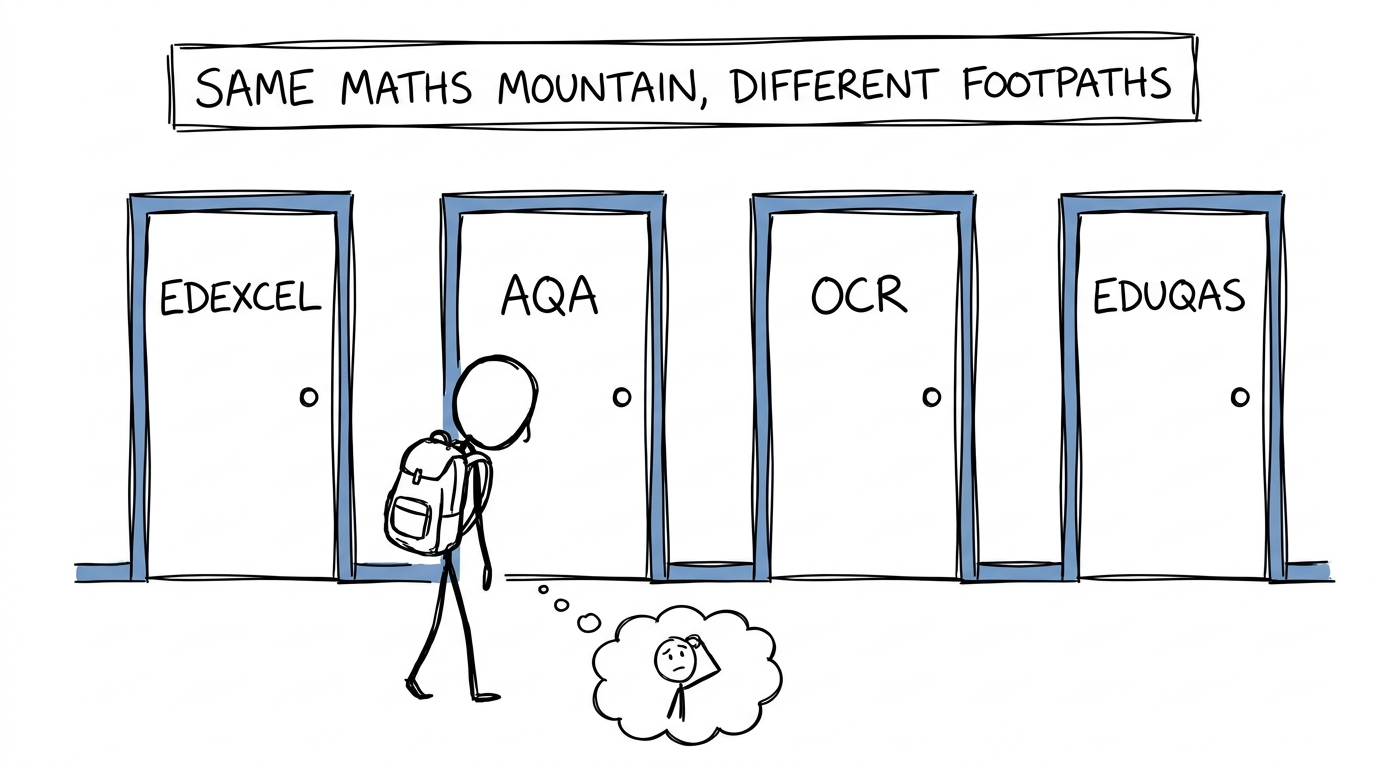 A student choosing between four exam-board routes up the same maths mountain
GCSE Maths topics by exam board
England's GCSE mathematics subject content is set nationally. Exam boards build their specifications and papers around that shared content, so changing board does not create an entirely different course. What changes is the organisation, paper structure, wording and style of assessment.
Edexcel GCSE Maths
Edexcel's qualification code is 111MA111. Its specification uses the six standard content areas. Students take three equally weighted papers: Paper 111 is non-calculator, while Papers 222 and 333 permit a calculator.
Edexcel gives approximate topic-weighting ranges. Foundation places the greatest emphasis on Number and Ratio, Proportion and Rates of Change. Higher gives the largest share to Algebra.
Students can organise their preparation through the Edexcel GCSE Maths revision hub, before moving to Edexcel GCSE Maths past papers and Edexcel predicted papers.
AQA GCSE Maths
AQA's qualification code is 830083008300. It also divides the course into Number, Algebra, Ratio, Geometry, Probability and Statistics. Students sit three papers at the same tier: Paper 111 is non-calculator and Papers 222 and 333 are calculator papers.
AQA states approximate overall tier weightings of 25%25\%25% Number, 20%20\%20% Algebra, 25%25\%25% Ratio, 15%15\%15% Geometry and 15%15\%15% Probability and Statistics at Foundation. At Higher, the corresponding figures are 15%15\%15%, 30%30\%30%, 20%20\%20%, 20%20\%20% and 15%15\%15%.
Use the AQA GCSE Maths revision hub for board-aligned resources, or go directly to the AQA GCSE Maths past papers.
OCR GCSE Maths
OCR's qualification code is J560560560. Its content appears under twelve detailed headings rather than only six: number operations and integers; fractions, decimals and percentages; indices and surds; approximation and estimation; ratio and proportion; algebra; graphs; basic geometry; congruence and similarity; mensuration; probability; and statistics.
That longer set of headings does not mean OCR students learn twelve unrelated branches of maths. OCR has simply divided the common content more finely.
OCR students take Papers 111-333 at Foundation or Papers 444-666 at Higher. The middle paper at each tier, Paper 222 or Paper 555, is non-calculator; the other two permit calculators.
Eduqas GCSE Maths
Eduqas uses the same six broad content areas and the same grade ranges, but its assessment structure is distinctive. Students take two equally weighted papers rather than three: one non-calculator component and one calculator-allowed component. Each lasts 222 hours 151515 minutes.
This makes paper stamina particularly important. A topic checklist can tell you what to learn, but only timed Eduqas papers can reveal whether you can sustain accurate work across a longer examination.
Full Foundation tier GCSE Maths topic list
Foundation tier offers grades 111-555. The following grouped checklist covers the common content assessed across the major boards, although individual specifications may classify a skill under a slightly different heading.
Number
- Integers, decimals, negative numbers and place value
- The four operations and order of operations
- Factors, multiples, primes, highest common factor and lowest common multiple
- Squares, cubes, roots and integer indices
- Fractions, decimals and percentages, including conversions
- Fractions and percentages of amounts
- Percentage increase, decrease and change
- Standard form
- Rounding, estimation and significant figures
- Limits of accuracy and error intervals
- Recurring decimals and exact values where required
- Calculator use and checking whether answers are reasonable
Algebra
- Algebraic notation, substitution and simplifying expressions
- Expanding brackets and factorising expressions
- Forming and solving linear equations
- Linear inequalities and number-line representations
- Rearranging straightforward formulae
- Coordinates and straight-line graphs
- Quadratic, cubic and reciprocal graph recognition
- Real-life graphs, including distance-time graphs
- Linear simultaneous equations
- Linear sequences and term-to-term rules
- Continuing non-linear sequences
- Function machines and inverse operations
- Basic algebraic reasoning and proof
Ratio, proportion and rates of change
- Writing, simplifying and sharing in a ratio
- Fractions linked to ratios
- Scale drawings, maps and scale factors
- Direct and inverse proportion in familiar contexts
- Best buys and unit pricing
- Percentage multipliers and reverse percentages
- Compound interest, depreciation and repeated change
- Speed, density, pressure and other compound measures
- Converting units of length, area, volume, mass and time
Geometry and measures
- Angle facts, parallel lines and polygons
- Properties of triangles, quadrilaterals and other polygons
- Bearings, scale drawings, constructions and loci
- Perimeter and area of 222D shapes
- Circumference and area of circles
- Surface area and volume of prisms and other solids
- Plans, elevations and properties of 333D shapes
- Reflection, rotation, translation and enlargement
- Congruence and similarity
- Pythagoras' theorem
- Right-angled trigonometry
- Geometrical reasoning and simple proof
Probability and statistics
- The probability scale from 000 to 111
- Relative frequency and expected outcomes
- Sample spaces, frequency trees and two-way tables
- Venn diagrams and set notation
- Probability trees and combined events
- Mean, median, mode and range
- Averages from frequency tables
- Bar charts, pie charts, line graphs and pictograms
- Scatter graphs, correlation and lines of best fit
- Frequency polygons and time-series graphs
- Sampling, questionnaires and sources of bias
MathsGenie's GCSE revision guides can help you turn each broad heading into manageable lessons and practice sessions.
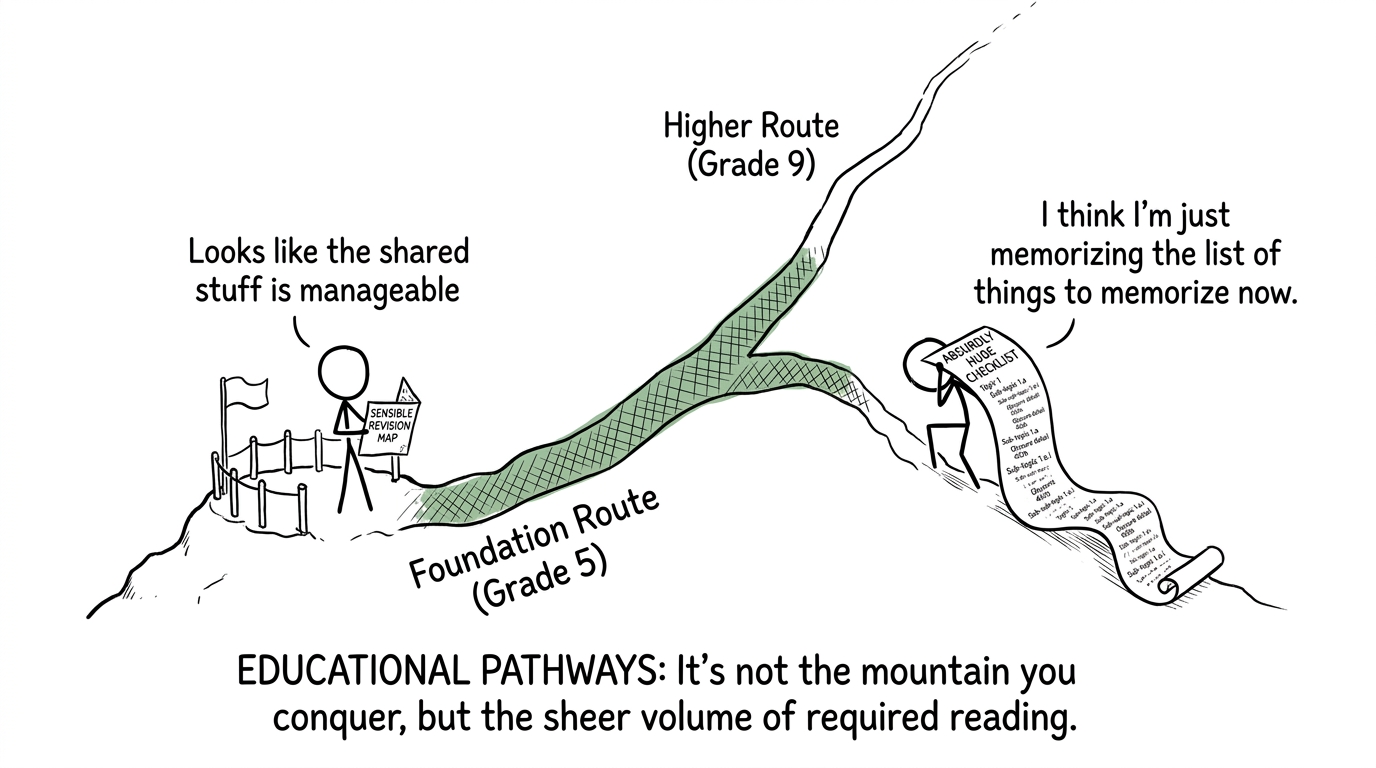 Foundation and Higher climbers following overlapping revision routes
Additional Higher tier GCSE Maths topics
Higher tier offers grades 444-999 and can assess all Foundation content. The overlap matters: a Higher paper is not made entirely from Higher-only techniques. Secure arithmetic, ratio and linear algebra still protect valuable marks.
Additional Higher content commonly includes:
Higher Number and algebra
- Fractional and negative indices
- Surds, including simplifying and rationalising denominators
- Calculations with bounds
- Recurring decimals expressed as fractions using algebra
- Expanding and factorising quadratics
- Solving quadratic equations by factorisation, formula and completing the square
- Algebraic fractions
- Simultaneous equations involving a linear and quadratic equation
- Iteration
- Quadratic and geometric sequences
- Functions, including composite and inverse functions
- Transformations of graphs
- Equations of circles and tangents
- Perpendicular gradients
- Algebraic proof
Higher proportion and geometry
- Algebraic direct and inverse proportion
- Exponential growth and decay
- Rates of change and gradients of curves
- Similarity involving area and volume scale factors
- Congruence proofs
- Sine rule, cosine rule and the area of a triangle
- Exact trigonometric values
- Trigonometry and Pythagoras in 333D
- Circle theorems and proofs
- Vectors and vector proof
- Frustums and more demanding compound solids
Higher probability and statistics
- Conditional probability
- More complex tree diagrams and dependent events
- Cumulative frequency diagrams
- Box plots and comparisons of distributions
- Histograms and frequency density
- Estimating statistics from grouped data
- More demanding sampling and statistical reasoning
The boundary between Foundation and Higher presentation can vary slightly in exam-board documents. Your own specification remains the final checklist, particularly for skills that boards divide into different levels of demand.
How to turn the topic list into a revision plan
A list gives reassurance, but it does not reveal what you can do under pressure. That evidence comes from questions.
Start with a timed paper or mini test. Mark it using the mark scheme, then label every lost mark with a topic. If several questions point towards fractions, straight-line graphs or circle theorems, those become your next revision priorities.
Use this cycle:
- Learn or revisit one method using a revision lesson.
- Complete focused practice questions without copying the solution.
- Mark the questions and record the exact error.
- Reattempt the skill after a short gap.
- Test it later inside a mixed past paper.
If the order feels unclear, follow the recommended order for learning GCSE Maths topics. Students considering a change of tier can also read the guide to moving from Foundation to Higher GCSE Maths.
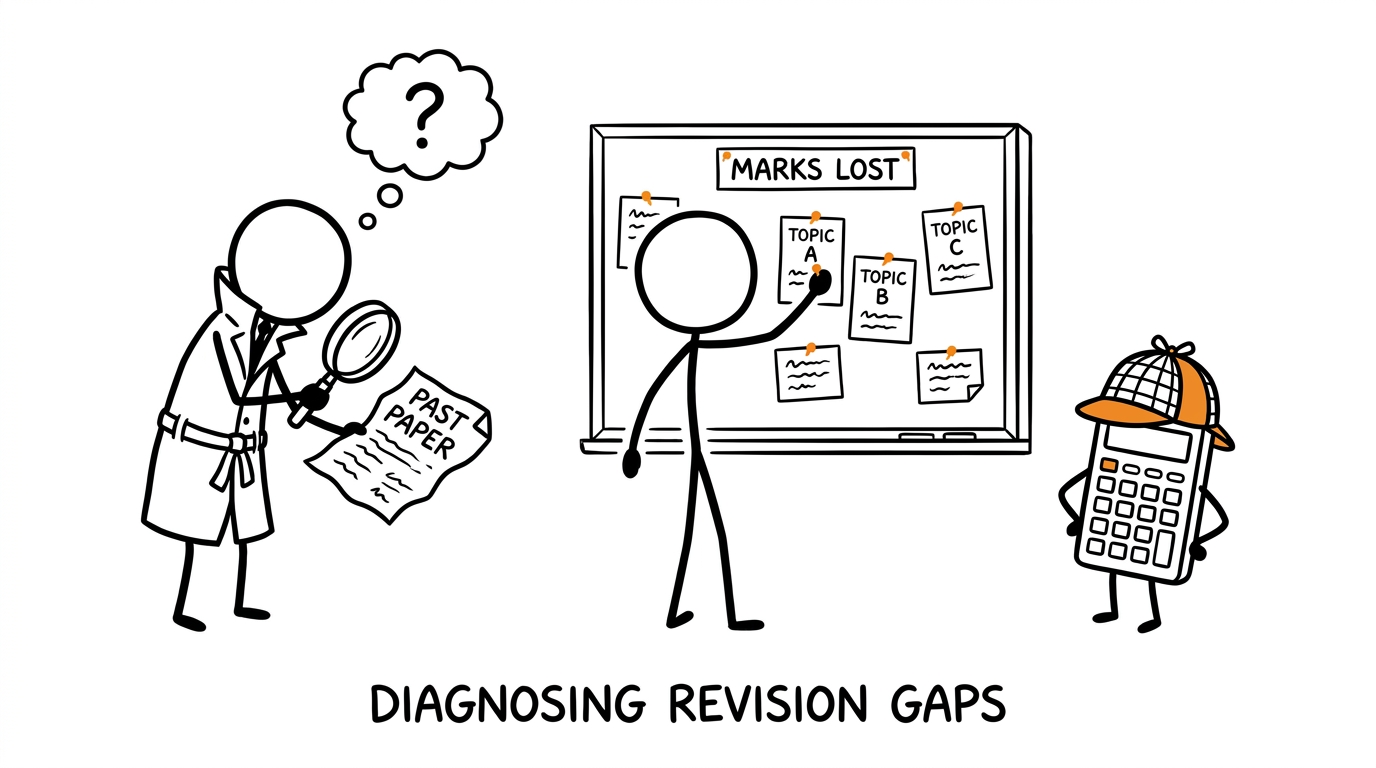 A student detective investigating lost marks in a past paper
Common mistakes when using a GCSE topic list
Treating every topic as equally weak. A complete list is useful for coverage, but your mistakes should decide where most of your time goes.
Revising only Higher-only topics. Higher students still need fluent Foundation skills. Difficult questions often connect advanced reasoning to basic fractions, percentages or algebra.
Using resources for the wrong board or tier. Extra questions from another board can be useful, but board-specific papers should be your main source of exam practice.
Reading instead of practising. Recognising a method in notes is not the same as producing it independently. Move from revision lessons to questions quickly.
Guessing future papers from previous topics. Any eligible content may be assessed. Predicted papers are valuable practice, not a guarantee of what will appear.
Ignoring mark schemes. The final answer is only part of the story. Mark schemes show where method, reasoning, units and accuracy earn marks.
Build confidence one topic at a time
The specification looks large because it describes years of learning on a few pages. Revision becomes calmer when that large document is reduced to one next action: one topic, one set of questions and one honest review.
Choose your board and tier in the MathsGenie GCSE Maths revision area. Use free revision lessons and practice questions to repair individual skills, mini tests to check progress, and past papers to build timing. Nearer the examination, add predicted papers, mark schemes and video solutions to make your remaining gaps visible.
The list tells you what could appear. Consistent practice is what makes you ready when it does.