

GCSE Past Papers: When Should You Start?
GCSE past papers work best when you start early and use them well. Learn the best timing, routines, and Maths Genie resources for top grades.
It usually starts the same way: you open a past paper, read Question 1, and your brain quietly negotiates with you. Maybe I’ll just watch one more video first.
If you’re revising for GCSE maths, that moment matters. Not because past papers are scary, but because they reveal the truth: what you know, what you nearly know, and what you only recognise when someone else is holding the pen.
So when should you start past papers? Earlier than most students think, but not in the way most students do. This guide shows you the best time to start, how to use past papers without wasting them, and how to build confidence using Maths Genie lessons, practice questions, mark schemes, and predicted papers.
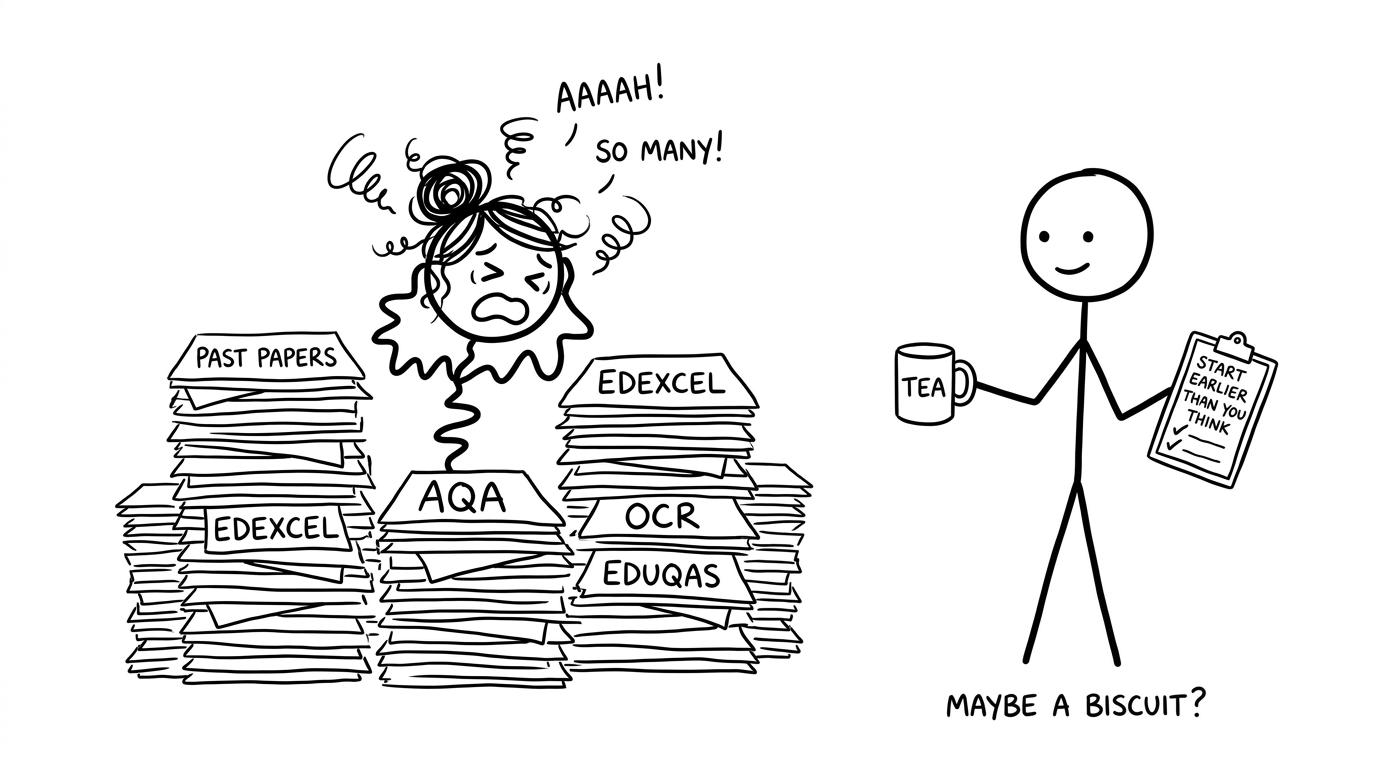 A stressed student and a calm checklist
The short answer: start past papers in phases
You don’t “start past papers” once. You grow into them.
Here’s the simplest checklist that works for GCSE and A Level maths students:
- Phase 1 (early revision): use mini tests and half-papers to diagnose weak topics.
- Phase 2 (building performance): do timed sections and targeted past paper questions by topic.
- Phase 3 (final run-in): full timed papers, strict exam conditions, then deep review with mark schemes.
- Phase 4 (last 1-2 weeks): predicted papers and polishing small errors.
On Maths Genie, you can build these phases using:
- GCSE Predicted Papers and Resources
- Target Tests (mini tests)
- Edexcel Predicted Papers (GCSE Maths)
- AQA GCSE Maths past papers page (papers view)
- A Level Maths Revision
- AQA A Level Past Exam Papers
Why past papers feel hard (and why that’s useful)
Past papers are stressful for one reason: they combine topics.
In lessons, you revise “simultaneous equations” on Tuesday and “Pythagoras” on Wednesday. In a GCSE paper, they might arrive in the same question, wearing a disguise, and asking for method marks.
That’s the hidden gift of past papers. They teach you to:
- choose a method under pressure,
- manage time across different mark questions,
- write working that earns marks,
- and recover when you get stuck.
But they only teach those skills if you use them deliberately. Doing full papers too early can feel like drowning. Waiting too late means you never learn to swim.
The best time to start past papers for GCSE maths
For GCSE maths (Edexcel, AQA, OCR, Eduqas), a strong rule of thumb is:
- 3-5 months before the exam: start some past paper practice (not necessarily full papers).
- 6-10 weeks before the exam: start regular timed papers.
- Final 2-4 weeks: use full papers plus predicted papers to sharpen technique.
The right moment depends on what you already know.
If you’re still learning lots of content
If your class is still covering major topics, start with shorter paper formats and topic practice:
- Use Target Tests to spot weak grades-based skills.
- Use revision lessons and exam questions on topic pages (via the Maths Genie GCSE revision structure).
- Only do a full paper occasionally, as a diagnostic, not a judgement.
If you’ve finished the course content
If you’ve covered most topics, start past papers earlier and more regularly:
- One timed paper every 1-2 weeks at first.
- Then 2-3 per week as exams approach.
- Always review with the mark scheme and fix gaps using revision lessons.
Foundation vs higher tier timing
The principle is the same, but the focus shifts:
- Foundation tier: start earlier on method confidence, accuracy, and “easy marks done perfectly”.
- Higher tier: start earlier on multi-step reasoning and the final 10-15 marks per paper where grades 7-9 often live.
A Level students: start past papers differently
A Level maths past papers are less forgiving because each question can be a longer chain of ideas. If you leave past papers until the final weeks, you don’t just miss practice; you miss learning how A Level questions think.
A strong approach is:
- Start topic-based exam questions early (throughout Year 12 and Year 13).
- Begin full A Level past papers around 8-12 weeks before exams.
- Use A Level Maths Revision for topic practice, then move to AQA A Level Past Exam Papers (or your board’s papers) to build stamina.
How to use GCSE past papers without wasting them
The biggest mistake is treating a past paper like a one-off event. Instead, think of each paper as a feedback machine.
Here’s the routine that high scorers use, even if they don’t talk about it.
Do the paper in realistic conditions
- Use the right time limit (typically 111 hour 303030 minutes per paper for GCSE maths).
- Use the correct calculator rule: non-calculator vs calculator.
- Don’t pause every time it gets hard. Circle it, move on.
Mark it like an examiner
Use mark schemes and solutions. Maths Genie past paper pages make this easier because they often include mark schemes and solutions together (for example, the AQA GCSE papers view).
When marking, don’t just count marks. Categorise each lost mark:
- Knowledge gap (didn’t know the method)
- Method slip (knew it, but executed poorly)
- Careless error (sign, arithmetic, rounding)
- Exam technique (didn’t show steps, misread question, ran out of time)
Build a “Fix List” and revisit it
A past paper should create a short to-do list.
Example fix list items:
- “Rearranging formulae when there’s a fraction”
- “Scatter graphs: line of best fit and interpreting”
- “Angles in parallel lines”
Then practise those topics using Maths Genie revision lessons and exam questions, and return to another paper.
A worked example: turning a past paper mistake into marks
A common GCSE past paper moment is losing marks not because the maths is impossible, but because the working is unclear.
Example: mean from a frequency table
A student is given values xxx with frequencies fff.
| xxx | fff |
|---|---|
| 222 | 333 |
| 555 | 444 |
| 999 | 111 |
Find the mean.
Method:
Compute ∑fx\sum fx∑fx and divide by ∑f\sum f∑f.
∑fx=2×3+5×4+9×1=6+20+9=35 \sum fx = 2\times 3 + 5\times 4 + 9\times 1 = 6 + 20 + 9 = 35 ∑fx=2×3+5×4+9×1=6+20+9=35 ∑f=3+4+1=8 \sum f = 3 + 4 + 1 = 8 ∑f=3+4+1=8So the mean is:
358=4.375 \frac{35}{8} = 4.375 835=4.375Why this matters for past papers:
- If you write only 4.3754.3754.375 and it’s wrong, you likely get 000.
- If you write ∑fx\sum fx∑fx and ∑f\sum f∑f clearly, you often pick up method marks.
That is the quiet power of practising past papers early: you learn what examiners reward.
The “paper ladder”: a smarter way to start
If full papers feel too big, use a ladder.
Start with mini tests
Use Target Tests to build confidence and spot gaps quickly. They’re short enough that you can finish one even on a tired day, which matters more than motivation.
Move to predicted papers at the right time
Predicted papers can be powerful, but they’re best used after you’ve built foundations and seen enough real papers.
Maths Genie’s GCSE Predicted Papers and Resources and Edexcel Predicted Papers are ideal in the final stages, when you want exam-style practice that targets likely gaps.
Mix boards carefully
If you do AQA papers but you’re sitting Edexcel (or OCR/Eduqas), don’t panic. The maths overlaps heavily. Just be aware that:
- wording and layout differ,
- some topics are emphasised differently,
- mark schemes reward slightly different working.
Use your own board for full papers, and other boards for extra practice questions.
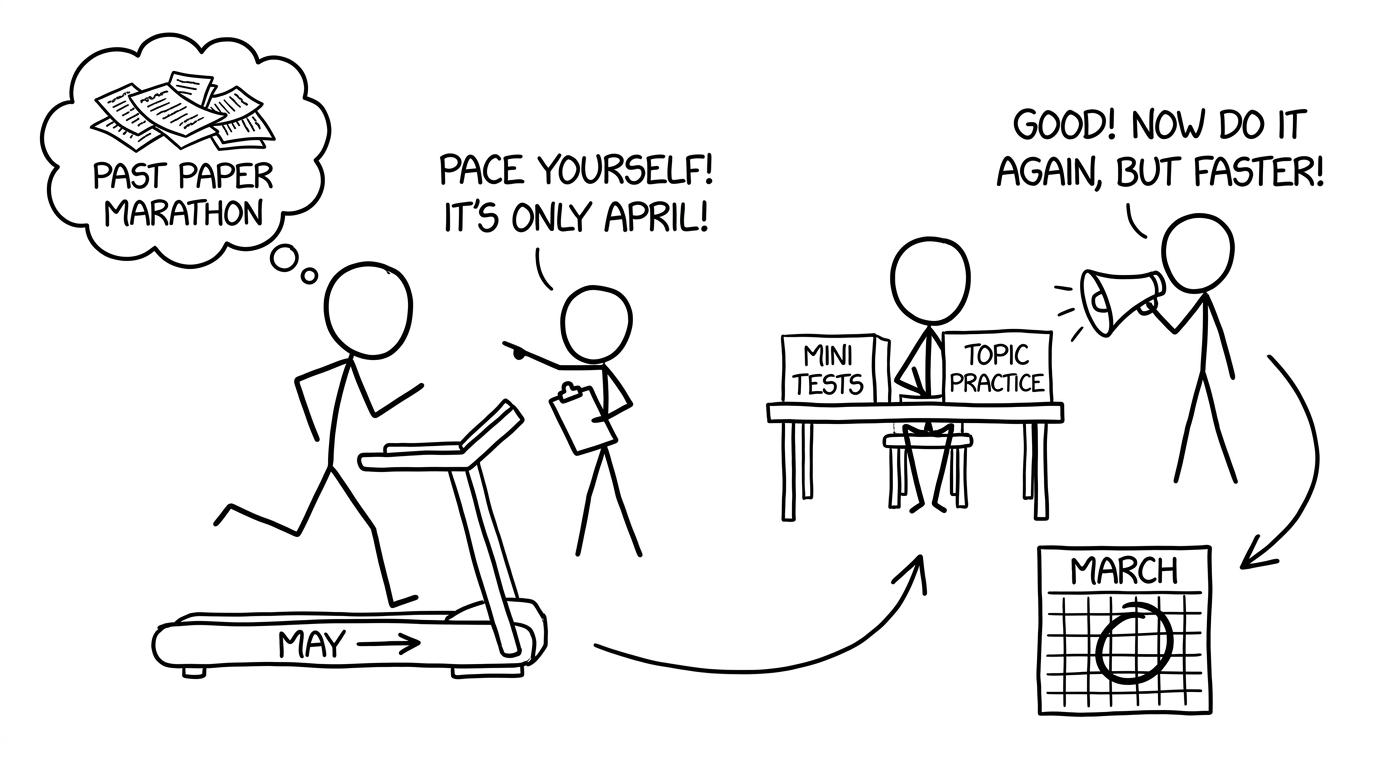 Past Paper Marathon vs training plan
Common mistakes students make with past papers
These are the patterns that quietly steal grades in GCSE and A Level maths.
Doing papers open-book and calling it revision
If you check notes every two minutes, you’re practising comfort, not recall. Use notes only after you’ve attempted a question properly.
Marking without learning
Marking is not the end. The win is the correction and the follow-up practice. If you don’t revisit the topic, you will lose the same marks again.
Only doing papers, never topic practice
Past papers show you the holes. Topic practice fills them. If you skip the filling, you just keep collecting holes.
Ignoring method marks
In maths, 000 and “nearly” often look the same in your head. On a mark scheme, they are not the same. Show your method so you can earn marks even when the final answer slips.
Saving the newest papers “for later”
Students hoard the best papers like they’re rare. But the real scarce resource is time and feedback. Use papers while they can still change your habits.
Bringing it together: the moment to start is when you’ll still listen to feedback
The best time to start past papers isn’t “when you’ve finished the course”. It’s when you still have enough weeks left to be changed by what you find.
For GCSE, that usually means starting small a few months out, then building to timed full papers in the final 6-10 weeks. For A Level, it means weaving exam questions into your revision earlier, then using full papers to build stamina and fluency.
If you want a calm, structured way to do this, Maths Genie is built for it: revision lessons to learn the method, exam questions to practise it, mark schemes and solutions to understand how marks are awarded, and predicted papers to sharpen your final preparation.
Use Target Tests to diagnose, then move to past papers via your board pages (for example AQA GCSE papers view), and finish with GCSE Predicted Papers and Resources when exams are close.
Start now, not because you’re meant to feel ready, but because past papers are how you become ready.










