

GCSE Maths Night-Before Plan That Avoids Panic
GCSE night-before maths plan to avoid panic: what to revise, how to use past papers and mark schemes, and a calm exam-morning routine.
The night before a GCSE Maths exam feels louder than it should
The night before a GCSE Maths exam has a special kind of noise. Not in the room, but in your head: the half-remembered formula, the fear that Paper 1 will ask the one topic you skipped, the temptation to “just do one more paper” until it’s suddenly midnight. The problem isn’t that you don’t care. It’s that you care so much you’re about to spend your last useful hours in a panic.
This plan is built for that moment. It’s a GCSE night-before routine that protects your sleep, focuses your revision on marks you can actually collect, and uses YesGenie in the most efficient way: lessons for gaps, practice questions for confidence, and mark schemes for accuracy.
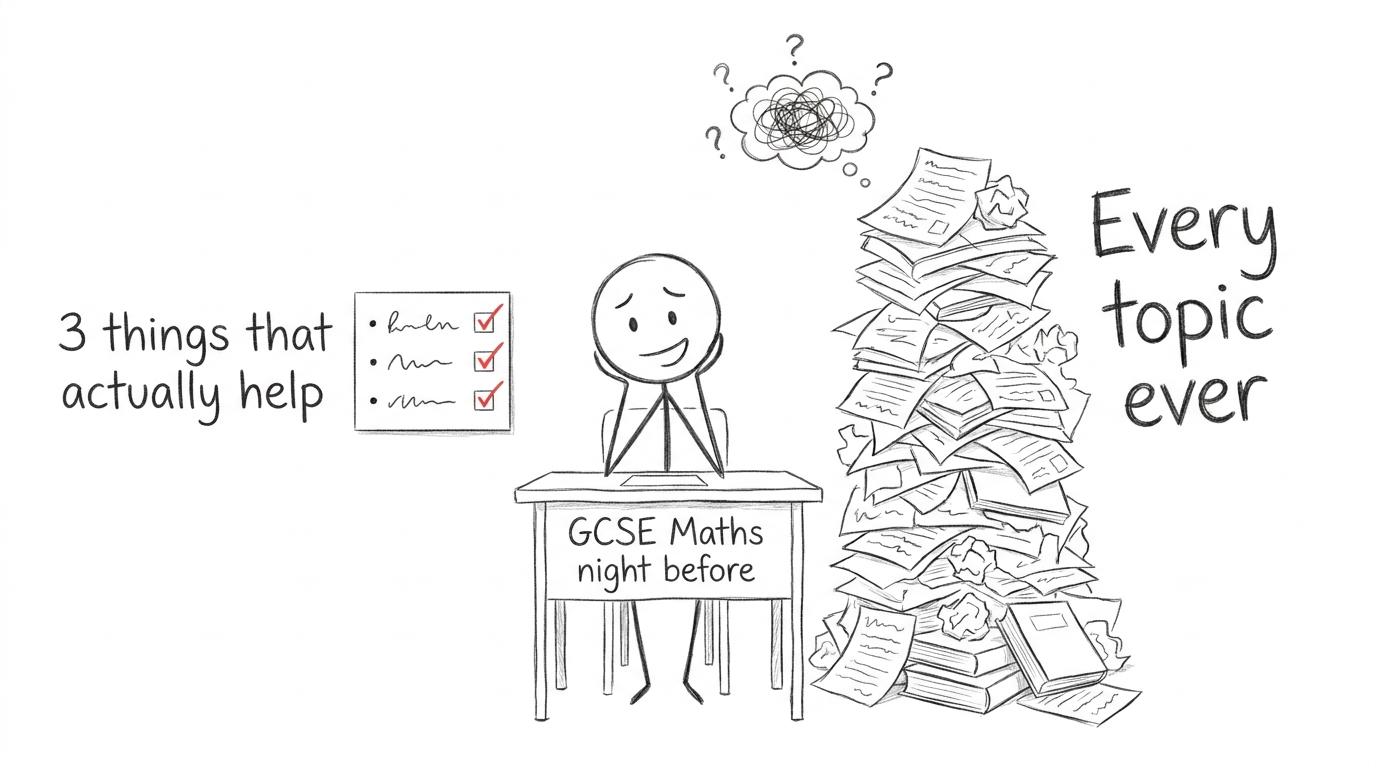 A student choosing a calm checklist over a huge pile of revision papers
The GCSE night-before checklist (simple, but strict)
Use this as your rulebook for the night before a GCSE Maths paper:
- Pick one exam board and tier (Edexcel, AQA, OCR, Eduqas; foundation or higher). Don’t mix styles.
- Do one timed paper section (or a short mini test), not three full papers.
- Mark it immediately using the mark scheme or video solutions.
- Fix three high-impact topics only.
- Prepare your exam kit and a morning plan.
- Be in bed early enough to get real sleep.
Good revision isn’t proving you can suffer. It’s collecting marks calmly.
Step 1: Decide what “useful revision” means tonight
The night before a GCSE exam is not for learning an entire topic from scratch. It’s for:
- Refreshing methods you already half-know.
- Reducing silly mistakes.
- Rehearsing exam behaviour (reading, planning, showing working).
That’s why your best tools are structured exam practice and quick targeted fixes.
On YesGenie, start by choosing the right exam resources:
- Use GCSE Past papers for the most authentic practice.
- If you want exam-focused practice in less time, use Edexcel GCSE Maths Mini Tests.
- If it’s during exam season and you need focus, use Edexcel GCSE Maths Predicted Papers.
- If you’re not sure where to start, open Resources and pick one lane.
This is a GCSE strategy: narrow the world until it fits in your hands.
Step 2: Do one timed set and stop at the bell
Pick one:
- A mini test (best if you’re anxious).
- Half a paper.
- A full paper only if you can genuinely finish and mark it without sacrificing sleep.
If you’re doing a non-calculator paper, the point is not speed. It’s fluency with arithmetic, fractions, and rearranging.
A calm rule: if you hit a question that feels like fog, circle it, move on, and come back. On a GCSE paper, finishing the paper is often worth more than wrestling one hard question for 15 minutes.
Then mark it.
Step 3: Mark like an examiner (this is where marks are hiding)
The fastest grade improvements the night before GCSE Maths often come from one habit: marking properly.
Use video solutions when you need clarity. For example, YesGenie has paper walkthroughs such as June 2019 Paper 1: Video Solutions.
Here’s what to write down while marking:
- Method mark trigger: what line earned the first method mark?
- Accuracy point: where did you lose the final mark (arithmetic, substitution, rounding, units)?
- Working style: did you show enough for follow-through marks?
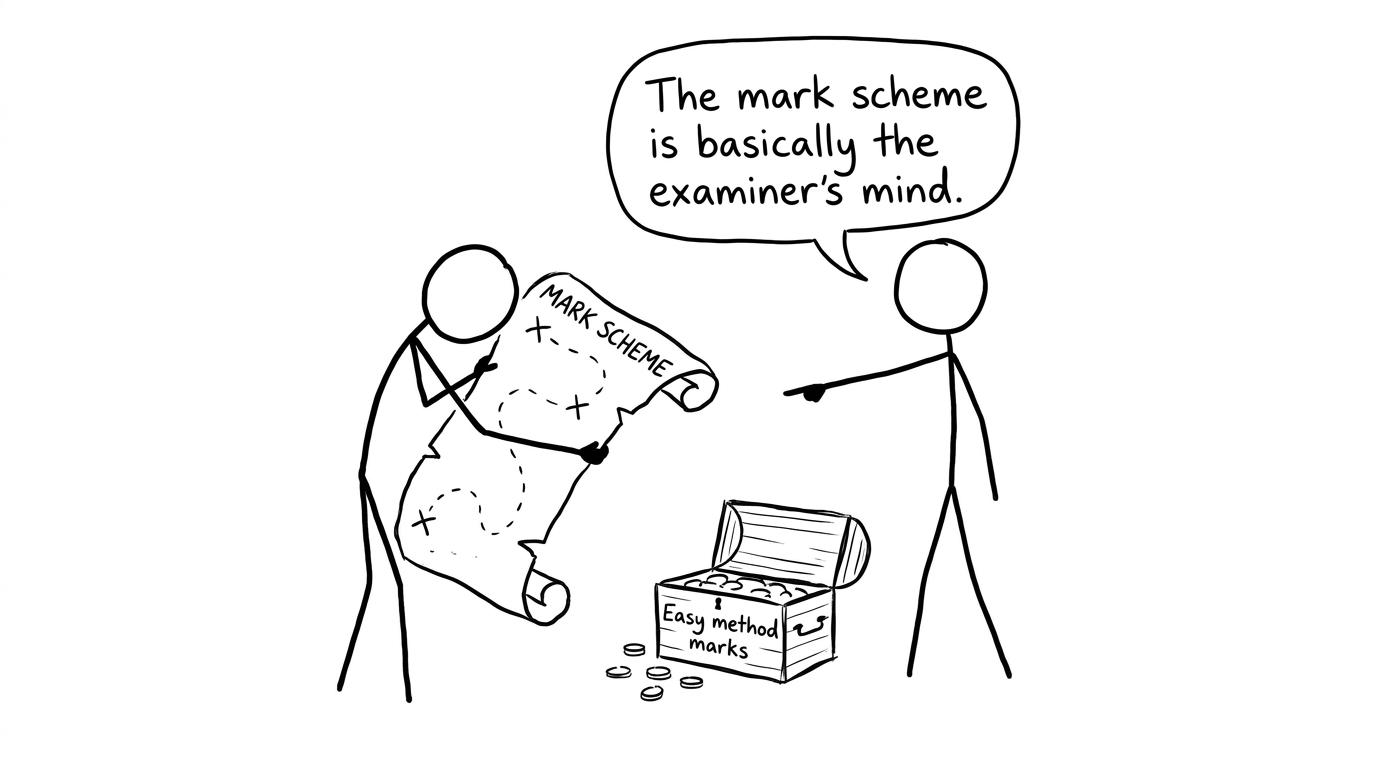 A stick figure treating the mark scheme like a treasure map
A quick worked example: best buy (easy marks when you write it cleanly)
Best buy questions are classic GCSE marks because they reward calm structure.
Suppose you need the cheapest unit price.
- Option A: 750 g750\text{ g}750 g for £2.402.402.40
- Option B: 1.2 kg1.2\text{ kg}1.2 kg for £3.603.603.60
Convert both to the same units and compute unit cost.
Option A in kilograms: 750 g=0.75 kg750\text{ g} = 0.75\text{ kg}750 g=0.75 kg.
Unit cost A:
2.400.75=3.2 \frac{2.40}{0.75} = 3.2 0.752.40=3.2So A costs £3.203.203.20 per kg.
Unit cost B:
3.601.2=3 \frac{3.60}{1.2} = 3 1.23.60=3So B costs £3.003.003.00 per kg.
Conclusion: Option B is the best value.
If you want to quickly refresh this style of question, use a focused page like Best Buy Questions: GCSE Maths.
Step 4: Fix three topics only (the “three fires” rule)
After marking, choose three fires to put out. Not ten. Not “everything algebra”. Three.
Good night-before GCSE topics are the ones that:
- Come up often.
- You nearly get right.
- Lose marks through one repeated mistake.
Examples:
- Ratio / proportion methods.
- Fractions and algebraic manipulation.
- Percentages and percentage change.
- Probability basics.
Use YesGenie revision guides for a short relearn, then a few practice questions.
Here are solid “fix in 20 minutes” pages:
- Writing a Ratio as a Fraction or Linear Function (AQA): Revision Guide
- Probability (WJEC): Revision Guide
- Algebraic Fractions (WJEC): Revision Guide
- If you’re aiming higher grades and want a quick confidence boost, skim a harder guide like Vectors Proof Questions (Edexcel): Revision Guide
A worked example: ratio sharing (a method that stays stable under pressure)
A GCSE classic: “Share £72 in the ratio 5:75:75:7.”
Total parts =5+7=12= 5 + 7 = 12=5+7=12.
One part is:
7212=6 \frac{72}{12} = 6 1272=6So the shares are:
- First share: 5×6=305 \times 6 = 305×6=30
- Second share: 7×6=427 \times 6 = 427×6=42
Check: 30+42=7230 + 42 = 7230+42=72.
Under exam stress, this method is reliable because it’s always the same steps: add parts, divide, multiply.
A worked example: probability estimate (the mark-friendly line)
If the probability of success is 0.30.30.3 and there are 505050 trials, the estimated number of successes is:
0.3×50=15 0.3 \times 50 = 15 0.3×50=15In GCSE mark schemes, that single line is often exactly what they want to see.
Step 5: Build your exam-morning autopilot
Your brain will be tired tomorrow. So tonight, decide what “automatic” looks like.
Pack your kit
- Calculator (and spare batteries if you have them)
- Ruler, protractor, compasses
- Two pens, pencil, eraser
- Water
Write a tiny first-minute script (yes, actually write it)
On a sticky note:
- Read the question.
- Underline what it asks.
- Plan the method.
- Show working.
- Check units and rounding.
That script is a GCSE grade-saver because it stops you giving away marks to speed.
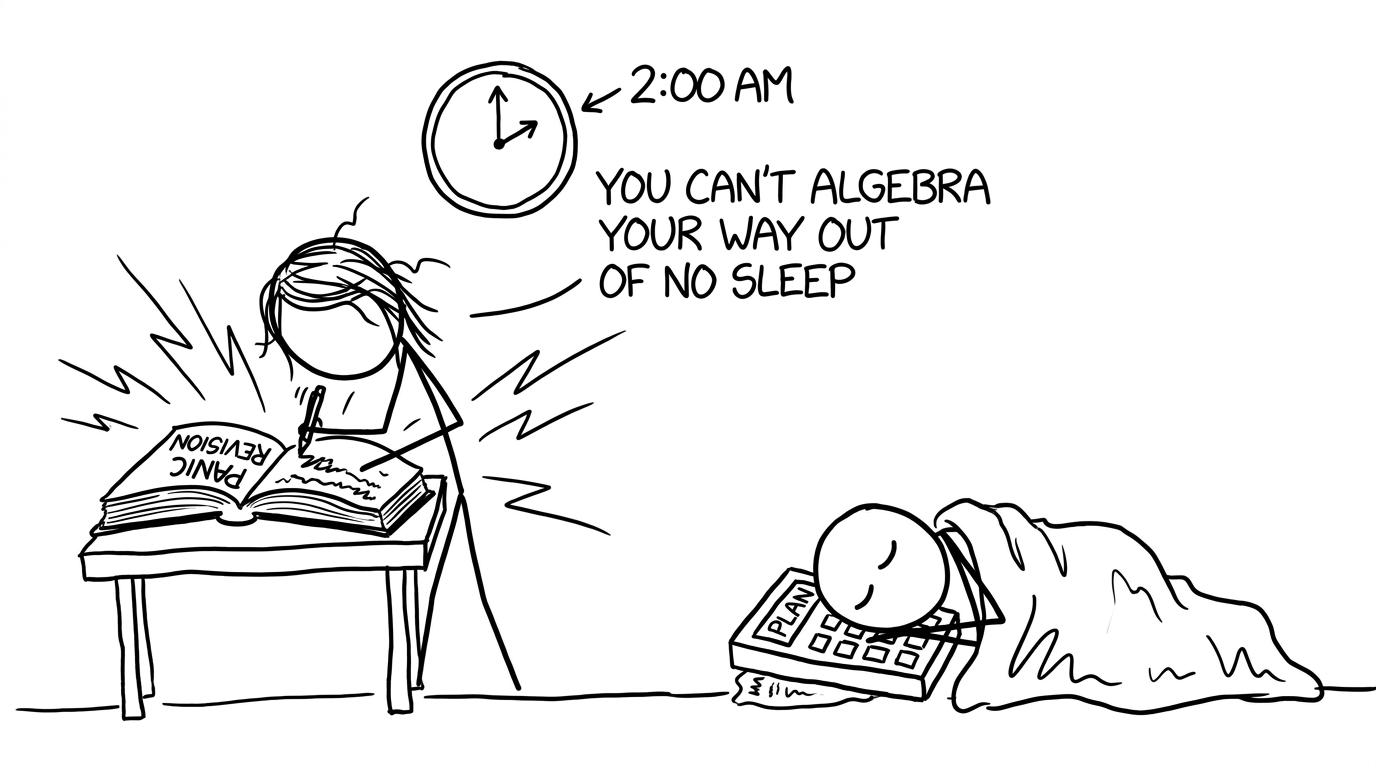 Two students: one panic-highlighting, one choosing sleep
Common mistakes that explode the night before GCSE Maths
These are the traps that create panic and cost marks:
- Doing too many papers and marking none properly. Practice without feedback is just anxiety with extra steps.
- Learning brand new topics at 11pm. It feels productive, but it’s usually shallow and fragile.
- Ignoring method marks. On a GCSE paper you can often earn marks even if the final answer is wrong, but only if your method is visible.
- Rounding too early. Keep full calculator values, round at the end.
- Unit confusion (grams vs kilograms, minutes vs hours). Convert first, then calculate.
- Tier mismatch. Foundation and higher papers reward different depth. Make sure your practice matches your entry tier.
A calm ending: you’re allowed to stop
A good GCSE night-before plan is quietly confident. It respects the exam, but it also respects you. You’ve done enough when you’ve practised a realistic chunk, marked it honestly, repaired three gaps, and set tomorrow up to be simple.
If you want the cleanest way to do that, build your evening around YesGenie: start with GCSE Past papers or Edexcel GCSE Maths Mini Tests, use revision guides to patch the gaps, and lean on mark schemes and video solutions to learn what earns marks. If it’s exam season, narrow your focus with Edexcel GCSE Maths Predicted Papers. Then close the laptop. Sleep.
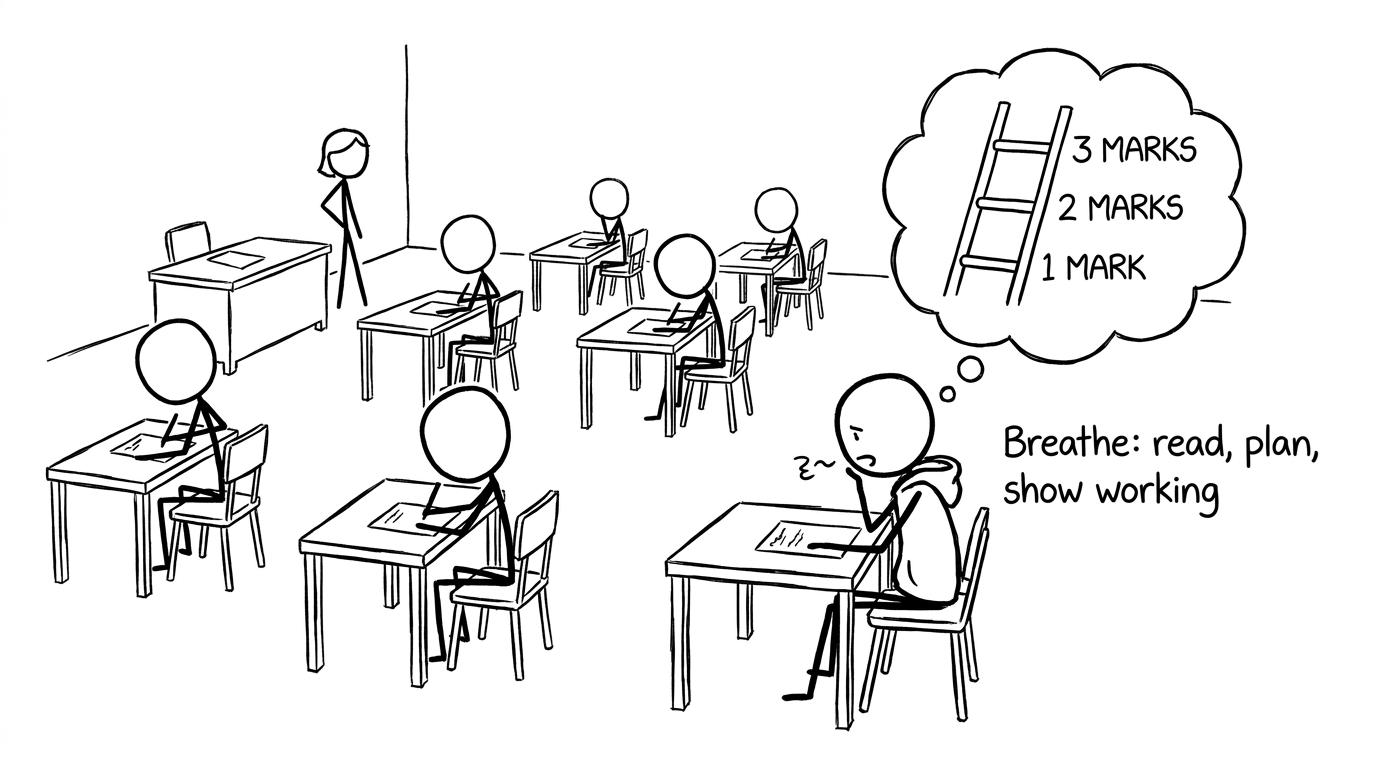 Exam hall scene where a student focuses on breathing and collecting method marks










