GCSE Revision: Find Your Weakest Topics Fast
GCSE revision made smarter: learn how to find your weakest topics using past papers, mini tests and a simple marks method to focus your time.
GCSE season has a particular kind of noise. It is not just the chatter in corridors, or the rustle of past papers, or the low panic of a calculator battery on 2%2\%2%. It is the noise in your head that says, “I revised loads… so why do I keep dropping marks?” The truth is: most students do enough GCSE revision. They just do it in the wrong places. This guide will show you how to find your weakest topics in GCSE Biology (and then translate that exact skill into GCSE maths, where the method is even easier to measure).
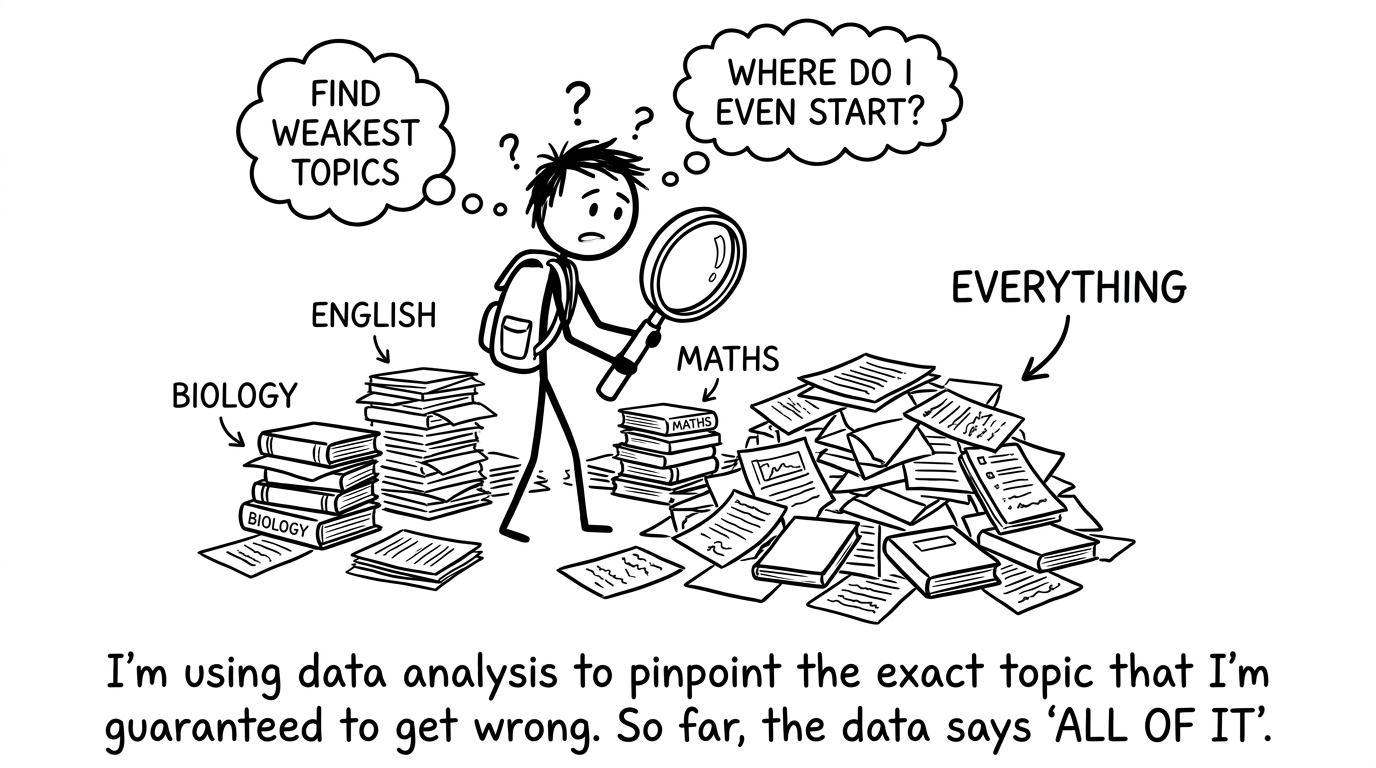 A student searching for weakest topics with a magnifying glass
On YesGenie, you can turn “I’m bad at science” or “I’m bad at maths” into something precise: I lose marks on ratio questions, or I confuse mitosis and meiosis, or I can’t interpret graphs under time pressure. Precision is calm. Precision is also how you improve.
The fastest way to find your weakest topics (GCSE checklist)
Use this as your 30-minute diagnostic routine for GCSE revision:
- Choose evidence: a real past paper, a predicted paper, or a set of mini tests.
- Mark properly: use a mark scheme and be strict.
- Log every lost mark: not just the question number, but the reason.
- Group mistakes into topics: aim for 5-8 topic buckets.
- Compute your “weakness score”: lost marks per topic (and optionally, per minute).
- Practise the worst 2 topics first: short, focused bursts.
- Re-test after 48 hours: your GCSE revision only counts if the gap closes.
If you want the evidence sources in one place, start here: GCSE Past papers, GCSE Mini Tests, and the Resources hub.
Why “weakest topics” is not a feeling
Students often describe weaknesses like weather: “Probability just isn’t my thing,” or “Biology content never sticks.” But GCSE examiners do not mark feelings. They mark decisions.
A topic becomes “weak” for one of three reasons:
- Knowledge gap (you don’t know the fact, definition, or process)
- Method gap (you know it, but cannot apply it in exam style)
- Accuracy gap (you know and can apply it, but lose marks through slips)
GCSE Biology tends to hide weaknesses inside long questions and unfamiliar contexts. GCSE maths, by contrast, is brutally honest: if you can’t do it, your working shows it. That is why using maths-style diagnosis can upgrade your science revision too.
How to find your weakest topics in GCSE Biology (and make it measurable)
In GCSE Biology (AQA, Edexcel, OCR, Eduqas), topics are broad: cells, organisation, infection and response, bioenergetics, homeostasis, inheritance, ecology. The exam questions mix knowledge with maths and practical skills.
Here’s the trick: track lost marks by skill-type as well as topic.
Create a simple table with these columns:
- Question
- Topic (e.g. homeostasis)
- Skill (recall / application / maths / graph / required practical)
- Marks lost
- Why you lost them (one sentence)
This instantly reveals something most GCSE students miss: sometimes your “weakest topic” is not content, it is graphs or calculations.
And that is where YesGenie becomes your advantage, because you can rebuild that skill systematically using GCSE maths practice.
Turn Biology weaknesses into maths wins (the overlap you can exploit)
A lot of GCSE Biology marks quietly depend on GCSE maths:
- Percentage change in populations
- Interpreting rates and gradients
- Mean, range, and drawing conclusions from data
- Units and conversions
- Standard form in larger numbers
So if Biology is your headline worry, your fastest improvement can still come from tightening the maths underneath.
Start with your exam board maths area and use the same “lost marks log” method:
Then use topic pages to go straight to the gap (lesson, practice questions, solutions, and revision guide all in one flow). For example, if your biology paper exposes algebra weakness (rearranging formulas, substitution), practise the foundations here: Simplifying Algebra (Edexcel topic page) or read the notes here: Simplifying Algebra revision guide (AQA).
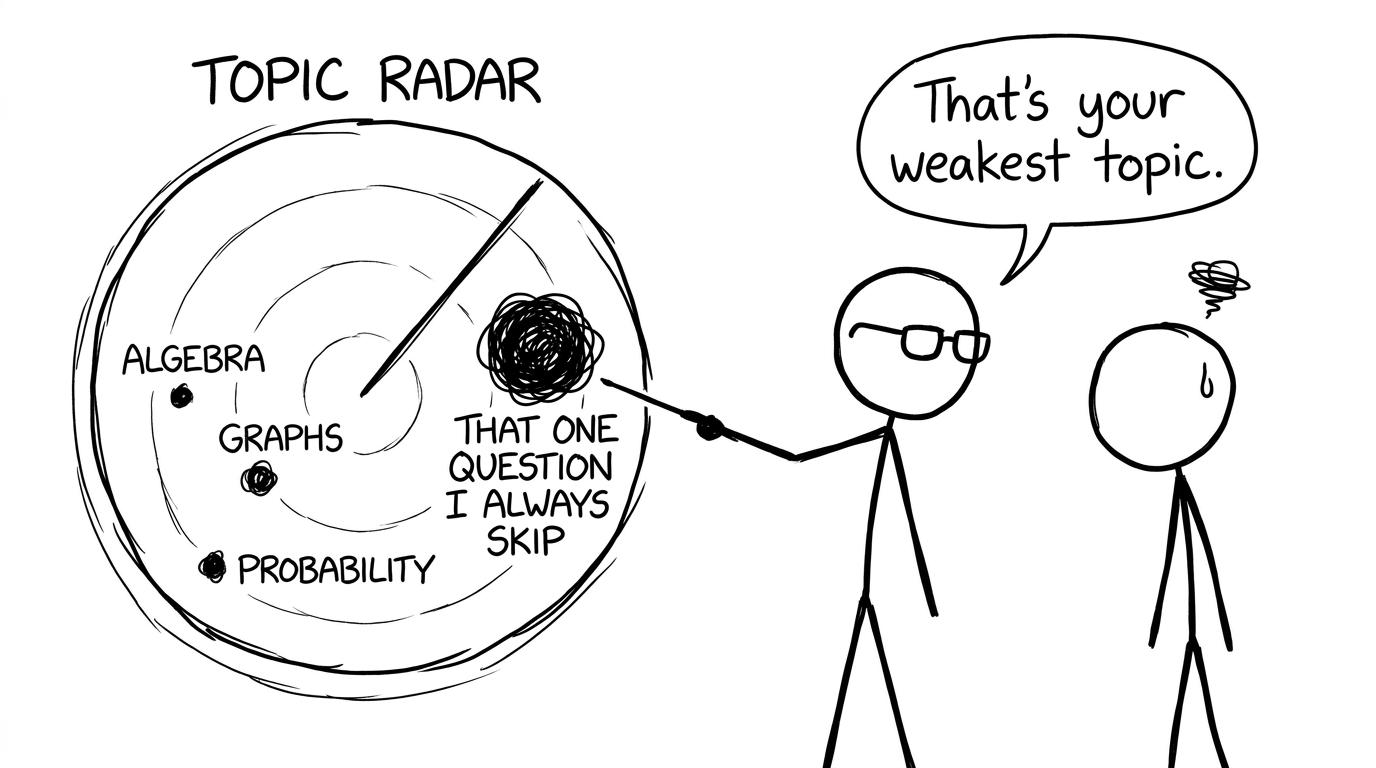 A topic radar showing the one giant weakness blip
A simple “weakness score” you can calculate in GCSE revision
You do not need fancy spreadsheets. You need one number that tells you where to spend the next hour.
For each topic, compute:
Weakness score=marks lost on topic \text{Weakness score} = \text{marks lost on topic} Weakness score=marks lost on topicIf you want to be sharper, include time too:
Weakness score (time-adjusted)=marks lostminutes spent \text{Weakness score (time-adjusted)} = \frac{\text{marks lost}}{\text{minutes spent}} Weakness score (time-adjusted)=minutes spentmarks lostWorked example (clear method)
Imagine you do a 45-minute GCSE Biology section and log the marks like this:
- Homeostasis: 666 marks lost in 101010 minutes
- Ecology: 333 marks lost in 151515 minutes
- Infection and response: 555 marks lost in 202020 minutes
Time-adjusted scores:
- Homeostasis: 610=0.6\frac{6}{10} = 0.6106=0.6 marks/min
- Ecology: 315=0.2\frac{3}{15} = 0.2153=0.2 marks/min
- Infection and response: 520=0.25\frac{5}{20} = 0.25205=0.25 marks/min
Your weakest area right now is homeostasis, because it leaks marks fastest.
Now apply the exact same idea to GCSE maths using mini tests (faster feedback) and past papers (best exam realism): Edexcel GCSE Maths Mini Tests and Edexcel GCSE Maths Past Papers.
The YesGenie routine: diagnose, practise, re-test
Once you know your weakest topics, the temptation is to “revise everything”. That feels responsible. It is also how you stay average.
Instead, run this loop:
Diagnose with exam-style evidence
- Use GCSE Past papers when you want full-paper stamina and realism.
- Use GCSE Mini Tests when you want quick topic signals.
- Use predicted papers when you want a controlled mock experience (especially close to exams). For maths, see: Edexcel GCSE Maths Predicted Papers.
Practise the smallest unit that fixes the mistake
If the weakness is “I can’t interpret graphs”, do not revise an entire chapter. Practise graph questions. If the weakness is “I lose marks rearranging formulas”, practise rearranging formulas.
YesGenie is built for that kind of GCSE revision: lessons for method, practice questions for repetition, and solutions for honest feedback.
Re-test within 48 hours
The point is not comfort. The point is proof. Re-test the same topic using a different paper or mini test and see if the weakness score drops.
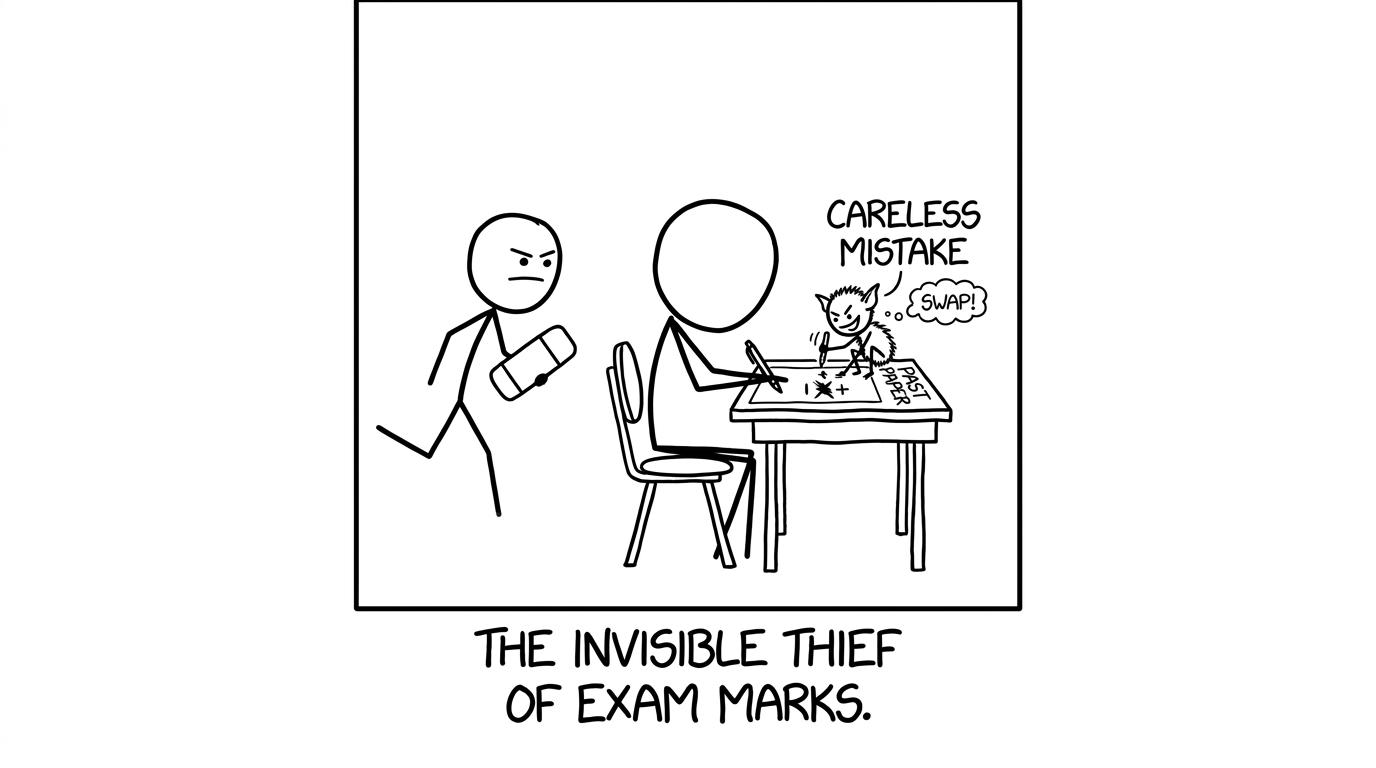 Careless mistake gremlin swapping signs on a paper
Common mistakes when finding your weakest topics
- Only counting questions you got fully wrong: in GCSE mark schemes, you can lose 111 mark repeatedly and it adds up. Log every dropped mark.
- Blaming the topic instead of the skill: “Ecology” might really mean “I can’t interpret a graph” or “I don’t show working”.
- Using one paper as the whole truth: one GCSE paper can be weirdly specific. Use at least two sources (e.g. one past paper and two mini tests).
- Not marking strictly: if you award yourself “method marks” you did not earn, you will misdiagnose your weakest topics.
- Revising by time, not by weakness score: spending an hour on a topic you already score well on is calming, but it is not strategic.
- Never closing the loop: GCSE revision without re-testing becomes a story you tell yourself, not a result you can see.
Closing: make GCSE revision honest (then make it easier)
Finding your weakest topics in GCSE Biology is not about labelling yourself “good” or “bad” at science. It is about making your revision measurable. Once you can point to where marks are leaking, you can fix the leak.
And if the leak involves data, graphs, percentages, or calculations, you can often fix it fastest through targeted GCSE maths practice. That is exactly what YesGenie is built for: revision lessons that teach a method, practice questions that reinforce it, and past papers and predicted papers that prove it under exam conditions.
Pick one paper. Mark it strictly. Build your weakness score. Then go straight into focused practice on YesGenie: GCSE Past papers, GCSE Mini Tests, and Edexcel GCSE Maths Revision. Your GCSE revision gets calmer the moment it gets clearer.