GCSE One Week Revision Plan for Maths (That Works)
GCSE one week revision plan for maths: daily focus, past papers, mini tests and worked examples. Build confidence fast with Maths Genie.
The week before the exam feels loud
The final seven days before a GCSE maths exam can feel like standing in a busy corridor while everyone shouts different advice: “Do a paper every night”, “Just learn formulas”, “Revise everything”, “Sleep is for after June”. None of it is cruel. It’s just unfocused.
A one week revision plan works because it shrinks the horizon. You don’t need to fix your whole maths journey in a week. You need to turn uncertainty into routines: practise, mark, learn, repeat. This GCSE one week revision plan is built around how marks are actually earned: method marks, accuracy marks, and the calm habit of showing working.
Along the way, you’ll use Maths Genie’s free revision lessons, topic questions, mini tests, past papers, predicted papers and video solutions to keep decisions simple.
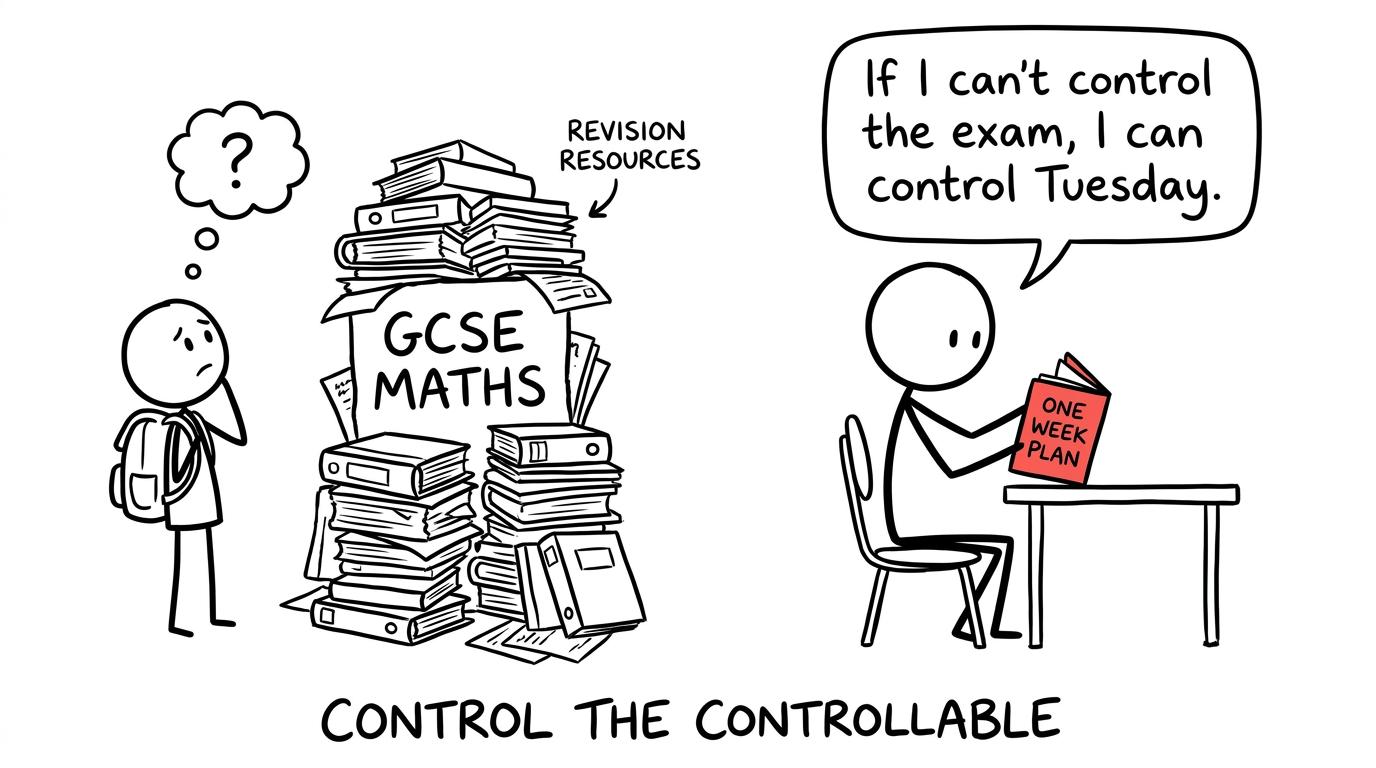 Student chooses a one week plan over a huge pile of resources
A simple checklist before you start your GCSE one week revision plan
You’ll revise better this week if you make three small commitments:
- Pick your tier and paper style: foundation or higher; non-calculator vs calculator.
- Mark everything: don’t just complete questions: use mark schemes and fix mistakes.
- Use short cycles: 252525-minute focus blocks (then 555 minutes off) beat three-hour slogs.
Useful Maths Genie pages to keep open in tabs:
- GCSE Predicted Papers
- GCSE Revision Summer 2024
- GCSE Revision Summer 2025
- Maths Genie Resources
- GCSE Statistics Revision
- A Level Maths Revision
If you’re doing A Level as well, keep that last link for your separate sessions. A Level revision needs longer chains of reasoning, but the same weekly structure still helps.
The GCSE one week revision plan (7 days, realistic hours)
This plan assumes roughly 1.51.51.5 to 2.52.52.5 hours per day. If you can do more, add an extra short topic block rather than stretching the past paper time.
Day 1: Diagnose, don’t guess
Goal: Find your fastest mark gains.
- Do a half paper or timed mixed set (around 454545 minutes). Maths Genie’s split papers and focused revision lists help here: start with Maths Genie Resources.
- Mark it carefully using the mark scheme. Read what the examiners reward: method marks (often labelled MMM) and accuracy marks.
- Make a “Fix List” of five topics. Not fifteen. Five.
Your Fix List should be specific. Not “algebra”, but “solving linear equations with fractions” or “expanding double brackets”.
Day 2: Algebra and rearranging (the mark factory)
Goal: Turn messy lines into calm steps.
Work through revision lessons and exam questions on your Fix List, then finish with a short mini test.
Use a structure like:
- 252525 minutes: revision lesson + a few example questions
- 252525 minutes: exam questions (harder)
- 101010 minutes: check solutions, write one improved model answer
You’ll find plenty of algebra practice within the GCSE revision pages like GCSE Revision Summer 2025.
Worked example: rearranging a formula
Rearrange y=3x−52y = \frac{3x - 5}{2}y=23x−5 to make xxx the subject.
Start by clearing the denominator:
2y=3x−5 2y = 3x - 5 2y=3x−5Add 555 to both sides:
2y+5=3x 2y + 5 = 3x 2y+5=3xDivide by 333:
x=2y+53 x = \frac{2y + 5}{3} x=32y+5This is exactly the kind of question that awards method marks for each step. In GCSE mark schemes, clean algebra often earns you marks even if you slip at the final arithmetic.
Day 3: Number, ratio and percentages (easy marks, if you practise)
Goal: Reduce silly mistakes under time pressure.
Today is about accuracy: fractions, percentages, ratio, standard form, bounds and rounding. These topics can feel “basic” until you lose 666 marks through rushed arithmetic.
Worked example: percentage change
An item costs £484848 and is reduced by 15%15\%15%. What is the new price?
15%15\%15% of 484848 is:
0.15×48=7.2 0.15 \times 48 = 7.2 0.15×48=7.2New price:
48−7.2=40.8 48 - 7.2 = 40.8 48−7.2=40.8So the new price is £40.8040.8040.80.
A strong habit for GCSE calculator papers: write the key line before you press buttons, e.g. 48−0.15×4848 - 0.15 \times 4848−0.15×48. It prevents the common “48−0.1548 - 0.1548−0.15” mistake.
Day 4: Geometry and measures (where diagrams hide marks)
Goal: Learn what to do when you don’t instantly know.
Geometry questions reward a calm sequence: write the formula, substitute values, show working, and label units.
Use the targeted lists on GCSE Revision Summer 2024 to practise the geometry topics likely to appear across the three papers.
Worked example: area of a trapezium
A trapezium has parallel sides of length 8 cm8\text{ cm}8 cm and 14 cm14\text{ cm}14 cm, with height 6 cm6\text{ cm}6 cm. Find the area.
Formula:
A=12(a+b)h A = \frac{1}{2}(a+b)h A=21(a+b)hSubstitute:
A=12(8+14)×6=12×22×6=11×6=66 A = \frac{1}{2}(8+14)\times 6 = \frac{1}{2}\times 22\times 6 = 11\times 6 = 66 A=21(8+14)×6=21×22×6=11×6=66So the area is 66 cm266\text{ cm}^266 cm2.
In GCSE papers, you’ll often get method marks just for stating and using the correct formula.
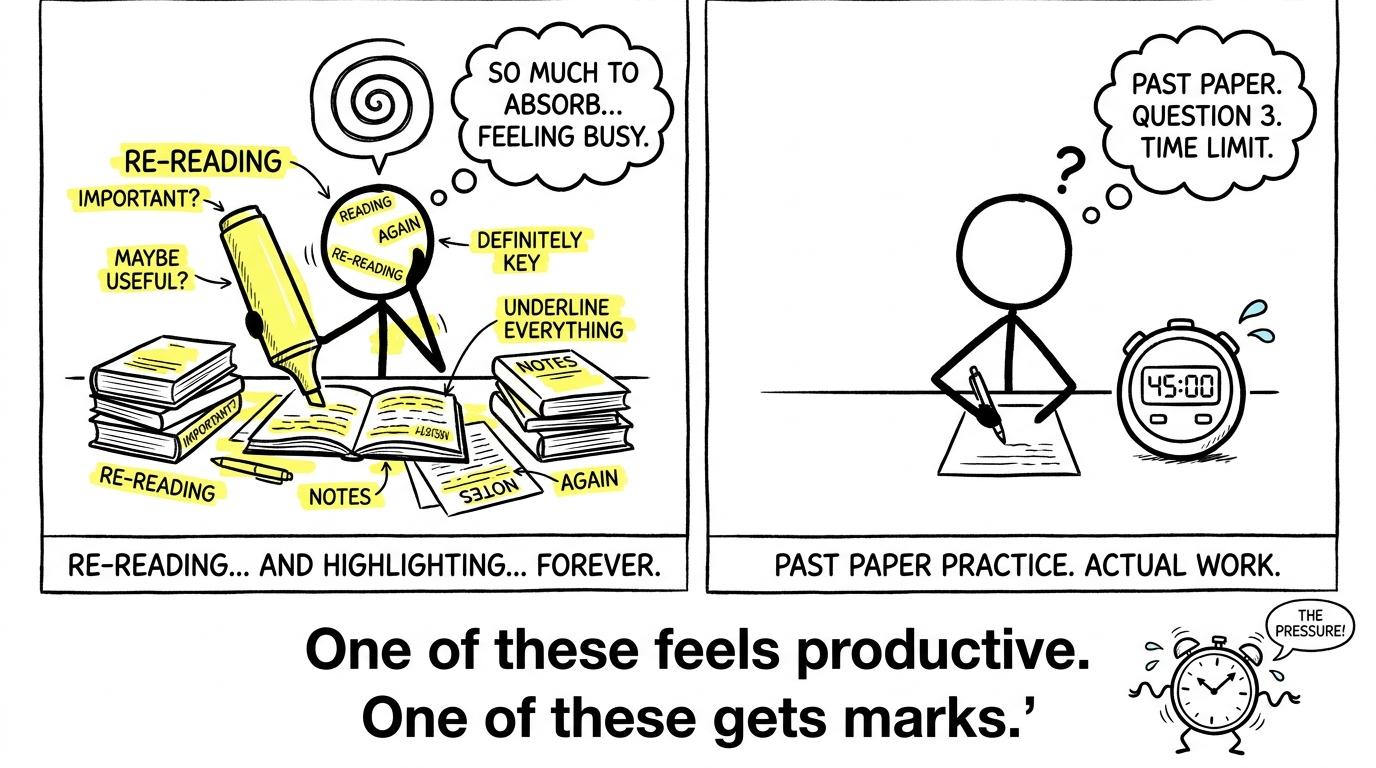 Two students: one re-reads notes, one does a timed paper
Day 5: Your first full past paper (with honest marking)
Goal: Build stamina and exam timing.
Choose a paper relevant to your exam board and tier. If you’re Edexcel, you can use the paper collections and predicted sets from Maths Genie. Start here:
Do it in proper conditions:
- Phone away
- Timer on
- Formula sheet rules as per your GCSE specification
Then mark it. Carefully. Don’t just total a score: categorise your errors:
- Knowledge gap (didn’t know the method)
- Execution error (knew method, did arithmetic wrong)
- Exam technique (misread, didn’t show steps, ran out of time)
If you want to see how examiners think about working, look at a real mark scheme PDF such as Mark Scheme (SPP) Summer 2024.
Day 6: Patch the gaps (the day that changes your grade)
Goal: Turn yesterday’s mistakes into tomorrow’s marks.
Most students do a paper, feel bad, and move on. The students who improve do something quieter: they rewrite the mistakes correctly.
Pick your top three error topics from Day 5. For each topic:
- Watch a Maths Genie revision lesson
- Do 888 to 121212 exam questions
- Mark and write a “model method” you can copy in the exam
If your course includes statistics (GCSE Statistics or extra topics), keep it contained: use GCSE Statistics Revision for a focused session rather than mixing it into everything.
Day 7: Predicted paper + calm review
Goal: Confidence, not cramming.
Do one predicted paper to simulate the feel of unseen questions:
Then spend your final hour on:
- your Fix List summary page
- formula recall and units
- the hardest five questions you’ve corrected this week
This is where the plan becomes more than revision. It becomes a story you can trust: “I’ve done the work. I know what to do next.” That’s how exam nerves shrink.
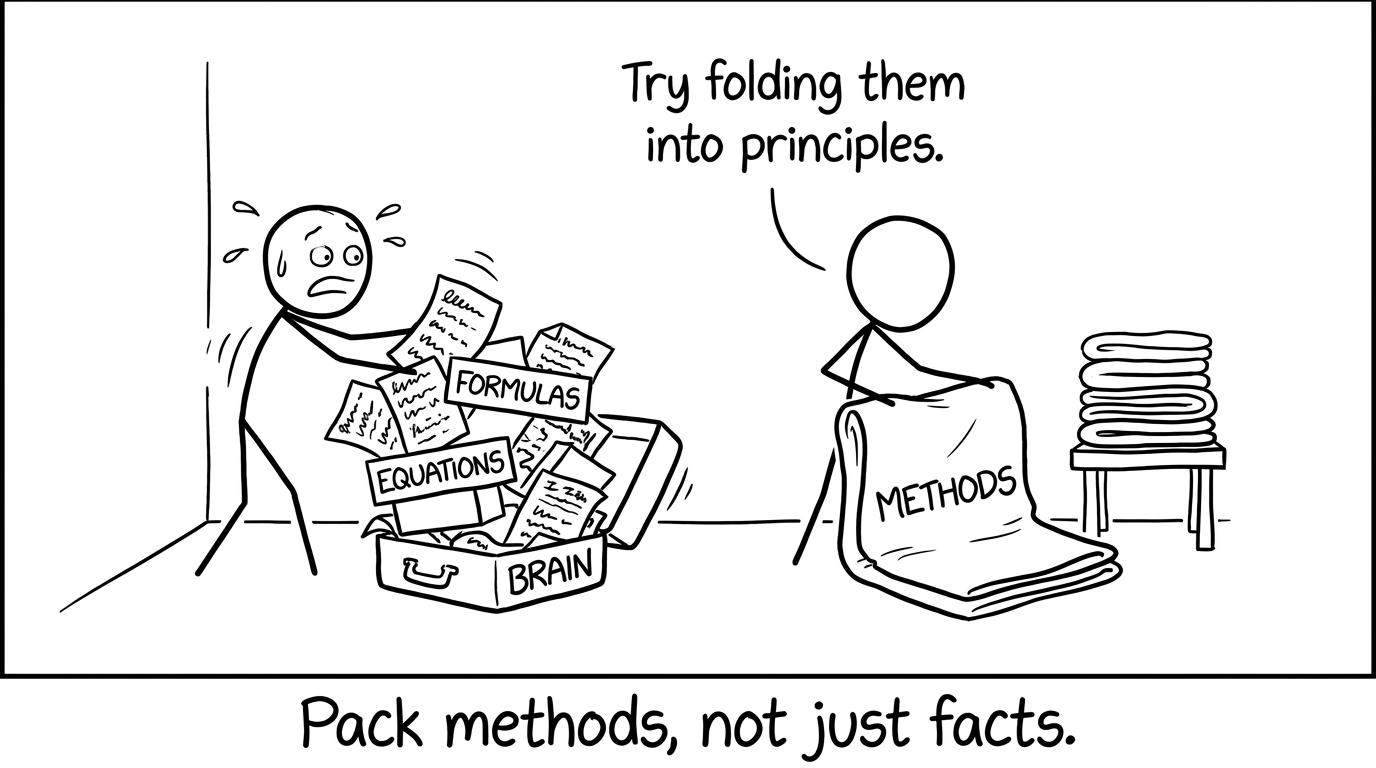 Stick figures packing methods into a suitcase labelled brain
How this one week plan also supports A Level students
If you’re an A Level student revising alongside a GCSE resit, or helping a younger sibling, the structure still holds: diagnose, practise methods, do a full paper, patch gaps.
The main difference is that A Level questions often chain ideas. A small algebra slip in line two can break line seven. So your “Fix List” should include prerequisite skills like indices, surds and rearranging, not just the headline topic.
Use A Level Maths Revision to pull targeted questions by topic and practise building full solutions with clear working.
Common mistakes in a GCSE one week revision plan
- Doing too many papers, not enough corrections. Papers reveal problems; corrections solve them.
- Re-reading notes instead of practising questions. Notes feel safe. Questions create change.
- Ignoring non-calculator skills. Paper 1 (for many boards) punishes weak fractions, standard form and mental arithmetic.
- Making a plan that depends on motivation. A plan should depend on routines: same time, same place, same first task.
- Not showing working. In GCSE maths, marks are often in the method. If you only write an answer, you often throw away method marks.
- Mixing tiers blindly. Foundation and higher reward different depths. Choose papers and questions that match your tier.
A closing thought: a week is short, but it’s not small
A week isn’t enough time to become a different person. But it is enough time to become a more consistent one.
If you follow this GCSE one week revision plan, you’ll do what strong students quietly do: practise questions, use mark schemes, learn from mistakes, and repeat until the methods feel familiar. Maths Genie is designed for that loop: revision lessons when you need teaching, exam questions when you need practise, mini tests when you need pace, and past papers and predicted papers when you need realism.
Open GCSE Revision Summer 2025 (or GCSE Revision Summer 2024), choose today’s topics, and start your first 252525-minute block. Then mark it. Fix one thing. That’s the whole game, and it’s how GCSE grades move.