GCSE Maths Revision: How to Revise Efficiently
GCSE maths revision made efficient: build a simple plan, practise the right questions, use past papers and mark schemes, and improve fast with YesGenie.
GCSE revision rarely fails because you’re not trying. It fails because you try to do everything at once. One night it’s algebra, the next it’s a past paper, then an hour of watching videos that feel productive but don’t move your marks.
Efficient GCSE maths revision is quieter than that. It’s a repeatable routine: choose one skill, practise it with exam-style questions, mark it honestly, then revisit it on a schedule. When you do this, you stop relying on confidence and start relying on evidence. And that’s what gets you from “I kind of get it” to “I can do it under time pressure”.
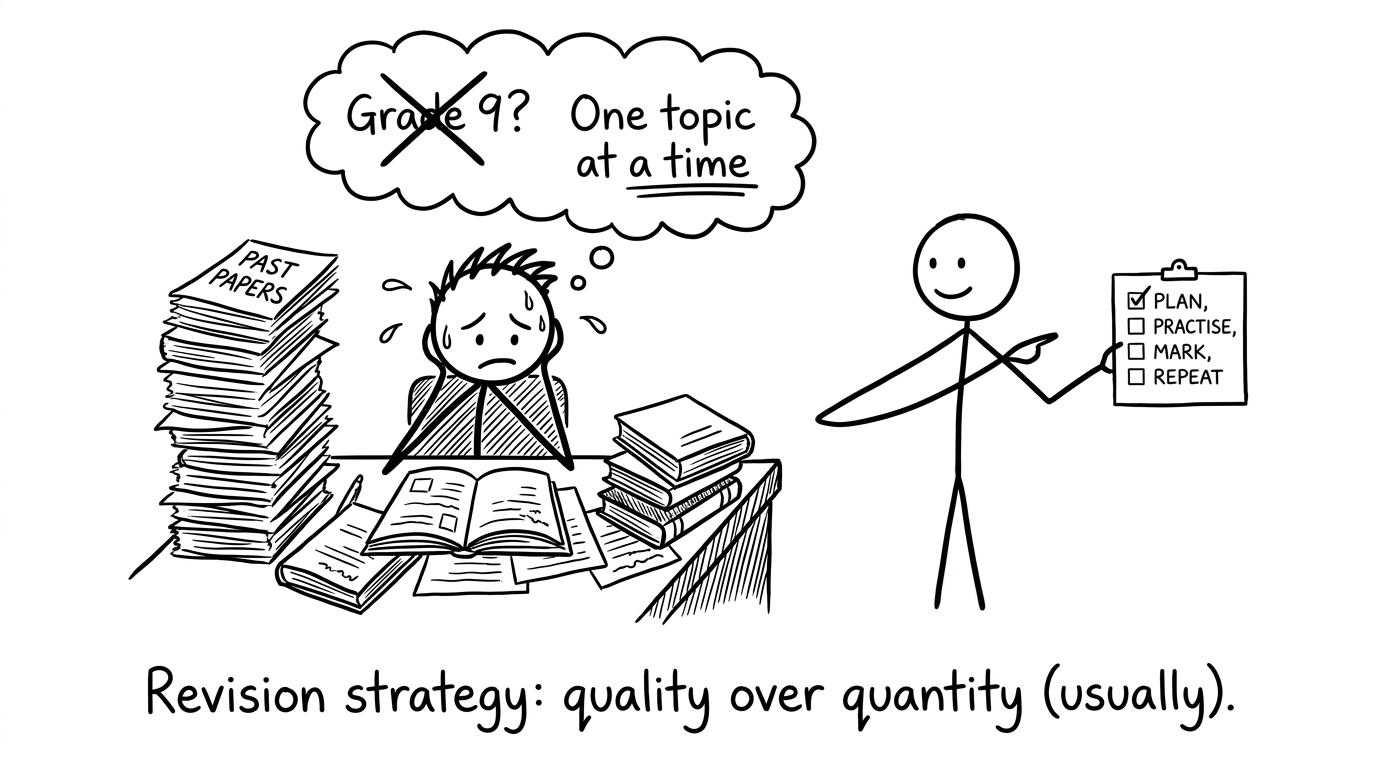 A calm revision checklist beats a mountain of papers
The efficient GCSE maths revision checklist
Use this as your default plan for GCSE maths revision. If you’re not sure what to do next, come back to this.
- Pick your exam board (Edexcel, AQA, OCR, Eduqas/WJEC) and tier (foundation or higher).
- Identify your top 3 weak topics by looking at mistakes, not feelings.
- For each topic, do: learn (short), practise (long), mark (immediate), fix (targeted).
- Use timed practice at least twice a week.
- Do one full past paper most weeks, then increase frequency near exams.
- Keep an “error log”: the exact reason each mark was lost.
YesGenie is built around this loop: revision guides, lessons, topic practice, past papers, predicted papers, mark schemes, and video solutions. Start from your board hub, for example Edexcel GCSE Maths Revision, and treat it like your home base.
Why GCSE maths revision feels inefficient (and how to fix it)
Most students revise GCSE maths like they’re packing a suitcase. They keep stuffing topics in, hoping the zip will close on exam day. But maths isn’t luggage. It’s muscle memory.
A mark scheme rewards methods, not memories. You get marks for setting up the equation, showing the substitution, choosing the correct formula, rounding correctly, and interpreting the final answer. Efficient GCSE maths revision means you practise methods until they come out reliably.
A practical way to do this is:
- If you can’t start a question, you need a quick lesson or revision guide.
- If you can start but can’t finish, you need more exam-style practice.
- If you can finish but lose marks, you need marking discipline and an error log.
For structured topic learning, use board-specific lesson lists like AQA GCSE Maths Lessons to move through skills in a sensible order.
Build a GCSE revision plan that actually holds
The best GCSE revision plan is the one you can repeat when you’re tired. A plan that needs perfect motivation won’t survive a school week.
Choose a small weekly rhythm
Try this simple rhythm for GCSE maths revision:
- Three short sessions (25-35 minutes): one topic each.
- One longer session (60-90 minutes): mixed practice or a timed paper section.
- One review session (20 minutes): error log fixes.
If you’re revising for multiple subjects, you’re not trying to “finish maths”. You’re trying to keep a steady drumbeat. That’s why short, high-quality sessions work.
Use the “two-page rule”
For a topic session, restrict yourself to:
- One page of notes (max)
- One page of worked examples
- Then straight into questions
This stops revision turning into rewriting the textbook. Use Resources on YesGenie to find mini tests and shorter papers when a full past paper feels too big.
Efficient GCSE practice: learn, practise, mark, fix
Efficient GCSE maths revision is less about what you “cover” and more about what you close (as in, closing gaps). Here’s what that looks like using two common GCSE skills.
Worked example 1: ratio sharing (a classic GCSE marks topic)
A common GCSE question:
Share £84 in the ratio 5:25:25:2.
Method
-
Add the parts: 5+2=75+2=75+2=7.
-
Find the value of one part:
- Multiply by each part:
- First share: 5×12=605 \times 12 = 605×12=60
- Second share: 2×12=242 \times 12 = 242×12=24
So the shares are £60 and £24.
If ratio is a weak area, revise it properly, not vaguely. Use a focused revision guide like Writing a Ratio as a Fraction or Linear Function (AQA) Revision Guide, then practise questions and mark them straight away.
Worked example 2: probability with missing outcomes
A GCSE probability question pattern:
A bag contains red, blue, and green counters. P(red)=0.3P(\text{red})=0.3P(red)=0.3 and P(blue)=0.45P(\text{blue})=0.45P(blue)=0.45. Find P(green)P(\text{green})P(green).
Method
Probabilities add to 111 when the outcomes listed cover everything:
P(green)=1−0.3−0.45=0.25 P(\text{green}) = 1 - 0.3 - 0.45 = 0.25 P(green)=1−0.3−0.45=0.25That single line is worth marks because it shows the correct structure. For support, use a clear topic explanation like Probability (WJEC) Revision Guide and then practise until you stop making the same slip.
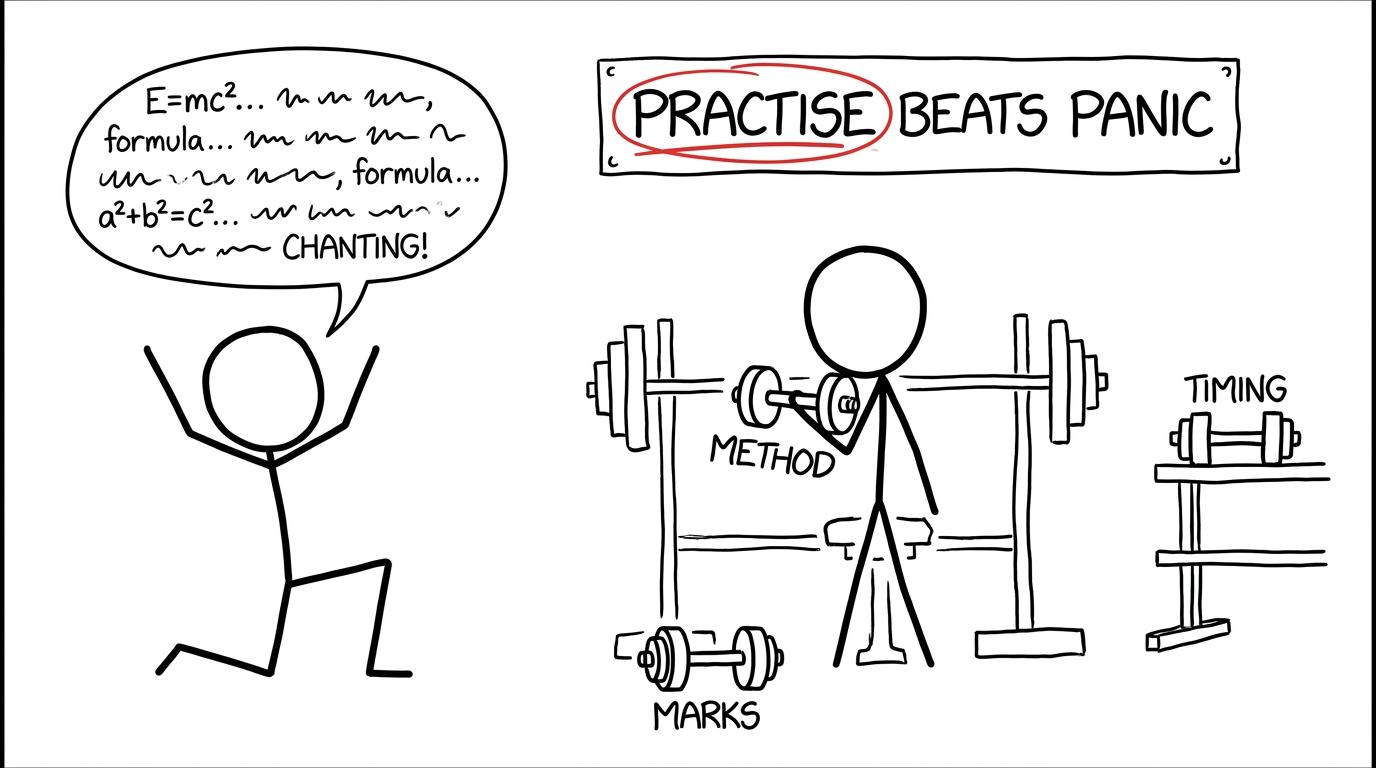 Practise beats panic
Past papers: the fastest way to upgrade GCSE exam technique
Topic practice makes you better at the skill. Past papers make you better at the exam.
The efficiency comes from the feedback loop:
- Do a paper (or half a paper) under timed conditions.
- Mark it with the mark scheme.
- Categorise every lost mark:
- content gap (don’t know the method)
- accuracy (careless arithmetic)
- exam skill (missed the command word, rounding, units)
- time pressure (rushed, skipped steps)
- Fix the root cause with targeted topic revision.
Start with GCSE Past papers and choose your board. If you’re Edexcel, the Edexcel GCSE Maths Revision hub keeps past papers and topic resources in one place.
How to use predicted papers without wasting time
Predicted papers are most efficient when you’ve already done some broad coverage. Use them closer to exam season to sharpen your recall and timing, not as a substitute for learning.
On YesGenie, predicted papers sit alongside past papers so you can blend realism (past papers) with focus (predicted papers). If you find you’re repeatedly dropping marks on the same grade 7-9 skills, consider targeted practice such as Proof (Grade 8-9) Topic Page.
Foundation vs higher GCSE: revise differently (a little)
Efficient GCSE maths revision depends on tier.
Foundation tier focus
Foundation success is built on reliable basics:
- fractions, decimals, percentages
- ratio and proportion
- graphs and equations
- measures and basic geometry
Your revision should heavily feature straightforward exam questions and method repetition. The goal is fewer unforced errors.
Higher tier focus
Higher tier adds complexity and unfamiliar structure:
- algebraic manipulation and multi-step equations
- harder geometry (circle theorems, proof)
- non-linear graphs and functions
Your revision should include more mixed questions and timed sections because the challenge is often choosing the method.
In both tiers, the most efficient thing you can do is keep a tight list of your recurring weaknesses and attack them deliberately.
Common mistakes that waste GCSE revision time
These are the slips that quietly drain marks in GCSE maths.
- Doing questions without marking them: practice without feedback is just repetition of whatever you already do.
- Fixing the wrong problem: if the issue is algebra accuracy, watching another video on the topic won’t help as much as doing ten carefully marked questions.
- Avoiding timing: a method you can do in ten minutes is not exam-ready if it needs two.
- Ignoring units and rounding: lots of GCSE questions quietly require units or rounding to a stated degree of accuracy.
- Not showing enough working: in GCSE maths, the mark scheme often rewards method marks even when the final answer is wrong.
- Mixing up similar ideas: for example, writing ab\frac{a}{b}ba when the question needs a ratio a:ba:ba:b, or treating an estimate as an exact answer.
If you spot yourself doing any of these, that’s good news: it’s fixable quickly once you name it.
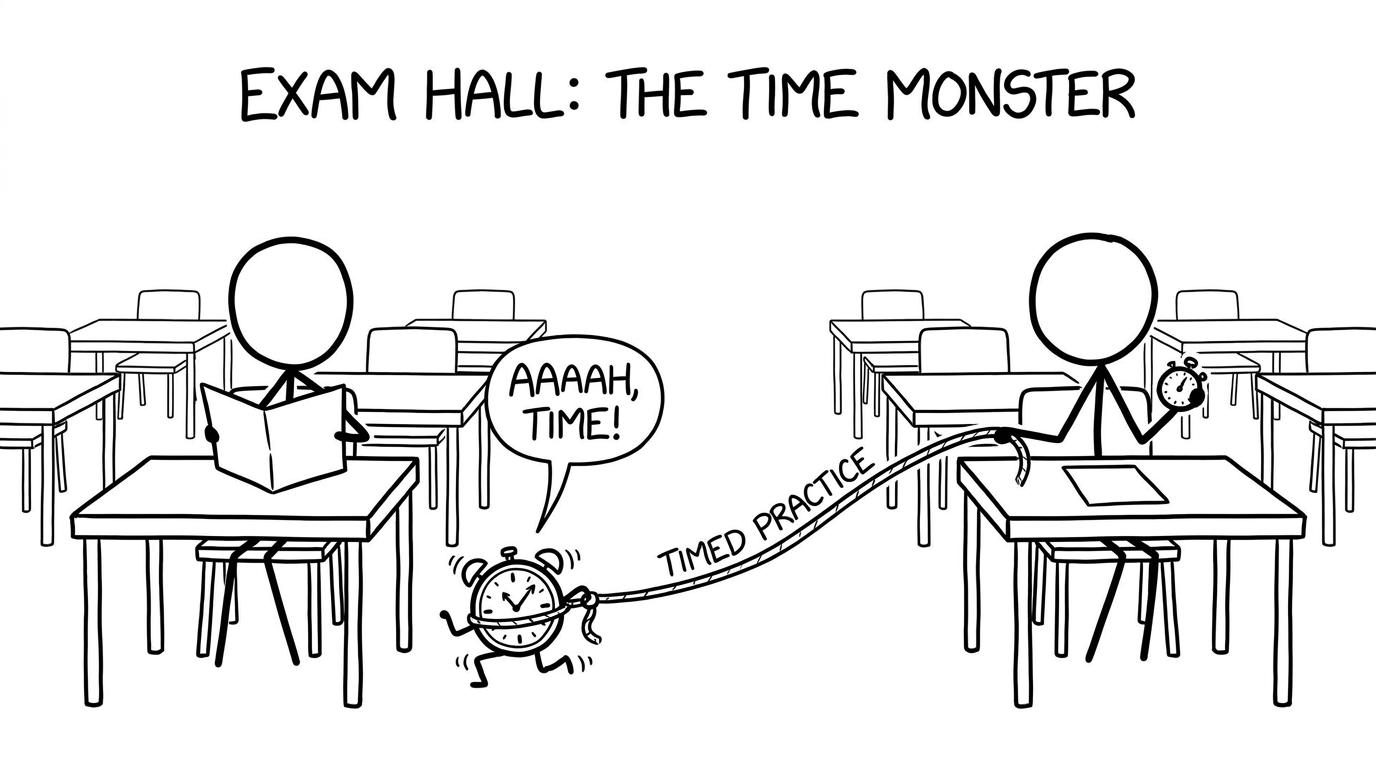 Timed practice lassoing the runaway time monster
A calm ending: make GCSE revision boring (in the best way)
The students who improve fastest at GCSE maths are rarely the most frantic. They’re the most consistent. They make revision slightly boring: same routine, same honesty in marking, same return to the topics that used to beat them.
If you want GCSE maths revision to feel efficient, let YesGenie do the organising. Start with your exam board hub, use revision lessons and revision guides to learn quickly, then practise with question banks and topic booklets, and finish with past papers and predicted papers using mark schemes and video solutions. Make your next session small and specific, and then repeat it tomorrow.
For the quickest next step, open GCSE Past papers, choose your board, and build a weekly loop around practise, marking, and fixing. GCSE success is rarely one big leap. It’s a lot of small, efficient returns.