

GCSE Arabic Revision Drop In Sessions: Worth It?
GCSE Arabic revision drop in sessions can offer speaking practice, feedback and focus. Learn when to attend and when revising alone is more effective.
A revision room can feel productive before you have answered a single question. There is a teacher, a stack of resources and the reassuring sense that everyone is working. But attendance is not the same as progress.
GCSE Arabic revision drop in sessions are worth attending when they give you something difficult to reproduce alone: live speaking practice, expert feedback, help with a specific weakness or realistic exam preparation. If the session is mostly quiet independent work that you could complete at home, revising alone may be the better use of your time.
That distinction matters when Arabic is only one part of a crowded GCSE timetable. For students also preparing for maths exams, the real question is not whether a drop-in session is generally helpful. It is whether that particular session will improve your performance more than the best alternative use of the same hour.
The quick decision checklist
Attend a GCSE Arabic drop-in session if you can answer yes to several of these questions:
- Will a teacher listen to and correct your spoken Arabic?
- Do you have a precise question or skill to work on?
- Can you receive feedback on writing, translation or pronunciation?
- Will the session use material matching your qualification and tier?
- Do you struggle to begin or concentrate when revising alone?
- Is the session preparing you for an assessment that is approaching soon?
- Can you attend without repeatedly sacrificing urgent maths revision?
Revise independently instead if the session has no clear plan, offers little access to the teacher or simply gives you worksheets you could complete more efficiently elsewhere.
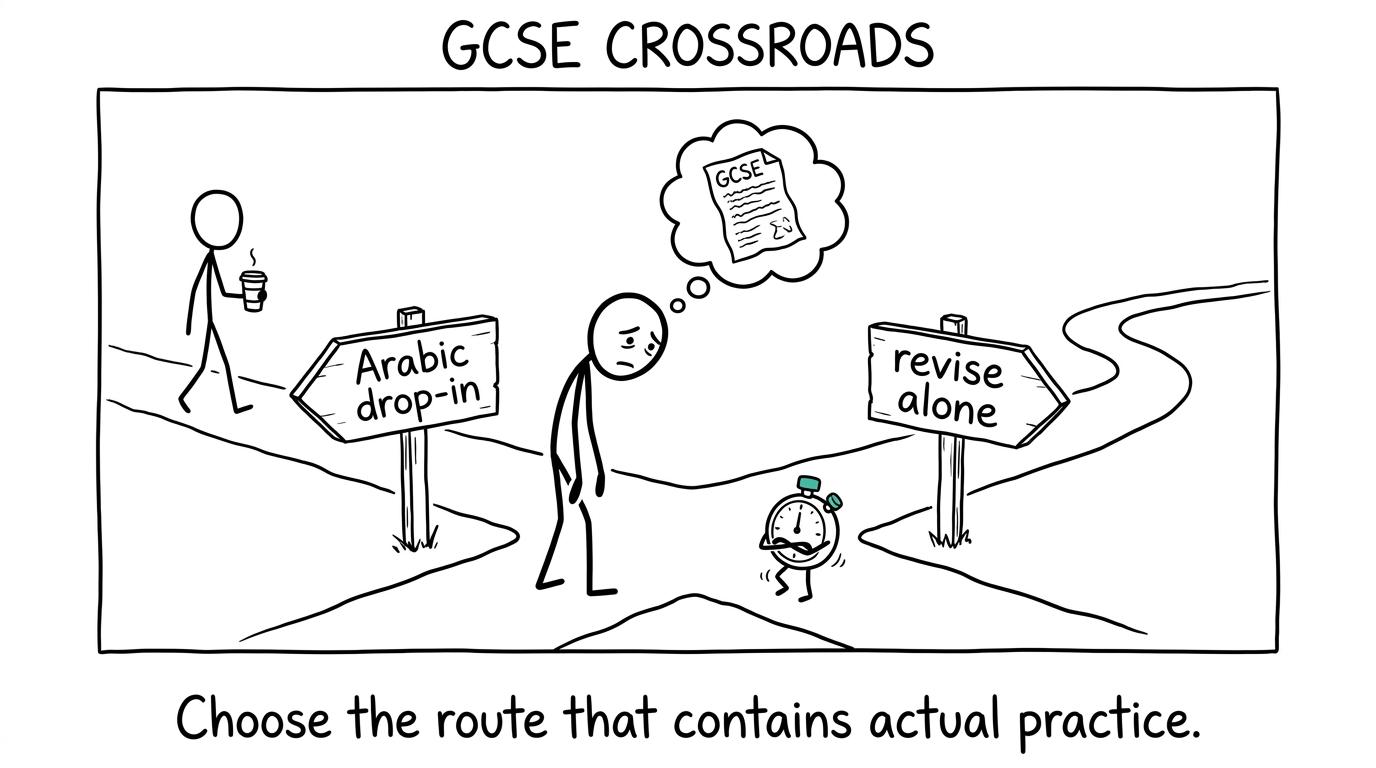 A student choosing between an Arabic drop-in and revising alone
What GCSE Arabic actually requires
Before judging a revision session, confirm your qualification with your school. GCSE Arabic and International GCSE Arabic are not interchangeable, and their assessment arrangements differ.
For the current Pearson Edexcel GCSE Arabic qualification, code 1AA0, students are assessed through listening, speaking, reading and writing. Each skill contributes 25%25\%25% of the qualification. Papers are available at foundation and higher tier, and candidates must be entered for the same tier across all papers. Dictionaries are not permitted in the assessments, including the preparation period for speaking.
This structure explains why some revision is naturally better with another person. You can retrieve vocabulary, read passages and practise writing independently. It is much harder to recreate a responsive speaking conversation, receive reliable pronunciation feedback or discover that an answer sounds memorised rather than communicative.
Your school should confirm the specification, tier, assessment arrangements and resources that apply to you. Do not assume that a workbook labelled “GCSE Arabic” matches the paper you will sit.
When drop-in sessions provide genuine value
Speaking practice is difficult to simulate alone
Speaking is the clearest reason to attend. Reading a prepared response aloud can improve fluency, but it does not test whether you can understand an unexpected question, choose relevant vocabulary and respond naturally.
A useful drop-in should make you speak. That might involve role-play practice, discussion prompted by a picture or follow-up questions that force you to adapt. The teacher can then identify whether your main issue is pronunciation, hesitation, limited vocabulary, misunderstanding the question or difficulty forming accurate sentences under pressure.
Recording yourself remains valuable, particularly between sessions. But a recording cannot interrupt with a follow-up question or tell you that a grammatically plausible phrase is unnatural in context.
Feedback can stop mistakes becoming habits
Independent revision is strongest when you can check your own work accurately. That is not always easy in a language. You may produce an answer that appears reasonable while repeating the same agreement, spelling or sentence-structure error.
Educational evidence on retrieval practice consistently emphasises the importance of feedback. Trying to recall information strengthens learning, but incorrect recall needs to be corrected. A productive drop-in creates that loop:
- attempt the task without support;
- receive specific correction;
- explain or rewrite the corrected version;
- attempt a similar task later;
- check whether the error has disappeared.
The same principle drives effective maths revision. On MathsGenie, students can attempt questions through the GCSE maths revision hub, check mark schemes or video solutions, and then return to the topic rather than merely reading an explanation.
A teacher can diagnose the real weakness
Students often describe a broad problem: “I am bad at listening” or “I cannot do writing.” Those labels are too large to guide a useful revision session.
A teacher may help reduce the problem to something actionable: missing tense markers, slow recognition of familiar vocabulary, weak understanding of the Arabic question words, incomplete coverage of bullet points or insufficient detail in extended answers.
This is diagnosis, not judgement. Maths students can use the same approach by following a weak-topic diagnostic process rather than repeatedly revising comfortable chapters.
When revising alone may be more effective
Drop-ins are not automatically superior. Independent revision can be better when the task is clear, the feedback is available and you need uninterrupted repetition.
Vocabulary retrieval, reading practice, listening drills and timed writing can all be completed alone. Independent work also lets you spend longer on your own weaknesses rather than moving at the pace of a group.
| Choose the drop-in | Choose independent revision |
|---|---|
| You need live speaking practice | You need repeated vocabulary retrieval |
| You need expert feedback on an answer | You already have reliable answers or feedback |
| You cannot identify why marks are being lost | You know the exact weakness to practise |
| The teacher is running a focused exam task | The session is mainly supervised worksheet time |
| Working near others improves your focus | The room is distracting or involves substantial waiting |
The best strategy is usually a combination. Use school sessions for interaction, diagnosis and correction. Use independent revision for repetition, consolidation and timed practice.
How to make a drop-in session worth attending
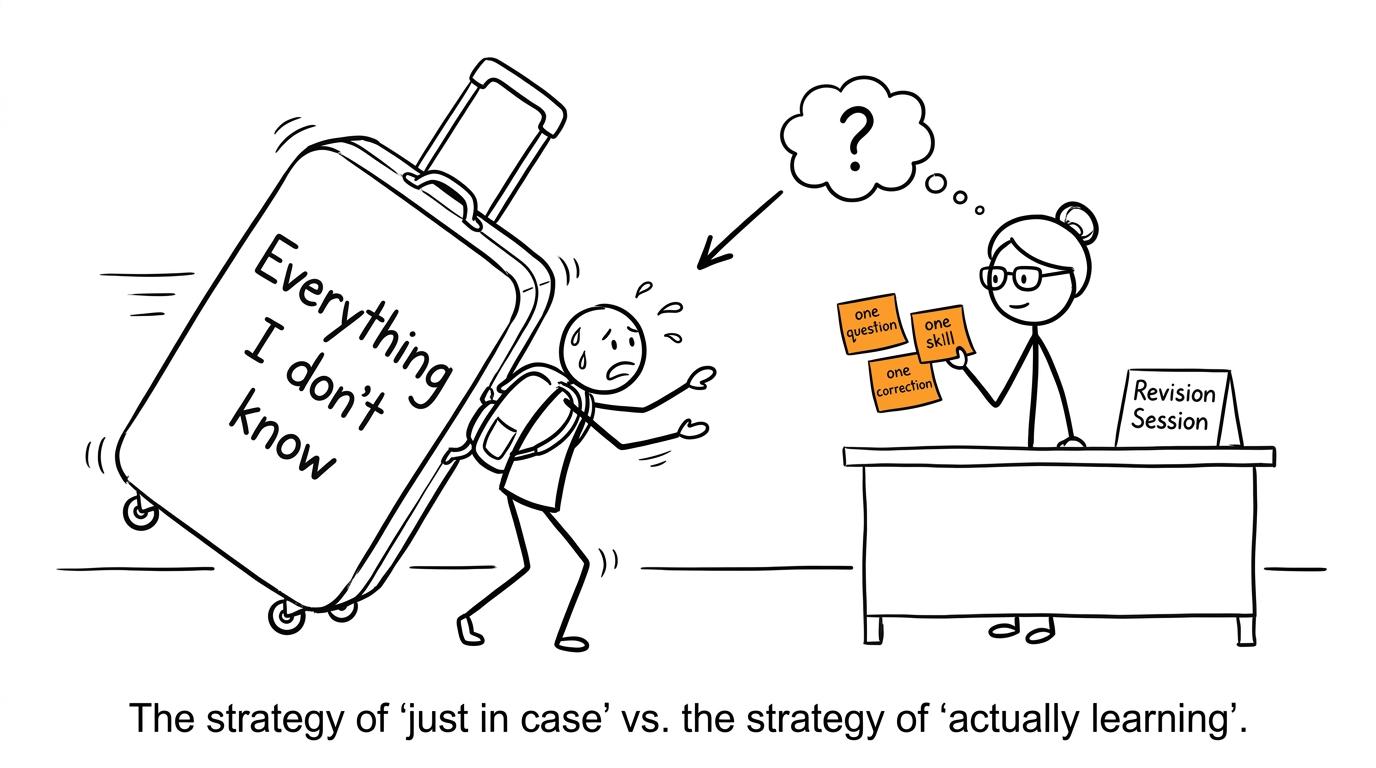 A student replacing a suitcase of problems with three precise questions
Arrive with one precise objective
“Revise Arabic” is not an objective. It is a subject name.
A useful objective might be to receive feedback on one writing response, practise responding to unfamiliar speaking questions or understand why marks were lost on a reading task. Bring the relevant question, your attempt and any teacher feedback already received.
This reduces waiting and prevents the session drifting into passive note-reading.
Attempt the work before asking for help
If possible, complete a first attempt independently. The teacher then sees what you can produce without prompts. This makes the feedback more diagnostic and turns the session into active retrieval rather than guided copying.
After receiving help, close the notes and repeat the task. The correction only becomes useful when you can retrieve and apply it yourself. Maths students can build the same habit through the active recall revision method.
Leave with a follow-up task
The session should produce a next action, not merely a page covered in corrections. Before leaving, write down:
- the exact error you made;
- the corrected rule, phrase or strategy;
- one task that will test it again;
- when you will complete that task.
Revisit the skill on another day. Spacing the practice gives you a more honest test than repeating it immediately while the teacher’s explanation is still in short-term memory.
Protecting maths revision time
For students preparing for both Arabic and maths, opportunity cost matters. An after-school session may consume more than its advertised length once travel, waiting and tiredness are included.
Start with your exam timetable and current weaknesses. If an Arabic speaking assessment is close, a live session may deserve priority because speaking practice is difficult to replace. If a maths mock is imminent and the Arabic drop-in offers only silent worksheet time, independent Arabic revision followed by focused maths practice may be more sensible.
Use a weekly plan rather than deciding according to guilt. The GCSE maths revision timetable guide explains how to combine focused topic work, feedback and timed practice without turning every evening into a marathon.
Short formats can preserve continuity when another subject needs attention. A GCSE maths 45-minute test provides structured paper practice without requiring a complete exam. When you need broader diagnosis, use an appropriate paper such as the AQA GCSE maths past papers, or select your own board through the main revision hub.
The goal is not to divide every evening equally. It is to give each subject the kind of practice it currently needs.
Common mistakes when using school revision sessions
Attending without a question
Turning up and asking the teacher what to do transfers the planning to someone else. Decide your target before the session begins.
Treating presence as evidence of progress
A full hour in a classroom can produce less learning than a focused independent task. Judge the session by what you attempted, corrected and can now do without help.
Spending the whole session making notes
Notes may support learning, but copying does not test recall. Include speaking, writing, listening, reading or self-quizzing with the notes closed.
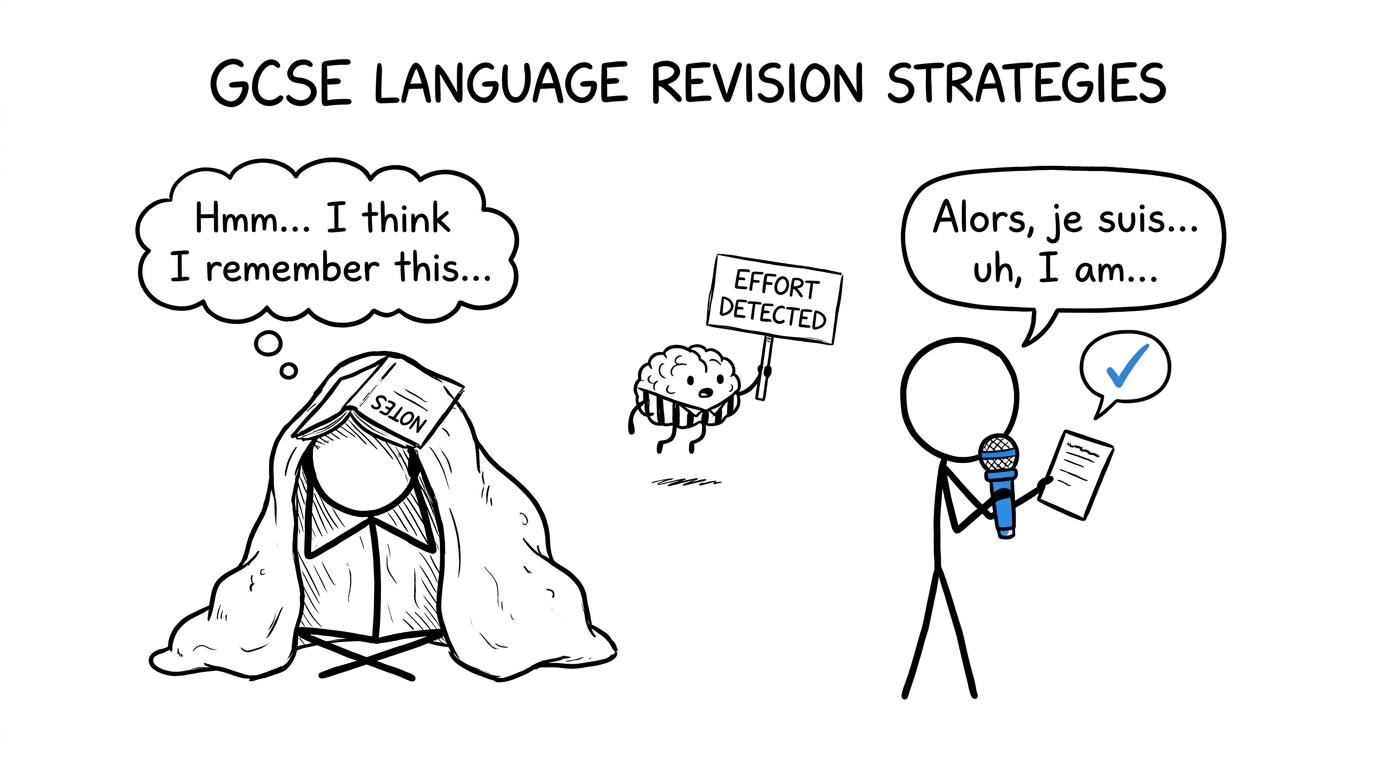 A brain referee detects the difference between rereading and active practice
Asking for feedback but not using it
A correction that remains in the margin will not protect marks. Rewrite, repeat and later retest the corrected skill.
Sacrificing every maths session
Optional support can expand until it occupies all available time. Keep a minimum maths routine during busy language weeks. MathsGenie’s predicted GCSE papers and shorter tests can help you maintain exam practice, but predicted papers should complement topic revision and official past papers rather than replace them.
The verdict: attend selectively and arrive prepared
School revision drop-ins are most worthwhile when they offer access to something scarce: a fluent conversation partner, informed feedback, precise diagnosis or realistic exam practice. They are less valuable when they become a place to sit, copy notes and wait for motivation.
Try a session with one defined objective. Afterwards, ask yourself what changed. Can you answer a speaking question more confidently? Did you correct a recurring writing error? Do you know exactly what to practise next? If so, return. If not, ask whether the format can be improved or use that time for structured independent revision.
And keep maths moving alongside Arabic. Start at the MathsGenie GCSE maths revision hub, choose your exam board and tier, then combine free revision lessons and practice questions with mini tests, past papers, predicted papers, mark schemes and video solutions. A good revision plan does not reward attendance. It rewards evidence that you can now do something you could not do before.











