

Old Textbook GCSE Arabic: Can You Still Use It?
Old textbook GCSE Arabic guide: check if a hand-me-down matches Edexcel 1AA0, what remains useful, and how to fill revision gaps before exams.
A hand-me-down textbook can feel like a bargain until one awkward thought appears: what if it teaches the wrong course? If you are wondering whether an old textbook GCSE Arabic resource is still useful, the short answer is yes, but only after you check its specification, exam format and publication date.
For students taking the current regulated GCSE in England, the key reference is Pearson Edexcel GCSE Arabic specification 1AA0. A book written for this course can still be valuable even if it is several years old. A book written before the reformed qualification began teaching in 2017, or for an International GCSE, needs much more careful handling.
The principle is simple: old knowledge does not automatically become wrong, but old exam guidance can become misleading.
The quick textbook checklist
Before building your revision around a second-hand book, check:
- Qualification: does it say GCSE, International GCSE or something else?
- Exam board: does it name Pearson Edexcel?
- Specification code: can you find 1AA0 on the cover or copyright page?
- Publication date: was it produced for first teaching from 2017?
- Skills: does it cover listening, speaking, reading and writing?
- Themes: does it follow the five current Edexcel themes?
- Tier: does it distinguish Foundation and Higher requirements where necessary?
- Assessment: are its paper descriptions consistent with your current specification?
- Vocabulary: are modern technology, social and global contexts represented?
- Practice: can you supplement it with current papers and teacher guidance?
If most of these checks pass, the book probably remains useful. If the qualification or specification code is wrong, treat it as an occasional language resource rather than your main exam guide.
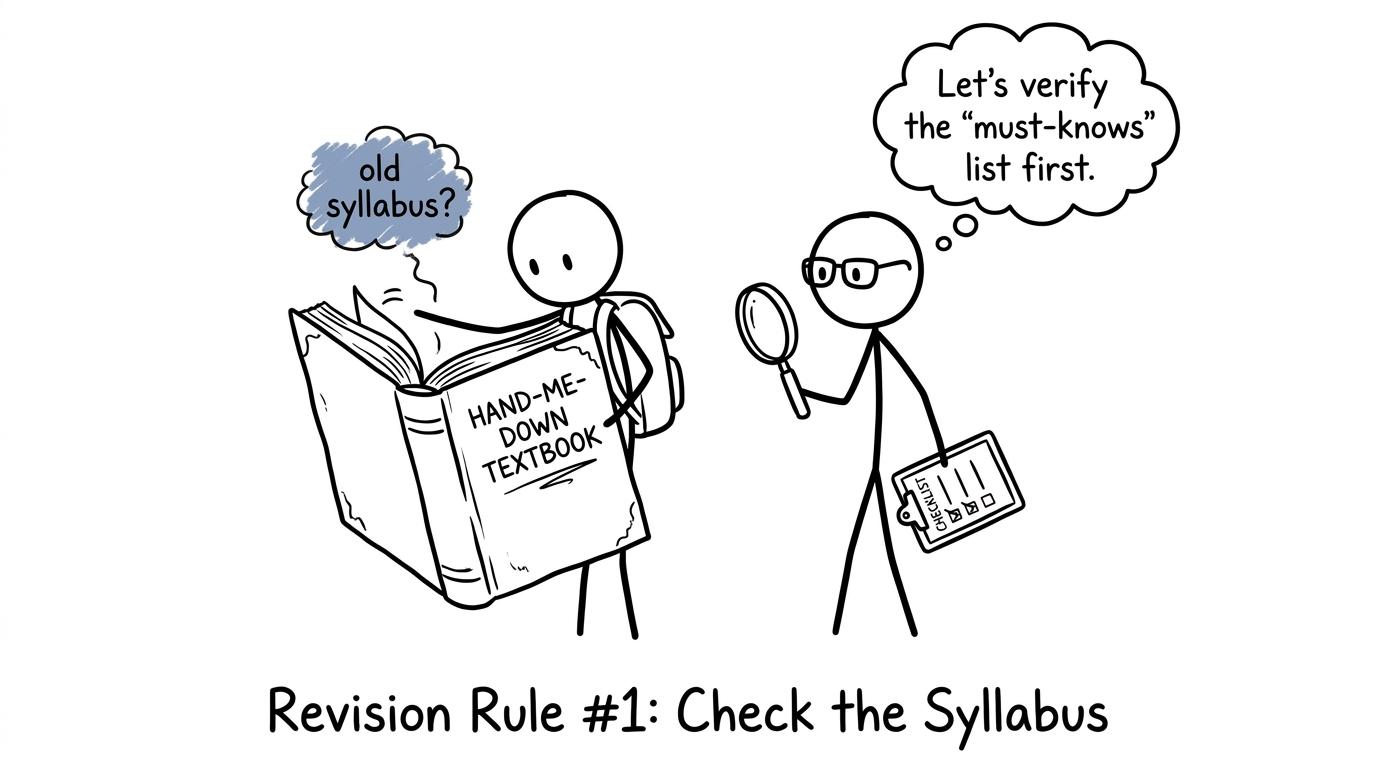 A student investigates whether a dusty revision book belongs to an old syllabus
How much has GCSE Arabic changed recently?
The current Pearson Edexcel GCSE Arabic qualification, specification code 1AA0, was first taught from September 2017 and first assessed in 2019. The latest published specification identified during our research is Issue 5, dated October 2022. Pearson's current information also lists 1AA0 for the June 2027 examination series.
That means GCSE Arabic has not recently undergone the same immediate specification replacement as GCSE French, German and Spanish. Revised content for those three languages began teaching in September 2024, with first examinations in summer 2026. Government guidance states that the previous modern foreign language subject content remains current for other languages, including Arabic.
This distinction matters. A headline saying that “language GCSEs are changing” does not necessarily describe your Arabic course.
There may eventually be wider curriculum and qualification reforms, but students should revise for the specification under which their school has entered them. For current GCSE Arabic candidates, that remains Edexcel 1AA0 unless their centre explicitly says otherwise.
What the current qualification assesses
The current GCSE has four skill-based papers:
- listening and understanding in Arabic;
- speaking in Arabic;
- reading and understanding in Arabic;
- writing in Arabic.
Each skill contributes one quarter of the qualification. Foundation and Higher versions are available, and a student must be entered at the same tier across all four papers. Dictionaries are not permitted in the assessments.
Questions are drawn from five broad themes:
- identity and culture;
- local area, holiday and travel;
- school;
- future aspirations, study and work;
- international and global dimension.
A suitable book should therefore develop all four skills across all five themes. A vocabulary-heavy book that ignores listening or speaking may be helpful, but it is not complete GCSE preparation.
When a hand-me-down textbook still holds up
Textbooks age at different speeds. Grammar usually ages slowly. Exam administration can age overnight.
An older book can remain strong for:
- Arabic script accuracy and spelling;
- grammatical structures;
- verb forms and agreement;
- sentence building;
- reading fluency;
- topic vocabulary that still appears in the specification;
- translation practice;
- planning spoken and written responses.
These are durable parts of language learning. A clear explanation of adjective agreement does not stop being useful because the cover looks dated. Nor does a reading exercise lose all value simply because the people in it use an old-fashioned device.
The book is especially likely to hold up if it explicitly names Edexcel 1AA0 and was published for the 2017 qualification. Since that specification remains available for current exam series, the age of the physical copy alone is not a reason to replace it.
This is similar to using older material in maths: the underlying method may remain sound, while the paper style, wording or emphasis needs checking. Maths students can use the GCSE Maths revision hub to match lessons and questions to their board rather than assuming every resource fits every course.
When an old GCSE Arabic book becomes risky
A textbook should not be your main resource if it was designed for the pre-2017 GCSE and presents a different assessment model. Older qualifications may organise themes differently or refer to assessment arrangements that no longer match the four current papers.
Be particularly cautious if the book:
- refers to the former Edexcel GCSE Arabic specification rather than 1AA0;
- describes controlled assessment or outdated unit arrangements;
- uses an old grading structure rather than grades 9-1;
- omits one or more of the four language skills;
- has no material on current 1AA0 themes;
- gives speaking or writing tasks in an obsolete format;
- claims that dictionaries or other resources are allowed without matching current rules.
The most dangerous errors are not necessarily incorrect Arabic. They are incorrect assumptions about what you must do in the examination.
A student can learn excellent vocabulary and still be underprepared for a role play, picture-based discussion, translation or the expected length and style of a written response. Content knowledge and exam readiness overlap, but they are not identical.
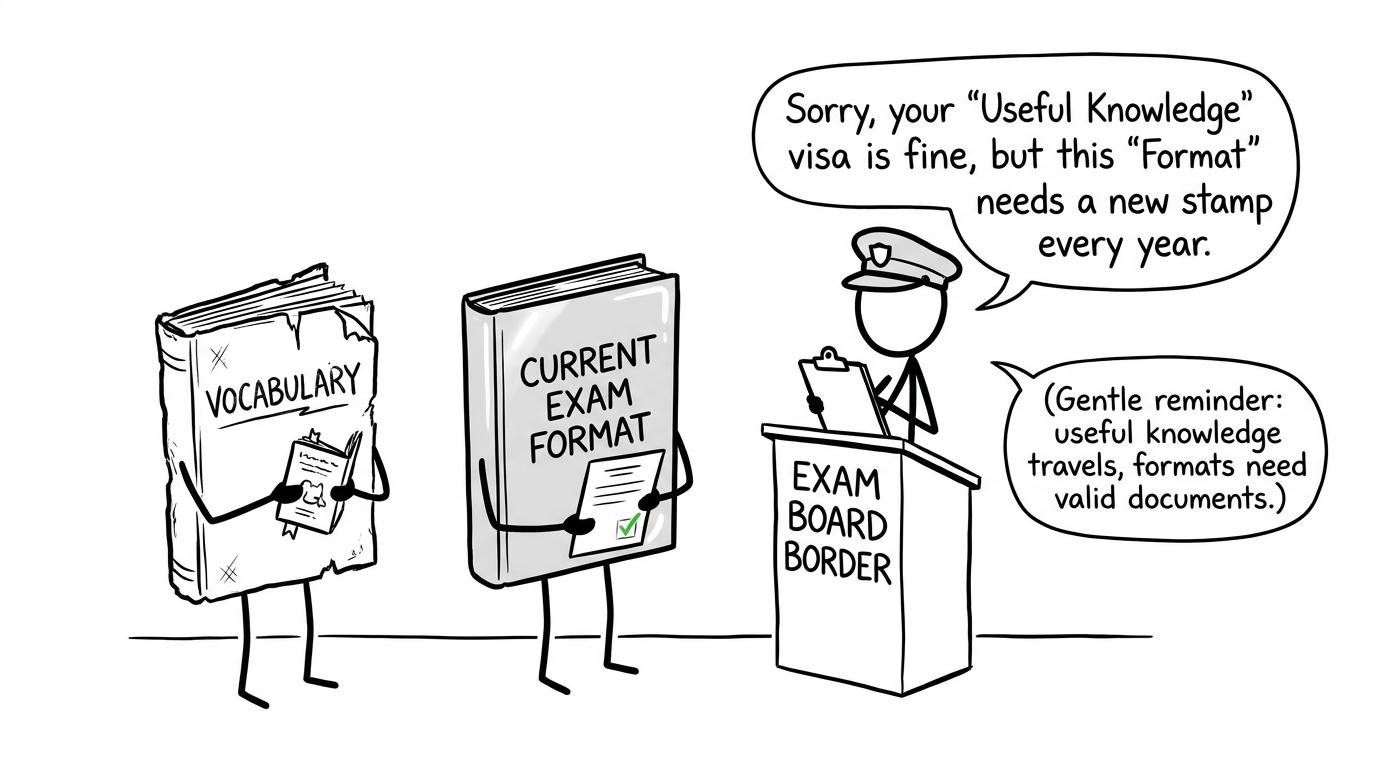 Old and new revision books have their exam-format documents checked
GCSE Arabic is not the same as International GCSE Arabic
One of the easiest mistakes is buying a book labelled “GCSE Arabic” without noticing the word “International”.
Pearson Edexcel GCSE Arabic 1AA0 assesses listening, speaking, reading and writing. Pearson's International GCSE Arabic (First Language) is a separate qualification with a different specification code and assessment structure. Other international awarding organisations may also offer their own Arabic qualifications.
An International GCSE book may contain sophisticated reading, grammar and writing practice, especially for first-language learners. That does not make it a reliable guide to Edexcel 1AA0. The title, code and papers must match the qualification you will actually sit.
If you are unsure, ask your teacher or examinations officer for three details:
- the full qualification title;
- the exam board;
- the specification or entry code.
Do this before buying another book. One minute of checking can prevent months of misdirected revision.
How to use an older textbook safely
The best approach is not to decide whether the whole book is “good” or “bad”. Audit it chapter by chapter.
Put the current specification beside it
Create a list of the five 1AA0 themes and four assessed skills. Mark where each appears in the book. This reveals both useful chapters and missing areas.
Use three labels:
- Keep: directly relevant content and practice;
- Check: useful language presented through an uncertain exam format;
- Replace: obsolete assessment guidance or content for another qualification.
This turns a vague worry into a manageable revision plan.
Use current papers to test relevance
The specification tells you what may be assessed. Current sample materials, past papers, mark schemes and examiner reports show how that content becomes questions.
After revising a theme from the book, attempt recent board-specific questions. If the textbook has prepared you to understand the language but not the task, keep the chapter and replace its exam practice.
The same feedback loop is useful across your GCSE subjects. MathsGenie's guide to using GCSE past papers properly explains the cycle clearly: complete, mark, diagnose, repair and retest.
Add what paper cannot provide
A printed textbook cannot reproduce a real spoken exchange. Even a perfectly aligned book needs support for listening and speaking.
Your revision should include:
- audio recorded at different natural speeds;
- regular speaking practice;
- timed role-play preparation;
- pronunciation feedback;
- unfamiliar reading passages;
- writing completed without a dictionary;
- marking against current criteria.
Do not confuse reading model answers with being able to produce your own response under pressure. Recognition feels comfortable. Retrieval earns marks.
Keep Arabic and maths revision organised
The target audience for this guide is likely balancing Arabic with compulsory GCSE maths and several other subjects. The resource problem is therefore partly a time problem. You do not need to replace every old page; you need to know which pages deserve your limited attention.
Use a weekly plan with specific outcomes, such as one Arabic theme, one listening session and one timed writing task. For maths, the GCSE maths revision timetable can help you combine topic work with paper practice without allowing one subject to consume the entire week.
Short tests are useful because they expose gaps quickly. MathsGenie's Edexcel GCSE Maths mini tests provide this kind of focused check for maths; in Arabic, recreate the principle with short vocabulary retrieval, listening extracts and timed speaking prompts.
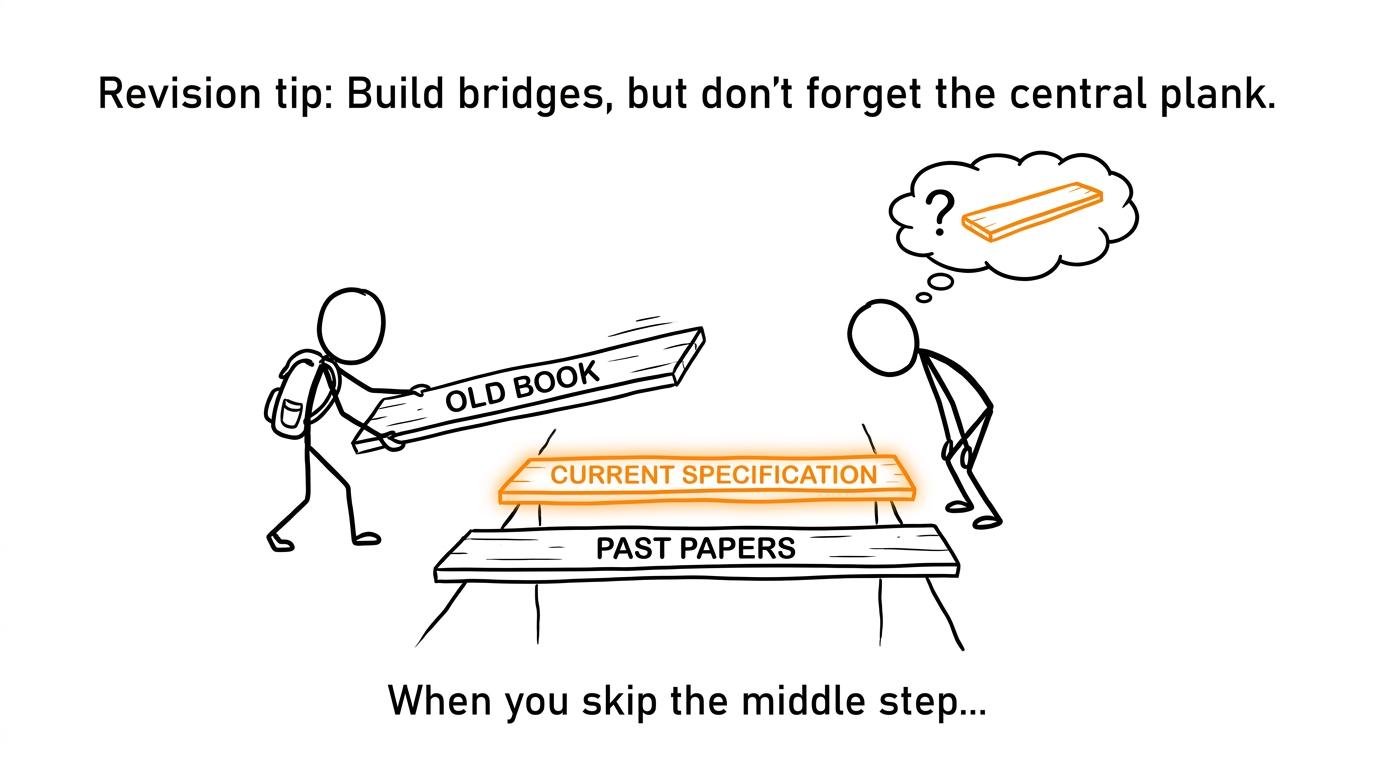 A revision bridge uses an old book, the current specification and past papers
Common mistakes when using an old textbook
Trusting the cover instead of the specification code
“GCSE Arabic” is not precise enough. Look for Edexcel and 1AA0. A similar title may hide a different qualification.
Assuming all modern language reforms apply to Arabic
The revised French, German and Spanish GCSE arrangements from 2026 do not automatically replace GCSE Arabic. Follow the current Arabic specification, not general headlines about language reform.
Using old exam questions without checking the format
An old question may still provide valuable language practice. It should not be used as proof of the current timing, task structure or marking criteria.
Revising only vocabulary
Vocabulary matters, but the qualification tests whether you can understand and communicate through four distinct skills. Speaking and listening require regular practice, not a final-week rescue attempt.
Ignoring the tier
Foundation and Higher papers differ in demand. Confirm your entry with your school and use tasks appropriate to that tier while continuing to strengthen core language.
Replacing useful resources too quickly
A new book is not automatically better. First identify the actual gaps. Spending money cannot replace a specification check, active practice or careful feedback.
Letting resource hunting replace revision
Students can lose hours searching for the perfect book. Set a deadline: verify the qualification, identify missing areas and begin practising. MathsGenie's advice on finding your weakest GCSE topics applies here too; evidence should decide what you revise next.
The verdict on an old textbook for GCSE Arabic
A hand-me-down textbook still holds up when it was written for Edexcel GCSE Arabic 1AA0, covers the current themes and develops all four skills. Since the specification first taught from 2017 remains available for current exam series, a correctly matched book does not become obsolete merely because it is a few years old.
A pre-2017 book can still support grammar, vocabulary and reading, but it should not control your exam strategy. An International GCSE book should also be treated as supplementary unless you are entered for that exact qualification.
Keep the useful knowledge. Replace outdated instructions. Test everything against the current specification and recent assessment materials.
Then protect time for your other subjects. MathsGenie provides free GCSE maths revision resources, including revision lessons, practice questions, mark schemes, video solutions, mini tests and past papers. As the exams approach, use Edexcel GCSE Maths predicted papers to rehearse under timed conditions and turn each mistake into a clear next step.
An old book can remain part of a strong revision plan. It simply should not be trusted without a map.











