Best Order to Learn GCSE Maths Topics (Fast Progress)
GCSE maths revision feels overwhelming. Learn the best order to learn GCSE maths topics, build foundations first, then practise with papers and mark schemes.
GCSE maths revision can feel like walking into a library where every book is shouting your name. Fractions. Algebra. Graphs. Geometry. Statistics. You open one, and it immediately references three others you haven’t read yet.
If you’ve ever thought, “What’s the best order to learn GCSE maths topics?”, you’re not behind; you’re noticing something important. GCSE maths is built like a house. Some topics are the foundations. Others are the wiring. And a few are the fancy loft conversion that only works if the stairs exist.
This guide gives you a sensible, confidence-building order to learn GCSE maths topics, with worked examples, common mistakes, and a practical plan you can actually follow with Maths Genie.
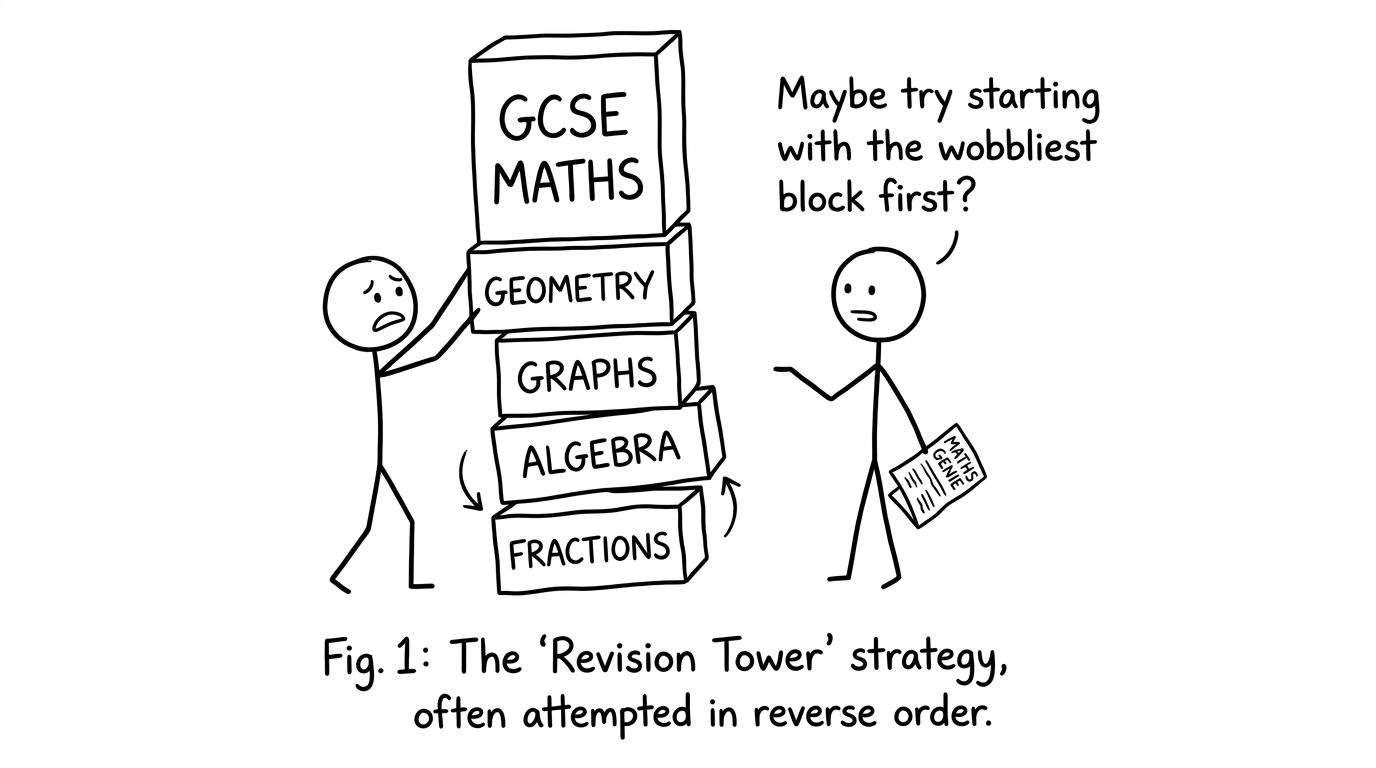 A wobbly revision tower labelled GCSE Maths
The best order to learn GCSE maths topics (quick checklist)
Use this as your map. You’ll loop back and revisit topics (that’s a good thing), but this order keeps your progress smooth.
- Stage 1: Number fluency: integers, decimals, fractions, BIDMAS, rounding
- Stage 2: Fractions, percentages, ratio: the “language” of GCSE worded questions
- Stage 3: Core algebra: simplifying, substitution, solving linear equations
- Stage 4: Graphs and sequences: coordinate geometry, straight lines, patterns
- Stage 5: Geometry and measures: angle facts, area/volume, circles
- Stage 6: Statistics and probability: averages, charts, probability trees
- Stage 7: Higher-only stretch (if you’re aiming for grades 666-999): quadratics, trigonometry, algebraic fractions, vectors
- Stage 8: Exam technique: mini tests, past papers, predicted papers, mark schemes
To make this feel structured, Maths Genie already organises GCSE content into a learning journey. Start with the Edexcel GCSE Maths course (stages and assessments) and adapt the order below to your needs.
Why order matters in GCSE maths
GCSE maths doesn’t reward “random topic hopping” as much as it rewards transfer. That’s when one skill quietly helps you elsewhere.
Fractions help with algebra. Algebra helps with graphs. Graphs help with real-life modelling. And suddenly a question about density becomes a question about rearranging a formula.
A good order does two things:
- It reduces the number of times you hit a question and think, “I don’t even know what this is asking.”
- It increases the number of marks you can pick up quickly because the same methods appear again and again across Edexcel, AQA, OCR and Eduqas.
Start with number: the marks you can’t afford to leak
A lot of GCSE maths marks disappear through tiny slips: negative signs, fraction errors, rounding mistakes. These don’t feel like “topics” so students skip them. But they’re the reason your working sometimes collapses halfway down the page.
Good starting points on Maths Genie:
Worked example: fractions first, then everything else gets easier
Simplify 1824\frac{18}{24}2418.
1824=18÷624÷6=34\frac{18}{24}=\frac{18\div 6}{24\div 6}=\frac{3}{4}2418=24÷618÷6=43Now use that fluency in a GCSE-style percentage link:
Find 75%75\%75% of 484848.
75%=75100=3475\% = \frac{75}{100}=\frac{3}{4}75%=10075=43So,
34×48=3×12=36\frac{3}{4}\times 48 = 3\times 12 = 3643×48=3×12=36This is why number comes first in GCSE maths. One clean idea becomes three different question types.
Then learn ratio and proportion: the hidden engine of GCSE maths
Ratio, proportion, and rates of change sit underneath so many GCSE problem-solving questions: recipes, best buys, scale drawings, speed, density, compound measures.
If you’re revising for foundation tier, this is where a grade 444 becomes realistic. If you’re on higher tier, this is where a grade 777 becomes efficient.
Helpful Maths Genie pages:
Worked example: sharing in a ratio
Share £969696 in the ratio 5:35:35:3.
Total parts =5+3=8=5+3=8=5+3=8.
One part =968=12=\frac{96}{8}=12=896=12.
So:
5 parts=5×12=605\text{ parts}=5\times 12=605 parts=5×12=60 3 parts=3×12=363\text{ parts}=3\times 12=363 parts=3×12=36Check: 60+36=9660+36=9660+36=96.
That “total parts” step appears everywhere in GCSE maths, including fraction and algebra questions later.
Build algebra next: GCSE maths starts to repeat itself here
Algebra is where GCSE maths becomes less about individual facts and more about methods. Learn these early and you’ll feel future topics getting easier.
Core algebra order:
- Simplifying expressions
- Substitution
- Expanding brackets
- Factorising
- Solving linear equations
- Rearranging formulae
Maths Genie links that fit this stage:
Worked example: solving a linear equation
Solve 3x−7=203x-7=203x−7=20.
Add 777 to both sides:
3x=273x = 273x=27Divide by 333:
x=9x=9x=9Now notice the story: “undo” operations in reverse order. That same story returns in GCSE rearranging formulae, inverse functions at A Level, and even logarithms later.
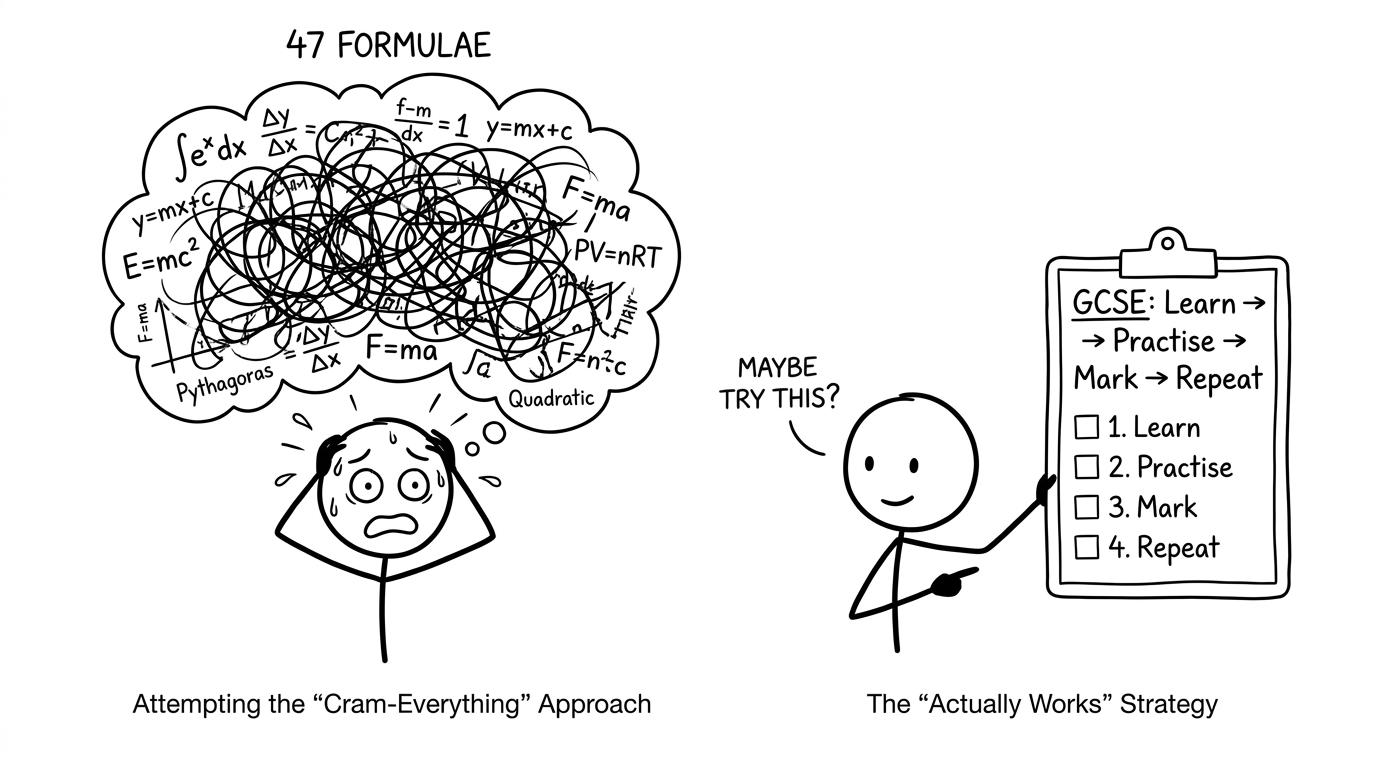 A checklist titled GCSE: Learn -> Practise -> Mark -> Repeat
Move to graphs and straight lines: make algebra visible
Graphs are where algebra stops being abstract. You can see gradient, intercepts, solutions, and patterns.
A very efficient order for GCSE graphs:
- Coordinates and plotting
- Straight line graphs
- y=mx+cy=mx+cy=mx+c
- Interpreting real-life graphs
Useful Maths Genie resource:
Worked example: gradient and intercept
Find the gradient and yyy-intercept of y=2x−5y=2x-5y=2x−5.
Compare to y=mx+cy=mx+cy=mx+c:
- m=2m=2m=2 (gradient)
- c=−5c=-5c=−5 (yyy-intercept)
If you need two points to plot:
- When x=0x=0x=0, y=−5y=-5y=−5 so point (0,−5)(0,-5)(0,−5).
- When x=3x=3x=3, y=2×3−5=1y=2\times 3-5=1y=2×3−5=1 so point (3,1)(3,1)(3,1).
That’s GCSE graph drawing in a calm, repeatable method.
Geometry and measures: learn the facts, then practise the links
Geometry is a classic GCSE trap because it feels like a list of disconnected facts. The trick is to learn it in clusters.
Suggested order:
- Angle facts (lines, triangles, parallel lines)
- Polygons and bearings
- Perimeter and area
- Circles (circumference, area)
- Volume and surface area
Why here? Because by this point, you can handle the algebra and number work that geometry questions often require.
Statistics and probability: late enough to make sense, early enough to score
Statistics and probability can be high-yield GCSE topics. The calculations are often straightforward, but the marks come from interpretation: what does the mean represent, what does a scatter graph suggest, what does a probability tree show.
If you leave this to the last week, you’ll feel rushed. If you learn it after number and ratio, it feels manageable.
Higher-only topics: add them once foundations feel stable
If you’re aiming for higher tier grades 666-999, you’ll want to build beyond the foundation core.
A sensible higher order:
- Quadratics (expanding/factorising, solving, graphs)
- Simultaneous equations (including with a quadratic)
- Trigonometry (SOHCAHTOA then sine/cosine rule later if needed)
- Vectors and geometric proof
Maths Genie’s staged course is particularly helpful here because it separates foundation and higher content. Use the GCSE scheme of learning structure to keep your GCSE revision organised.
Turn the order into results: practise like the exam is written
Learning the best order to learn GCSE maths topics matters. But GCSE grades are decided by performance under timed conditions.
Here’s how to convert topic learning into marks:
Use mini tests to make topics stick
Mini tests are short enough to be honest. They show you what you forgot, not what you understood yesterday.
Use: GCSE mini tests (foundation and higher)
Use past papers to learn the examiner’s language
Past papers teach you what “show your working” really looks like.
If you’re on Eduqas, you can use: Eduqas GCSE past exam papers
Use predicted papers for focused GCSE revision
Predicted papers are useful when you’ve done the basics and want realistic practice that mirrors exam season.
Use: GCSE predicted papers (Edexcel)
Keep it time-realistic
If full papers feel too big, build up in chunks.
Try: Edexcel GCSE 45 minute tests
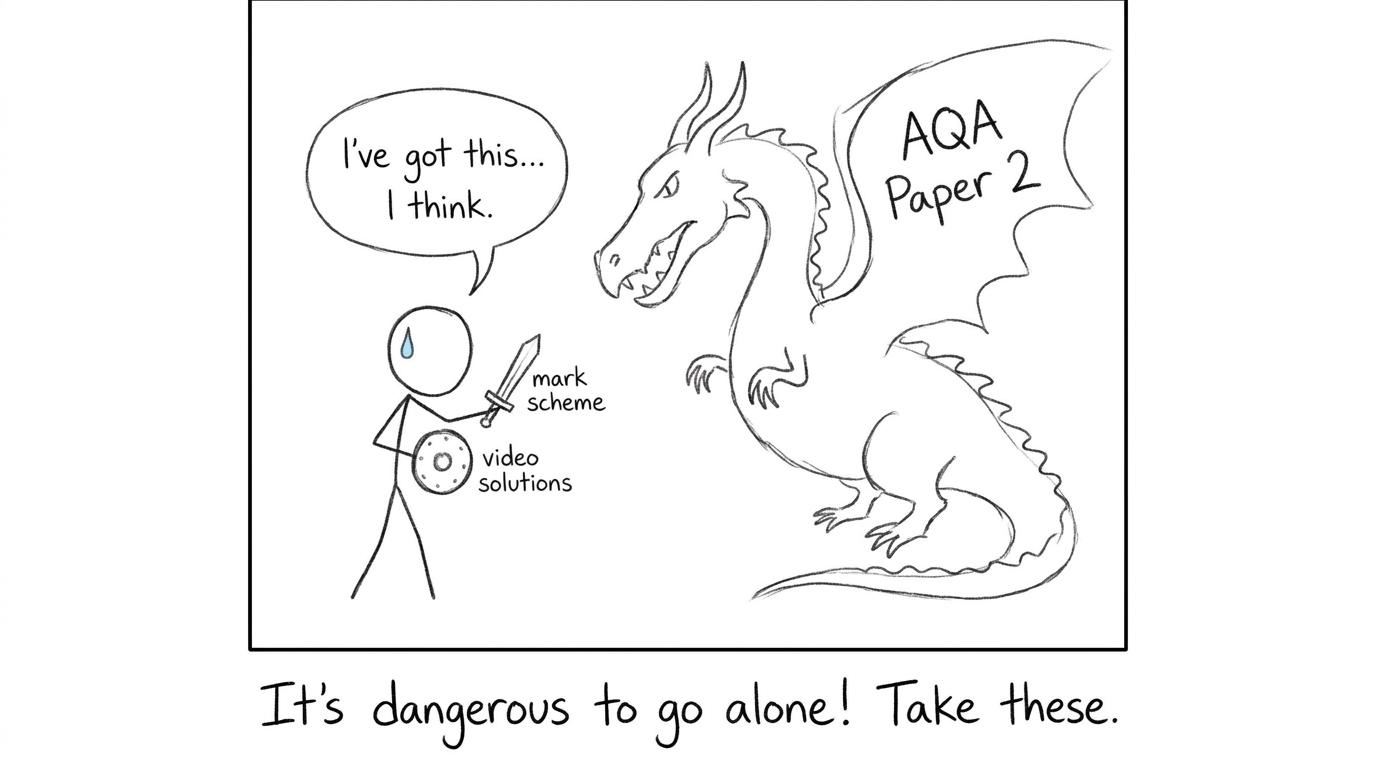 A past paper dragon labelled Paper 2 and a sword labelled mark scheme
Common mistakes when choosing your GCSE maths topic order
- Starting with the hardest topics to “get them out of the way”: it sounds brave, but it often creates panic and avoidance. In GCSE maths, confidence is a strategy because it increases practice time.
- Only revising what you enjoy: you can become brilliant at one area and still drop grades because GCSE papers are balanced across the specification.
- Doing topics in big blocks and never returning: memory fades quickly. Better GCSE revision comes from spaced practice: revisit the same topic several times over weeks.
- Avoiding mark schemes: the mark scheme isn’t just answers. It’s the examiner showing you what earns marks.
- Treating calculator papers as “easy”: calculator papers still test algebra, reasoning, and set-up. The calculator only helps after you’ve built the method.
A simple weekly plan using Maths Genie (that actually works)
- Two days per week: learn/relearn topics in the order above using revision lessons and worked examples.
- Two days per week: practise exam questions by topic and mark them carefully.
- One day per week: do a mini test or a timed paper section.
- Weekend (optional): one past paper or predicted paper, then review mistakes.
If you want a structured route, start from the GCSE scheme and stages, then use Resources (predicted papers and more) to keep practice varied.
Conclusion: the best order to learn GCSE maths topics is the one you can stick to
The best order to learn GCSE maths topics is not “start with the hardest”. It’s “start with the foundations that make everything else cheaper”. Number fluency stops silly errors. Ratio and percentages unlock worded questions. Algebra gives you methods that repeat across the whole GCSE. Graphs and geometry become clearer because the basics are already there.
Then, when you’re ready, you switch from learning to scoring: mini tests, past papers, predicted papers, and careful marking.
Use Maths Genie as your home base for GCSE revision: revision lessons, practice questions, mark schemes and video solutions, plus predicted papers when exam season gets real. Pick your next topic, follow the order, and practise until it feels boring, because “boring” in GCSE maths usually means “reliable marks.”