When to Stop Revising GCSE Sociology Night Before
When to stop revising GCSE Sociology night before: set a cut-off that protects sleep, use a focused final review and arrive calm for your exam.
The night before an exam has a peculiar way of making every unfinished page feel urgent. One missing sociologist becomes an entire weak topic. One forgotten study begins to look like the difference between two grades.
If you are wondering when to stop revising GCSE Sociology night before the exam, the practical answer is simple: stop about 454545 to 606060 minutes before bed, and choose a bedtime that gives you roughly 888 to 101010 hours of sleep. Do not keep going until you feel completely prepared. That feeling may never arrive. Stop when the planned, useful work is finished.
Your final evening should contain a short active review, basic preparation for the morning and a proper wind-down. It should not contain a new unit, a full paper or an attempt to memorise the entire specification.
Your night-before checklist
Use this as your stopping rule:
- Decide when you need to wake up.
- Protect enough time for approximately 888 to 101010 hours of sleep.
- Finish revision 454545 to 606060 minutes before bed.
- Complete no more than 606060 to 909090 minutes of focused revision that evening.
- Review familiar material rather than learning a major new topic.
- Test yourself instead of repeatedly reading notes.
- Pack your equipment and confirm the exam time and location.
- Stop at the planned time, even if one more topic is calling.
This is not giving up early. It is recognising that the exam tests what you can retrieve and explain tomorrow, not how long you can remain beside a textbook tonight.
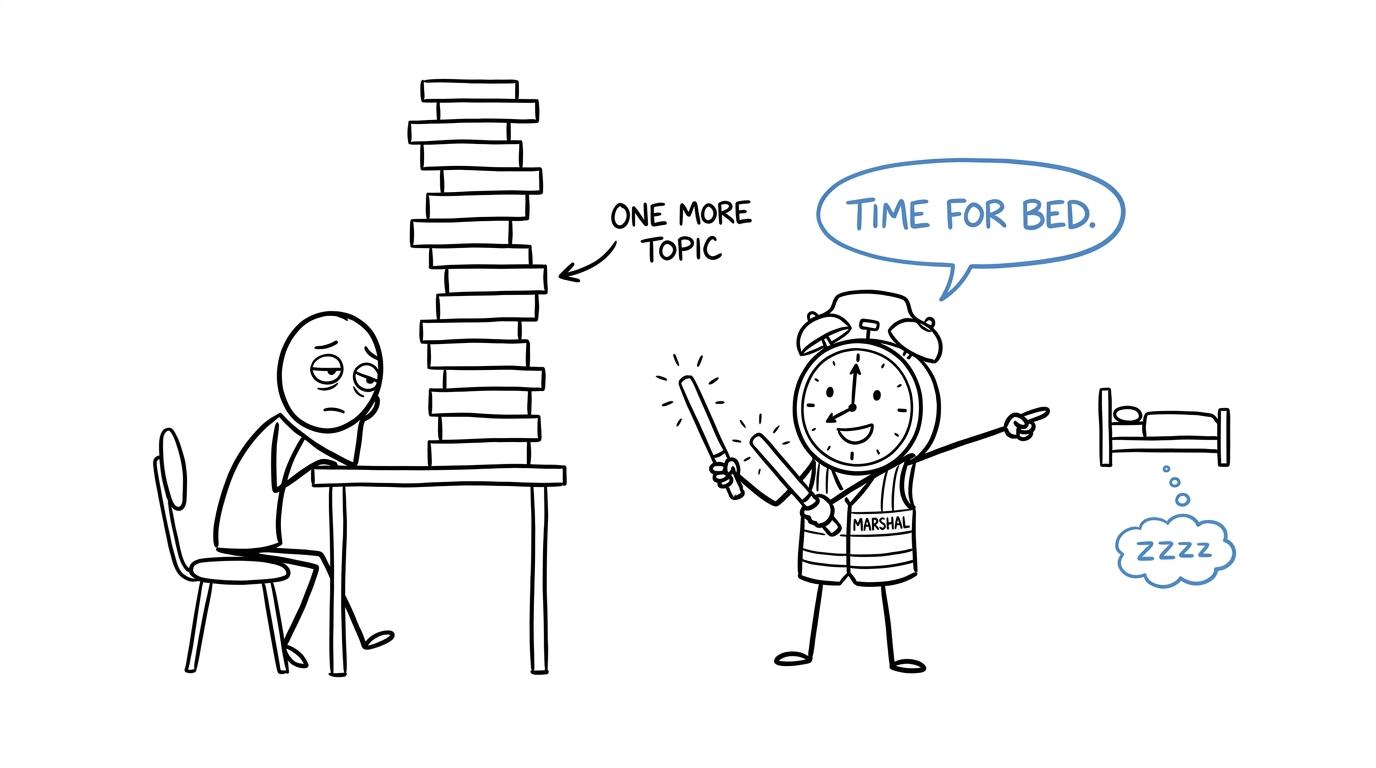 A tired student is directed away from one more topic and towards bed
Why sleep should determine your cut-off
Most teenagers need around 888 to 101010 hours of sleep. NHS guidance also recommends allowing time to wind down between revision or screen use and going to bed, and warns that all-night cramming before an exam is usually a poor idea.
That makes your wake-up time the starting point. Work backwards to find a sensible bedtime, then move back another 454545 to 606060 minutes to find your revision cut-off.
The wind-down period matters because stopping work is not the same as falling asleep. Your mind may still be rehearsing definitions, arguments and imagined questions. A quiet buffer gives that mental noise time to settle.
Protecting sleep is especially important if Sociology is one exam in a crowded GCSE timetable. A late night does not remain neatly inside one subject. It can affect your concentration in the morning and leave you more tired for the next maths, science or English paper.
MathsGenie's GCSE maths night-before plan follows the same principle: use a short, deliberate review, prepare your equipment and set a firm sleep time. The subject changes. The value of arriving rested does not.
What to revise before you stop
The final session should strengthen access to knowledge you already possess. It is a retrieval session, not a rescue mission.
Check the exact paper first
Before opening your notes, confirm your exam board and the paper you are sitting. GCSE Sociology content and question structures are not identical across boards.
For example, AQA GCSE Sociology covers families, education, crime and deviance, social stratification and research methods across two written papers. Eduqas organises its content and assessment differently. Use your own specification, teacher guidance and exam timetable rather than revising from a generic online checklist.
Write down the two or three areas that are both relevant to tomorrow's paper and slightly uncertain. That is your boundary. Everything else waits.
Use active recall
Close your notes and try to retrieve:
- key sociological concepts and definitions;
- named theories, studies or evidence required by your course;
- strengths and limitations of research methods;
- contrasts between sociological perspectives;
- a simple structure for extended responses;
- the meaning of command words used by your exam board.
Then check your answers. Correct omissions briefly and test them once more.
This is more useful than highlighting because it reveals whether information is available without a prompt. The exam will not show you the paragraph from your revision guide before asking you to analyse it.
Review answer structure, not whole essays
You do not need to write several complete essays late at night. Instead, plan the skeleton of one or two likely responses:
- identify the question's focus;
- choose relevant knowledge;
- connect that knowledge to the issue or source;
- develop analysis;
- consider an alternative or limitation;
- reach a reasoned judgement where required.
The precise structure should reflect the question and your board's mark scheme. Avoid treating a paragraph acronym as a substitute for sociology. A clear structure helps, but marks come from relevant knowledge, application, analysis and evaluation.
Finish with a one-page morning sheet
Create one page containing only material you have already revised: a few easily confused concepts, essential names and two or three exam reminders. Keep it short enough to scan calmly in the morning.
Do not turn this into another set of complete notes. Its purpose is reassurance and retrieval, not coverage.
A sensible final-evening routine
A calm evening needs fewer decisions. The following sequence works well:
- First 101010 minutes: confirm the paper and select up to three priorities.
- Next 252525 minutes: retrieve key concepts, evidence and perspectives without notes.
- Next 202020 minutes: check corrections and outline one or two responses.
- Final 101010 minutes: prepare the one-page morning sheet.
- After revision: pack, switch off and wind down.
These timings are a ceiling, not a target you must fill. If you are exhausted, an earlier stop is sensible. If you have already completed a productive day of revision, the final evening can be shorter still.
The important question is not, “Could I keep going?” You almost always could. Ask, “Is the next half-hour likely to make tomorrow better?” Once the answer becomes doubtful, stopping is productive.
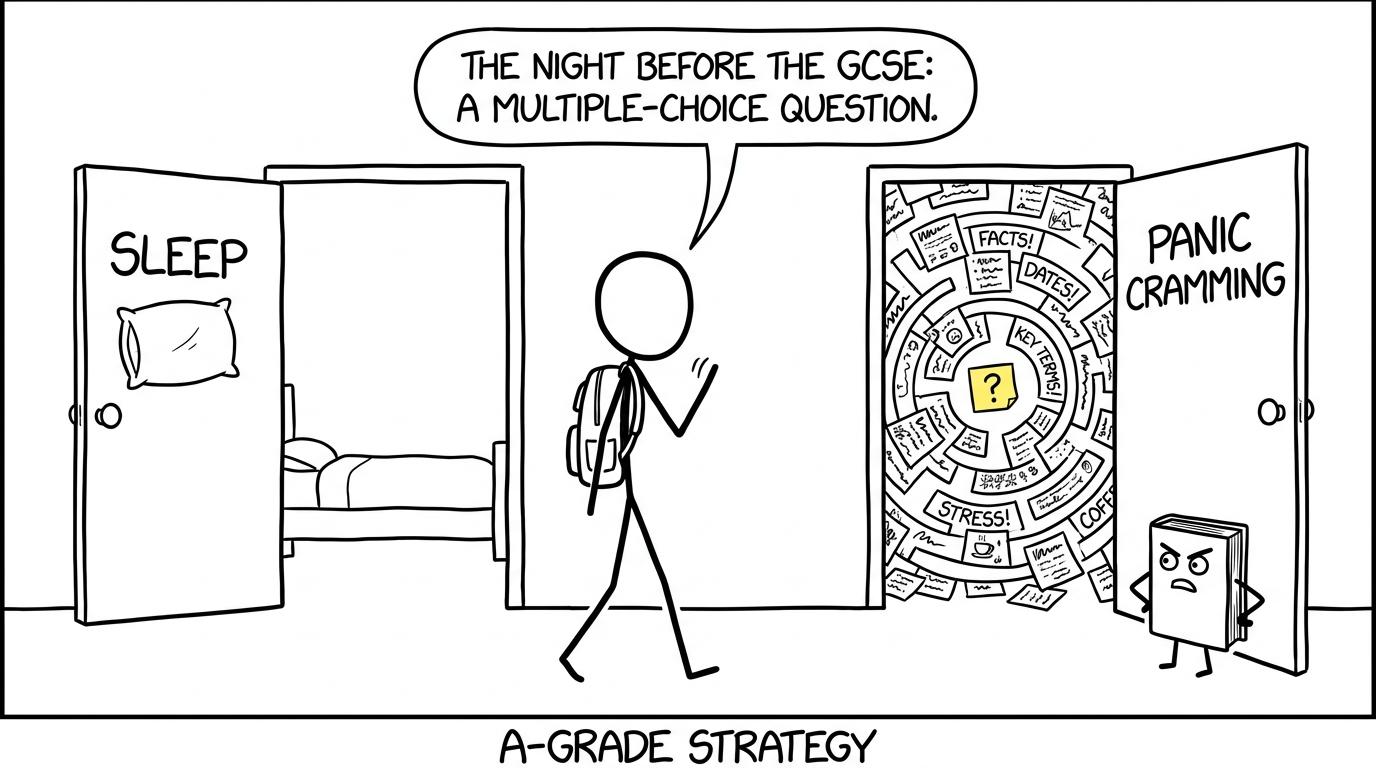 A student wisely chooses the sleep door instead of the panic-cramming maze
Signs you should stop revising now
Your planned cut-off is the main rule, but your concentration can give you an earlier warning. Stop if you are:
- reading the same paragraph without processing it;
- confusing ideas that were clear earlier;
- answering carelessly because you are tired;
- jumping repeatedly between unrelated topics;
- becoming more frightened with every page;
- starting a large new unit because it feels urgent;
- delaying sleep simply to reduce guilt.
Tired revision can create the appearance of effort without much dependable learning. It may also damage confidence: familiar knowledge begins to feel unfamiliar because your attention is depleted.
If you discover a genuine gap, record it in one sentence. Review only the minimum needed to understand the central idea, then stop. One imperfect topic does not erase everything else you know.
What to do after the cut-off
Prepare the practical details first. Pack black pens, permitted stationery, water if your school allows it, and any other equipment your centre has told you to bring. Check the exam time, room and travel arrangements. Set an alarm and, if useful, a backup.
Then move to a quiet routine. Avoid turning your bed into a second revision desk. Put notes away, lower stimulation and choose a calm activity. NHS sleep guidance commonly advises avoiding electronic devices immediately before bedtime and limiting caffeine later in the day.
If worries keep repeating, write them down rather than reopening every folder. A short note such as “review research-method limitations in the morning” gives the concern somewhere to go.
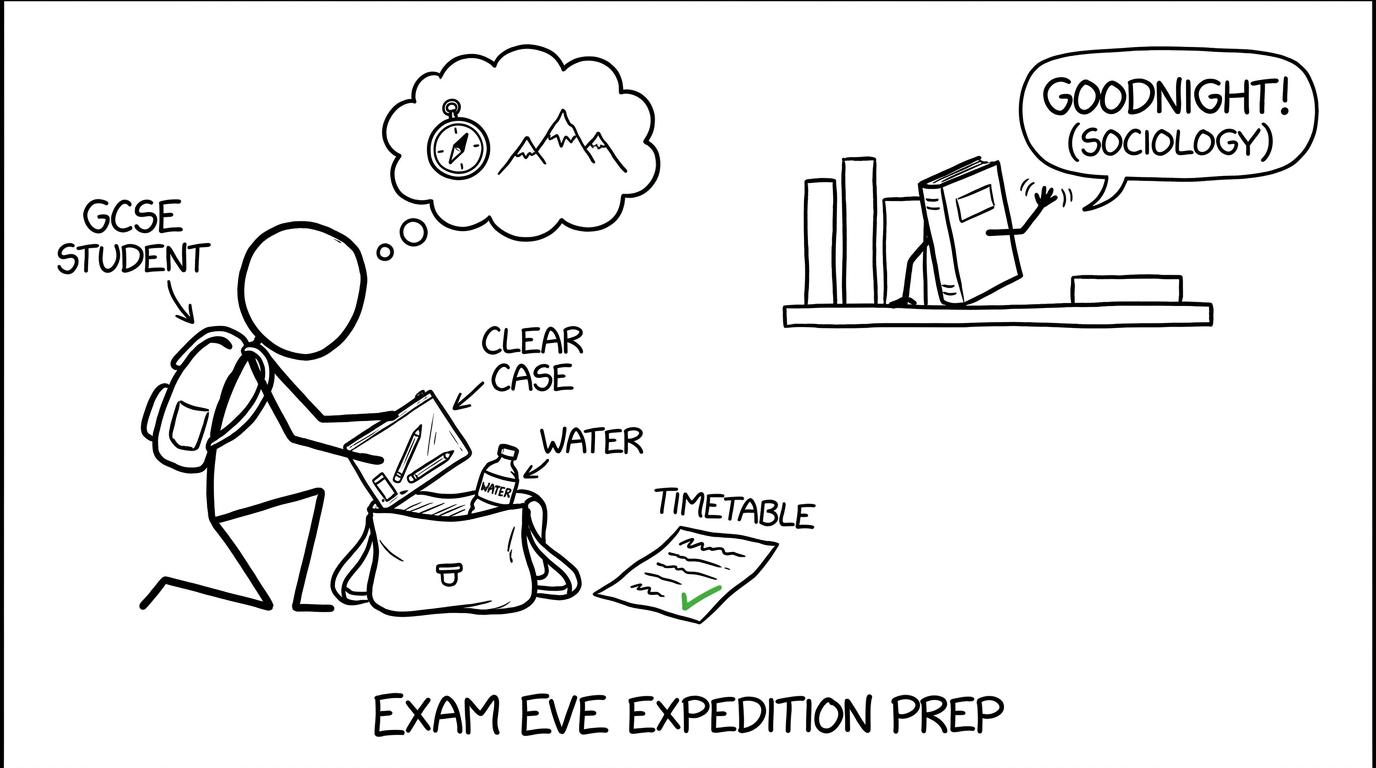 A student packs for the exam while the sociology textbook waves goodnight
What to do on the morning of the exam
The morning is for activation, not panic. Eat and drink as normally as you can, leave enough time to arrive and scan your one-page sheet for around 101010 to 151515 minutes.
Do not begin comparing how much you know with friends outside the exam room. Their last-minute discussion may be correct, mistaken or irrelevant to your paper. None of those possibilities helps you think clearly.
Once the exam begins, read command words and source material carefully. Match the depth of your response to the marks available, use relevant sociological evidence and leave time to check that you answered the actual question.
Common mistakes the night before GCSE Sociology
Revising until you feel ready
Readiness is not a clear finish line. Anxiety can keep moving it. Use a clock-based cut-off instead of an emotion-based one.
Attempting a complete past paper late at night
Full papers are valuable earlier in revision, when there is time to mark them and repair weaknesses. MathsGenie's guide to when to start GCSE past papers explains why paper practice works best as a staged process rather than a final-night emergency.
Reading everything again
Rereading feels safe because recognition is easy. Retrieval is more revealing. Close the notes, answer from memory, check and correct.
Treating every gap as equally urgent
Prioritise content relevant to tomorrow's paper and ideas that connect to several possible questions. Do not sacrifice sleep to polish a minor detail.
Borrowing time from another exam
GCSE exam weeks are cumulative. Protect tomorrow's energy and the subjects that follow. The GCSE maths exam-week checklist can help you organise maths around the same calm rhythm.
Leaving the decision until bedtime
Set the stopping time before revision begins. Making the decision while tired makes “another ten minutes” unusually persuasive.
Build a better plan for the rest of exam season
A difficult final night often begins several weeks earlier, when revision has no clear structure. The cure is not greater panic. It is earlier feedback.
For maths, use the free GCSE maths revision hub to select your exam board and work through revision lessons, practice questions, past papers, predicted papers, mark schemes, mini tests and video solutions. The GCSE maths revision timetable can help distribute that work without letting one subject consume every evening.
If exams are close, adapt the one-week GCSE maths revision plan. If you have longer, the one-month revision plan provides a steadier route. You can also use the method in finding your weakest GCSE topics to replace guesswork with evidence.
Stop with tomorrow in mind
The best cut-off is not the latest moment at which you can still hold a pen. It is the point that preserves useful knowledge, allows a genuine wind-down and protects enough sleep.
Aim to finish GCSE Sociology revision 454545 to 606060 minutes before bed. Keep the final session short, active and limited to familiar priorities. Pack what you need, put the notes away and trust the revision already completed.
Then bring the same discipline to maths. Open MathsGenie's free revision hub, use revision lessons and practice questions to repair weak topics, and test progress with mini tests, past papers and predicted papers. Mark carefully, learn from video solutions and use the revision planner approach to spread the work across the weeks.
Tomorrow's exam needs an alert student more than tonight needs one more highlighted page.