GCSE Maths Exam Week Checklist (Simple, Calm, Effective)
GCSE maths exam week checklist: what to revise each day, how to use past papers, predicted papers and mark schemes, plus calm exam-day routines.
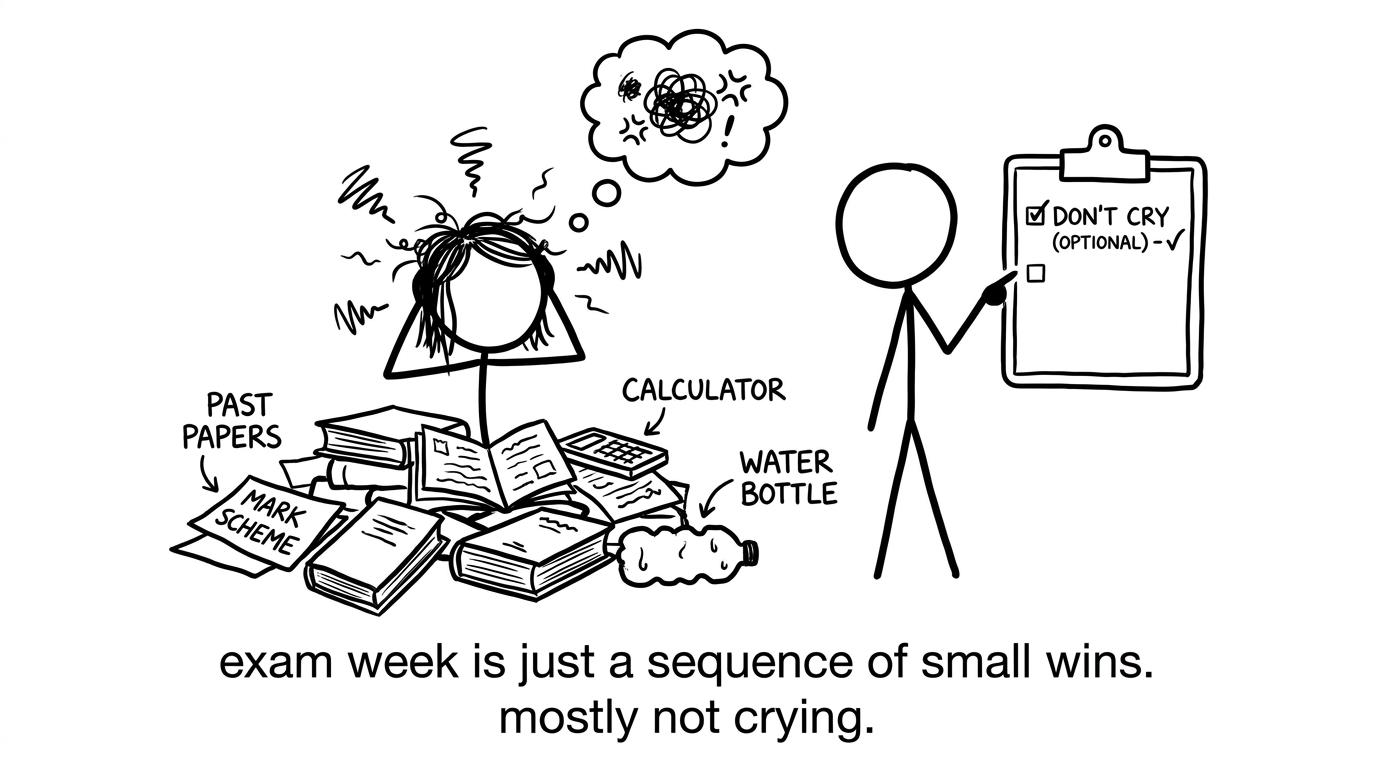 A calm checklist beats panic cramming
Somewhere between your last lesson and the first GCSE paper, revision can start to feel like carrying water in your hands. You know you’ve done work. You’ve watched the videos, highlighted the notes, maybe even finished a past paper. Yet exam week arrives and your brain says: none of it is in the right place.
This is where a simple GCSE maths exam week checklist helps. Not because you need more content, but because you need fewer decisions. The best GCSE weeks are quietly boring: small routines, lots of mark schemes, short bursts of practice, and sleep you don’t negotiate with.
Below is a calm, practical checklist you can follow whether you’re foundation tier or higher tier, and whether you’re sitting Edexcel, AQA, OCR, or Eduqas. It uses YesGenie’s free revision lessons, practice questions, mini tests, past papers, predicted papers, and video solutions so your GCSE revision stays targeted.
The GCSE maths exam week checklist (print-this-in-your-head version)
Keep this as your default plan. Then repeat it each day of exam week.
- Choose one weak topic to tidy up (not five).
- Do one timed set of exam-style questions.
- Mark it immediately using the mark scheme.
- Write a tiny “tomorrow list”: three fixes, not a novel.
- Do a short recall review (formulae, key methods, common errors).
- Pack your kit the night before and protect your sleep.
For resources, start here:
- GCSE Past papers
- Edexcel GCSE Maths Predicted Papers
- Edexcel GCSE Maths Mini Tests
- Edexcel GCSE Maths Lessons
- AQA GCSE Maths Lessons
- Resources hub (mini tests, predicted papers, more)
How to use this checklist across GCSE exam week
Exam week is a sequence, not a single moment. Your job is to arrive at each paper with the right things warm in your mind: methods, not just memories.
The night before any GCSE maths paper
Your confidence the next morning is mostly decided the previous evening.
- Do one light timed section: 202020 to 404040 minutes.
- Mark it straight away. Circle the exact step where marks were lost.
- Watch one video solution if you need a clean model of the method.
- Prepare your “first five minutes” plan for the exam (more on that below).
- Pack: calculator (if allowed), spare batteries, ruler, protractor, compasses, pens, pencil, eraser.
If you want something structured but not exhausting, use a mini test rather than a full paper:
The morning of a GCSE maths paper
Keep it simple. You are not trying to learn brand new topics at 777am.
- Eat something predictable.
- Spend 101010 minutes on short recall: formulae and “go-to” methods.
- Do two very small questions just to wake up accuracy (not speed).
A good “wake-up” pair is one algebra and one geometry skill. For example:
3(2x−5)−4(x+1)=0 3(2x-5)-4(x+1)=0 3(2x−5)−4(x+1)=0Simplify carefully:
6x−15−4x−4=0 6x-15-4x-4=0 6x−15−4x−4=0 2x−19=0⇒x=192 2x-19=0 \Rightarrow x=\frac{19}{2} 2x−19=0⇒x=219No drama. Just a reminder that you can still move symbols around correctly under pressure.
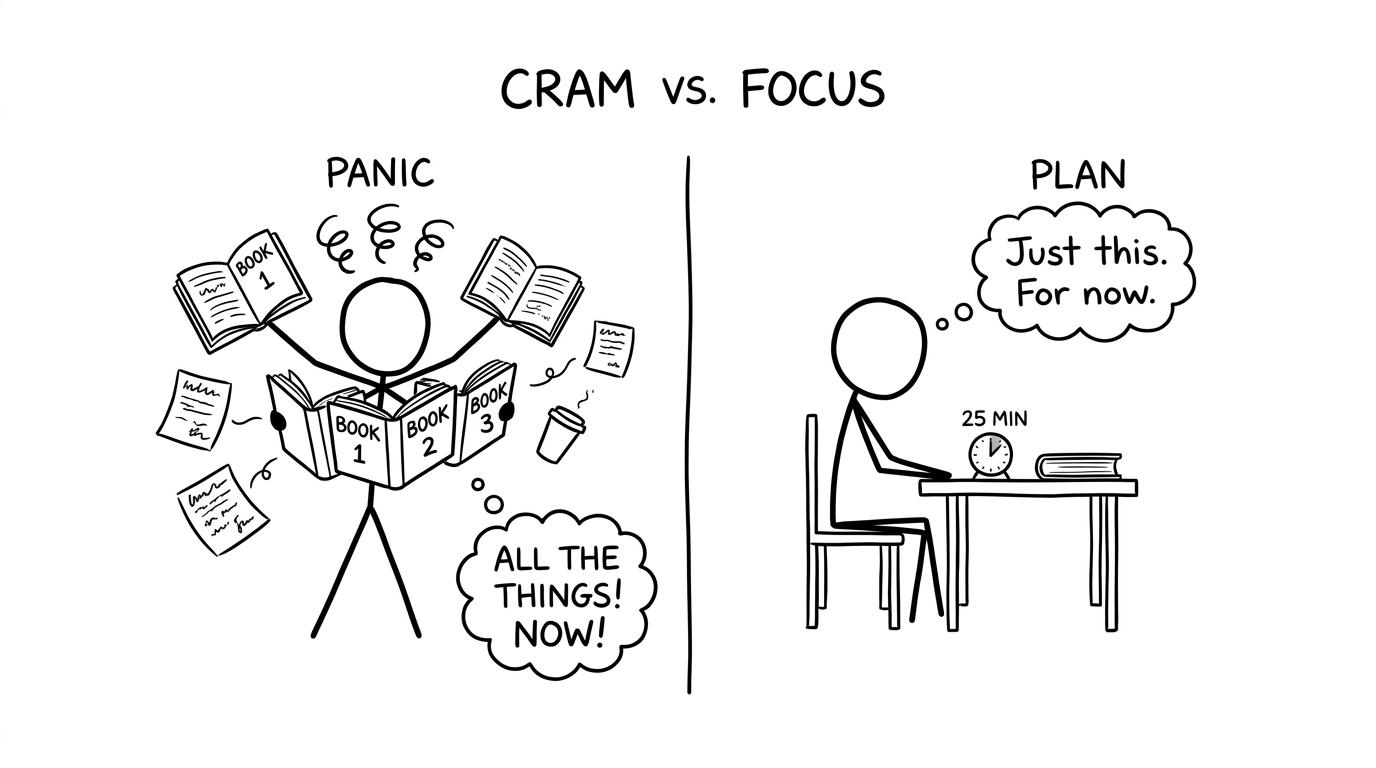 Plan vs panic in exam week
The one-hour GCSE revision block (the engine of exam week)
If exam week feels chaotic, it’s usually because revision blocks are vague. Make every block do a job.
Pick one weak topic (not a whole grade)
Choose a single topic that reliably leaks marks. Typical GCSE “mark leakers”:
- algebra manipulation
- ratio and proportion
- probability
- graphs and functions
- circle theorems and geometry
Use a bite-sized lesson to remind yourself of the method, then move straight into exam questions:
Do timed exam-style practice
Your goal is not “finish everything”. It’s “finish with control”. A simple target for GCSE exam week is:
- foundation tier: aim for clean method marks
- higher tier: aim for method marks first, then push into the last questions when calm
Pull questions from:
Mark immediately, then write a three-line fix
Mark schemes are not judgement. They are directions.
After marking, write:
- the mistake (what happened)
- the rule (what should happen)
- one example step you will copy next time
That’s how a GCSE weakness turns into a habit.
Two worked examples that pay off in GCSE exam week
These are the kinds of questions that appear across exam boards, and the methods are stable. In exam week, stable is gold.
Worked example: ratio and sharing (quick, repeatable method)
A question like this turns up constantly in GCSE Maths.
Example: Share £848484 in the ratio 2:52:52:5.
Total parts =2+5=7=2+5=7=2+5=7.
One part is:
847=12 \frac{84}{7}=12 784=12So the shares are:
- 222 parts: 2×12=242 \times 12=242×12=24
- 555 parts: 5×12=605 \times 12=605×12=60
Check: 24+60=8424+60=8424+60=84.
If ratio questions are a weak spot, practise one focused lesson then a booklet of exam questions:
Worked example: probability with a tree (method marks matter)
Probability questions reward clear working. Even if you slip at the end, method marks keep your GCSE grade safe.
Example: A bag has 333 red and 222 blue counters. Two counters are picked without replacement. Find the probability both are red.
First pick red:
P(R1)=35 P(R_1)=\frac{3}{5} P(R1)=53Now there are 222 red left out of 444 total:
P(R2∣R1)=24=12 P(R_2\mid R_1)=\frac{2}{4}=\frac{1}{2} P(R2∣R1)=42=21Multiply along the “red then red” path:
P(RR)=35×12=310 P(RR)=\frac{3}{5}\times\frac{1}{2}=\frac{3}{10} P(RR)=53×21=103That structure is what examiners reward: correct fractions, correct conditional second step, then multiplication.
For targeted practice:
The GCSE paper strategy: how to start, how to rescue, how to finish
Exam technique is not a personality trait. It’s a script you practise.
Your first five minutes
- Write your name details carefully.
- Skim the paper for 303030 seconds.
- Start where you can bank marks quickly.
That early run of marks changes how the later questions feel. In GCSE maths, calm is a scoring advantage.
If you get stuck
- Circle the command word: “show that”, “prove”, “estimate”, “exact”.
- Write something relevant immediately (a formula, a diagram label, a substitution). Method marks often live in the first line.
- Move on and return later.
Your last five minutes
- Check units.
- Check rounding.
- Check you answered the question asked (not the one you wish it asked).
- If you have time: substitute back to verify.
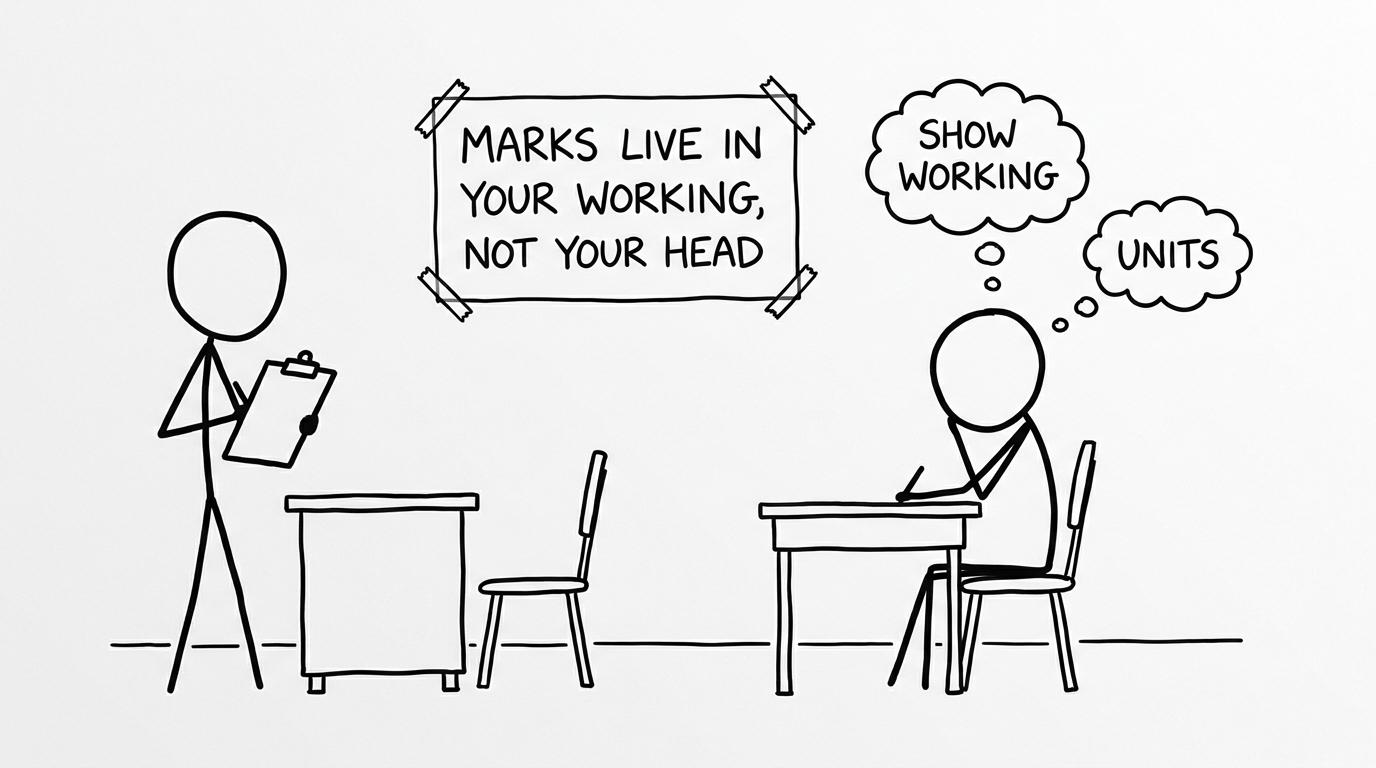 Marks live in your working
Common mistakes that cost GCSE marks (and how to stop them)
These are not “silly mistakes”. They’re predictable mistakes. Which means they’re fixable.
Cancelling terms instead of factors
In algebra, you can cancel common factors, not parts of a sum. For example:
x+3x≠3 \frac{x+3}{x} \neq 3 xx+3=3because x+3x+3x+3 is not a factor of xxx. In exam week, if algebraic fractions appear, slow down and factorise first.
Losing negatives when expanding
A minus sign in front of brackets is a trap that turns into a habit.
−(2x−5)=−2x+5 -(2x-5)=-2x+5 −(2x−5)=−2x+5Write the negative explicitly before you expand.
Rounding too early
If you round mid-solution, you can drift away from the correct answer. Keep exact values as long as possible, then round at the end.
Not showing enough working
Even if you can do it mentally, the mark scheme can’t award marks for thoughts. Write the method line. In GCSE maths, working is a safety net.
Reading “exact” as “estimate”
If it says exact, keep surds and \pi where relevant. For example, exact area of a circle is A=πr2A=\pi r^2A=πr2, not a decimal approximation.
A simple GCSE exam week plan (you can repeat for each paper)
If you want a concrete template, here is one that fits most students:
- Day before paper: mini test or half-paper timed, mark, fix list, early night.
- Paper day afternoon: light review of mistakes only, then rest.
- Between papers: one topic lesson + exam questions + mark scheme.
Pick your pathway depending on your board:
- Edexcel: Edexcel GCSE Maths Revision
- AQA: AQA GCSE Maths Lessons
- OCR: GCSE Maths OCR
Closing thought: GCSE exam week is built from small wins
The quiet truth about GCSE maths is that confidence doesn’t arrive as a feeling first. It arrives as evidence. One marked paper. One fixed mistake. One method you can repeat when the question looks different.
If you want exam week to feel simpler, let YesGenie hold the structure. Use the free revision lessons to refresh methods, then practise with mini tests, past papers and predicted papers, and mark everything with the mark schemes and video solutions. Start today with:
Keep the checklist. Keep the sleep. Keep collecting small wins. Your GCSE grade is usually closer than it feels.