

GCSE Maths Revision Timetable That Actually Works
GCSE revision timetable for maths: build a realistic weekly plan using Maths Genie lessons, practice questions, past papers and mark schemes.
A GCSE revision timetable shouldn’t feel like a lie you tell yourself
The night you decide to “get serious” about GCSE maths revision usually feels the same for everyone. You open a notes app, write a beautiful timetable, colour-code it, and promise your future self you’ll follow it perfectly. Then life happens: homework, tiredness, a Saturday disappears, and suddenly the timetable isn’t a plan; it’s evidence.
A GCSE revision timetable that works isn’t the one that looks most impressive. It’s the one that survives a normal week and still gets you more marks on exam-style questions. That’s what we’re building here: a simple structure, anchored to Maths Genie resources, that turns revision time into exam marks.
Along the way you’ll use the Maths Genie learning journey (so you always know what to do next), targeted topic practice (so weak areas actually improve), and past papers with mark schemes (so you learn how GCSE examiners reward method).
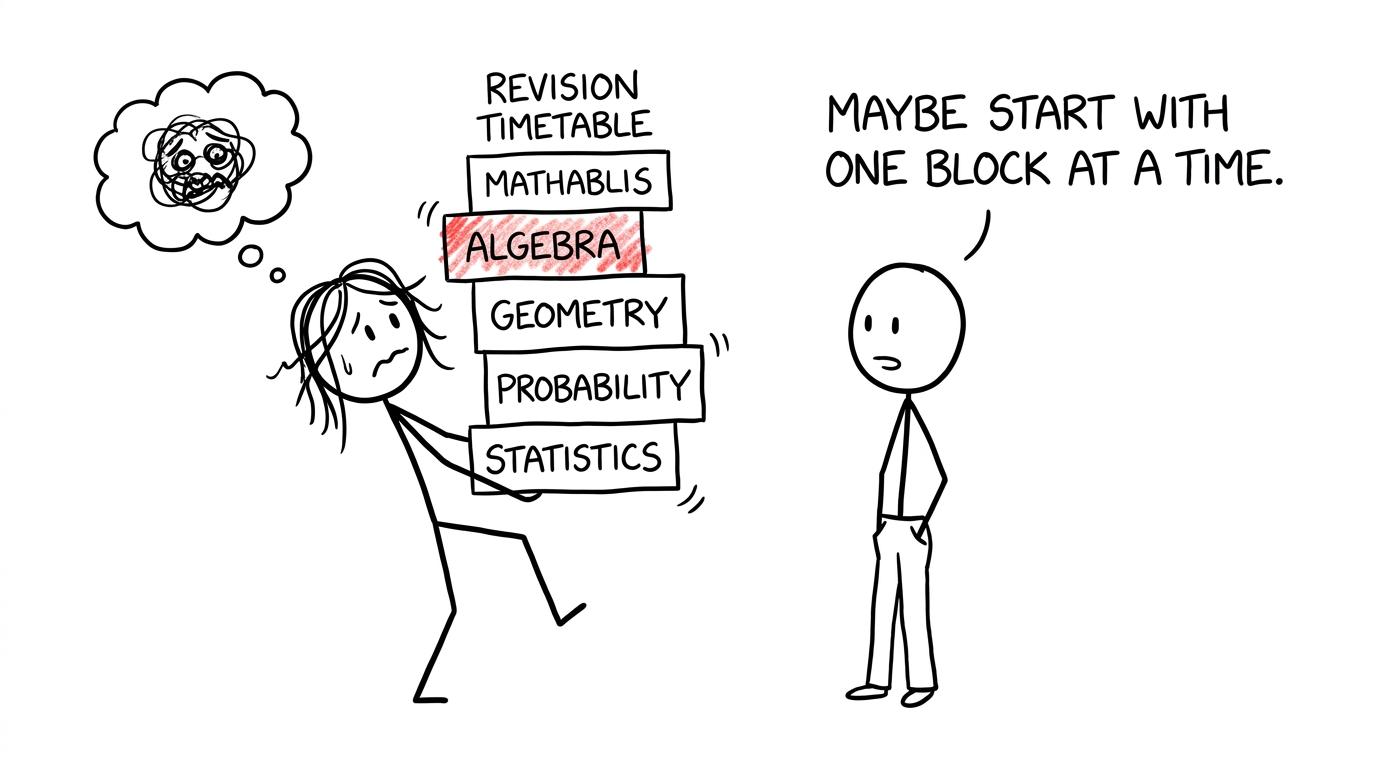 Student building a revision timetable like Jenga
The best GCSE maths revision timetable: a quick checklist
A strong GCSE maths revision timetable usually does these things:
- Prioritises the topics you personally drop marks on (not the topics you like).
- Revisits topics little and often (spaced practice), not in one big block.
- Mixes GCSE skills practice with full exam questions.
- Uses mark schemes and model solutions to close the gap quickly.
- Builds towards timed papers (because timing is a skill).
- Leaves space for school, rest and catching up.
Maths Genie is ideal for this because it’s already organised as a journey with clear steps, and it has the practice questions and papers you need:
- Scheme of Learning
- GCSE Revision Summer 2025
- Resources and Predicted Papers
- Self Assessment Sheet (PDF)
- GCSE Statistics Revision
Start with honesty: how many hours can you really do?
A timetable fails when it assumes you will become a different person on Monday.
Pick a weekly number you can repeat for 6-8 weeks. For most GCSE students, that’s somewhere like 444 to 888 hours per week for maths, depending on confidence and targets. A Level students retaking or supporting skills might do less, but more consistently.
Here’s a quick way to estimate your weekly revision time:
- Weeknights: 444 days imes45 imes 45imes45 minutes =3= 3=3 hours
- Weekend: 111 longer session of 909090 minutes =1.5= 1.5=1.5 hours
Total =4.5= 4.5=4.5 hours.
That might not sound heroic. But a boring plan you complete beats a heroic plan you abandon. In GCSE maths, consistency creates the compounding effect: small gaps filled early stop becoming big gaps later.
Build your GCSE revision timetable around three session types
Most students revise GCSE maths in only one mode: “do questions until tired”. That’s better than nothing, but it’s not strategic. A timetable that works rotates through three session types.
Foundations session (learn or re-learn a topic)
Use this when you don’t know how to do a topic.
- Watch the revision lesson.
- Write a short method checklist.
- Do a small set of exam-style questions.
Maths Genie makes this straightforward because each topic is built as lesson $ ightarrowquestionsquestionsquestions ightarrow$ solutions.
A helpful route is to follow the stages in the Scheme of Learning. For Higher tier students, this is especially useful because stages 111111 to 141414 keep the harder content organised.
Example internal stage page (Higher): Scheme Stage 11.
Practice session (turn knowledge into marks)
Use this when you roughly know the method but lose marks through slips, incomplete method, or misreading.
- Pick one or two topics.
- Do exam questions.
- Mark with solutions.
- Write down the exact error.
A surprisingly effective habit is to keep a “mistakes list” where you write one sentence per error. Not the whole solution. Just the cause.
For topic banks and structured practice, use the curated lists on GCSE Revision Summer 2025.
Exam session (timed paper skills)
Use this when your knowledge is broad enough that you need exam sharpness.
- Do a timed section.
- Mark it.
- Re-do the questions you dropped marks on.
If full papers feel too big at first, use shorter paper formats. Maths Genie has split papers into manageable chunks like Edexcel GCSE Maths 45 Minute Tests.
And when you’re close to the exams, build in predicted paper practice from Resources and Predicted Papers.
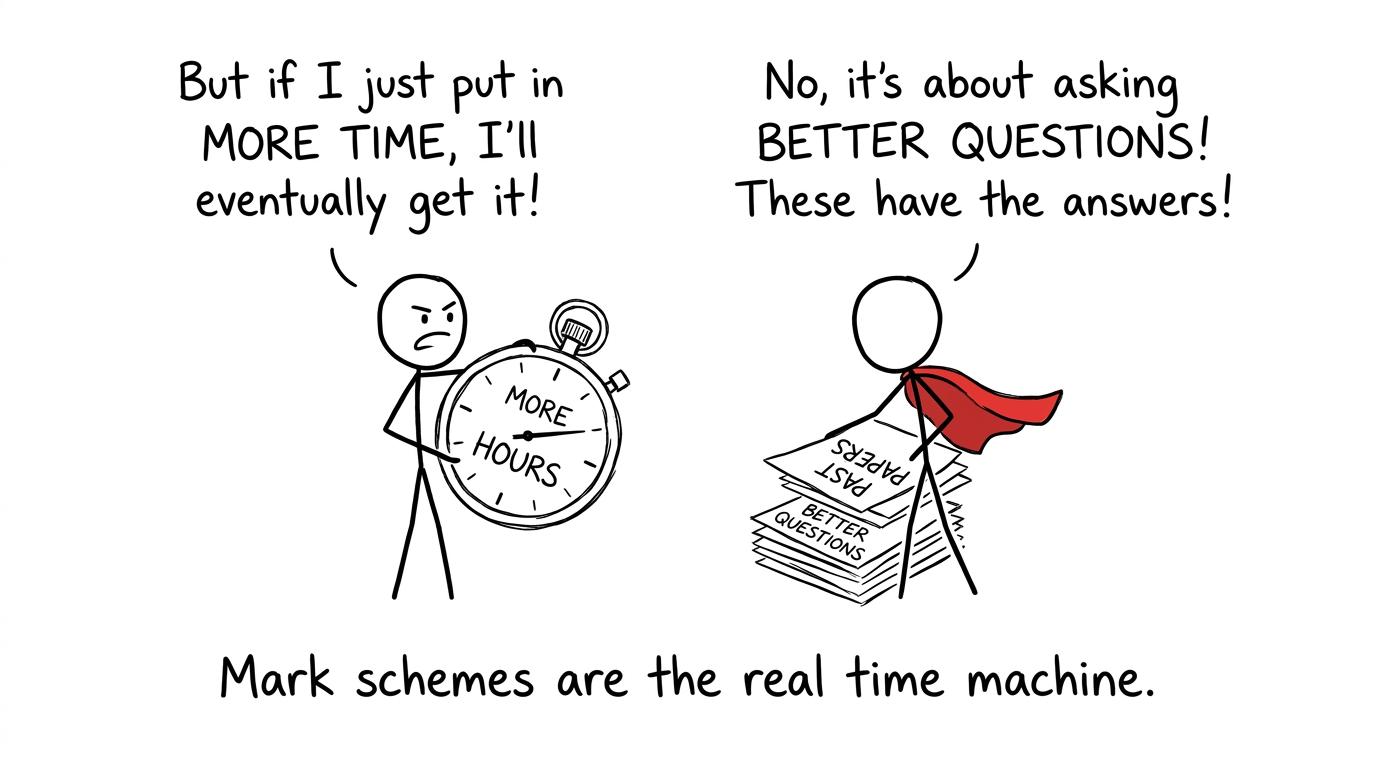 Stopwatch vs stack of past papers debate
A realistic weekly GCSE revision timetable (template)
Below is a timetable you can actually live with. It works for both Foundation and Higher tier GCSE because you’re choosing topics at your level.
Weeknight structure (45 minutes)
- 5 mins: quick recall (formulae, key facts)
- 30 mins: foundations or practice (topic work)
- 10 mins: mark and write one mistake note
Weekend structure (90 minutes)
- 60 mins: timed exam questions
- 30 mins: review mistakes + revise the weakest topic
Example week
- Monday: Foundations session (algebra topic)
- Wednesday: Practice session (geometry topic)
- Thursday: Practice session (ratio/percentages)
- Saturday: Exam session (45-60 minutes timed) + review
If you’re doing GCSE maths alongside A Level subjects, this timetable is deliberately small. The goal is repeatability. After two weeks, you can scale up slightly if you’re coping.
Use self-assessment to choose topics (not vibes)
Students often pick revision topics based on fear. Fear is loud, but it’s not accurate.
Use a self-assessment to identify the real gaps, then build your GCSE revision timetable around them. Maths Genie provides a useful GCSE Maths Self Assessment Sheet (PDF). Work through it honestly. Any area you can’t do confidently becomes a scheduled topic.
Then map your gaps to the learning journey:
- If your weaknesses are early number skills, start at earlier stages on the Scheme of Learning.
- If you’re Higher tier and struggling with harder algebra, use Higher-only stages such as Scheme Stage 11.
This is how a timetable becomes personal. And personal timetables get followed.
Worked example: planning your time like an examiner
A timetable is only useful if it changes how you behave in a question.
Here’s a short GCSE-style example where timing and method matter.
Example: percentage change
A phone costs £480480480. In a sale, the price is reduced by 15%15\%15%.
Find the sale price.
Method
A 15%15\%15% reduction means you pay 85%85\%85% of the original price.
Sale price=480×0.85 \text{Sale price} = 480 \times 0.85 Sale price=480×0.85Calculate:
480×0.85=480×85100=480×0.85=408 480 \times 0.85 = 480 \times \frac{85}{100} = 480 \times 0.85 = 408 480×0.85=480×10085=480×0.85=408So the sale price is £408408408.
Timetable takeaway: If you got stuck here, you don’t need “more papers”. You need one focused foundations session on percentages, then a practice session marking your errors. That’s exactly what a good GCSE revision timetable forces you to do.
Worked example: algebra accuracy beats speed
Example: solve a linear equation
Solve 3(2x−5)=4x+73(2x-5)=4x+73(2x−5)=4x+7.
Expand:
6x−15=4x+7 6x - 15 = 4x + 7 6x−15=4x+7Subtract 4x4x4x from both sides:
2x−15=7 2x - 15 = 7 2x−15=7Add 151515:
2x=22 2x = 22 2x=22Divide by 222:
x=11 x = 11 x=11Timetable takeaway: Many GCSE slips here are sign errors when moving terms. A practice session should include marking with solutions and writing a note like: “When I move a term, I must add/subtract on both sides, not ‘jump it over’.” That one sentence prevents repeating the same mistake.
How to adapt your GCSE revision timetable by tier and exam board
Foundation tier GCSE
Foundation revision should heavily weight fluency: number, fractions, ratio, simple algebra, and straightforward geometry. A strong Foundation timetable uses more short practice sessions and less full-paper work early on, because confidence comes from repeated wins.
A good pattern is: 333 topic sessions per week plus 111 short timed paper section.
Higher tier GCSE
Higher students often have a different problem: they can do lots of topics, but they leak marks on multi-step questions. The timetable should include at least one weekly exam session where you practise completing longer questions under time pressure.
Higher also benefits from revisiting core skills, because even grade 888 to 999 students drop marks on basics when stressed.
Edexcel, AQA, OCR, Eduqas
The content overlaps heavily, but your paper style matters. Whatever your board, use past papers and mark schemes to learn how questions are phrased.
If you’re on AQA, Maths Genie provides an AQA paper collection here: AQA GCSE Maths Past Papers.
And for broader predicted paper practice and revision structure, you can always use the general hub: Resources and Predicted Papers.
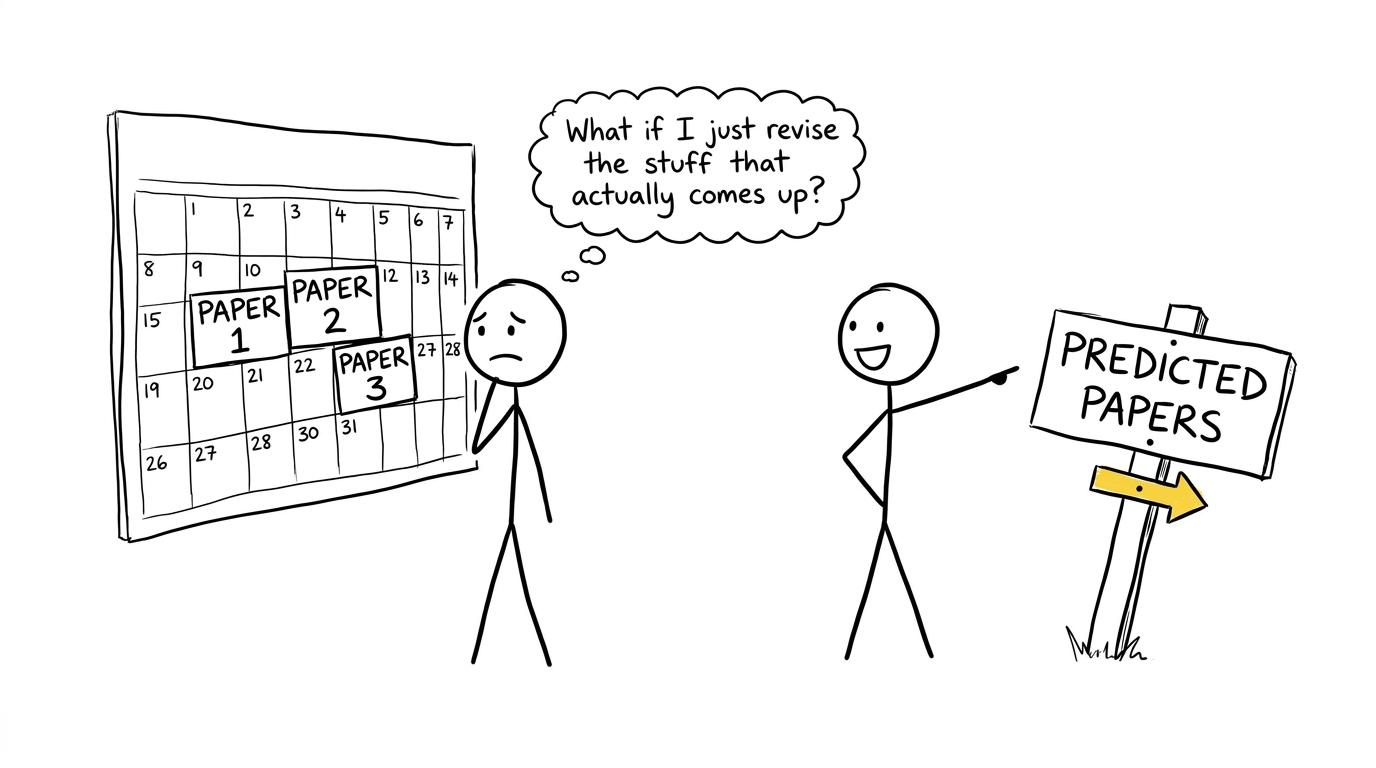 Calendar with Paper 1, Paper 2, Paper 3 and a predicted papers signpost
Common mistakes that break a GCSE revision timetable
- Making the timetable too strict. If missing one session collapses the whole plan, it’s not a plan; it’s a trap. Build catch-up space.
- Only doing questions you can already do. Comfort feels productive, but it doesn’t raise your GCSE grade.
- Never marking properly. If you don’t use solutions and mark schemes, you’re practising mistakes.
- Cramming one topic for hours. Block revision feels satisfying, but spaced practice is more effective for memory.
- Ignoring non-calculator skills. Even confident students lose easy marks when they avoid arithmetic practice.
- Doing full papers too early, too often. Papers are powerful, but only after you’ve repaired the biggest topic gaps.
Bring it together: the timetable is the story you repeat
A GCSE maths grade rarely changes because of one heroic weekend. It changes because you build a timetable that you can repeat when you’re busy, tired, and not in the mood. That repetition creates something subtle: you stop fearing topics because you have a system for them.
If you want a simple next step, do this today:
- Use the GCSE Maths Self Assessment Sheet to identify your gaps.
- Follow the Scheme of Learning to choose the right stage.
- Practise using topic lessons and exam questions on GCSE Revision Summer 2025.
- Add weekly paper practice using AQA GCSE Maths Past Papers (or your exam board equivalent), then refine with Resources and Predicted Papers.
Build your GCSE revision timetable around Maths Genie’s free revision lessons, practice questions, past papers, predicted papers, mark schemes and video solutions, and you’ll feel the difference where it counts: on the page in front of you, in the marks you actually earn.










