GCSE One Month Revision Plan (Maths) That Works
GCSE one month revision plan for maths: weekly focus, past papers, mini tests, and worked examples. Build confidence with Maths Genie resources.

A month sounds like ages, until it’s suddenly a week away and you’re doing that very specific kind of maths where you calculate how many marks you can lose and still get a grade 6. If you’re revising for GCSE maths, the problem usually isn’t motivation. It’s direction. You open a notebook, see a wall of topics, and your brain quietly suggests reorganising your highlighters instead.
This GCSE one month revision plan is designed for real life: school, homework, tired evenings, and the fact that confidence only arrives after you’ve earned it through practice. It also works if you’re an A Level student who wants a disciplined four-week reset (you’ll just scale the difficulty and swap in A Level papers where needed).
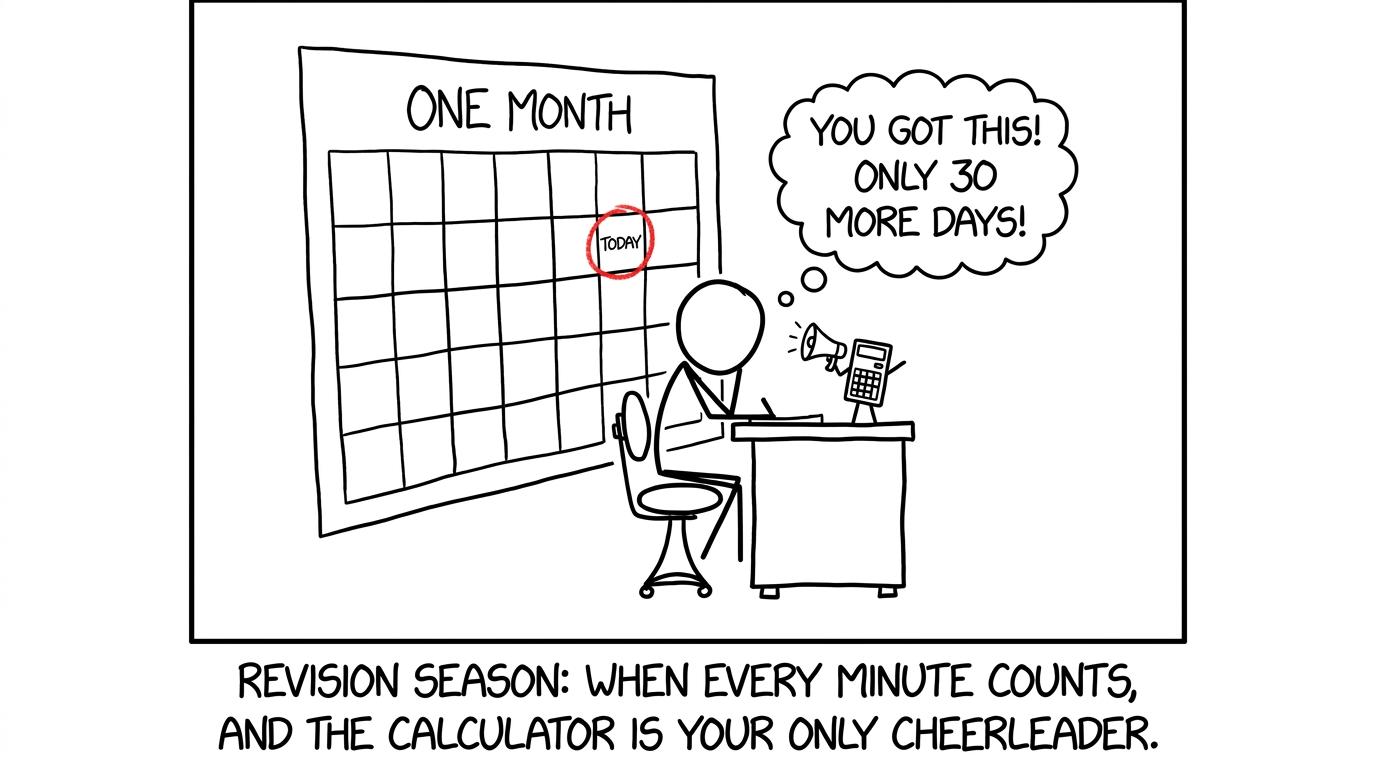 A student vs the one-month calendar
The one month revision plan (quick checklist)
Use this as your daily compass. It keeps GCSE revision simple and measurable.
- Diagnose first: find weak topics (not the ones you like).
- Two-topic blocks per week: depth beats breadth.
- Daily retrieval: short, timed practice beats rereading.
- Past papers every week: start earlier than feels comfortable.
- Mark scheme learning: treat it like a map, not a judgement.
- Spaced repetition: revisit topics after 2 days, then 1 week.
- Final week = exam conditions: timing, accuracy, method marks.
For resources that match this structure, Maths Genie is built for it: revision lessons, practice questions, mark schemes, mini tests, and predicted papers.
Set-up day: build your plan from reality, not vibes
Before Day 1, take one set-up session (30-60 minutes). This is where a good GCSE month starts to feel calm.
Step 1: Choose your exam board and tier
- GCSE exam boards commonly include Edexcel, AQA, OCR and Eduqas.
- Be honest about foundation vs higher tier (and if you’re aiming for a particular grade 9-1 boundary, ask your teacher what’s realistic).
Step 2: Create your topic hit list
Use a quick diagnostic:
- Do a short timed set of mixed questions (or a half paper).
- Mark it and list topics you dropped marks on.
Maths Genie has structured content and papers you can use to do this efficiently, starting at the main Resources page (predicted papers, tests, and more).
Step 3: Decide your daily minimum
Your minimum must be small enough to do on a bad day.
A strong baseline for GCSE maths:
- 30-45 minutes on weekdays
- 60-90 minutes on one weekend day
If you do more, great. But the plan survives because the minimum survives.
Week 1: rebuild core marks (the topics that quietly fund your grade)
Week 1 is where a lot of GCSE grades are won. Not with flashy topics, but with reliable ones: algebra basics, number, fractions, rearranging, standard form, and straight-line graphs.
Aim: turn “I sort of remember” into “I can do it under time pressure”.
Good places to revise by topic include Maths Genie’s GCSE topic pages (for example the broader Shape revision page, plus topic-by-topic revision lessons and questions across the site).
Daily structure (Week 1)
- 10 minutes: mini retrieval (old topic)
- 25 minutes: one focused skill (new/weak topic)
- 10 minutes: exam-style questions + mark scheme check
Worked example: rearranging a formula (common GCSE skill)
Rearrange y=3x−5y = 3x - 5y=3x−5 to make xxx the subject.
Start from:
y=3x−5 y = 3x - 5 y=3x−5Add 555 to both sides:
y+5=3x y + 5 = 3x y+5=3xDivide both sides by 333:
x=y+53 x = \frac{y+5}{3} x=3y+5Why this matters for GCSE: this skill shows up everywhere: straight lines, sequences, physics-style formulae, and “show that” questions where method marks matter.
Week 2: algebra and graphs (where higher-tier confidence is built)
Week 2 is your GCSE algebra week. Even on foundation tier, algebra is the glue that holds marks together.
Focus areas:
- expanding and factorising
- solving linear equations and inequalities
- quadratic basics (higher tier especially)
- coordinates and straight-line graphs
If you’re also doing A Level maths, this is your moment to rebuild the algebra you keep tripping over, because A Level differentiation and integration punish algebra mistakes more than they punish unfamiliar calculus.
You can extend this week for A Level using the A Level (Edexcel) topic page to choose “algebra-first” topics like functions, exponentials/logarithms and trigonometry.
Worked example: solving a quadratic by factorising
Solve x2−5x+6=0x^2 - 5x + 6 = 0x2−5x+6=0.
Factorise:
x2−5x+6=(x−2)(x−3) x^2 - 5x + 6 = (x-2)(x-3) x2−5x+6=(x−2)(x−3)Set each bracket to zero:
x−2=0orx−3=0 x-2 = 0 \quad \text{or} \quad x-3 = 0 x−2=0orx−3=0So:
x=2orx=3 x = 2 \quad \text{or} \quad x = 3 x=2orx=3Exam craft note for GCSE: if the question says “solve”, you nearly always need the solutions, not just the factorisation. Those last two lines are often the final mark.
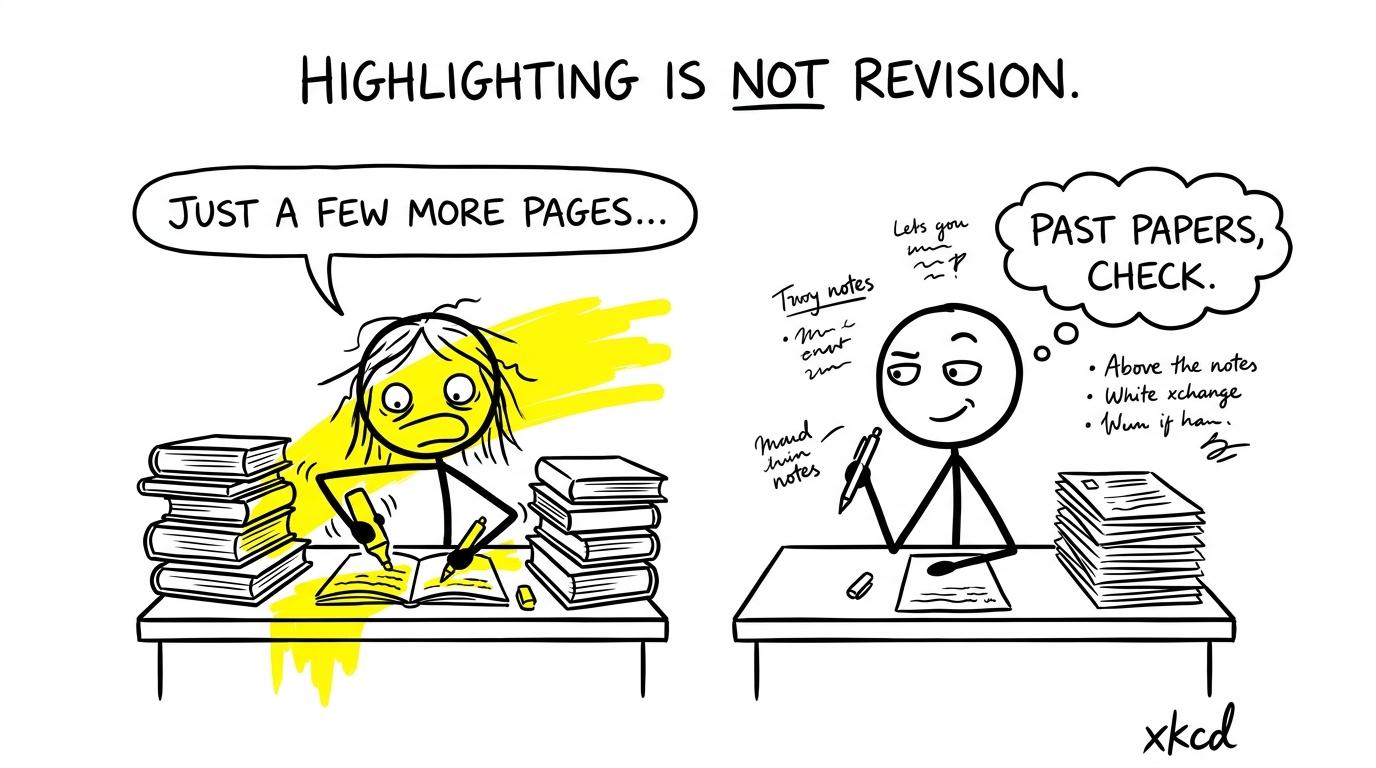 Highlighting vs doing past papers
Week 3: the examiner’s favourites (ratio, probability, geometry, trig)
By Week 3, your GCSE revision should shift from “I can do a topic” to “I can do it when it’s disguised”. This is where questions combine skills.
Pick two or three clusters:
- ratio, proportion, percentages
- probability and Venn diagrams
- angles, bearings, circle theorems (higher)
- Pythagoras and trigonometry
- area/volume and compound measures
The goal: fewer surprises. Not because the paper becomes predictable, but because you become adaptable.
Worked example: trigonometry in a right-angled triangle
In a right-angled triangle, the hypotenuse is 10 cm10\text{ cm}10 cm and an angle is 35∘35^\circ35∘. Find the length of the side adjacent to the 35∘35^\circ35∘ angle.
Use cosθ=adjacenthypotenuse\cos\theta = \frac{\text{adjacent}}{\text{hypotenuse}}cosθ=hypotenuseadjacent:
cos35∘=a10 \cos 35^\circ = \frac{a}{10} cos35∘=10aSo:
a=10cos35∘ a = 10\cos 35^\circ a=10cos35∘Calculate:
a≈10×0.8192=8.192 a \approx 10 \times 0.8192 = 8.192 a≈10×0.8192=8.192So a≈8.19 cma \approx 8.19\text{ cm}a≈8.19 cm (to 333 s.f.).
GCSE mark scheme habit: round appropriately, and include units. If the question implies a measurement, write cm\text{cm}cm.
Week 4: exam conditions, mark schemes, and finishing strong
Week 4 is where you stop hoping you’ll be fine and start proving it.
Your plan for this final GCSE week:
- 2 full papers under exam conditions (timed, quiet, no pauses)
- 2 targeted paper halves (or 45-minute blocks)
- Daily fix sessions (repeat the exact type you missed)
Maths Genie’s papers and solutions make this part straightforward. Start at the Resources page and choose the right level of paper for your stage.
For A Level students, use the A Level exam paper video solutions page and the A Level revision hub to run the same pattern: timed papers, mark scheme learning, then targeted drills.
The 3-pass method (works brilliantly in GCSE maths)
When you do a GCSE paper, don’t treat it like one long battle. Treat it like three smaller ones:
- Pass 1 (easy marks): take anything you can do in under a minute.
- Pass 2 (thinking marks): the multi-step questions.
- Pass 3 (rescue marks): return to the hardest ones and hunt method marks.
You’re not trying to be perfect. You’re trying to be strategic.
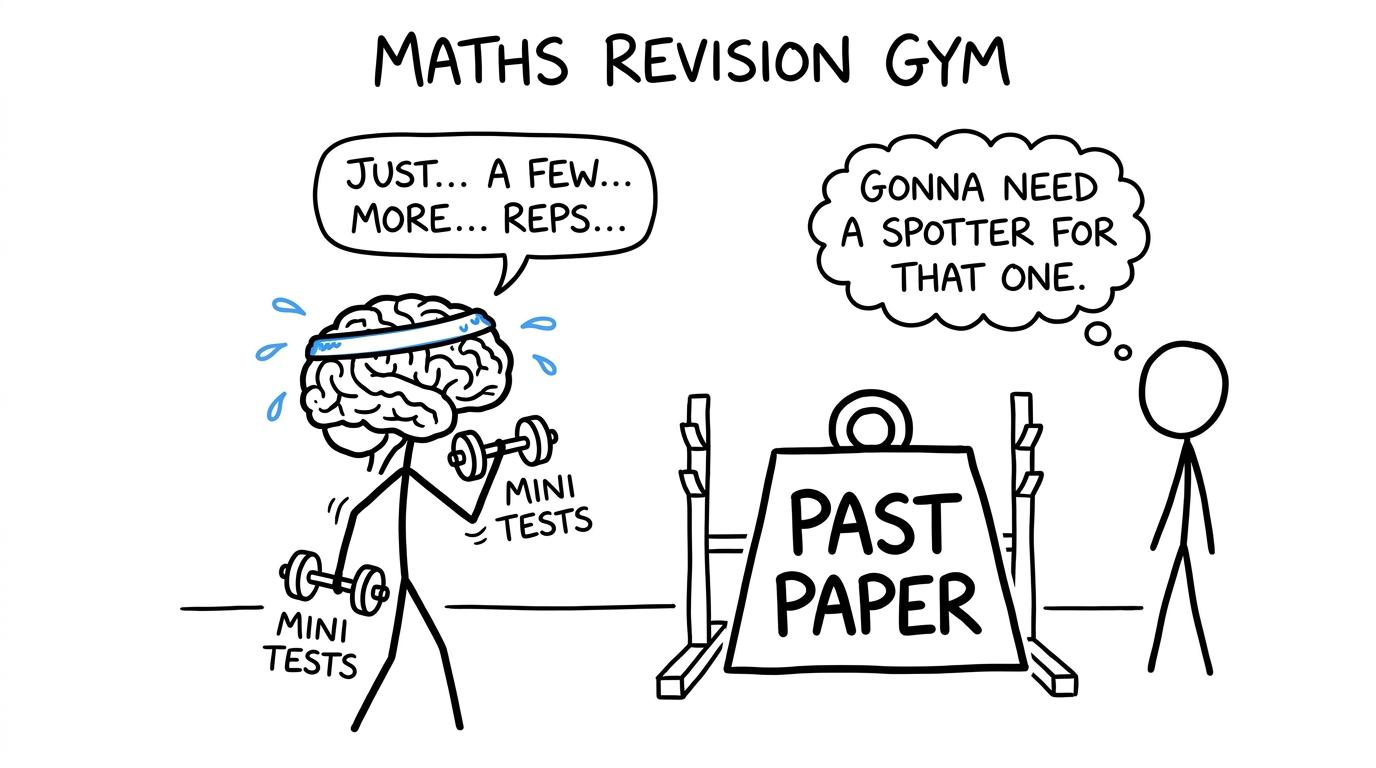 Mini tests as training, past paper as the big lift
A simple weekly timetable you can copy (GCSE + A Level friendly)
You can adapt the topics, but keep the rhythm. Consistency is most of the story.
Monday to Thursday (45 minutes)
- 10 min retrieval (old topic)
- 25 min focused lesson + examples
- 10 min exam questions + mark scheme
Friday (30-45 minutes)
- Mini test / mixed questions
- Mark and list “next week fixes”
Weekend (60-90 minutes)
- Half paper or full paper (depending on stamina)
- Mark scheme review and redo mistakes
If you want smaller exam blocks, use split papers such as Edexcel GCSE 45 Minute Tests to practise timing without burning out.
Common mistakes that waste marks (and how to stop them)
These show up constantly in GCSE maths, across Edexcel, AQA, OCR and Eduqas.
Not writing the final answer the question asked for
You find xxx, but the question asked for 2x+12x+12x+1. Or you calculate the radius when it asked for the diameter. Train yourself to underline the final request.
Rounding too early
If you round mid-calculation, your final answer drifts. Keep full calculator precision, then round at the end. If you must round, keep at least 444 significant figures during working.
Losing method marks by skipping steps
Even when you can do it in your head, the examiner can’t see that. In GCSE, visible method is protection. Two extra lines can be the difference between 000 and 222 marks.
Mixing up sine and cosine rules (or SOHCAHTOA)
This is usually a “which side is opposite?” problem, not a memory problem. Draw the triangle again and label it clearly.
Not learning from the mark scheme
The mark scheme isn’t there to tell you you’re wrong. It’s there to show you what a full-mark solution looks like. Treat it like a model answer you can copy in your own style.
Closing: make this month count (and keep it simple)
A month of GCSE revision doesn’t need to feel dramatic. It needs to feel deliberate. Most students don’t fail because they didn’t care; they fail because their revision was scattered, or because they only practised what already felt safe.
So pick your minimum. Stick to the weekly rhythm. Do the papers. Learn from the mark schemes. Then repeat the exact questions you got wrong until they stop being “tricky” and start being familiar.
When you’re ready to run this plan properly, build it around Maths Genie: use the revision lessons to understand the method, the practice questions to make it yours, the mini tests to build speed, and the past papers and predicted papers to make exam day feel like another practice session. Start at the Maths Genie Resources hub, and commit to the next 30 days like it matters, because in GCSE maths, it genuinely does.