GCSE Physics Homework Grade Impact: Does It Matter?
GCSE physics homework grade impact explained: see when homework raises exam marks, when it wastes time, and how to balance physics with maths revision.
A physics worksheet can occupy an entire evening without teaching you very much. Another might take twenty focused minutes and expose the exact misunderstanding that would otherwise cost marks in June. That difference explains the real GCSE physics homework grade impact: homework can improve your final result, but completing more of it does not automatically produce a higher grade.
Homework itself does not normally count towards your GCSE Physics grade. Your result comes from the assessments defined by your exam board's specification. Homework matters indirectly, by strengthening the knowledge, application, mathematical and practical skills those assessments test.
The useful question is therefore not simply, “Did I finish it?” It is, “Did this homework make me more capable of answering an exam question without help?”
The short answer
Effective physics homework is likely to help when it:
- revisits content already taught in class;
- requires you to retrieve knowledge without copying;
- includes calculations, graphs and exam-style questions;
- is marked accurately and followed by corrections;
- targets a specific weakness;
- is completed in focused sessions rather than exhausted marathons.
Its value falls when it becomes copying, passive reading, decorative note-making or repeated practice of something you can already do confidently.
If you are balancing physics with maths revision, do not treat the subjects as complete rivals. Algebra, standard form, proportion, graphs and unit conversion support both. Start with the weakest high-mark skill, then use feedback to decide what deserves the next session.
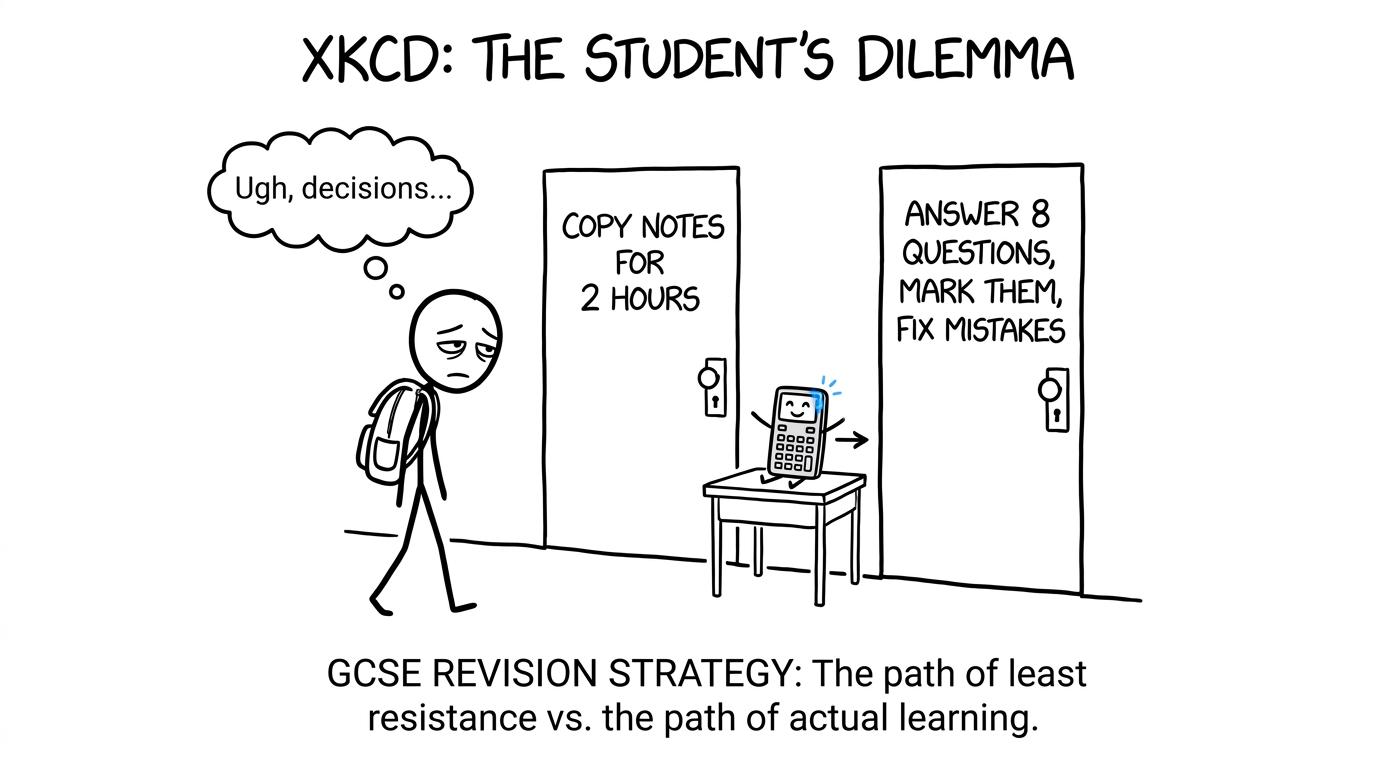 A student chooses between copying notes and focused marked questions
What the evidence actually says about homework
The Education Endowment Foundation's current Teaching and Learning Toolkit reports a positive average effect for homework, with a larger average impact at secondary school than at primary school. Its headline estimate is equivalent to several months of additional progress.
That finding needs careful interpretation. It is an average across different subjects, schools, tasks and pupils. The evidence security is rated low, and it does not mean that one worksheet adds a predictable fraction of a GCSE grade. Nor does it isolate GCSE Physics homework precisely.
Government research reviews have also found associations between completing homework and stronger secondary-school attainment. Yet association is not the same as cause. Pupils who complete homework consistently may also attend more regularly, receive more support, organise their time better or already feel more motivated.
The most defensible conclusion is modest but useful: well-designed homework can improve learning, especially at secondary school, but quality, purpose and feedback matter more than accumulating hours.
This matches the practical experience of revision. A task linked closely to recent teaching gives you a chance to consolidate it. Feedback then closes the loop. Without feedback, the same misconception may simply become more familiar.
Why physics homework can transfer into exam marks
GCSE Physics papers do not only test remembered facts. Across exam boards such as AQA, Edexcel, OCR and Eduqas, students must also apply ideas, analyse information, interpret evidence and handle mathematical relationships. Exact paper structures vary, so always follow your own specification and teacher's guidance.
AQA's current GCSE Physics assessment objectives, for example, give substantial weight to both knowledge and application, with further marks for analysis and evaluation. That helps explain why merely rereading a textbook feels productive but often transfers poorly to an unfamiliar question.
Useful homework rehearses the actions required in the assessment:
- selecting relevant information;
- recalling definitions accurately;
- choosing and rearranging equations;
- substituting values with consistent units;
- interpreting graphs and experimental data;
- explaining relationships using precise scientific language;
- evaluating methods and suggesting improvements.
For a sense of what focused topic practice looks like, explore MathsGenie's speed, velocity and acceleration revision resources. The accompanying motion revision guide connects equations, units and graphs rather than treating them as separate pieces of knowledge.
The homework features that matter most
It forces an honest attempt
Recognition is comfortable. Retrieval is revealing. If you look at a formula and think, “I knew that,” you have tested familiarity rather than recall.
Begin suitable homework questions with your notes closed. Attempt what you can, mark the work, and only then consult a lesson or guide. MathsGenie's guide to turning physics notes into active recall offers a practical structure for converting notes into questions and retesting missed material.
It provides usable feedback
A total mark tells you how the attempt ended. A correction tells you what to change.
Classify lost marks as:
- knowledge, a fact, definition or relationship was missing;
- selection: you knew several ideas but chose the wrong one;
- mathematics: algebra, arithmetic, graphs or standard form caused the error;
- units: values were not converted or the final unit was absent;
- communication: the scientific explanation was too vague;
- exam technique: you misread a command word or did not show enough working.
The category determines the repair. There is little value in rereading an entire forces chapter when the actual problem is changing the subject of a formula.
It returns to weaknesses later
Correcting an answer while the mark scheme is open can create an illusion of mastery. Retest the same skill on another day, preferably with a different question.
That delay matters because the exam requires independent recall after time has passed. The MathsGenie guide to using past papers properly follows the same principle: attempt, mark, diagnose, repair and retest.
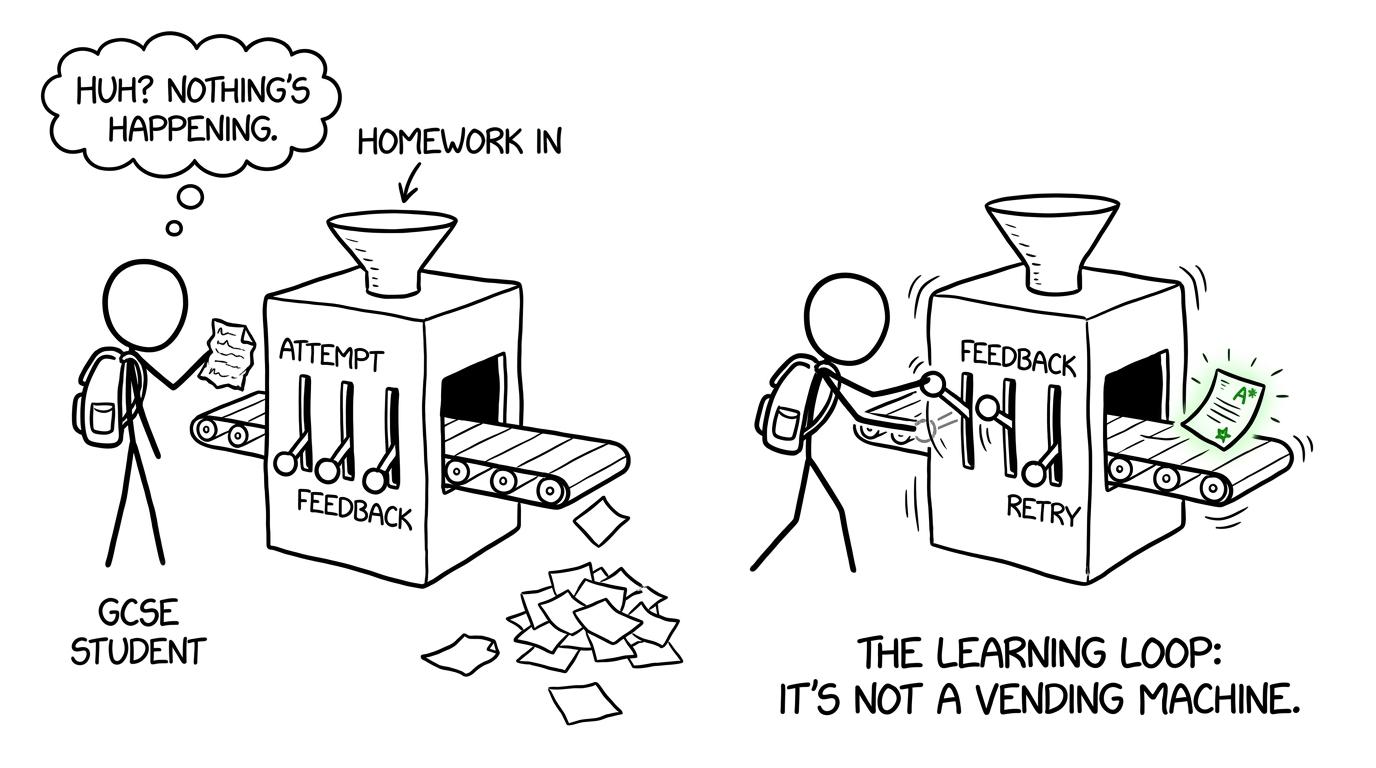 A homework machine only produces progress after attempt, feedback and retry
When physics homework becomes low-value work
Not every completed task deserves equal credit in your revision plan. Homework becomes less useful when you:
- copy answers from notes or another person;
- spend most of the session formatting headings;
- watch solutions before attempting questions;
- continue practising secure material while avoiding weak topics;
- mark only final answers and ignore method marks;
- work for so long that concentration and accuracy collapse;
- leave corrections until you can no longer remember your reasoning.
This does not mean you should ignore assigned homework. Your teacher may be using it to diagnose class-wide gaps or prepare the next lesson. Complete required work, but improve its learning value: attempt it independently, identify uncertainty and use feedback.
If a long worksheet contains many nearly identical questions, ask whether each new answer is still testing you. Once the method is secure, mixed questions or a different topic may offer greater value. Students currently stuck around a pass grade can use the more targeted priorities in how to revise GCSE Physics when you are stuck.
Should physics homework take time away from maths revision?
Sometimes. Time has an opportunity cost: an hour used for one subject cannot also be used for another. But the best decision depends on deadlines, current weaknesses and upcoming exams, not on which subject feels easier tonight.
Use this order of priority:
- Complete urgent, purposeful work set by your teacher.
- Repair recurring weaknesses revealed by marked questions.
- Prepare for the nearest assessment.
- Protect regular maths practice rather than abandoning it for several weeks.
- Reduce passive tasks before cutting exam-style practice.
The boundary between physics and maths is also more porous than it appears. Physics homework can strengthen substitution, rearranging formulae, proportional reasoning, gradients, areas under graphs, significant figures and standard form. Those skills can support GCSE Maths, while stronger maths reduces the cognitive load of physics calculations.
If both subjects need attention, divide the session by task rather than vaguely “doing revision”. For example, use one focused block for a physics question set and another for maths practice. The exact length matters less than having a clear outcome and marking the work.
MathsGenie's article on revising OCR Physics without wasting time shows how equation work, units, graphs and error correction can be organised efficiently. For broader sequencing, the best order for learning GCSE maths topics helps you prioritise transferable number, algebra and graph skills.
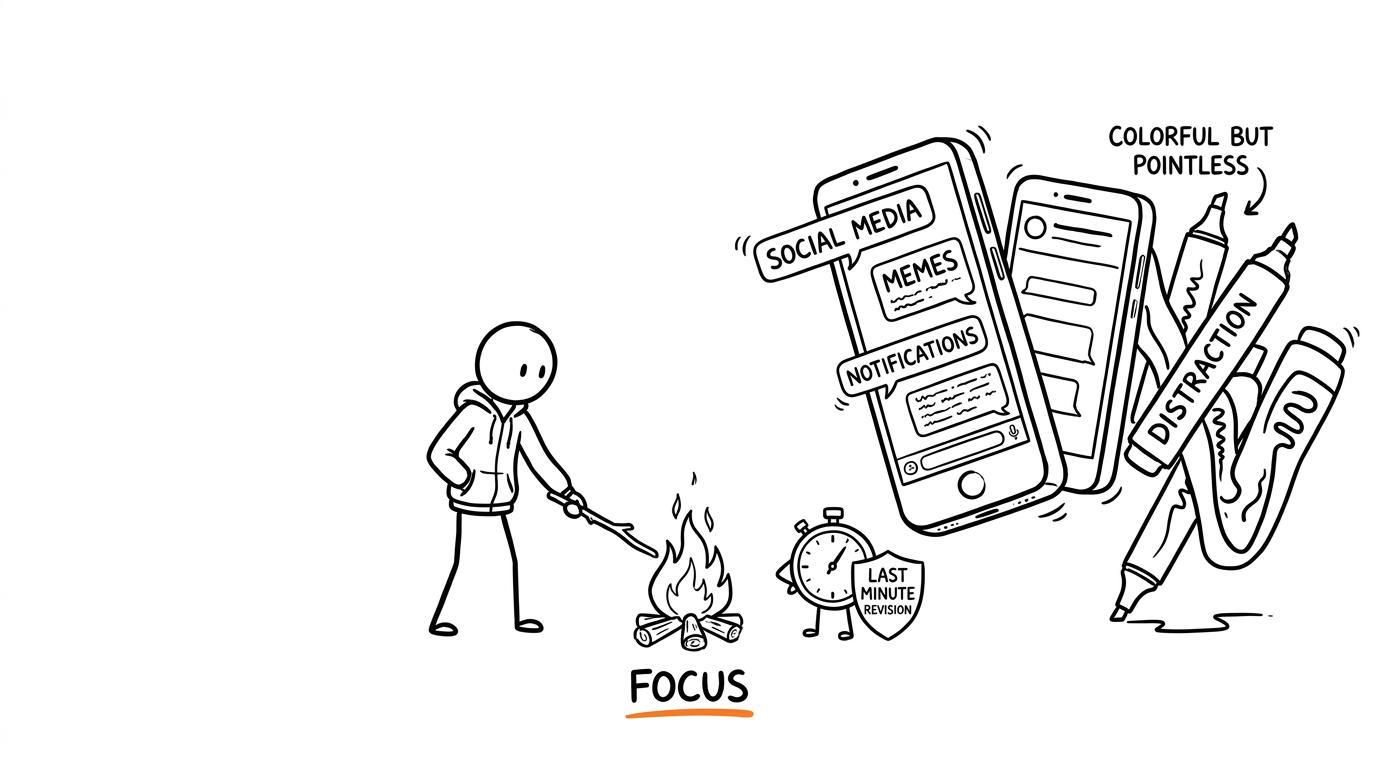 A student protects focused revision from phones and endless highlighting
A better homework routine
A strong routine does not need to be elaborate:
Before starting
Choose one purpose: recall, calculation practice, data interpretation, practical evaluation or exam technique. Remove distractions and gather the correct specification, calculator and resources.
During the task
Work without notes first where appropriate. Show each stage of calculations, retain units and mark uncertain answers rather than immediately searching for help. Difficulty is useful information.
After the task
Mark promptly. Record the cause of each lost mark in one sentence, review the relevant revision lesson, then answer a fresh question. Schedule a short retest later.
As exams approach, past and predicted papers can reveal whether isolated homework skills survive in mixed conditions. MathsGenie's Edexcel GCSE Maths predicted papers include mark schemes and solutions, while the advice on whether to redo GCSE past papers explains why repair should come before repetition.
Common homework mistakes
Measuring success by time: A long session may reflect distraction or confusion. Measure completed questions, corrected errors and successful retests instead.
Treating completion as understanding: Finished work can still contain copied methods or unchecked misconceptions. Close the notes and explain the idea independently.
Ignoring mark-scheme language: Physics explanations often require precise links between cause and effect. Compare your wording carefully rather than checking only whether it sounds similar.
Dropping units and working: Correct reasoning may earn method marks even when arithmetic goes wrong. Write the equation, substitution and unit clearly.
Doing only favourite topics: Confidence feels good, but recurring errors identify where the next marks are most likely to come from.
Sacrificing sleep for routine homework: Tired, unfocused work can have diminishing value. Speak to your teacher if workload is repeatedly unmanageable rather than silently copying or rushing it.
Make homework serve the grade
Homework is not a receipt proving that revision happened. It is a tool. Its GCSE Physics value comes from what changes after you complete it: stronger recall, cleaner calculations, better explanations and fewer repeated errors.
Start with one honest attempt. Mark it. Name the weakness. Repair it. Return later and see whether the improvement remains.
MathsGenie gives you a free base for that cycle. Use the MathsGenie revision hub to move between revision lessons, practice questions, mini tests, past papers, predicted papers, mark schemes and video solutions. Add each task to your revision planner, then let your mistakes decide what comes next. The aim is not to do the most homework. It is to make each focused session more likely to become marks when the paper is in front of you.