GCSE: How to Use Past Papers Properly
GCSE past papers work best with timing, marking and an error log. Learn a simple method to turn every paper into higher grades with Maths Genie.
Past papers feel like the most honest mirror in revision. You sit down, open a paper, and within ten minutes you’re either flying or staring at a question that makes you forget everything you’ve ever learned.
That’s why GCSE past papers are so powerful. Not because they magically raise your grade, but because they reveal what your brain does under exam pressure: where you rush, where you freeze, and which topics only feel secure. Used properly, a past paper becomes a map. Used badly, it becomes a treadmill.
This post shows you how to use past papers properly for GCSE maths (foundation and higher) and how the same approach scales up for A Level maths too.
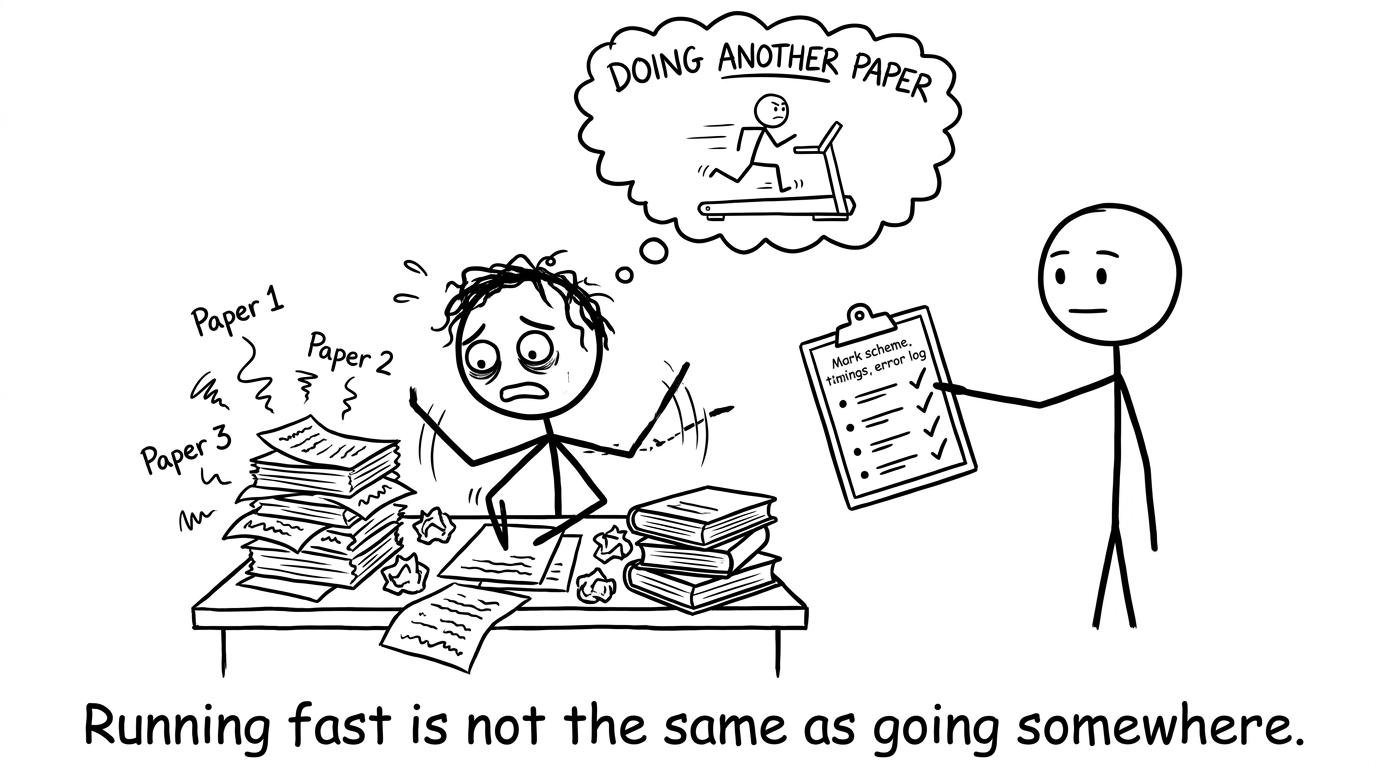 A student learns that more papers isn't always better
The past paper method (the checklist that actually works)
If you remember nothing else, remember this: a past paper is not revision. It is assessment. The revision happens afterwards.
Use this loop every time:
- Choose the right paper (tier, board, calculator/non-calculator)
- Sit it like the real thing (timing, silence, no hints)
- Mark it properly (method marks, not just answers)
- Build an error log (one line per mistake, with a fix)
- Relearn the weak topic (lesson + practice questions)
- Retest the weakness (mini test or topic set)
- Repeat with the next paper
Maths Genie makes the loop simple because you can move from papers to mark schemes to video solutions, then straight into topic-by-topic practice.
Useful starting points:
- GCSE Predicted Papers and Resources
- Edexcel Predicted Papers (GCSE)
- AQA GCSE Papers (Foundation and Higher)
- OCR GCSE Past Exam Papers
- AQA A Level Past Exam Papers
- GCSE Mini Tests (quick retesting)
Choosing the right past papers for GCSE and A Level
Not all past papers are equally useful at every stage of revision.
Match your exam board and tier first
For GCSE maths, the big boards are Edexcel, AQA, OCR and Eduqas. The style is similar, but wording and structure can differ enough to throw you in an exam if you’ve only practised one type.
Also make sure you’re using the correct tier:
- Foundation tier targets grades 111 to 555.
- Higher tier targets grades 444 to 999.
That doesn’t mean higher students should never look at foundation questions. It means your past paper practice should mostly reflect what you’ll sit.
Use shorter papers when your stamina is low
If full papers make you switch off, you don’t need more motivation; you need better sizing.
A strong stepping stone is completing shorter timed sets, then building up. Maths Genie has split-paper practice that suits this idea:
Save predicted papers for the right moment
Predicted papers are brilliant, but only if you treat them like a dress rehearsal. If you do them too early, they become just another worksheet. If you do them near the end, they test whether your revision has actually stuck.
Start here:
How to sit a GCSE past paper properly (without kidding yourself)
The aim is to recreate exam behaviour, not homework behaviour.
Set exam conditions you can repeat
- Use the correct time limit (typically 111 hour 303030 minutes for many GCSE papers)
- No notes, no phone, no pause button
- Use the right equipment (ruler, protractor, calculator if allowed)
- Start with the front page instructions (it trains your brain)
Then do something that feels small but changes everything: write the time you started and the time you should finish.
If you start at 18:1018{:}1018:10 on a 909090 minute paper, your finish time is
18:10+1:30=19:40. 18{:}10 + 1{:}30 = 19{:}40. 18:10+1:30=19:40.That one line prevents the slow drift into “I’ll just take a bit longer”.
Use a simple timing rule inside the paper
When students say “I ran out of time”, it’s often because they donated ten minutes to a question worth two marks.
Try this rule:
- If you’ve made no progress after 909090 seconds, circle the question number, leave space, move on.
- If you’ve made some progress, give it another minute, then decide.
In maths, momentum is a mark-winning habit.
Marking: how to turn a GCSE mark scheme into a teacher
Most students mark like this:
Tick, cross, total, sigh.
Proper marking is slower, but it’s where the grade jumps happen.
Mark for method, not just the final answer
A typical mark scheme rewards steps, not just results. For example, suppose a question asks you to solve
3(x−2)=15. 3(x-2)=15. 3(x−2)=15.A full-mark method is:
3(x−2)=15 3(x-2)=15 3(x−2)=15 x−2=5 x-2=5 x−2=5 x=7. x=7. x=7.If you wrote the first two lines but made an arithmetic slip at the end, you might still earn method marks. When you mark your own work, you learn what examiners reward: clear algebra, sensible steps, and readable working.
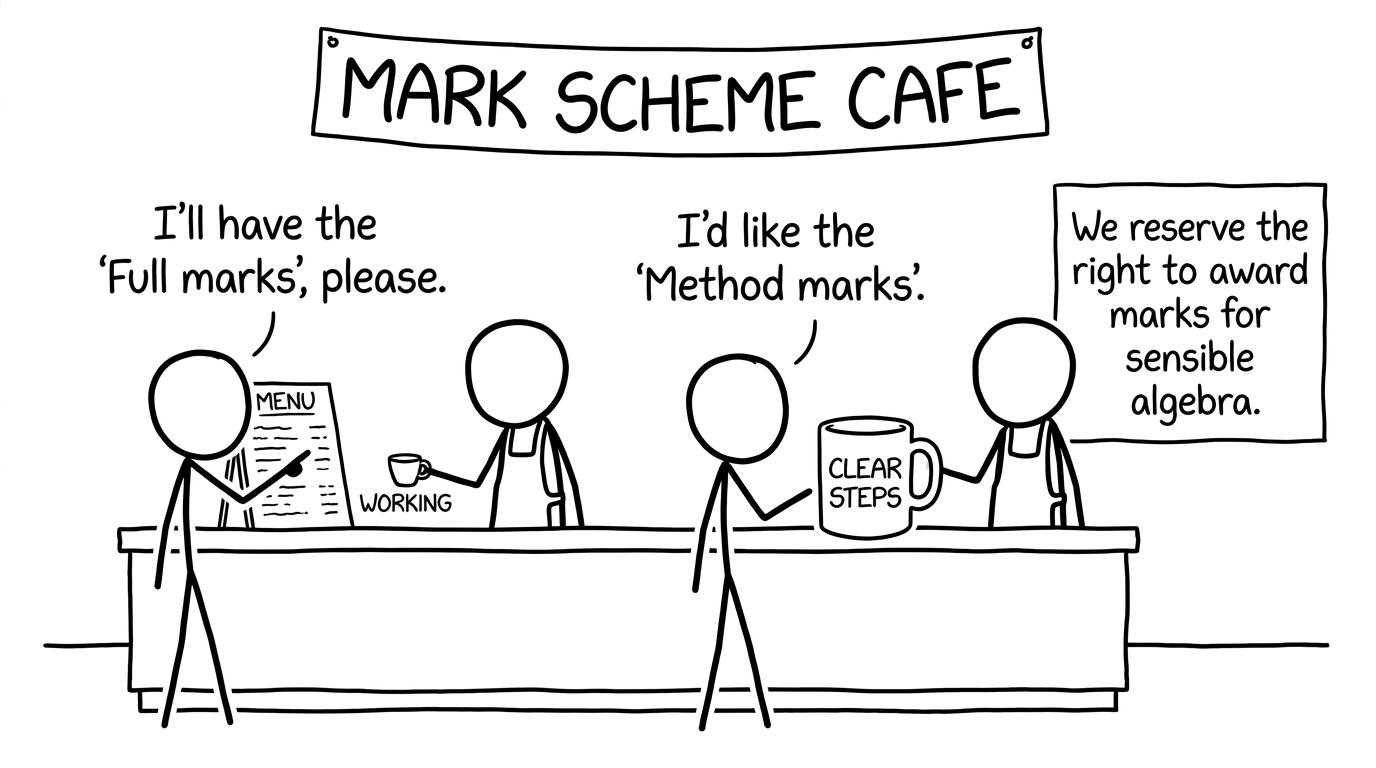 A humorous look at method marks
Add one extra step: classify the error
Next to each lost mark, write one letter:
- T = topic gap (you didn’t know what to do)
- P = procedure slip (you knew, but executed badly)
- C = careless (sign error, misread, wrong substitution)
- S = speed (ran out of time, rushed final line)
This matters because each category has a different fix.
Your error log: the quiet tool behind confident GCSE results
An error log is a small document (paper or digital) with one row per mistake:
- Paper + question
- Topic
- What went wrong (one sentence)
- Correct method (two or three lines)
- A “next time” rule
Here’s what that looks like with a common topic: standard form.
Worked example: standard form under pressure
Suppose the question is:
“Write 0.000560.000560.00056 in standard form.”
Standard form is a×10na \times 10^na×10n where 1≤a<101 \le a < 101≤a<10.
Move the decimal to make a number between 111 and 101010:
0.00056=5.6×10⁻⁴. 0.00056 = 5.6 \times 10^{-4}. 0.00056=5.6×10⁻⁴.Because the decimal moved 444 places to the right, the power is negative.
Your error log entry might say:
- What went wrong: “I wrote 5.6×1045.6 \times 10^{4}5.6×10⁴ (power sign wrong).”
- Next time rule: “If the original number is less than 111, then nnn is negative.”
That single rule can save multiple marks across multiple papers.
The fix loop: what to do after a past paper
A past paper tells you where you are. The fix loop moves you forward.
Relearn the topic with one clear explanation
If your error type is T (topic gap), go straight to a lesson and rebuild the idea. Maths Genie’s strength is that you can revise the exact weak area, then practise it immediately using exam-style questions and mark schemes.
If you’re revising beyond GCSE content, you can do the same at A Level:
Practise just enough to prove you’ve improved
After relearning, do targeted practice. Then retest with something small and timed.
A brilliant quick retest tool is:
Mini tests stop you from pretending a topic is fixed. You either score well or you don’t, and your revision stays honest.
Then return to the next full paper
This is where most students go wrong. They do five full papers back-to-back, never repairing the holes. The correct rhythm is:
Paper -> mark -> fix -> retest -> next paper.
It looks slower, but it compounds.
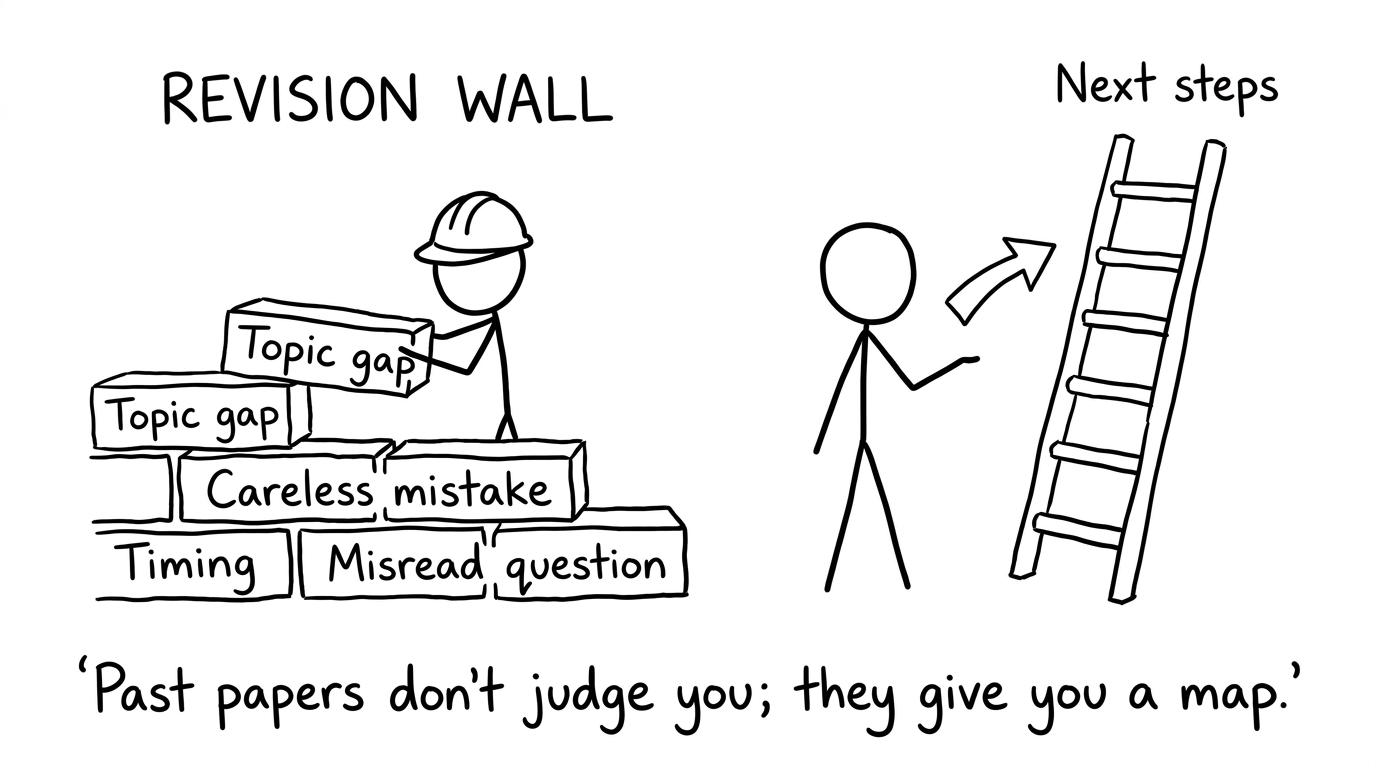 Past papers as a map rather than a judgement
Two exam-style worked examples (GCSE core skills)
Past papers reward reliable techniques. Here are two that appear constantly across Edexcel, AQA, OCR and Eduqas.
Worked example: fractions in an algebra context
Simplify:
34x+16x. \frac{3}{4}x + \frac{1}{6}x. 43x+61x.Find a common denominator. The LCM of 444 and 666 is 121212:
34x=912x,16x=212x. \frac{3}{4}x = \frac{9}{12}x, \quad \frac{1}{6}x = \frac{2}{12}x. 43x=129x,61x=122x.Add:
912x+212x=1112x. \frac{9}{12}x + \frac{2}{12}x = \frac{11}{12}x. 129x+122x=1211x.A common GCSE mistake is adding denominators (getting 410x\frac{4}{10}x104x or similar). Past paper marking quickly punishes that, so your method needs to be automatic.
Worked example: simultaneous equations (one substitution)
Solve:
y=2x+1 y = 2x + 1 y=2x+1 x+y=10. x + y = 10. x+y=10.Substitute yyy into the second equation:
x+(2x+1)=10 x + (2x+1)=10 x+(2x+1)=10 3x+1=10 3x+1=10 3x+1=10 3x=9 3x=9 3x=9 x=3. x=3. x=3.Now find yyy:
y=2(3)+1=7. y=2(3)+1=7. y=2(3)+1=7.So the solution is (x,y)=(3,7)(x,y)=(3,7)(x,y)=(3,7).
In a GCSE mark scheme, you’ll often earn marks for the substitution line and the solving line separately. Clear working is not “extra”; it’s literally where marks live.
Common mistakes when using past papers
- Doing papers open-book: it feels productive, but it trains a behaviour you’re not allowed in the exam.
- Marking too generously: if your working is unclear, assume the examiner can’t award the mark.
- Ignoring method marks: losing 111 mark repeatedly on “show your working” questions is a silent grade killer.
- No error log: without a record, you repeat the same mistakes and call it “bad luck”.
- Only doing your favourite topics: past papers should expose discomfort, not avoid it.
- Using predicted papers too early: predicted papers are most valuable when your foundation is already built.
- Never retesting: if you don’t retest a weak topic, you don’t actually know if it’s fixed.
Bringing it all together (and making Maths Genie your system)
The students who improve fastest aren’t the ones who “do loads of papers”. They’re the ones who use each GCSE past paper like an investor uses a statement: not to feel judged, but to decide the next sensible move.
So here’s your plan for this week:
- Choose one paper from your exam board and tier
- Sit it properly, timed
- Mark it with the mark scheme and be strict
- Write an error log and classify each mistake
- Use Maths Genie revision lessons and practice questions to fix the biggest two gaps
- Retest with a mini test
- Repeat
When you’re ready to scale up, use:
- GCSE Predicted Papers and Resources
- AQA GCSE Papers (Foundation and Higher)
- Edexcel Predicted Papers (GCSE)
- OCR GCSE Past Exam Papers
- Edexcel 45 Minute Tests
- GCSE Mini Tests
- A Level Maths Revision
- AQA A Level Past Exam Papers
If you want a single place to run the whole process: revision lessons, past papers, predicted papers, practice questions, mark schemes and video solutions; Maths Genie is built for exactly that. Pick your next paper, and let it tell you the truth. Then use that truth to get better.