How to Revise GCSE Physics When You’re Stuck at a Pass
GCSE Physics revision plan for students stuck at a pass grade. Learn the maths-first methods, exam technique, and practice routine to move up.
If you’re stuck at a pass grade, it rarely means you “don’t get” GCSE Physics. It usually means you’re leaking marks in predictable places: rearranging formulas, handling units, reading graphs, and writing the kind of explanation the mark scheme recognises. The strange comfort is that these are not mysterious problems. They are fixable habits.
A student I once spoke to described revision like this: “I revise for hours and still get the same score.” When we looked at their paper, the story was different. They weren’t losing marks on the big ideas. They were losing them on the small decisions made under pressure. In GCSE Physics, a pass can become a strong grade just by learning to make better small decisions.
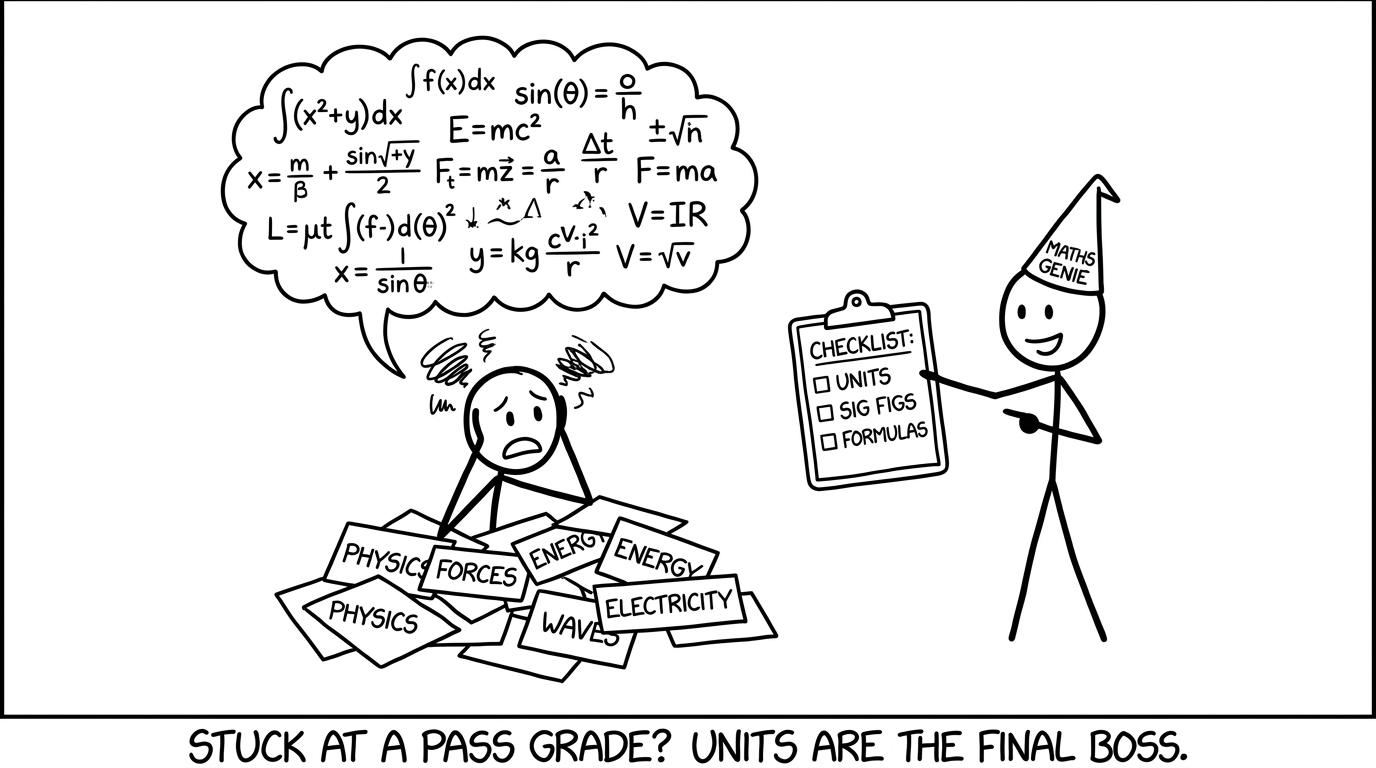 A stressed student meets a checklist
The pass-to-strong-grade checklist (save this)
If you’re aiming to move beyond a GCSE pass, prioritise these in order:
- Learn the “core equations” and, more importantly, how to rearrange them.
- Master units and prefixes (especially k\text{k}k, m\text{m}m, μ\muμ) so your answers scale correctly.
- Practise graphs: gradients, intercepts, and what a straight line through the origin implies.
- Do exam-style questions with mark schemes, not just notes.
- Build a mistake log and revisit it every 48 hours.
YesGenie is designed for this kind of targeted improvement: revision lessons, practice questions, and mark schemes that make patterns obvious. Start with the GCSE Past Papers and use Resources when you want predicted papers, mini tests, and shorter timed sets.
Why you get stuck at a GCSE pass grade in Physics
A pass-grade plateau happens because Physics is a two-language subject.
- One language is concepts: forces, energy, electricity, waves.
- The other language is maths: ratios, rearranging, graphs, powers of ten.
At GCSE level, the conceptual knowledge often isn’t the limiting factor. The limiting factor is translation. You know what the question is about, but you can’t translate it into a clean method quickly enough.
That’s good news for a maths student, because translation is trainable. And you can train it using the same approach you use in maths: methods, routines, checking.
If you want one place to strengthen that “maths engine”, use the YesGenie maths revision guides alongside Physics practice. Two of the most useful cross-over skills are rearranging formulas and handling standard form.
- Transforming Graphs y=f(x)y=f(x)y=f(x) (GCSE Maths) for graph confidence and reading changes.
- Standard Form (Revision Guide) for prefixes, big numbers, and tiny numbers.
GCSE Physics revision that actually moves marks
Treat equations like sentences you can rewrite
Most GCSE Physics calculations are the same three-step loop:
- Write the equation.
- Rearrange for the subject you need.
- Substitute values with units and calculate.
The step that creates the biggest jump in marks is step 2. Rearranging is where pass-grade students hesitate, guess, or press buttons too soon.
Here’s a core example you’ll see across AQA, Edexcel, OCR and Eduqas.
Worked example: weight from mass
Use the equation W=mgW = mgW=mg.
A student has mass m=75 kgm = 75\text{ kg}m=75 kg. Take gravitational field strength as g=9.8 N/kgg = 9.8\text{ N/kg}g=9.8 N/kg. Find the weight WWW.
W=mg=75×9.8=735W = mg = 75 \times 9.8 = 735W=mg=75×9.8=735So W=735 NW = 735\text{ N}W=735 N.
Now reverse it, because that’s where marks are often dropped.
Worked example: mass from weight (rearranging)
A diver has weight W=686 NW = 686\text{ N}W=686 N on Earth. With g=9.8 N/kgg = 9.8\text{ N/kg}g=9.8 N/kg, find their mass.
Start with W=mgW = mgW=mg and make mmm the subject:
W=mg ⟹ m=WgW = mg \implies m = \frac{W}{g}W=mg⟹m=gWSubstitute:
m=6869.8=70m = \frac{686}{9.8} = 70m=9.8686=70So m=70 kgm = 70\text{ kg}m=70 kg.
This exact theme appears in the YesGenie Physics content too. If weight, mass and graphs feel wobbly, use Gravity (GCSE Physics Revision Guide) to see the equation, units, and how it links to gradient on a graph.
Learn the “units first” habit
A surprisingly high percentage of GCSE Physics marks come from not panicking with units.
Build this routine:
- Write given values with units.
- Convert prefixes before substituting.
- Only then calculate.
- Write the final unit.
Worked example: converting before calculating
A car travels 3.6 km3.6\text{ km}3.6 km in 180 s180\text{ s}180 s. Find the speed in m/s\text{m/s}m/s.
Convert distance:
3.6 km=3600 m3.6\text{ km} = 3600\text{ m}3.6 km=3600 mThen use v=stv = \frac{s}{t}v=ts:
v=3600180=20v = \frac{3600}{180} = 20v=1803600=20So v=20 m/sv = 20\text{ m/s}v=20 m/s.
Notice what this does: it removes the “I’m stuck” feeling. You always have a first move.
Make graphs your easiest marks, not your scariest
Graph questions are often pass-grade gold because the marks are structured and the methods repeat.
The key skills:
- Gradient as “change in yyy divided by change in xxx”.
- Straight line through the origin means proportionality.
- Intercepts tell you what happens when the other variable is 000.
In gravity, the weight-mass graph is a perfect example. A straight line through the origin with gradient ggg is not a detail, it is a mark-making machine.
If you want to strengthen the maths side of graphs quickly, revise gradient and change carefully, then practise under time. YesGenie’s Other Resources includes printable graph paper and axes, which sounds small until you realise how many students avoid sketching because they don’t have the right paper.
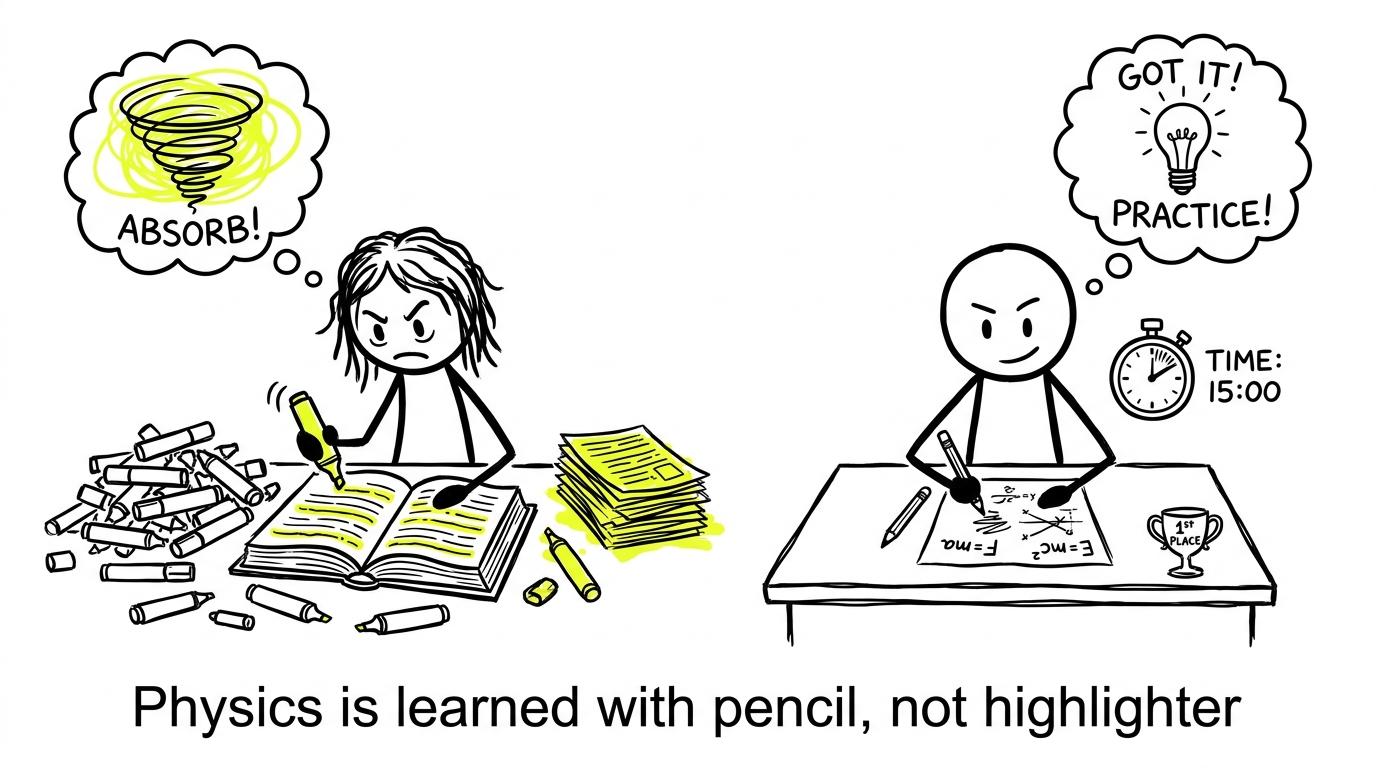 Highlighting vs practice questions
A practical weekly revision plan (built for pass-grade students)
A plan should be boring enough to follow. Here’s a simple structure that works well for GCSE Physics when you’re stuck.
Two short sessions on methods (not notes)
- Pick one topic (e.g. forces, electricity, energy).
- Learn or revisit the key equations.
- Do 10 exam-style questions.
- Mark using the mark scheme and write your mistake in one sentence.
For marking practice, use YesGenie’s GCSE Past Papers and get used to how exam boards phrase the same idea in different ways.
One timed paper chunk
If full papers feel overwhelming, split them.
- Do a 45-minute block.
- Mark it.
- Identify the top two error types.
YesGenie’s Resources area includes predicted papers and shorter tests, which are ideal when you’re building stamina without burning out.
One “maths for physics” session
This is the quiet secret weapon for GCSE Physics: build your maths so the physics becomes simpler.
Focus on:
- Rearranging formulas.
- Standard form and prefixes.
- Ratio and proportion.
- Graph gradient.
Useful YesGenie pages to weave in:
- Eduqas GCSE Maths Revision Guides (browse skills that also show up in Physics calculations).
- Reverse Percentages (Revision Guide) (helpful for any “percentage change” style reasoning).
Common mistakes that keep you at a GCSE pass
- Substituting before rearranging. If you substitute first, you often end up trying to rearrange messy numbers instead of clean symbols.
- Ignoring unit conversions. Leaving km\text{km}km with seconds, or g\text{g}g with kg\text{kg}kg, quietly destroys answers.
- Rounding too early. Keep full calculator accuracy, then round at the end unless the question specifies.
- Not writing the final unit. Many mark schemes reward correct units, and they also help you catch nonsense.
- Gradient errors. Students use “rise over run” but choose points too close together, or misread the scale.
- Weak explanations. In Physics, written marks often want a cause-and-effect sentence, not a definition copied from memory.
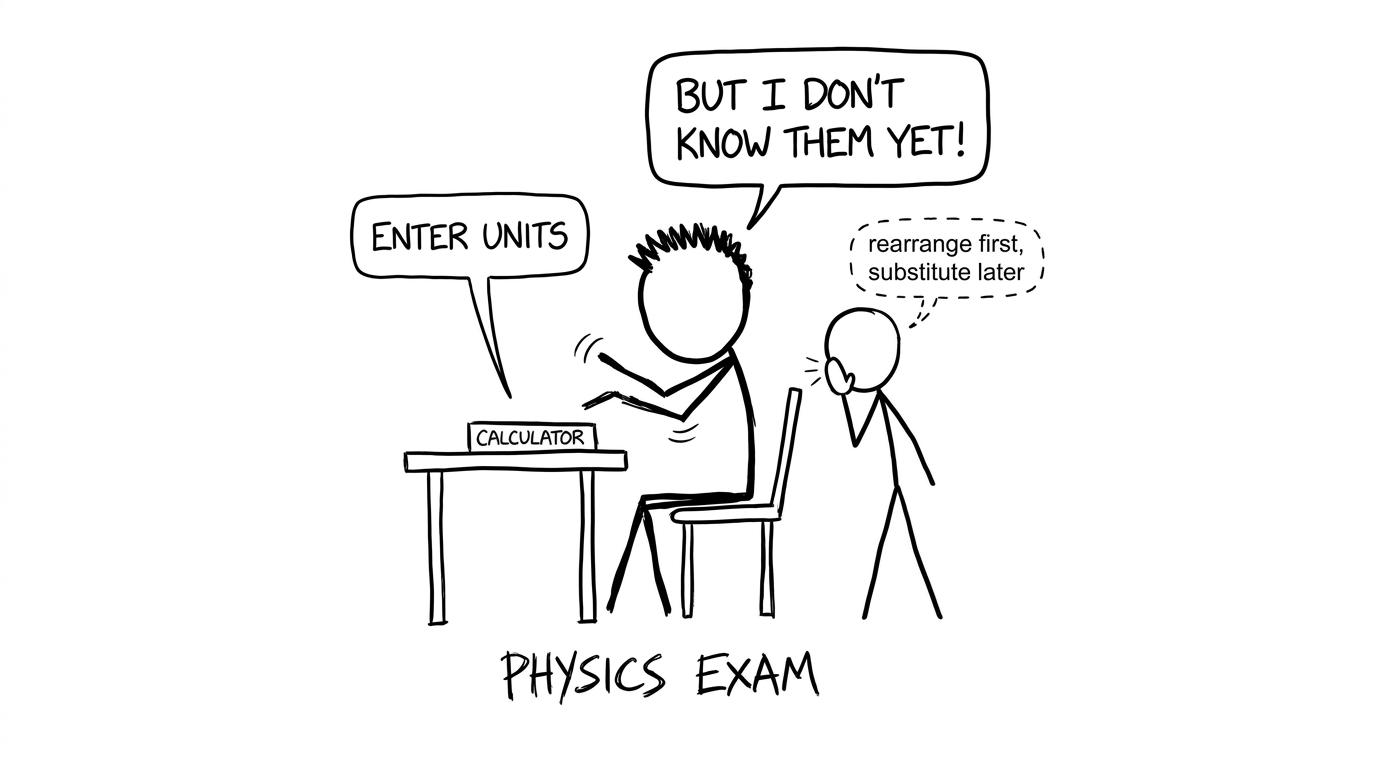 Calculator demands units
Bringing it together: your next 7 days
If you’re stuck at a GCSE pass grade in Physics, make the next week simple and measurable.
- Do one short equation session (rearrange first, substitute second).
- Do one graph session (gradient, intercept, proportionality).
- Do one timed block using exam-style questions.
- Mark carefully and write a mistake log.
Then repeat, but slightly better.
YesGenie exists for exactly this stage of revision: when you don’t need more motivation, you need better feedback loops. Use the revision lessons to relearn methods calmly, the practice questions to build fluency, and the mark schemes to understand how the exam boards award marks. Start with GCSE Past Papers, build a routine using Resources, and use targeted guides like Gravity (GCSE Physics) to turn common topics into dependable marks. If you do that consistently, the “pass grade ceiling” stops feeling like a wall and starts feeling like a doorway.