2.2.1 Speed and distance–time graphs
Speed and average speed
Average speed
Average speed is the total distance travelled divided by the total time taken.
Instantaneous speed
Instantaneous speed is the speed of an object at a particular moment.
- Speed is a scalar quantity because it has magnitude but no direction.
- The equation for average speed is
- average speed=distance travelledtime taken\text{average speed}=\frac{\text{distance travelled}}{\text{time taken}}average speed=time takendistance travelled
- Using symbols,
- v=stv=\frac{s}{t}v=ts
- where vvv is average speed in m/s\text{m/s}m/s, sss is distance in m\text{m}m and ttt is time in s\text{s}s.
- The rearranged forms are s=vts=vts=vt and t=svt=\dfrac{s}{v}t=vs. Convert every measurement to compatible units before substitution.
- A cyclist covers 750 m750\ \text{m}750 m in 50 s50\ \text{s}50 s.
- Substitution gives v=75050v=\dfrac{750}{50}v=50750.
- The average speed is 15 m/s15\ \text{m/s}15 m/s.
Average speed for a whole journey
- Average speed is not normally the arithmetic mean of two speeds. It depends on the total distance and total time.
- Include time spent stationary because it contributes to the total journey time even though no distance is travelled during that interval.
- A bus travels 600 m600\ \text{m}600 m in 40 s40\ \text{s}40 s, waits for 20 s20\ \text{s}20 s and then travels 900 m900\ \text{m}900 m in 60 s60\ \text{s}60 s.
- The total distance is 600+900=1500 m600+900=1500\ \text{m}600+900=1500 m.
- The total time is 40+20+60=120 s40+20+60=120\ \text{s}40+20+60=120 s.
- The average speed is 1500120=12.5 m/s\dfrac{1500}{120}=12.5\ \text{m/s}1201500=12.5 m/s.
Distance–time graphs
Gradient
The gradient of a graph is the change in the vertical-axis quantity divided by the change in the horizontal-axis quantity.
- A distance–time graph shows distance on the vertical axis and time on the horizontal axis.
- The gradient represents speed because
- gradient=ΔdistanceΔtime=speed\text{gradient}=\frac{\Delta \text{distance}}{\Delta \text{time}}=\text{speed}gradient=ΔtimeΔdistance=speed
- A horizontal line has zero gradient, so the object is stationary.
- A straight sloping line has constant gradient, so the object moves at constant speed.
- A steeper line represents a greater speed because more distance is covered in the same time.
- A curve with an increasing gradient represents increasing speed. A curve that becomes less steep represents decreasing speed.
Calculating a graph gradient
- Choose two points far apart on the straight section of the graph. If a best-fit line is present, the points should lie on that line and do not need to be plotted data points.
- Draw a large gradient triangle and read the coordinate differences from the axes.
- Calculate
- speed=d2−d1t2−t1\text{speed}=\frac{d_2-d_1}{t_2-t_1}speed=t2−t1d2−d1
- Include the unit obtained from the graph axes, commonly m/s\text{m/s}m/s.
- A straight section passes through (10 s,40 m)(10\ \text{s},40\ \text{m})(10 s,40 m) and (30 s,140 m)(30\ \text{s},140\ \text{m})(30 s,140 m).
- The change in distance is 140−40=100 m140-40=100\ \text{m}140−40=100 m.
- The change in time is 30−10=20 s30-10=20\ \text{s}30−10=20 s.
- The speed is 10020=5.0 m/s\dfrac{100}{20}=5.0\ \text{m/s}20100=5.0 m/s.
- Do not calculate a gradient using d/td/td/t from one point unless the straight line passes through the origin.
- Do not describe a horizontal section as moving at constant speed. Its speed is zero.
- A distance–time graph does not show direction, so its distance values do not decrease.
- For a graph description, link each shape to motion: horizontal means stationary, straight and sloping means constant speed, and changing gradient means changing speed.
- Show the coordinate differences used for a gradient. A large triangle reduces the percentage uncertainty in reading the axes.
- Keep units with all substitutions and quote a sensible number of significant figures.
- What equation links average speed, distance and time?
- What does the gradient of a distance–time graph represent?
- What motion produces a horizontal section?
- How does a curved distance–time graph show acceleration or deceleration?
2.2.2 Acceleration and the uniform-acceleration equation
Acceleration
Acceleration
Acceleration is the rate of change of velocity.
Deceleration
Deceleration is acceleration that reduces the magnitude of an object's velocity.
- Acceleration is a vector quantity because velocity is a vector. A change in speed, direction or both produces acceleration.
- The acceleration equation is
- a=v−uta=\frac{v-u}{t}a=tv−u
- where aaa is acceleration in m/s2\text{m/s}^2m/s2, uuu is initial velocity in m/s\text{m/s}m/s, vvv is final velocity in m/s\text{m/s}m/s and ttt is time in s\text{s}s.
- The unit m/s2\text{m/s}^2m/s2 means that velocity changes by that many metres per second during each second.
- With one direction chosen as positive, a negative acceleration points in the negative direction. It represents slowing down only when velocity points in the positive direction.
- A car increases its velocity from 6.0 m/s6.0\ \text{m/s}6.0 m/s to 22 m/s22\ \text{m/s}22 m/s in 4.0 s4.0\ \text{s}4.0 s.
- Substitution gives a=22−6.04.0a=\dfrac{22-6.0}{4.0}a=4.022−6.0.
- The acceleration is 4.0 m/s24.0\ \text{m/s}^24.0 m/s2.
Rearranging the acceleration equation
- Useful rearrangements are
- v=u+atv=u+atv=u+at
- u=v−atu=v-atu=v−at
- t=v−uat=\frac{v-u}{a}t=av−u
- Keep the signs of velocities and acceleration during substitution. A negative value may carry essential directional information.
- A train travelling at 25 m/s25\ \text{m/s}25 m/s slows uniformly at −0.50 m/s2-0.50\ \text{m/s}^2−0.50 m/s2 for 30 s30\ \text{s}30 s.
- Using v=u+atv=u+atv=u+at gives v=25+(−0.50)(30)v=25+(-0.50)(30)v=25+(−0.50)(30).
- The final velocity is 10 m/s10\ \text{m/s}10 m/s.
Uniform acceleration without time
Uniform acceleration
Uniform acceleration is acceleration that remains constant.
- When acceleration is uniform and time is not given, use
- v2−u2=2axv^2-u^2=2axv2−u2=2ax
- where xxx is displacement in m\text{m}m. This equation applies only when acceleration is constant.
- Useful rearrangements include
- x=v2−u22ax=\frac{v^2-u^2}{2a}x=2av2−u2
- a=v2−u22xa=\frac{v^2-u^2}{2x}a=2xv2−u2
- When solving for velocity, take the square root only after evaluating v2v^2v2. Select the root that matches the stated direction of motion.
- A vehicle moving at 20 m/s20\ \text{m/s}20 m/s comes to rest with uniform acceleration over 50 m50\ \text{m}50 m.
- Substitution gives 02−202=2a(50)0^2-20^2=2a(50)02−202=2a(50).
- Rearrangement gives a=−400100=−4.0 m/s2a=\dfrac{-400}{100}=-4.0\ \text{m/s}^2a=100−400=−4.0 m/s2.
Interpreting acceleration
- Positive and negative signs indicate direction relative to the chosen positive direction. They do not automatically mean speeding up and slowing down.
- An object speeds up when its velocity and acceleration have the same sign.
- An object slows down when its velocity and acceleration have opposite signs.
- An object moving at constant speed in a circle accelerates because its direction, and therefore its velocity, continually changes.
- Do not use m/s\text{m/s}m/s as the unit of acceleration. The correct unit is m/s2\text{m/s}^2m/s2.
- Do not use v2−u2=2axv^2-u^2=2axv2−u2=2ax when acceleration changes during the motion.
- Do not discard a negative acceleration. Explain its direction or identify it as deceleration only when the motion direction makes that description correct.
- Write the selected equation before substituting and keep all quantities in SI units.
- Edexcel calculation marks commonly reward substitution, evaluation and the final unit, so show these stages clearly even when your calculator gives the answer directly.
- Check whether the question gives distance or displacement and whether the signs make physical sense.
- What does an acceleration of 3 m/s23\ \text{m/s}^23 m/s2 mean?
- What equation links uuu, vvv, aaa and ttt?
- When may v2−u2=2axv^2-u^2=2axv2−u2=2ax be used?
- When does a negative acceleration make an object speed up?
2.2.3 Velocity–time graphs
Velocity–time graphs
Velocity-time graph
A velocity-time graph shows how an object's velocity changes with time.
Uniform acceleration
Uniform acceleration is acceleration that remains constant.
- Velocity is plotted on the vertical axis and time on the horizontal axis. Values below the time axis represent motion in the chosen negative direction.
- A horizontal line represents constant velocity and zero acceleration.
- A straight sloping line represents uniform acceleration.
- A curve represents changing acceleration because its gradient changes.
- Crossing the time axis means the velocity is zero at that instant. If the graph continues across the axis, the object reverses direction.
Gradient gives acceleration
- The gradient of a velocity–time graph is
- gradient=ΔvΔt=a\text{gradient}=\frac{\Delta v}{\Delta t}=agradient=ΔtΔv=a
- A positive gradient gives acceleration in the positive direction and a negative gradient gives acceleration in the negative direction.
- To calculate uniform acceleration, choose two points far apart on the straight section and use
- a=v2−v1t2−t1a=\frac{v_2-v_1}{t_2-t_1}a=t2−t1v2−v1
- Velocity rises uniformly from 4.0 m/s4.0\ \text{m/s}4.0 m/s at 2.0 s2.0\ \text{s}2.0 s to 16 m/s16\ \text{m/s}16 m/s at 8.0 s8.0\ \text{s}8.0 s.
- The velocity change is 16−4.0=12 m/s16-4.0=12\ \text{m/s}16−4.0=12 m/s.
- The time change is 8.0−2.0=6.0 s8.0-2.0=6.0\ \text{s}8.0−2.0=6.0 s.
- The acceleration is 126.0=2.0 m/s2\dfrac{12}{6.0}=2.0\ \text{m/s}^26.012=2.0 m/s2.
Area gives displacement
Displacement from a velocity-time graph
Displacement is the signed area between a velocity-time graph and the time axis.
- For uniform acceleration, split the region into rectangles and triangles, then calculate each area.
- For a rectangle, A=bhA=bhA=bh. For a triangle, A=12bhA=\dfrac{1}{2}bhA=21bh. Time provides the base and velocity provides the height, so the area unit is s×m/s=m\text{s}\times\text{m/s}=\text{m}s×m/s=m.
- Area above the time axis is positive displacement. Area below the axis is negative displacement.
- Total displacement is the signed sum of all areas. Total distance is the sum of the magnitudes of the separate areas.
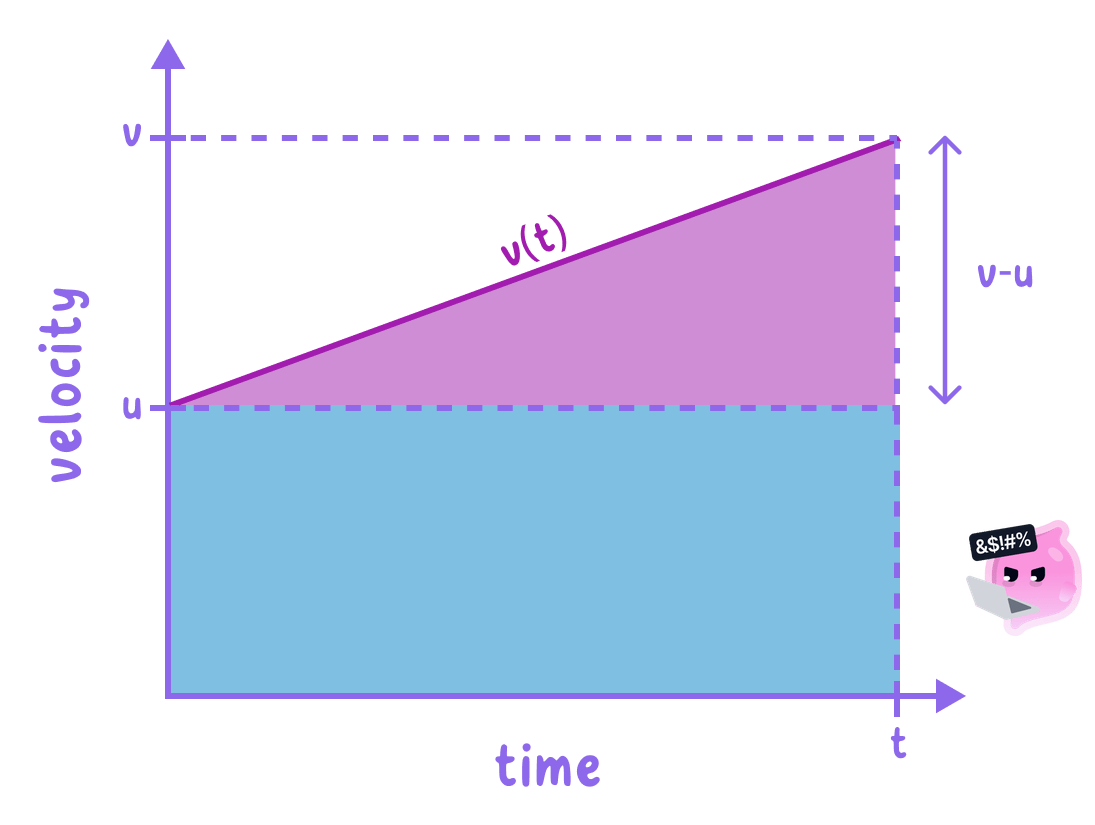
- A car accelerates uniformly from 5.0 m/s5.0\ \text{m/s}5.0 m/s to 15 m/s15\ \text{m/s}15 m/s in 4.0 s4.0\ \text{s}4.0 s.
- The area is a rectangle plus a triangle: x=(5.0)(4.0)+12(4.0)(15−5.0)x=(5.0)(4.0)+\dfrac{1}{2}(4.0)(15-5.0)x=(5.0)(4.0)+21(4.0)(15−5.0).
- The displacement is 20+20=40 m20+20=40\ \text{m}20+20=40 m.
Describing motion from the graph
- State the velocity at the start of each section, whether it is constant or changing, and the direction of motion.
- Use the sign and gradient separately. The sign of velocity gives the direction of motion, while the sign of the gradient gives the direction of acceleration.
- An upward-sloping line below the axis can represent an object slowing down while travelling in the negative direction because its velocity moves towards zero.
- A downward-sloping line below the axis can represent speeding up in the negative direction because the magnitude of velocity increases.
- Do not call every negative gradient deceleration. Compare the signs of velocity and acceleration.
- Do not use the line length as distance. Calculate the area between the graph and the time axis.
- Do not add areas below the axis as positive when finding displacement. Use signed areas.
- For a comparison of accelerations, compare gradients and state which line is steeper.
- For displacement, label the geometric shapes, show every area calculation and combine them with the correct signs.
- When a graph crosses the axis, state that the object is momentarily at rest and then changes direction.
- What does the gradient of a velocity–time graph represent?
- What does the area between the line and time axis represent?
- How is total distance found when part of the graph lies below the axis?
- What happens when a velocity–time graph crosses the time axis?
2.2.4 Measuring speed, typical speeds and free-fall acceleration
Measuring speed
Average speed
Average speed is the total distance travelled divided by the total time taken.
Resolution
Resolution is the smallest change in a quantity that a measuring instrument can distinguish.
- Every speed method measures a distance and the corresponding time, then uses
- average speed=distancetime\text{average speed}=\frac{\text{distance}}{\text{time}}average speed=timedistance
- For a stopwatch method, mark two positions a measured distance apart. Time the object between the markers, repeat the measurement and calculate a mean.
- A long measured distance reduces the percentage uncertainty in the distance and makes reaction-time uncertainty a smaller fraction of the measured time.
Using light gates
- Attach a card of measured length to the moving object. Connect a light gate to a timer or data logger.
- As the card passes through the beam, the logger measures the interruption time. The instantaneous speed at the gate is approximated by
- v=card lengthinterruption timev=\frac{\text{card length}}{\text{interruption time}}v=interruption timecard length
- With two light gates, measure their separation and the travel time between them to calculate average speed over that interval.
- Light gates remove the delay caused by starting and stopping a handheld stopwatch, so they reduce reaction-time uncertainty.
Other laboratory methods
- A ticker timer makes dots on a moving tape at equal time intervals. Measure the distance across several intervals and divide by their total time.
- If the mains frequency is 50 Hz50\ \text{Hz}50 Hz, successive dots are separated by 150=0.020 s\dfrac{1}{50}=0.020\ \text{s}501=0.020 s. Increasing gaps show increasing speed.
- Video analysis uses a known scale in the frame and the recording frame rate. Measure the displacement across a known number of frames and divide by the elapsed time.
- Motion sensors can record distance at short regular intervals. The gradient of a distance–time graph then gives speed.
- A complete method names the equipment, states what distance and time are measured, gives the speed equation, repeats the readings and calculates a mean.
- When explaining an improvement, link it to the relevant uncertainty. Light gates reduce reaction-time uncertainty, while a longer timing distance reduces percentage uncertainty.
- Use consistency, reliability, precision or reduced random error when justifying repeats. Do not claim that repeats automatically remove systematic error.
Typical speeds
- Typical values are estimates that provide an order-of-magnitude check rather than exact constants.
- Walking is about 1.5 m/s1.5\ \text{m/s}1.5 m/s, running about 3 m/s3\ \text{m/s}3 m/s and cycling about 6 m/s6\ \text{m/s}6 m/s.
- A car in urban traffic is about 13 m/s13\ \text{m/s}13 m/s, which is roughly 30 mph30\ \text{mph}30 mph, while motorway travel is about 30 m/s30\ \text{m/s}30 m/s.
- A train may travel at about 50 m/s50\ \text{m/s}50 m/s and a cruising passenger aircraft at about 250 m/s250\ \text{m/s}250 m/s.
- A gentle breeze is about 5 m/s5\ \text{m/s}5 m/s and a gale about 20 m/s20\ \text{m/s}20 m/s.
- Sound in air travels at about 330 m/s330\ \text{m/s}330 m/s.
- Useful conversions are 1 m/s=3.6 km/h1\ \text{m/s}=3.6\ \text{km/h}1 m/s=3.6 km/h and 1 m/s≈2.2 mph1\ \text{m/s}\approx2.2\ \text{mph}1 m/s≈2.2 mph.
- A person walks for 20 min20\ \text{min}20 min at an estimated 1.5 m/s1.5\ \text{m/s}1.5 m/s.
- The time is 20×60=1200 s20\times60=1200\ \text{s}20×60=1200 s.
- The estimated distance is s=vt=(1.5)(1200)=1800 ms=vt=(1.5)(1200)=1800\ \text{m}s=vt=(1.5)(1200)=1800 m, which is about 2 km2\ \text{km}2 km.
Free-fall acceleration
Free fall
Free fall is motion in which gravity is the only force acting on an object.
Gravitational acceleration
Gravitational acceleration is the acceleration caused by a gravitational field.
- Near the Earth’s surface, the acceleration in free fall is
- g=10 m/s2g=10\ \text{m/s}^2g=10 m/s2
- The acceleration is directed downwards towards the centre of the Earth. An object’s downward velocity therefore increases by about 10 m/s10\ \text{m/s}10 m/s each second when air resistance is negligible.
- All objects have the same free-fall acceleration at the same location, regardless of mass. A greater mass produces a proportionally greater weight, so a=F/ma=F/ma=F/m remains the same.
- A ball thrown upwards is still accelerating downwards. It slows while rising, has zero instantaneous velocity at its highest point, then speeds up downwards.
- The symbol ggg can also represent gravitational field strength in N/kg\text{N/kg}N/kg. The numerical value near Earth is also about 101010, but acceleration and field strength have different units.
- A ball is released from rest and falls freely for 0.80 s0.80\ \text{s}0.80 s.
- Using v=u+atv=u+atv=u+at with u=0u=0u=0 and a=10 m/s2a=10\ \text{m/s}^2a=10 m/s2 gives v=0+(10)(0.80)v=0+(10)(0.80)v=0+(10)(0.80).
- The speed after 0.80 s0.80\ \text{s}0.80 s is 8.0 m/s8.0\ \text{m/s}8.0 m/s.
Estimating accelerations
- Use a=v−uta=\dfrac{v-u}{t}a=tv−u with sensible estimates for the velocity change and time interval.
- A train leaving a station may accelerate at about 0.5 m/s20.5\ \text{m/s}^20.5 m/s2, a car pulling away at about 2 m/s22\ \text{m/s}^22 m/s2 and a sprinter at about 5 m/s25\ \text{m/s}^25 m/s2.
- Hard braking can produce a deceleration with magnitude approaching 10 m/s210\ \text{m/s}^210 m/s2.
- Check that the estimate matches the context and quote an appropriate unit and sensible precision.
- Do not state that heavier objects have a larger free-fall acceleration. Differences observed in air result from air resistance.
- Do not describe ggg as a force. Weight is the force, calculated using W=mgW=mgW=mg.
- Do not use a single short timing interval when a longer interval or electronic timer is available.
- What two measurements are required in every speed method?
- How does a light gate determine speed from a card?
- What are suitable estimates for walking speed and the speed of sound in air?
- What is the value and direction of free-fall acceleration near Earth?
- Why do different masses have the same free-fall acceleration?
