Should You Redo Past Papers? GCSE Maths Revision
GCSE past papers are powerful, but only if you redo them the right way. Learn when to retake papers, how to analyse errors, and improve marks.
The question every tired reviser asks
There’s a moment in GCSE maths revision when past papers stop feeling like practice and start feeling like judgement. You sit down, do Paper 1, mark it, and the number you get feels like a verdict on your intelligence, not a snapshot of your current habits. Then someone says, “Just redo past papers.”
But should you?
Redoing papers can be one of the fastest ways to improve your GCSE grade. Or it can become a comforting loop where you memorise mark schemes, repeat the same mistakes, and wonder why nothing changes. The difference isn’t effort. It’s method.
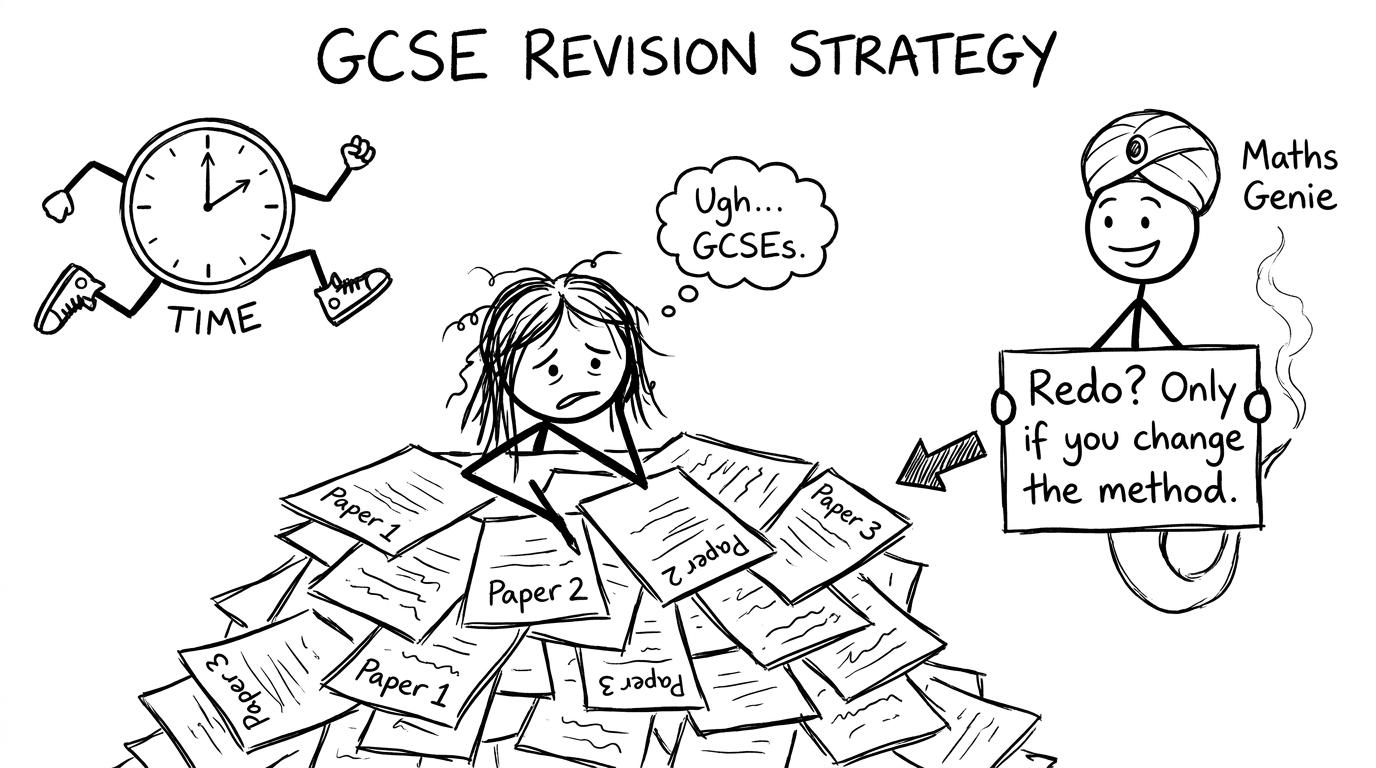 A stressed student and the ‘redo’ question
A quick checklist before you redo a past paper
Use this checklist to decide whether redoing a paper is the right next move in your GCSE (or A Level) maths revision:
- Have you marked it properly using the mark scheme, not just glanced at answers?
- Do you know why each lost mark was lost (concept, method, accuracy, exam technique, time)?
- Have you done targeted practice on the topics you missed?
- Are you leaving enough time between attempts to avoid pure memory?
- Are you redoing the whole paper or the questions you got wrong (both can work, but for different reasons)?
If you answered “no” to two or more, redoing the whole paper today probably won’t give you the best return.
Why redoing past papers works (when it works)
Past papers are unusual practice because they simulate the real conditions of a GCSE exam: mixed topics, unpredictable question order, and the quiet pressure of time. When you redo them well, you’re training three things at once.
You convert feedback into memory
Most revision fails because it stays polite. You do a topic, feel like you understand it, and move on. Past papers are less polite. They show you what you actually do when the question is worded differently, when it’s hidden inside context, or when you’re slightly stressed.
Redoing is the step that converts “I saw that mistake” into “I don’t make that mistake anymore”.
You build exam reflexes
In GCSE maths, many marks come from reliable routines: rearranging formulae, using standard form, solving equations, interpreting graphs, and so on. Redoing papers makes those routines automatic.
You practise judgement, not just calculation
The hard part of exams is often deciding what this question is asking. Redoing past papers improves that decision-making speed.
On Maths Genie, you can combine papers with targeted topic work using the free GCSE Maths revision pages and then test yourself again.
When you should redo a past paper
Redoing is most useful in these situations.
You fixed the underlying topic gap
If you lost marks because you didn’t know what to do, redoing the paper immediately is like re-watching a film in a language you still don’t speak. The better order is:
- Mark and diagnose.
- Learn or re-learn the topic.
- Practise topic questions.
- Retest with a redo (or a fresh paper).
Maths Genie makes step 2 and 3 straightforward because the lessons and practice are organised by topic and grade, so your GCSE revision isn’t guesswork.
Your marks were dragged down by technique
If you understood the maths but lost marks for incomplete reasoning, missing units, or not showing working, a redo helps a lot. You’re not trying to learn the whole topic again; you’re polishing how you present it.
You need timing and stamina
Some students know the content but run out of time, especially on higher tier GCSE Paper 2 and Paper 3 when calculator questions can expand quickly. Redoing papers under timed conditions trains pacing.
A good compromise is smaller timed practice such as the 45 Minute Edexcel GCSE Tests if a full paper feels too heavy at first.
You’re using predicted papers strategically
Closer to exams, you may want papers that mimic likely topic balance. Maths Genie collects these on the Predicted GCSE Papers and revision resources page and the GCSE predicted papers section. Redoing a predicted paper after targeted fixes can sharpen you quickly.
When you should not redo a past paper (yet)
Redoing can become a distraction if it’s used to avoid the uncomfortable bit: fixing weaknesses.
You can still remember the answers
If you redo the same GCSE paper the next day, your brain will often “recognise” the question rather than solve it. You may score higher, but the improvement is brittle.
A useful rule: leave at least 1-2 weeks before redoing the same paper, unless you are only redoing the specific questions you got wrong.
You haven’t made a mistake log
If you don’t capture what went wrong, you’ll repeat it. A mistake log can be one page in your notebook:
- Question/topic
- What I did
- Why it was wrong
- Correct method
- A similar question to practise
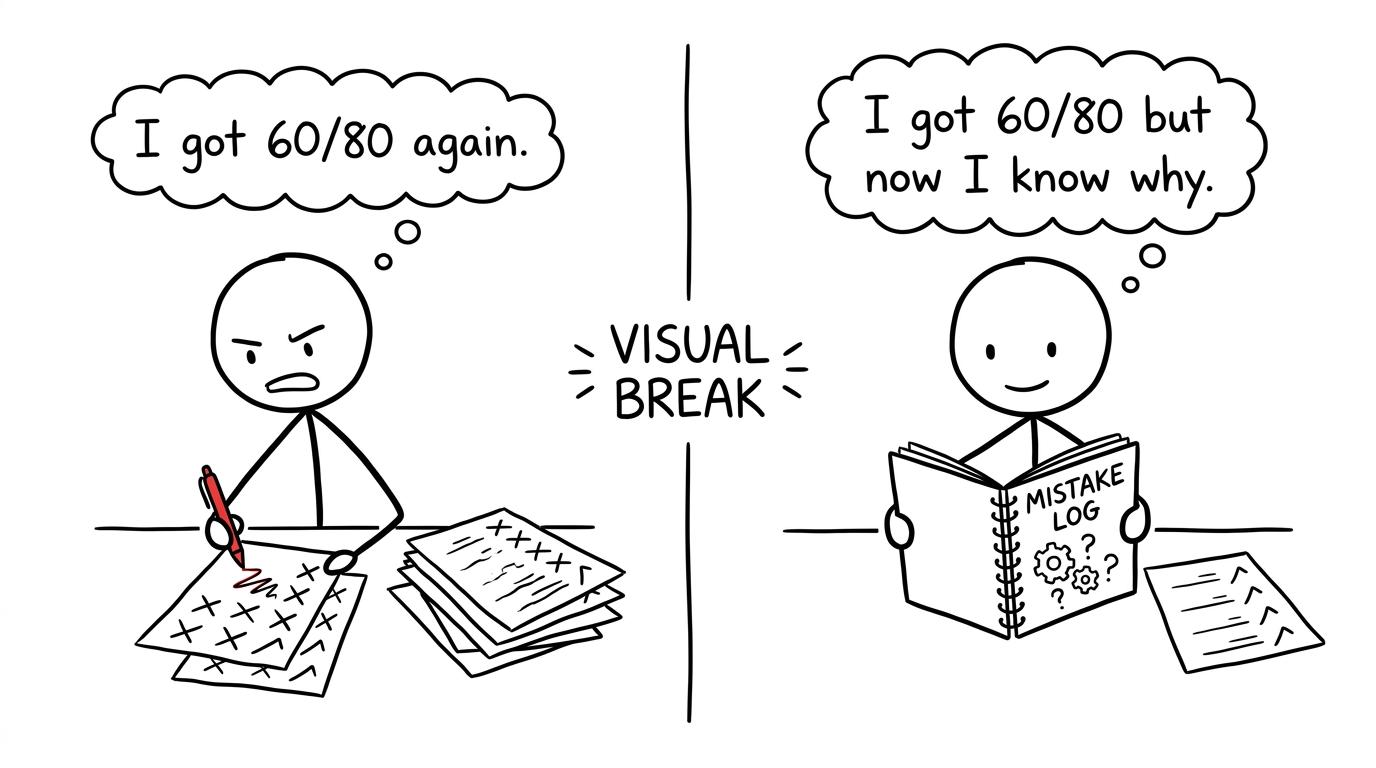 Marking vs learning from mistakes
Your issue is topic coverage, not exam practice
If your paper shows gaps across lots of topics (for example, you’re missing marks on ratio, graphs, and probability), doing more full papers might just keep exposing the same gaps.
In that case, use the paper as a diagnostic, then switch to targeted revision on Maths Genie before you retest.
The best way to redo past papers (GCSE and A Level)
Here’s a method that works for GCSE and scales up to A Level.
Mark like an examiner, not like a disappointed friend
Use the mark scheme and be strict. If the scheme expects a method mark and you’ve only written an answer, don’t award yourself the mark.
This is where official paper sets help. For example:
Categorise every lost mark
For each lost mark, label it:
- Concept (didn’t know the topic)
- Method (knew topic but chose wrong approach)
- Accuracy (arithmetic/algebra slip)
- Communication (working, units, rounding, form)
- Time (didn’t finish or rushed)
This takes five minutes and saves hours.
Do a targeted repair session
Before any redo, do 30-60 minutes of targeted practice on the exact types of questions you missed. This is where Maths Genie shines because you can move directly from diagnosis to practice questions and video solutions.
Redo with a different goal
If your first attempt goal was “finish the paper”, your redo goal might be “get full method marks” or “show every step”. If your first attempt goal was “be accurate”, your redo goal might be “improve timing by 10 minutes”.
A redo without a new goal is usually just repetition.
Worked examples: how redoing changes your method
Redoing papers should change how you think. Here are two examples of what that looks like.
Example 1: Algebra error you can actually fix
A GCSE higher tier student solves:
3(x−4)=2x+5 3(x-4)=2x+5 3(x−4)=2x+5First attempt (common wrong method):
3x−4=2x+5 3x-4=2x+5 3x−4=2x+5The mistake is expanding incorrectly. Redoing the question isn’t about “trying harder”; it’s about restoring a reliable routine.
Correct method:
3(x−4)=2x+5 3(x-4)=2x+5 3(x−4)=2x+5Expand properly:
3x−12=2x+5 3x-12=2x+5 3x−12=2x+5Collect like terms (subtract 2x2x2x from both sides):
x−12=5 x-12=5 x−12=5Add 121212 to both sides:
x=17 x=17 x=17How redo helps: when you redo, you’re training the habit “multiply the bracket term-by-term”. Your mistake log should say: I forgot to multiply −4-4−4 by 333. That’s a small sentence that protects a lot of marks.
Example 2: A Level technique: redo to improve structure
An A Level student is asked to differentiate:
y=(2x−1)(x2+3) y=(2x-1)(x^2+3) y=(2x−1)(x2+3)If you expand first, you might create more room for slips. Redoing can teach you a cleaner method: the product rule.
Product rule:
If y=uvy=uvy=uv, then dydx=udvdx+vdudx\frac{dy}{dx}=u\frac{dv}{dx}+v\frac{du}{dx}dxdy=udxdv+vdxdu.
Let u=2x−1u=2x-1u=2x−1 and v=x2+3v=x^2+3v=x2+3.
Then:
dudx=2,dvdx=2x. \frac{du}{dx}=2, \qquad \frac{dv}{dx}=2x. dxdu=2,dxdv=2x.So:
dydx=(2x−1)(2x)+(x2+3)(2). \frac{dy}{dx}=(2x-1)(2x)+(x^2+3)(2). dxdy=(2x−1)(2x)+(x2+3)(2).Simplify:
(2x−1)(2x)=4x2−2x, (2x-1)(2x)=4x^2-2x, (2x−1)(2x)=4x2−2x,and
2(x2+3)=2x2+6. 2(x^2+3)=2x^2+6. 2(x2+3)=2x2+6.Therefore:
dydx=6x2−2x+6. \frac{dy}{dx}=6x^2-2x+6. dxdy=6x2−2x+6.How redo helps: it nudges you away from “messy but possible” towards “standard and efficient”. That matters in timed A Level papers.
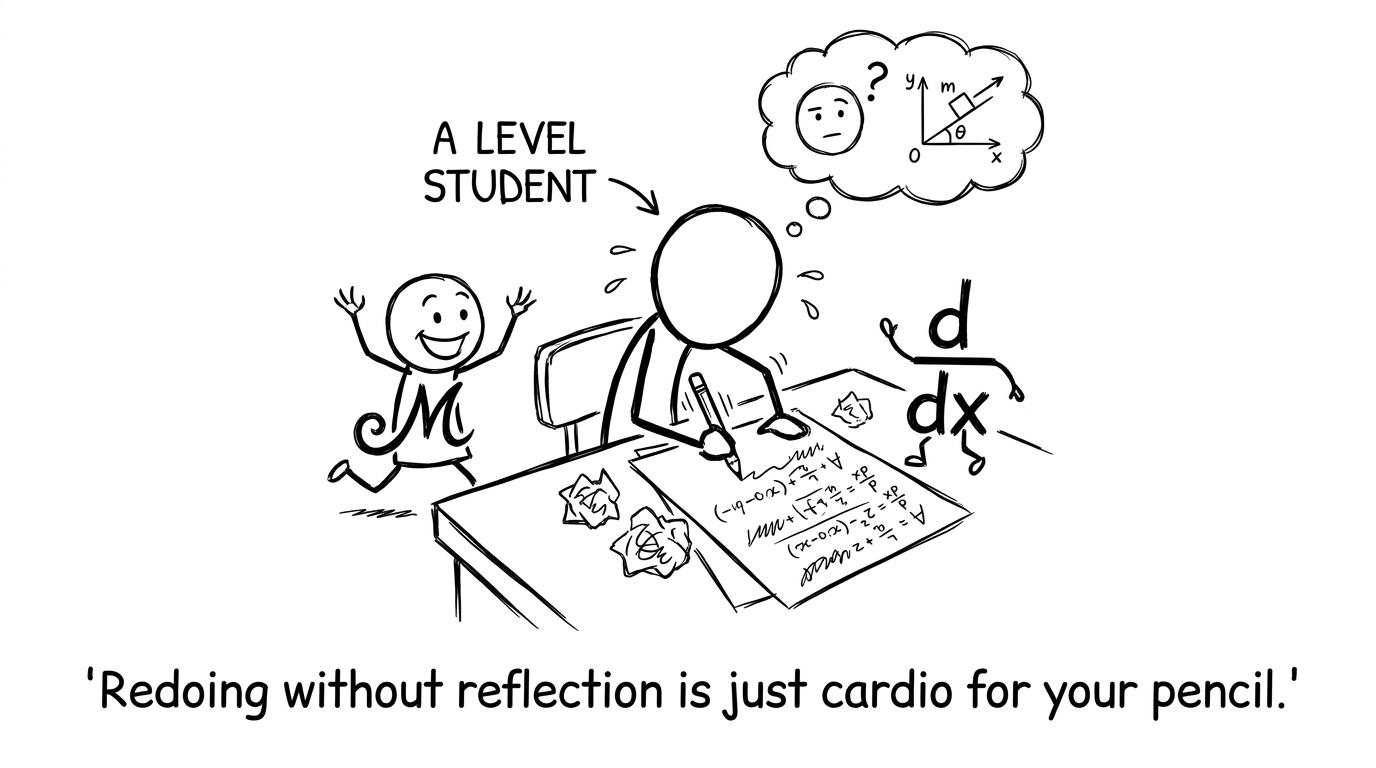 A Level redo without reflection joke
A simple redo schedule that actually improves marks
If you’re revising for GCSE maths, here’s a practical approach that avoids memorisation.
Two-paper rotation (great for busy weeks)
- Week 1: Do Paper A timed, mark, diagnose.
- Week 1-2: Repair topics.
- Week 2: Do Paper B timed, mark, diagnose.
- Week 3: Redo Paper A (or redo only the questions you missed).
This keeps pressure low but feedback high.
Three-layer approach (best near exams)
- Past papers for exam realism.
- Topic practice to patch gaps.
- Predicted papers to focus revision late on.
You can get the paper practice and mark schemes from Maths Genie’s GCSE resources page, then build topic strength on the GCSE maths revision section.
Common mistakes when redoing past papers
- Redoing too soon and mistaking recognition for understanding.
- Marking kindly and inflating scores, which hides what to fix.
- Only reading the mark scheme instead of rewriting a correct solution yourself.
- Ignoring method marks (especially damaging in GCSE and A Level maths).
- Not revisiting the same weakness with similar questions after the redo.
- Obsessing over the overall score rather than the specific marks you can reliably gain next.
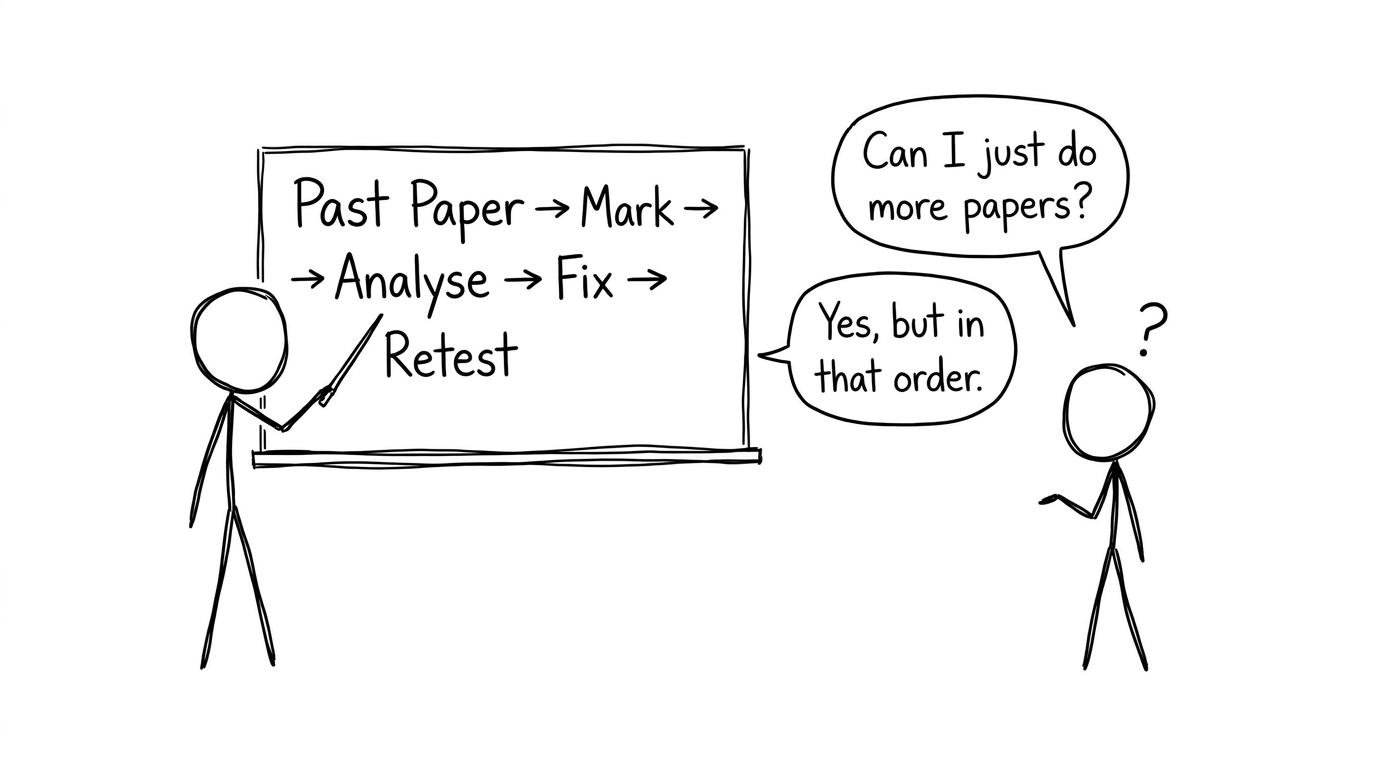 The sensible redo order
The answer: yes, but only with a plan
Redoing past papers is one of the simplest ways to improve GCSE maths results, but it only works when you treat it like feedback, not fate. A past paper is not a prophecy. It’s a mirror. If you look, wince, and walk away, nothing changes. If you look, name what went wrong, fix it, and then retest, you build something rare in revision: momentum.
If you want a clear, free system for that loop, use Maths Genie as your base camp: start with the GCSE maths revision lessons, practise with topic questions and mini tests, then move into past papers and mark schemes from the GCSE resources page. When you’re ready, use predicted papers to rehearse the real thing. Redo past papers, yes, but redo them with purpose, and your GCSE grade will start to move for reasons you can explain.