Typing vs Handwriting Notes for GCSE Arabic
Typing vs handwriting notes GCSE Arabic guide: learn which supports recall, when to use each method, and how active retrieval makes revision stick.
A page of typed vocabulary can look wonderfully organised. Everything lines up, mistakes disappear with one keystroke, and the finished document feels like progress. Then you close it and discover that very little comes back.
That is the real question behind typing vs handwriting notes GCSE Arabic students need answered: which method improves recall? Research suggests handwriting may have a small average advantage in some note-taking situations, particularly when learners select and process ideas rather than transcribing them. But the effect is neither enormous nor universal. What matters more is what you do with the notes afterwards.
For GCSE Arabic, the most effective approach is usually a deliberate mixture: type to organise and edit information, handwrite to practise producing Arabic, then retrieve vocabulary and structures without looking.
The short answer: which method sticks better?
Choose the method that matches the task:
- Handwrite when learning Arabic spelling, letter formation, connected script or written responses.
- Type when collecting vocabulary, reorganising themes or creating searchable revision materials.
- Use active recall after either method by closing the notes and reproducing what you remember.
- Space your practice across several days instead of copying everything in one sitting.
- Practise in the format required by your assessment, following your school and exam board guidance.
The pen is not magical, and the keyboard is not harmful. Memory strengthens when you pay attention, make meaning, retrieve information and revisit it after a gap. Note format can support that process, but it cannot replace it.
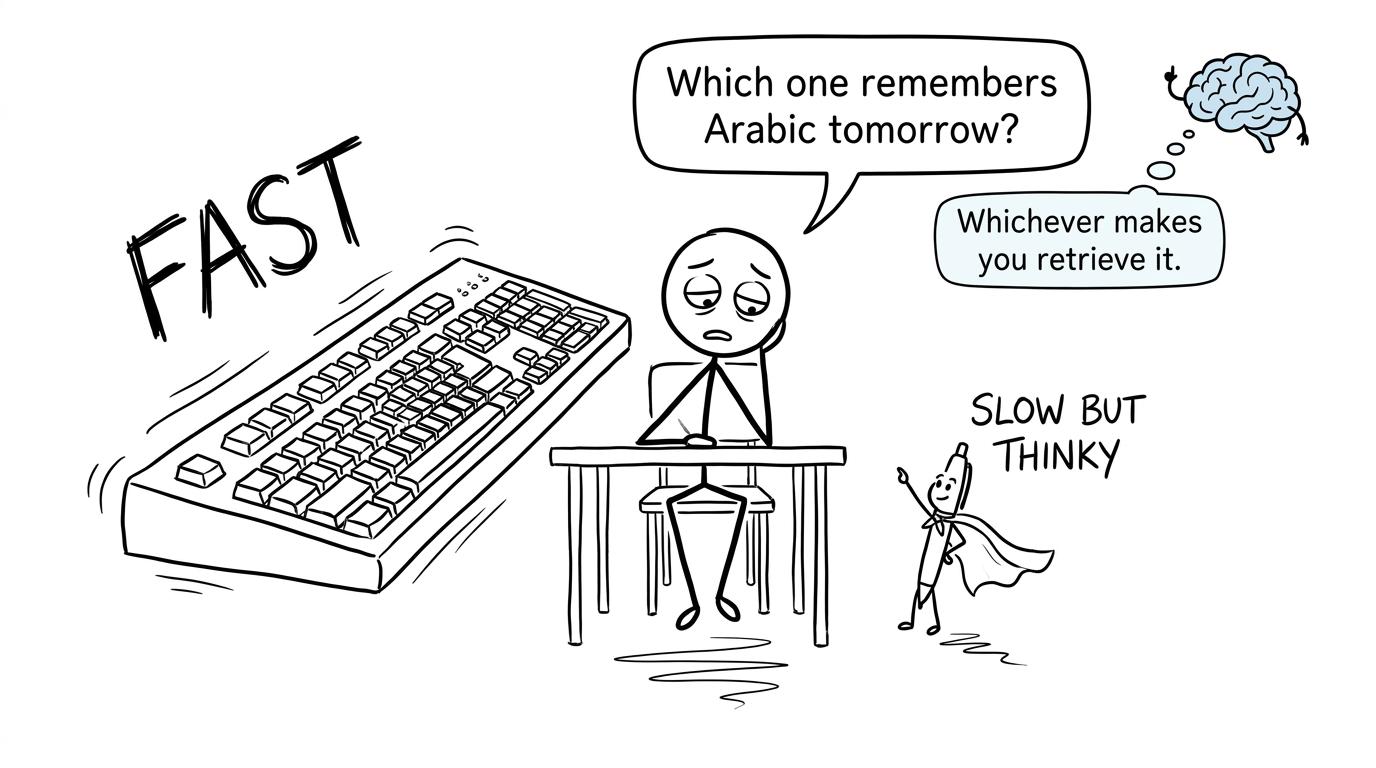 A student choosing between a fast keyboard and a thoughtful pen while a tiny brain recommends retrieval
How memory actually turns notes into learning
Notes have two possible jobs. First, making them can help you process new material. Second, the finished notes can store information for later review. Problems arise when students concentrate entirely on the second job.
A beautiful document is useful storage. It is not proof of learning.
Encoding requires attention and decisions
Encoding is the process through which information first enters memory. Handwriting is slower than typing for many students, and that limitation can be helpful: you may have to choose the central idea, shorten an explanation or connect a word with a familiar phrase.
Typing can encourage near-verbatim transcription because it is often faster. If your fingers copy a vocabulary list while your attention drifts, the resulting file may be accurate without being memorable. However, typing thoughtfully, paraphrasing meanings, grouping related terms and adding your own prompts, can also involve deep processing.
The meaningful distinction is therefore not simply pen against keyboard. It is thinking against copying.
Retrieval makes memories usable
Recognition can be deceptive. An Arabic word may look familiar when it is on the screen, yet remain unavailable when you need to produce it independently. Retrieval practice exposes that difference.
After making notes, hide them and attempt one of these tasks:
- recall the Arabic term from its English meaning;
- recall the English meaning from the Arabic term;
- write a short phrase using the term;
- list what you remember from a topic;
- explain a grammar pattern without consulting your notes;
- compare your answer with the source and correct it.
This resembles effective maths revision. Reading a solution is different from producing a method unaided. MathsGenie's guide to turning short sessions into active GCSE revision uses the same principle: retrieve first, practise, mark and decide what to revisit.
Spacing prevents quick familiarity from fading
A word copied several times in one evening can feel secure because it remains active in short-term memory. That feeling often fades. Revisiting material after increasing gaps makes retrieval effortful again, which is precisely what makes the practice informative.
A practical sequence is to test new material later that day, the following day, several days later and again the next week. These intervals are a flexible routine, not a scientific formula. Bring a word back sooner if you repeatedly miss it; extend the interval when recall becomes reliable.
For planning revision across several subjects, the GCSE one-month revision plan shows how retrieval, marking and spaced review can fit into a manageable week.
Why handwriting helps with GCSE Arabic
Arabic is not only information to recognise. Students must learn to produce its script accurately and fluently. Handwriting therefore serves a practical purpose beyond general note-taking research.
Writing by hand makes you attend to letter shape, direction, joining and the placement of distinguishing dots. It also reveals hesitations that typing may conceal through predictive text, automatic correction or an on-screen keyboard.
Handwriting is particularly valuable for:
- practising letters in their different positions within words;
- noticing where letters connect or do not connect;
- learning spelling from memory;
- building speed and legibility;
- planning and producing written responses;
- checking that vocabulary can be recalled without digital prompts.
Do not confuse handwriting with repeated copying. Writing the same visible word many times mainly practises looking and copying. A stronger sequence is to inspect the word carefully, cover it, write it from memory, check it and correct the exact error.
Because assessment arrangements and specifications can change, confirm the required writing format and any approved access arrangements with your teacher. Revision should reflect the conditions under which you personally will be assessed.
When typing Arabic notes is the better tool
Typing becomes valuable when the main challenge is organisation rather than script production. A digital document can be searched, reordered and updated quickly. That makes it suitable for building thematic vocabulary banks, collecting model structures and tracking recurring errors.
Typing can also reduce friction for students who find extended handwriting physically difficult or who use approved accessibility arrangements. The correct choice should support learning rather than become a test of endurance.
Use typed notes for:
- sorting vocabulary by theme or level of confidence;
- creating question-and-answer prompts;
- comparing related expressions;
- recording corrections from feedback;
- maintaining a searchable mistake log;
- preparing material that will later become a closed-book test.
Avoid depending on transliteration when the examination requires Arabic script. Transliteration may help at an early stage if your teacher recommends it, but it should not become a permanent substitute for reading and producing Arabic.
The organisational benefit of digital notes has a parallel in maths. The GCSE Maths revision hub separates lessons, questions and papers by board and topic so that organisation leads towards practice rather than becoming the final activity.
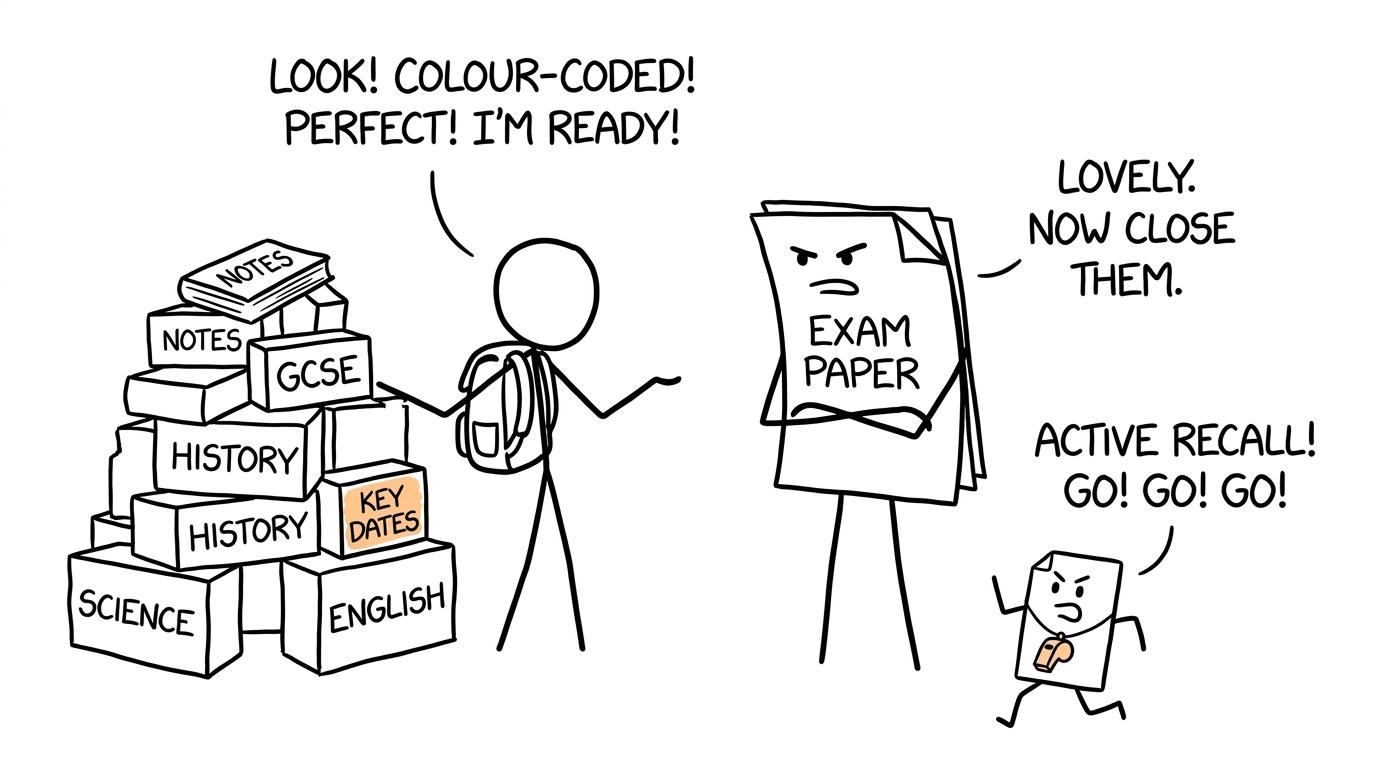 A perfectly colour-coded mountain of notes meets an exam paper asking the student to close them
A hybrid note-taking system that improves recall
The strongest routine uses each medium for what it does well.
Capture and organise digitally
During initial revision, type a compact set of vocabulary, structures and reminders. Group material by meaning rather than preserving the order in which it appeared in a textbook. Keep the page short enough to test.
Turn statements into prompts. Instead of creating a document that merely displays an Arabic word beside its translation, separate the prompt from the answer so that you must attempt retrieval before revealing it.
Process important material by hand
Choose a small set of high-priority words or structures. Handwrite them carefully, paying attention to script and spelling. Then close the source and reproduce them from memory.
This stage should be selective. Recopying an entire typed document creates work without guaranteeing thought. Concentrate on material that is new, easily confused or repeatedly forgotten.
Test in both directions
Translation knowledge is not automatically reversible. Recognising an Arabic word does not guarantee that you can produce it from an English prompt. Test both directions, then include the vocabulary in short original phrases so that meaning, spelling and grammar become connected.
Keep a mistake log
Record the precise failure:
- missing or misplaced dot;
- incorrect letter form;
- non-joining letter handled incorrectly;
- forgotten meaning;
- spelling confusion;
- grammar not applied;
- word recognised but not produced.
The purpose is diagnosis, not self-criticism. MathsGenie's method for finding weak GCSE topics quickly follows the same logic: mark honestly, classify the error, practise the smallest weak skill and test it again.
Move from notes to exam practice
Notes should become less visible as the examination approaches. Increase closed-book recall, timed writing and appropriate past-paper tasks. Afterwards, use feedback or a mark scheme to decide what enters the next revision cycle.
For maths, students can make this transition using AQA GCSE Maths past papers or Edexcel GCSE Maths predicted papers. Predicted papers should supplement specification-aligned learning and past papers, not replace them.
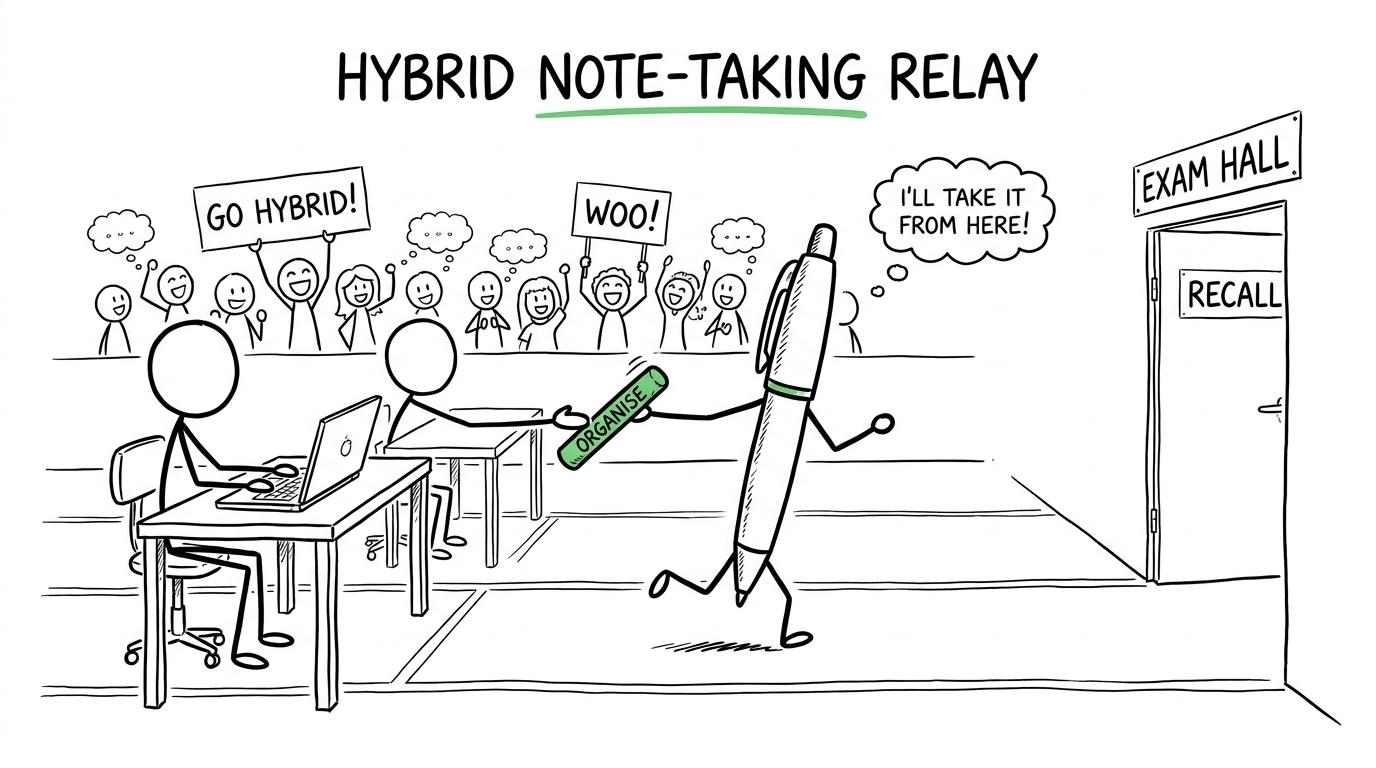 A laptop and pen working as a revision relay team, passing from organisation to recall
Common mistakes when choosing between typing and handwriting
Treating neatness as evidence of memory
Colour, formatting and tidy headings can make revision easier to navigate. They do not demonstrate that you can recall the material. Add a closed-book test to every note-making session.
Copying instead of selecting
Whether typed or handwritten, copying whole passages can allow meaning to pass by unnoticed. Summarise, classify, question and connect the material instead.
Testing only recognition
Rereading a vocabulary list produces familiarity. GCSE performance requires usable knowledge. Cover the answer and produce it before checking.
Typing with digital assistance switched on
Predictive text and automatic correction may complete precisely the spelling you need to learn. When testing recall, remove assistance where possible or move to paper.
Handwriting everything regardless of purpose
Handwriting is useful, but rewriting every resource consumes time that could be spent retrieving, correcting and applying knowledge. Select difficult material and turn it into practice.
Ignoring the rest of the GCSE timetable
Arabic revision exists beside maths and other subjects. A sustainable system protects time for each. The GCSE Maths topics by exam board and tier guide can help foundation and higher tier students identify what must be covered for Edexcel, AQA, OCR or Eduqas.
The method matters more than the stationery
In the typing-versus-handwriting debate, the winning tool is the one that makes you think and prepares you for the task ahead. Handwriting deserves a central role in GCSE Arabic because the script itself must be practised. Typing is excellent for organising, editing and building testable resources. Neither method sticks reliably when revision stops at note creation.
So use the keyboard to build order. Use the pen to practise production. Then close both and retrieve.
Apply the same principle to maths revision with MathsGenie's free GCSE resources: learn through revision lessons and video solutions, answer practice questions without copying, check mark schemes, and test yourself with mini tests, past papers and predicted papers. Notes can point towards knowledge. Practice is what makes that knowledge available when the exam begins.