Learning Styles GCSE Arabic: Do They Matter?
Learning styles GCSE Arabic advice based on evidence. Discover which revision methods improve listening, speaking, reading and writing effectively.
A revision session can feel productive without producing much learning. You colour-code vocabulary, replay an audio clip and copy a page of notes. Everything looks organised. Yet two days later, the words have gone.
That experience often leads students to search for learning styles GCSE Arabic advice. Perhaps you have been told that you are a visual, auditory or kinaesthetic learner and should revise accordingly. The evidence does not support that conclusion. Preferences are real, but matching revision to a supposed learning style has not reliably been shown to improve attainment.
A better approach is to match the method to the skill. Listen when practising listening, speak when developing spoken Arabic, read unfamiliar passages and write answers from memory. Then space those activities over time and check what you can actually do without support.
The short answer: preferences matter less than practice
The popular learning-styles theory suggests that each student has a relatively fixed way of learning best. A visual learner might use diagrams, an auditory learner might listen to recordings, and a kinaesthetic learner might learn through movement.
However, major research reviews have not found convincing evidence for the central claim, sometimes called the matching or meshing hypothesis: that students achieve better results when instruction is matched to their declared sensory preference.
The Education Endowment Foundation describes the evidence for learning-styles approaches as extremely limited. It also warns that restricting pupils to activities associated with one label may damage progress. Wider reviews have reached a similar conclusion: students certainly have preferences, but preference does not reliably tell us which method will produce the strongest learning.
This distinction matters. Enjoying audio does not make audio sufficient for an exam that also tests reading and writing. Liking colourful notes does not mean that recognising a word on a flashcard will prepare you to produce it independently.
A practical revision checklist
Use this instead of a learning-style quiz:
- Identify the specific skill being assessed.
- Attempt something from memory before checking notes.
- Practise listening, speaking, reading and writing directly.
- Revisit vocabulary and grammar across several days.
- Use feedback to find errors and correct them.
- Practise in a format resembling the assessment.
- Record what you cannot yet do, not simply what you have covered.
This is also a reliable framework for maths. The free GCSE Maths revision hub lets you choose your exam board and move from revision lessons into questions, papers and solutions rather than relying on passive review.
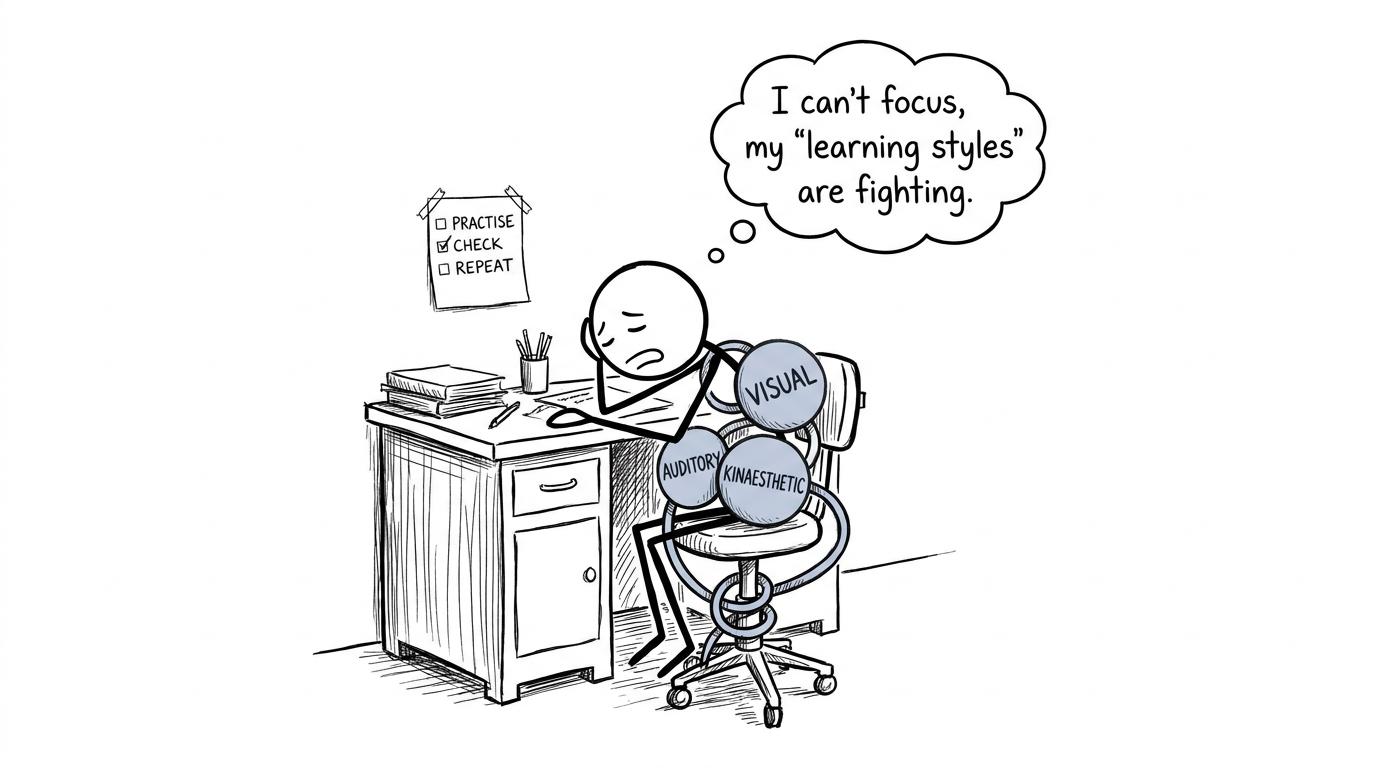 A student tangled in learning-style labels while a simple practice checklist waits nearby
What the evidence actually says about learning styles
Good evidence for learning styles would need to show more than visual learners enjoying pictures or auditory learners choosing podcasts. Researchers would need to classify students, assign them to matched and unmatched methods, assess everyone in the same way and find a consistent advantage from the match.
Reviews using those standards have not found a dependable benefit. A recent double meta-analysis likewise reported a negligible effect for matching teaching to preferred styles. That does not prove every learner is identical. It means the familiar visual-auditory-kinaesthetic categories are not a sound basis for deciding how GCSE revision should work.
Three conclusions are useful:
- Preferences are not prescriptions. You may prefer videos, but still need written and spoken practice.
- The subject determines the format. Pronunciation must be heard and produced; spelling must be read and written.
- Variety can help without proving learning styles. Combining audio, text, speech and handwriting gives you practice across the different performances the qualification demands.
Labels can become particularly unhelpful when they turn into limits: “I am not an auditory learner, so listening is not for me.” Listening may be uncomfortable precisely because it needs practice. Difficulty is diagnostic information, not evidence that the method conflicts with your identity.
Match GCSE Arabic revision to the assessment
The current Pearson Edexcel GCSE Arabic qualification consists of four papers covering listening, speaking, reading and writing. Each skill contributes 25%25\%25% of the qualification, and students enter Foundation or Higher tier across the papers. Always confirm the specification, tier and arrangements used by your school rather than assuming another language or exam board has an identical format.
The structure itself gives you a revision plan. You need balanced competence across four different actions.
Listening needs attentive retrieval
Listening practice should require you to extract meaning, not merely let Arabic play in the background. Before viewing a transcript, identify the topic, key details, opinions, negatives and changes of tense that you heard. Then check the transcript and replay only the difficult section.
Audio is appropriate here because the assessment is auditory, not because you are an “auditory learner”. The aim is to recognise language at natural speed when visual cues are unavailable.
Speaking needs spoken production
Silent preparation cannot fully develop pronunciation, fluency or responsiveness. Say answers aloud, record them where appropriate and listen back for hesitations or missing detail. Practise responding without reading a complete script.
A model answer can support the first stage, but eventually the support must disappear. The exam asks you to communicate, so revision must include communication.
Reading needs unfamiliar text
Highlighting familiar vocabulary can create confidence without testing comprehension. Use passages you have not memorised. Identify what each question requires, locate evidence and distinguish between words that look familiar and sentences you genuinely understand.
Reading practice can include translation where required by the specification, but it should also train you to infer meaning from context rather than stopping at every unknown word.
Writing needs recall and feedback
Copying accurate Arabic may improve familiarity, but it does not prove that you can generate a response. Write from a prompt without looking at a prepared paragraph. Afterwards, check vocabulary, grammar, agreement, tense, spelling and whether every part of the task was answered.
Keep an error log containing short, specific corrections. “Writing is weak” is not actionable. “I repeatedly change tense halfway through an answer” tells you what to practise next.
Revision methods with stronger support
Rejecting fixed learning styles does not mean revision methods are interchangeable. Some approaches place far greater demands on memory and performance.
Retrieval practice
Retrieval means trying to recall knowledge before looking at the answer. That might involve recalling vocabulary, producing a sentence, summarising a recording or answering questions on an unseen passage.
The attempt matters, even when it exposes a gap. Recognition can feel smooth because the answer is visible. Retrieval tells you whether the knowledge is available when the support disappears.
This principle transfers directly to GCSE maths. Reading a solution is not the same as producing one. MathsGenie’s guide to stopping forgotten GCSE maths content explains how active recall, spaced practice and exam questions can form one repeatable routine.
Spaced practice
Spacing means returning to material over time rather than completing one long block and abandoning it. Revisit vocabulary, grammar and exam skills after a gap, especially when they are beginning to feel less secure.
You do not need an elaborate system. A realistic plan with short recurring sessions is better than a perfect timetable that lasts three days. The same idea underpins MathsGenie’s GCSE maths revision timetable, which balances topic work, error correction and timed practice.
Interleaving and balanced practice
Interleaving means mixing related content rather than practising one narrow type for too long. In Arabic, a revision week might revisit several themes while alternating vocabulary recall, listening, reading and production.
Do not confuse variety with random activity. Each task should have a purpose and a way to check success. Balanced practice prepares you to select knowledge under changing conditions, much as mixed questions do in maths.
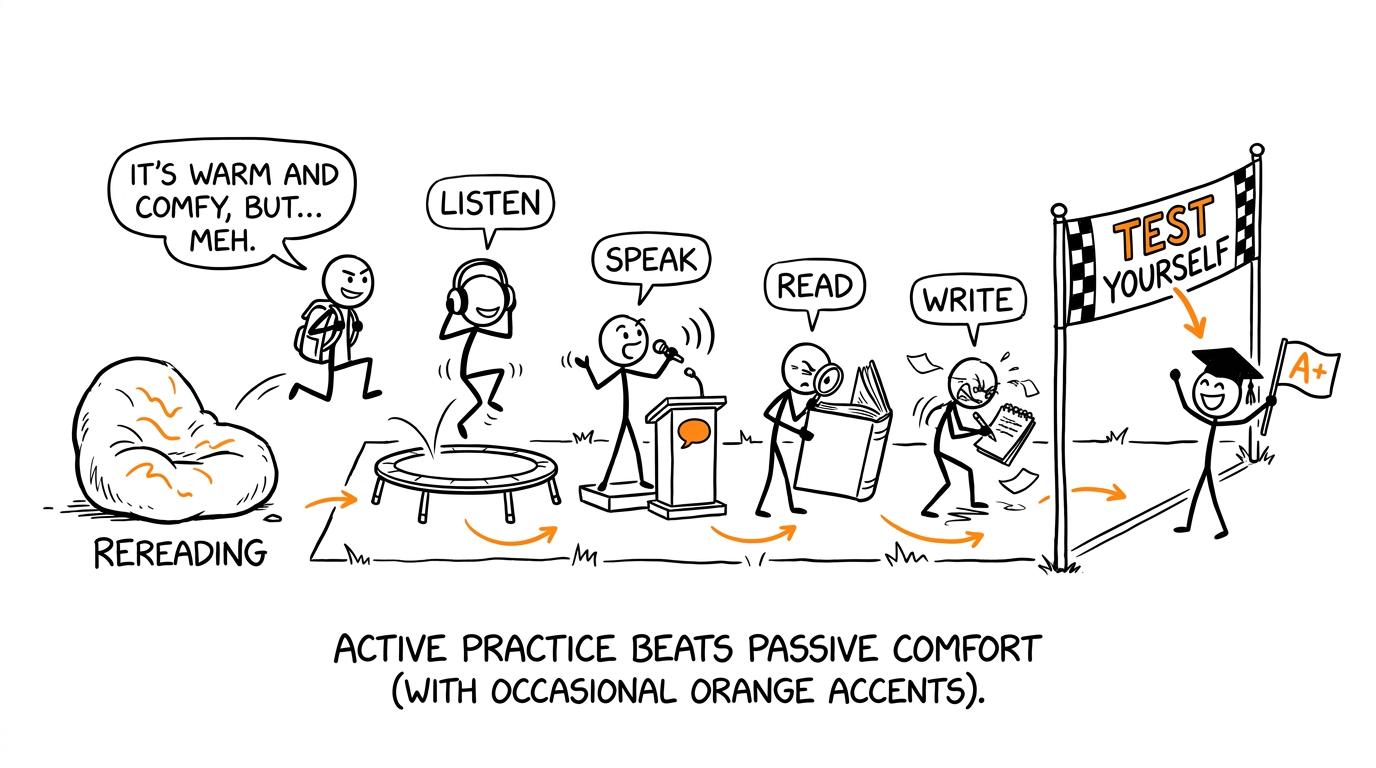 A student completing listening, speaking, reading and writing stations while passive rereading waits on a beanbag
Build a revision loop that produces evidence
A good session should leave proof behind: an assessed response, a list of missed vocabulary, corrected sentences or a score on an unseen task.
Use this loop:
- Choose: Name one skill and one small content area.
- Retrieve: Attempt it without notes.
- Check: Use reliable answers, teacher feedback or assessment criteria.
- Correct: Rewrite or repeat the exact part that failed.
- Schedule: Return to it after a gap.
- Retest: Use a fresh prompt rather than memorising the correction.
For students balancing Arabic with maths, the structure can stay the same even though the content changes. MathsGenie’s Edexcel GCSE Maths mini tests provide quick retrieval and feedback. Longer-term exam practice can then come from Edexcel GCSE Maths past papers or AQA GCSE Maths past papers, depending on your board.
The medium may change. The learning process does not: attempt, check, correct and return.
Common mistakes with learning styles and GCSE Arabic
Using a label to avoid a tested skill
A student who calls themselves visual may avoid listening practice. Another may prefer speaking and neglect accurate writing. The examination does not adapt to those preferences, so revision must cover the full specification.
Mistaking familiarity for memory
Rereading a vocabulary list makes words look familiar. That is not the same as recalling meaning, spelling or usage without prompts. Close the list and test yourself in both directions.
Making resources instead of using them
Flashcards, mind maps and recordings can be useful. Producing them is only preparation, however. Their value appears when they make you retrieve, apply and correct knowledge.
Repeating strengths because they feel comfortable
Comfortable tasks often produce reassuring sessions. Weak areas produce useful information. Let mistakes decide part of tomorrow’s plan.
Checking only the final result
A score tells you that something went wrong; analysis tells you what to change. Separate vocabulary gaps, grammar errors, misunderstood instructions, timing problems and avoidable slips.
Maths students should apply the same discipline. The guide to using GCSE past papers properly shows how to turn mark schemes and mistakes into targeted revision rather than treating a paper as a final judgement.
Choose adaptable strategies, not a fixed identity
The most useful answer to whether learning styles matter for GCSE Arabic is calm but clear: your preferences can make revision more pleasant, but the evidence does not justify matching all revision to a fixed visual, auditory or kinaesthetic identity.
Match the method to the task instead. Retrieve vocabulary. Listen closely. Speak aloud. Read unfamiliar material. Write without a model. Check errors, space the practice and retest yourself.
When you switch back to GCSE maths, keep the same evidence-led habit. Start with MathsGenie’s free revision lessons and practice questions, use mini tests to uncover gaps, and build towards past papers with mark schemes and video solutions. Nearer the exams, Edexcel predicted papers can provide fresh timed practice after your foundations are secure.
A learning-style label tells you what may feel comfortable. Deliberate practice shows you what is improving. Open one weak topic today, attempt it before looking at the answer, and let the evidence plan your next session.