GCSE: Turn Physics Notes into Active Recall (Fast)
GCSE revision: learn how to turn Physics notes into active recall using flashcards, retrieval practice and maths-style exam questions for higher marks.
GCSE revision has a quiet trap: you can spend hours rewriting Physics notes and still walk into the exam hall feeling like your brain is a blank whiteboard. It’s not because you’re lazy, or because you “just don’t get it”. It’s because notes are evidence that you looked at information, not that you can retrieve it under pressure.
Active recall is the opposite. It’s the habit of pulling facts, definitions, equations and methods out of your head on purpose, before you’re forced to do it for real. If you’re a UK GCSE or A Level maths student, this should feel familiar: you don’t learn algebra by admiring worked solutions. You learn it by trying, getting it wrong, and correcting it.
This post shows you how to turn GCSE Physics notes into active recall in a way that suits maths-minded students: structured, marks-focused, and built for Edexcel, AQA, OCR and Eduqas-style exams.
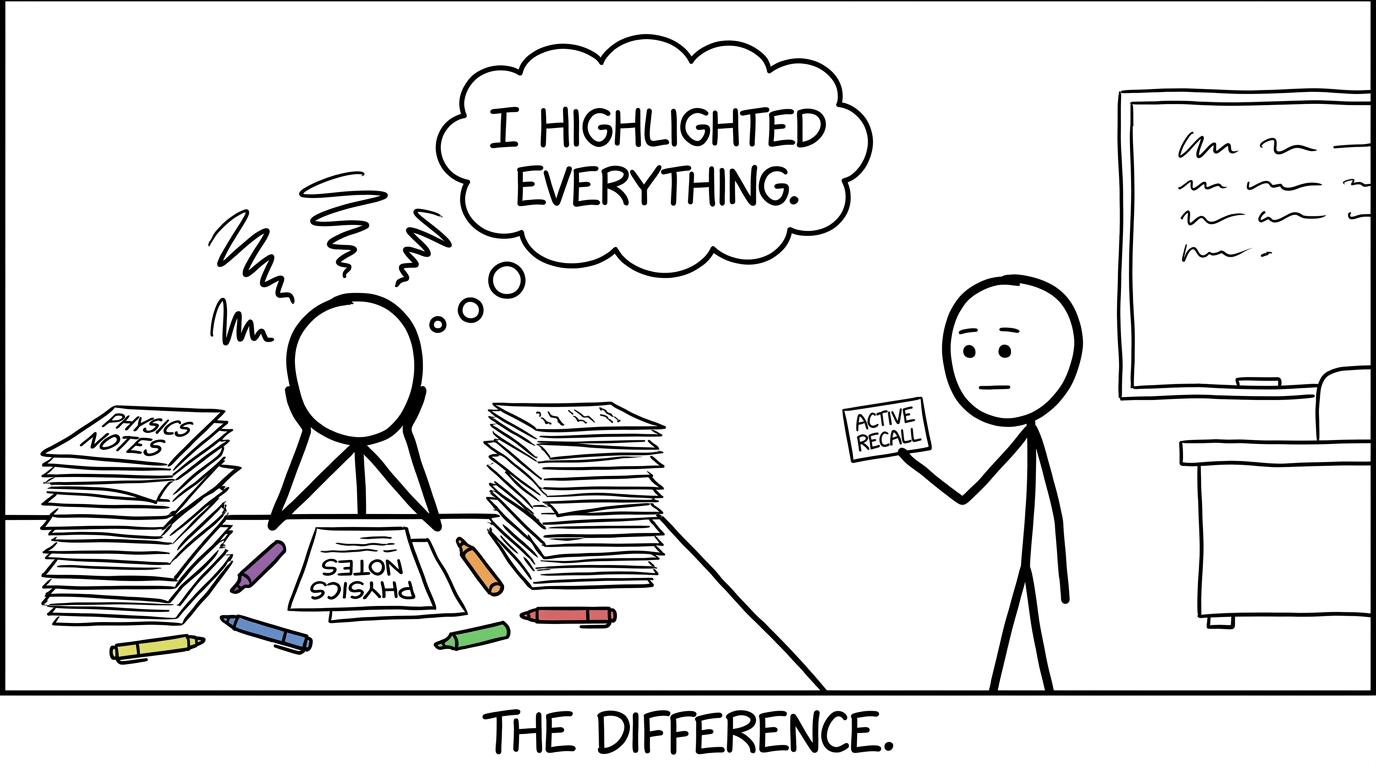 A stressed student with a mountain of notes and a tiny flashcard saying ACTIVE RECALL
The simple GCSE checklist (notes to recall)
Keep this on one page. If a study session doesn’t include steps 2 and 3, it’s not active recall yet.
- Choose one chunk from your GCSE Physics notes (one page, one subtopic, 10-15 minutes max).
- Hide the notes and write what you can remember (blurting).
- Convert what you missed into questions (flashcards or a question list).
- Practise retrieval on a timer (short, awkward, honest attempts).
- Mark like an examiner using mark-scheme language.
- Space and interleave: come back tomorrow, then in 3 days, then next week.
- Add maths-style practice: rearranging, units, proportional reasoning, graphs.
If you want a structured place to run this loop for maths, start from GCSE Maths Revision and use lessons plus exam practice to make retrieval unavoidable.
Why GCSE notes feel productive (but often aren’t)
There’s a reason rewriting notes feels soothing. It gives you a clean page and a sense of progress you can see. In the moment, your brain recognises the words, and recognition feels like knowing.
But GCSE exams don’t reward recognition. They reward recall under constraints: time, unfamiliar wording, and mark schemes that care about precision.
Maths students already live in that world. In maths, you can’t “kind of remember” the quadratic formula; you either produce it and use it correctly, or you don’t. Physics is the same, except it hides behind paragraphs.
Active recall is simply deciding that your revision sessions should look more like the exam than your notebook does.
Step 1: Shrink your GCSE Physics notes into “exam-sized” chunks
Your notes are probably too big. A whole topic like Electricity or Forces is not a chunk; it’s a unit of curriculum. Instead, slice it into questions that match the specification.
Examples of exam-sized chunks:
- “Define resultant force and state what it means for motion.”
- “Explain what happens to current in a series circuit.”
- “Use Ek=12mv2E_k = \frac{1}{2}mv^2Ek=21mv2 to calculate kinetic energy.”
Each chunk should produce 10-20 minutes of active recall. If it becomes an hour, it’s too broad.
For your maths structure alongside Physics, it helps to have a clear topic list. The Edexcel GCSE Maths Revision Guides show what “spec-sized” chunks look like in practice.
Step 2: Do a “closed-book blurt” (your first active recall pass)
A blurt is not pretty. That’s the point.
- Put your GCSE Physics notes away.
- On a blank page, write everything you can remember about one chunk.
- After 3-5 minutes, stop. Open your notes.
- Use two colours: one for what you remembered, one for what you missed.
Then comes the key move: anything you missed becomes a question.
This is how you turn passive notes into active recall without reinventing the content.
Step 3: Convert notes into questions (the only conversion that matters)
Most students convert notes into neater notes. Convert them into questions instead.
Use three question types:
Definition questions (short, exact)
- “What is potential difference?”
- “What is half-life?”
Process questions (cause and effect)
- “Why does increasing resistance reduce current in a circuit?”
- “How does a distance-time graph show speed?”
Calculation questions (maths-style)
- “Rearrange v=stv = \frac{s}{t}v=ts to make ttt the subject.”
- “Calculate density given mass and volume.”
If you’re unsure how “maths-style” your recall should be, practise the same thinking in pure maths using GCSE Maths Lessons (the lesson format naturally forces retrieval in small steps).
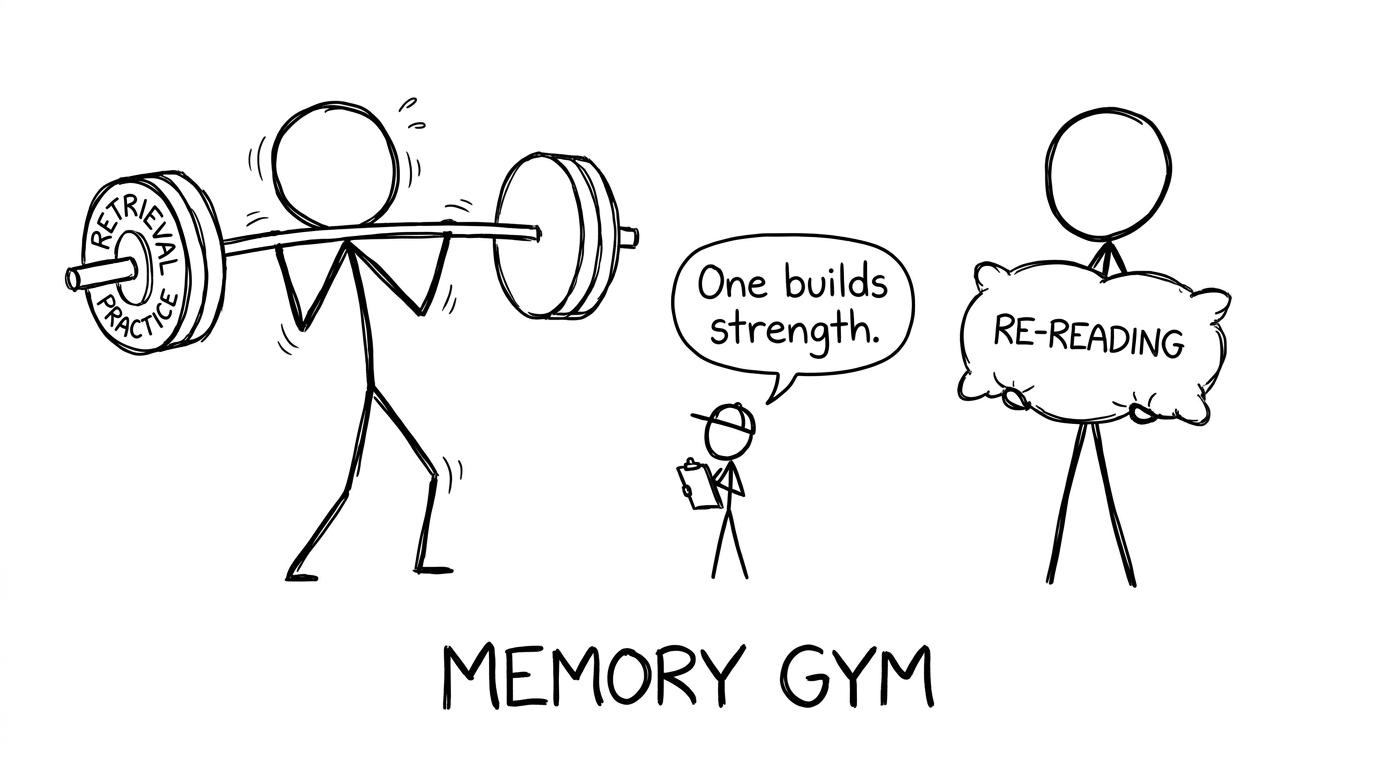 A memory gym: retrieval practice vs re-reading
Step 4: Retrieval practice that actually fits GCSE exam marks
Active recall only works when it’s marked. Otherwise you’re just guessing and moving on.
Here’s a reliable routine that suits GCSE students:
- Round 1 (easy retrieval): answer your questions with no notes.
- Check immediately: correct in a different colour.
- Round 2 (harder retrieval): re-answer the ones you got wrong, but this time add a constraint: 30 seconds, or one sentence, or an equation plus units.
- Mark-scheme language: rewrite the final version as if it’s worth 2-4 marks.
For maths, the most direct way to build this habit is using real examiner materials. YesGenie’s GCSE Past Papers are perfect for making retrieval realistic: time pressure, mark schemes, and the same awkward phrasing you’ll see in the hall.
Worked examples: make Physics recall behave like maths
Maths students do well in Physics when they treat every formula like a method, not a fact. Below are worked examples you can convert into active recall prompts.
Worked example: rearranging a GCSE Physics formula
Suppose your notes include v=stv = \frac{s}{t}v=ts.
If you need ttt, rearrange:
v=st v = \frac{s}{t} v=tsMultiply both sides by ttt:
vt=s vt = s vt=sDivide both sides by vvv:
t=sv t = \frac{s}{v} t=vsActive recall prompt you create from this: “Start with v=stv = \frac{s}{t}v=ts. Make ttt the subject. Write each algebra step.”
To strengthen this algebra fluency for GCSE maths, practise rearranging in topics like Algebraic Fractions (Revision Guide) because it trains careful symbol handling (exactly what Physics punishes when you rush).
Worked example: substituting and checking units
A common GCSE Physics calculation is kinetic energy:
Ek=12mv2 E_k = \frac{1}{2}mv^2 Ek=21mv2Let m=3 kgm = 3\text{ kg}m=3 kg and v=4 m/sv = 4\text{ m/s}v=4 m/s.
Ek=12×3×42 E_k = \frac{1}{2} \times 3 \times 4^2 Ek=21×3×42 Ek=1.5×16=24 E_k = 1.5 \times 16 = 24 Ek=1.5×16=24So Ek=24 JE_k = 24\text{ J}Ek=24 J.
Active recall prompts:
- “State the formula for kinetic energy.”
- “Calculate EkE_kEk for m=3m=3m=3 and v=4v=4v=4.”
- “What does squaring vvv do to the size of the answer?”
Worked example: graphs and gradients (Physics recall via GCSE maths)
Physics loves graphs because they’re quietly a maths test.
If a displacement-time graph is linear, its gradient is speed.
Say two points on the line are (t,s)=(2,5)(t,s) = (2,5)(t,s)=(2,5) and (6,17)(6,17)(6,17).
Gradient:
gradient=17−56−2=124=3 \text{gradient} = \frac{17-5}{6-2} = \frac{12}{4} = 3 gradient=6−217−5=412=3So the speed is 3 m/s3\text{ m/s}3 m/s.
Active recall prompts:
- “How do you calculate gradient from two points?”
- “What does the gradient represent on a displacement-time graph?”
For more direct gradient practice in GCSE maths language, use Gradient of a Line (Lessons list) and then apply it straight back to Physics graphs.
How to space active recall (without a complicated system)
GCSE revision doesn’t need a perfect algorithm. It needs a rhythm you’ll actually keep.
Try:
- Day 1: make questions from notes and do first retrieval.
- Day 2: re-test the same questions (fast).
- Day 5: re-test again, but mix with a different topic (interleaving).
- Day 12: re-test, then do an exam-style set.
When you want shorter, timed checkpoints, use Edexcel GCSE Maths Mini Tests. They’re a good model for what “small but real” retrieval feels like.
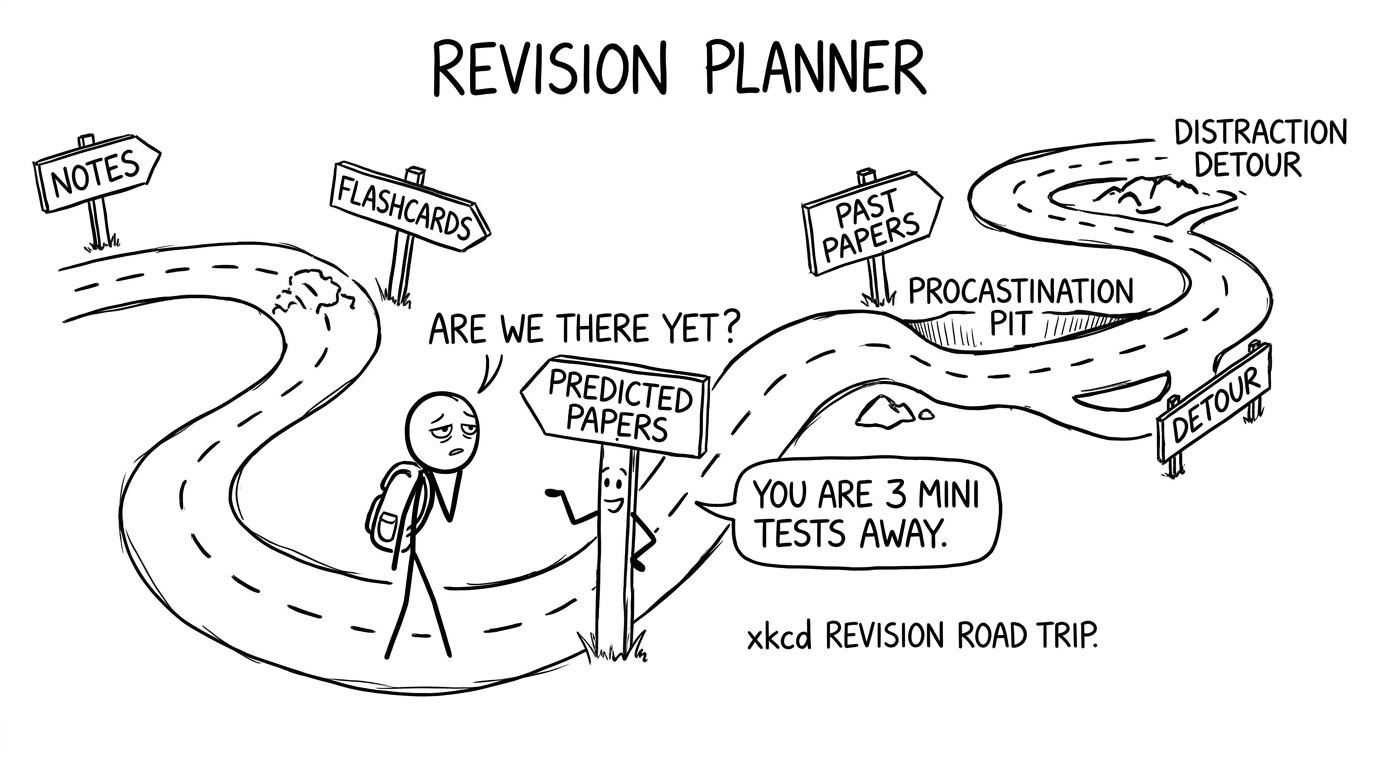 A revision planner road trip with signposts
Using exam-board thinking: AQA, Edexcel, OCR, Eduqas
GCSE Physics and GCSE maths share a truth: exam boards don’t just assess knowledge, they assess presentation.
- AQA often rewards clear explanations linked to principles (your active recall questions should force full sentences).
- Edexcel style calculations can be method-heavy (your recall should include rearranging, substituting, rounding appropriately).
- OCR frequently leans on interpretation and application (your recall should include “why” prompts and graph reading).
- Eduqas can be very mark-scheme specific (your recall should practise the exact phrasing for definitions and required steps).
For maths exam practice that mirrors this reality, pick your board area like Edexcel GCSE Maths Revision, then combine topic work with timed papers.
Common mistakes when turning GCSE Physics notes into active recall
- Making flashcards that are too big. If the answer needs a paragraph, it’s not a flashcard. Split it into two or three precise questions.
- Testing without marking. Active recall without feedback is just rehearsal of mistakes. Always check, correct, and rewrite the clean version.
- Avoiding calculations because “I’m not a Physics person”. Most GCSE Physics marks are earned through structured method and units. Treat formula questions like maths questions.
- Not practising mark-scheme wording. “It increases” is often not enough. Force yourself to include the variable and the direction, like “as resistance increases, current decreases”.
- Leaving retrieval until the week before. Active recall relies on spacing. If you cram, you’ll feel fluent today and blank tomorrow.
- Separating maths and science revision completely. Your algebra, graphs, ratio and units fluency are transferable. Use maths practice to make Physics recall easier.
Bring it home: make GCSE recall your default
The best GCSE students aren’t the ones with the prettiest notes. They’re the ones who can sit down with a blank page and produce the ideas: the equations, the definitions, the methods, the reasoning. That’s active recall. It feels harder because it is closer to the exam.
If you want your revision to feel more like marks and less like highlighting, build your routine around YesGenie. Start with GCSE Subjects to organise what you’re revising, use GCSE Maths Revision to keep your methods sharp, then pressure-test your recall with GCSE Past Papers and Edexcel GCSE Maths Predicted Papers when exam season gets close. Add short checkpoints through Edexcel GCSE Maths Mini Tests, and use mark schemes to learn how examiners award marks.
Turn notes into questions. Practise retrieval. Mark honestly. Repeat. That’s how GCSE revision stops being time spent and starts becoming grades earned.