

Exam Anxiety GCSE Arabic: A Practical Plan
Exam anxiety GCSE Arabic advice for calming speaking, listening, reading and writing nerves with realistic practice, routines and exam-day strategies.
The hardest moment in GCSE Arabic may arrive before anyone asks a question. You hear the recording equipment switch on, see a page of unfamiliar text or worry that one forgotten word will undo months of revision. If exam anxiety GCSE Arabic searches have brought you here, start with this: anxiety becomes more manageable when you stop treating Arabic as one enormous test and prepare separately for listening, speaking, reading and writing.
That is the practical answer. Rehearse the exact situations that worry you, reduce uncertainty about the assessment and use a short calming routine until it feels familiar. You do not need to eliminate every nerve. You need a plan that still works while you feel nervous.
Your GCSE Arabic anxiety checklist
Before building a detailed routine, check these essentials:
- Confirm your exam board, specification and tier with your teacher.
- Identify whether listening, speaking, reading or writing causes the most anxiety.
- Practise Standard Arabic in the formats required by your assessment.
- Use short, regular sessions rather than occasional exhausting ones.
- Rehearse the speaking assessment aloud and under realistic conditions.
- Complete timed listening, reading and writing tasks from your board's materials.
- Review errors by category: vocabulary, comprehension, grammar, timing or panic.
- Protect sleep and ask for support early if anxiety affects daily life.
Pearson Edexcel GCSE Arabic, for example, assesses listening, speaking, reading and writing in four separate papers, each worth 25%25\%25% of the qualification. Foundation and Higher papers differ in length and demand, and candidates are entered at one tier across the qualification. Always use the specification and instructions for your actual entry rather than relying on advice written for another language or board.
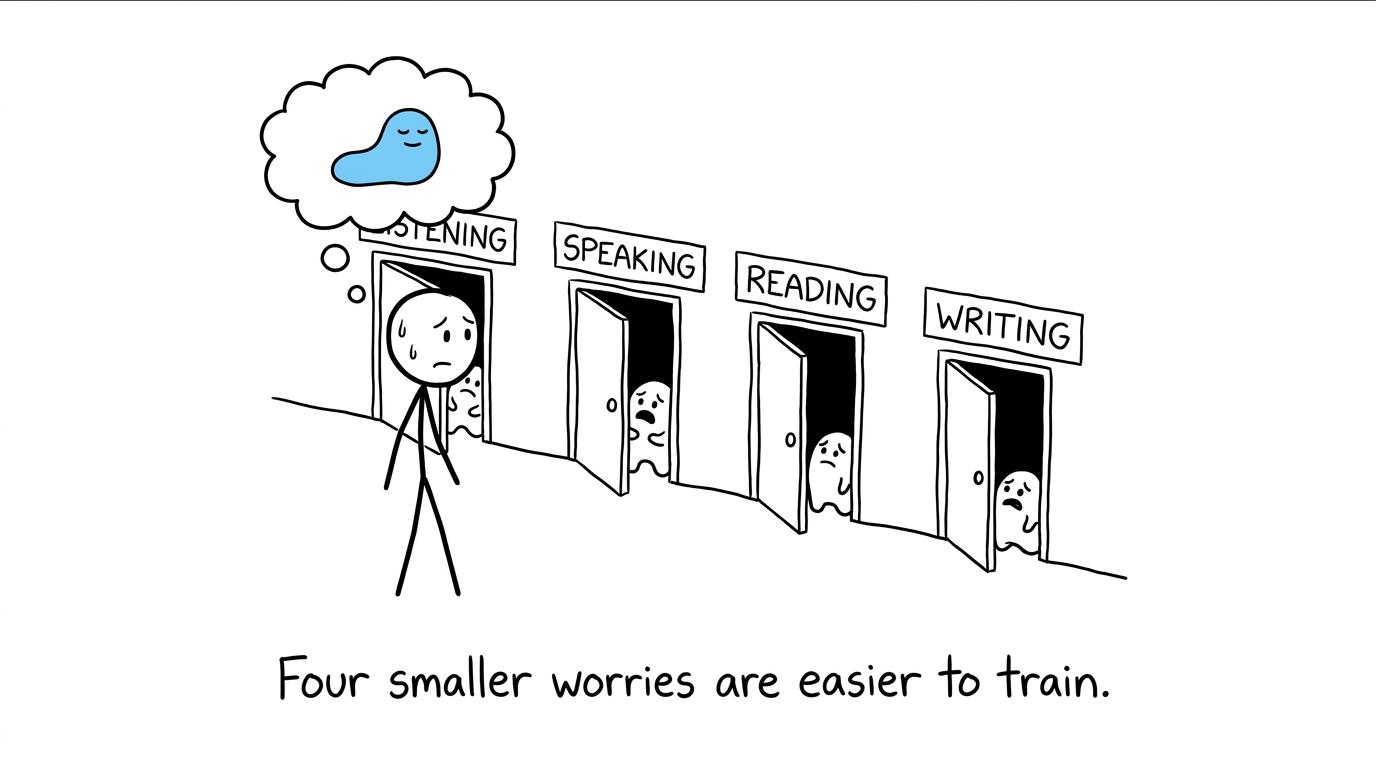 A student discovers that four smaller exam worries are easier to train than one giant worry
Find the precise source of your Arabic anxiety
Saying "Arabic makes me anxious" is understandable, but it is too broad to guide revision. A useful diagnosis is more specific:
- "I lose track when the listening recording moves quickly."
- "I freeze when the teacher asks an unexpected speaking question."
- "One unknown word makes me doubt an entire reading passage."
- "I worry about spelling, letter forms or finishing every writing task."
Write down the situations that trigger the strongest reaction. Then rank them as low, medium or high anxiety. Begin with a low or medium challenge and repeat it until it becomes ordinary before increasing the difficulty.
This resembles the process used to find weak GCSE topics efficiently. Evidence is more useful than a vague feeling. In maths, a marked paper reveals a weak topic; in Arabic, a recorded answer or timed listening task reveals the exact moment confidence breaks down.
Reduce speaking exam anxiety through rehearsal
Speaking feels unusually personal because your answer happens in real time. Silence can seem longer than it is, and a small pronunciation error can feel enormous. The solution is not to memorise one perfect speech. It is to practise recovering.
For Pearson Edexcel GCSE Arabic, the speaking assessment includes a role play, questions based on a picture stimulus and a conversation. Build separate routines for each task.
Practise flexible answer structures
Prepare language that helps you begin, develop and clarify an answer. Practise expressing an opinion, giving a reason, referring to different time frames and asking for clarification where the assessment rules permit it. Your teacher should confirm the acceptable communication strategies for your specification.
Do not memorise a long paragraph so rigidly that one different question causes everything to collapse. Instead, prepare adaptable vocabulary and sentence patterns around each theme. Record short responses, listen back and notice whether you answered the actual question.
Rehearse imperfect conversations
Ask a teacher, classmate or family member to vary the order and wording of questions. Include occasional pauses or follow-up questions. The goal is to make surprise familiar.
Practise a recovery sequence: pause, breathe out slowly, identify the key question word and give the simplest relevant answer you can. A shorter accurate response is more useful than silence while searching for an elaborate one.
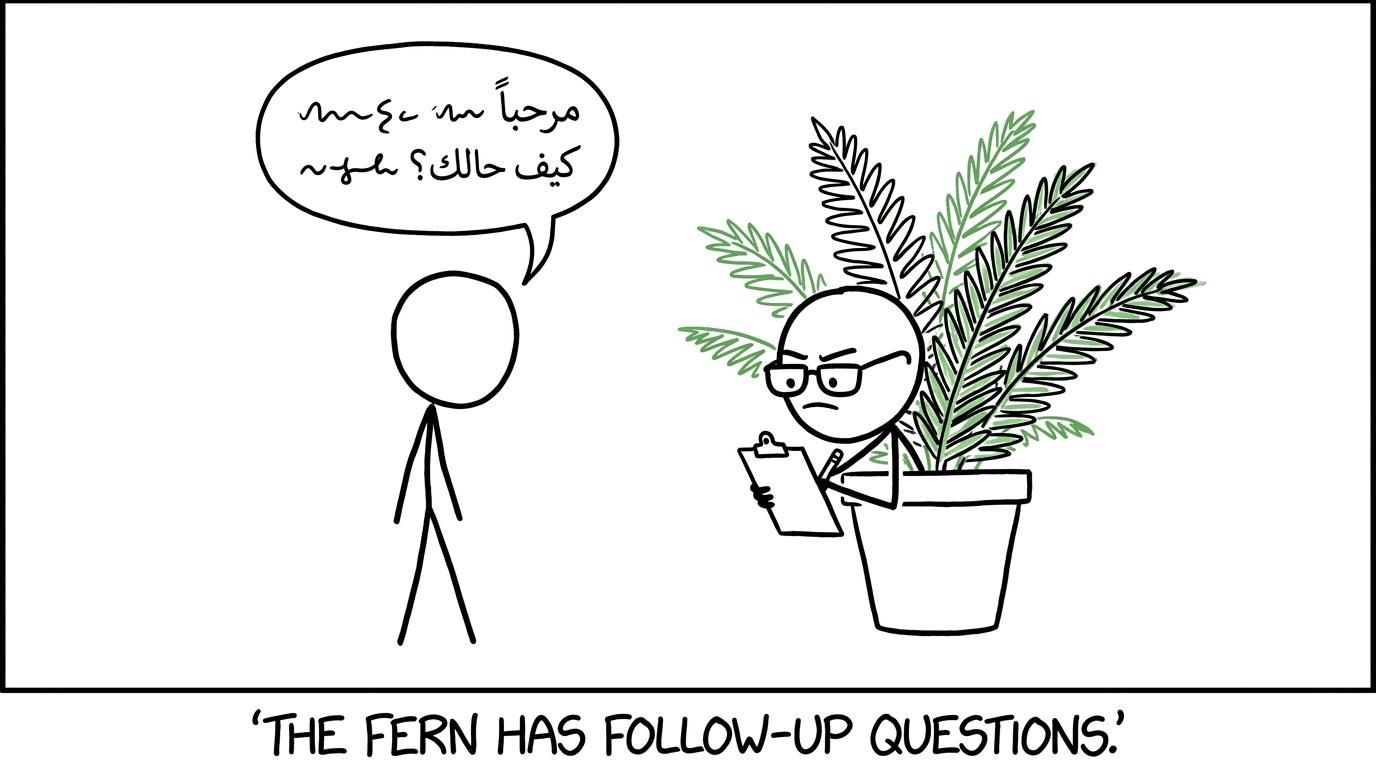 A GCSE student rehearses an Arabic speaking assessment with an unexpectedly demanding houseplant
Make listening practice predictable
Listening anxiety often comes from irreversibility: the recording continues even when you miss something. Train yourself not to chase a lost word into the next sentence.
Before the audio begins, use the available reading time carefully. Scan the questions, identify what information is required and notice whether answers must be given in Arabic, English or a non-verbal format. In the Pearson Edexcel assessment, the language used for questions varies by section, so familiarity with the paper structure matters.
During practice:
- Listen for meaning rather than attempting to translate every word.
- Mark a question and move on if one phrase escapes you.
- Use the second hearing, where provided, to target missing information.
- Review whether an error came from vocabulary, pronunciation recognition or attention.
- Include different voices and natural speeds in teacher-approved materials.
An unfamiliar accent, voice or topic does not mean you have failed. It means the paper is testing whether you can extract useful information from spoken Standard Arabic. Practising the same short clip repeatedly may improve memory for that clip, but fresh exam-style material develops listening resilience.
Stop unknown words controlling reading
An anxious reader often gives one unfamiliar word too much power. Yet comprehension questions frequently depend on the surrounding sentence, a contrast, a time phrase or an opinion rather than complete translation.
Train three habits. First, read the question before studying the passage closely. Second, underline evidence rather than relying on your first impression. Third, distinguish between a word that blocks the answer and one you can safely leave unresolved.
GCSE Arabic reading can include different text types and translation into English, depending on the board and paper. Practise moving between Arabic and English without expecting a word-for-word match. Translation should preserve meaning, not imitate Arabic sentence structure awkwardly.
Timed exposure matters here. The NHS advises students to familiarise themselves with exam layouts and practise activities they will perform on the day. For wider GCSE preparation, MathsGenie's guide to using past papers properly explains the useful cycle: complete, mark, diagnose, correct and retest.
Build calm into Arabic writing practice
Writing anxiety usually grows from competing demands: content, vocabulary, grammar, spelling, handwriting, time and task coverage. Reduce that load with a fixed checking order.
Before writing, identify the purpose, audience and every required bullet point. Plan a small number of relevant ideas. During the response, prioritise clear communication and language you can control. Afterwards, check task coverage first, then verbs and time frames, agreements, spelling, letter connections and punctuation.
Practise writing Arabic by hand under timed conditions if that is how you will sit the examination. Keyboard fluency does not automatically become confident handwriting. If letter formation or writing speed is a concern, raise it with your teacher well before the examination rather than hiding it.
Keep a correction log with headings such as:
- missed task requirement;
- wrong verb form or time frame;
- agreement error;
- spelling or letter-form error;
- overambitious vocabulary;
- poor time allocation.
Correct patterns, not just individual answers. That principle also supports maths revision. A realistic GCSE revision timetable can help you balance Arabic practice with maths rather than allowing the most worrying subject to consume every evening.
Use a short anxiety routine before and during the exam
A routine is valuable because it removes decisions at the moment your mind feels busiest.
Before practice and on the exam day, place both feet on the floor and let your breathing become gentle. NHS breathing guidance recommends breathing comfortably into the belly, inhaling through the nose and exhaling through the mouth, with steady counting if helpful. Practising regularly is more useful than trying the technique for the first time outside the exam room.
Then use three prompts:
- Body: loosen your shoulders and jaw.
- Task: identify only the next instruction.
- Action: underline, listen, plan or speak.
If your mind goes blank in speaking, return to the key word in the question. In listening, release the missed phrase and rejoin the recording. In reading, locate evidence. In writing, return to the next bullet point. Each response moves attention from imagined results back to a controllable action.
Sleep also matters. NHS guidance says most teenagers need around 888 to 101010 hours of sleep and warns that all-night cramming is usually less useful than rest. A calm GCSE night-before plan can help you protect that boundary across your exam timetable.
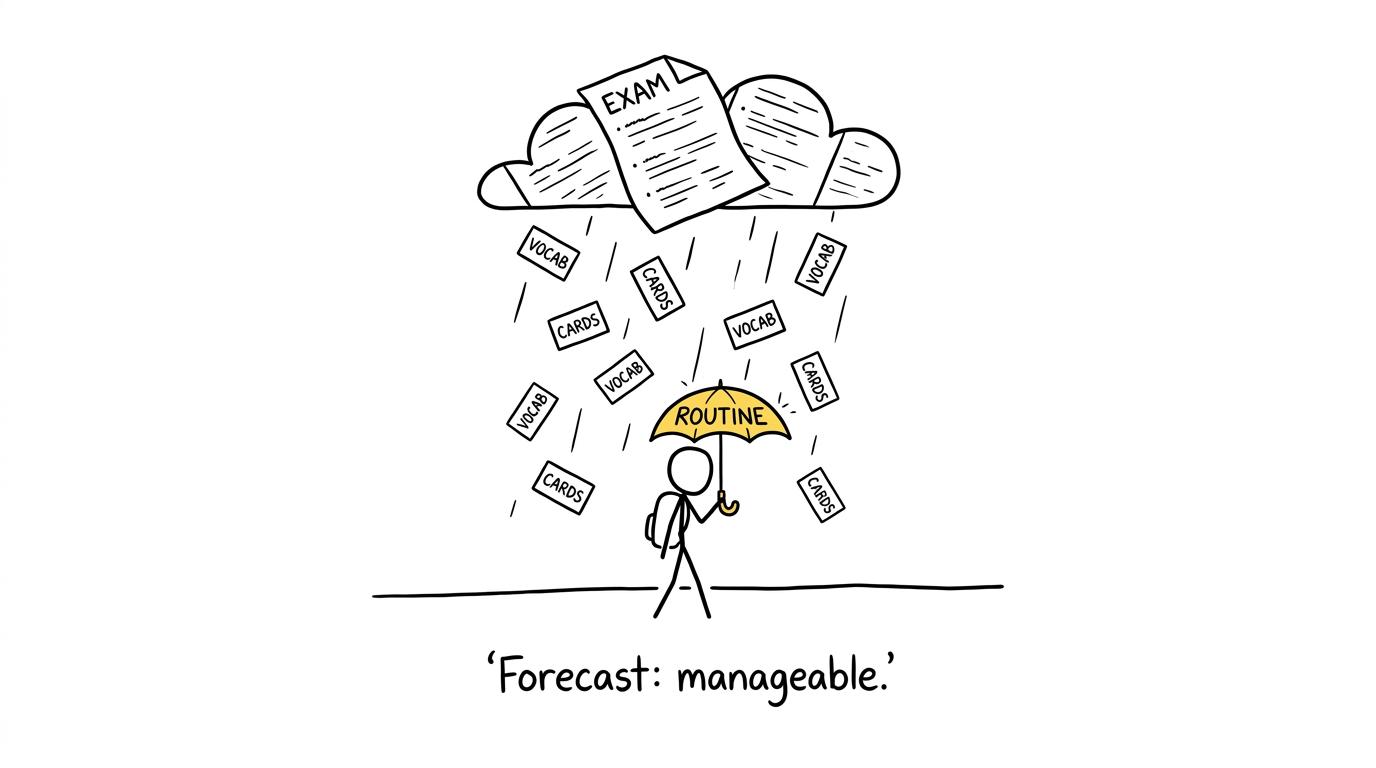 A student walks calmly beneath a vocabulary storm using a revision routine as an umbrella
Keep Arabic and maths revision from competing
Many students searching for Arabic support are also preparing for compulsory GCSE maths papers. Anxiety rises when every subject appears urgent at once.
Give Arabic a defined slot based on the skill you need to train: perhaps a short speaking rehearsal, a listening task or one timed writing response. Give maths its own evidence-based session using the GCSE maths revision hub. Separating tasks prevents "revise Arabic" or "revise maths" becoming endless, shapeless instructions.
On tired days, use smaller units. MathsGenie's Edexcel GCSE mini tests provide focused maths practice, while one brief Arabic role play or reading extract can maintain language contact. On longer days, move towards realistic papers. The Edexcel GCSE maths past papers include mark schemes and worked solutions where available.
Common mistakes when managing GCSE Arabic anxiety
Avoiding the speaking task
Silent vocabulary revision feels safer, but it does not reproduce the pressure of speaking. Begin with private recordings, then progress to another person and finally realistic teacher-led practice.
Revising only comfortable themes
Familiar topics can create confidence without revealing gaps. Rotate through the full specification and give extra attention to the situations that trigger hesitation.
Treating a home dialect as a weakness
Dialect knowledge can be a valuable linguistic foundation. The task is to practise the Standard Arabic and assessment conventions required by your specification, not to view your existing language experience as a failure. Ask your teacher to identify specific differences that affect assessed responses.
Memorising answers without listening to questions
A polished answer earns little if it does not address what was asked. Train recognition of question words, tense and topic before launching into prepared material.
Completing practice without reviewing it
Repeated papers do not automatically reduce anxiety. Mark, classify errors and revisit the weakest skill. Maths students can apply the same method through MathsGenie's one-month revision plan.
Waiting too long to ask for help
If anxiety is severe, persistent or interfering with sleep, eating, school attendance or everyday life, tell a trusted adult, teacher or pastoral member of staff. A GP is also an appropriate starting point for health support. If you believe you may need exam access arrangements, speak to your school's SENCO or exams officer early; arrangements must follow current awarding-body rules and cannot be guaranteed simply because they are requested.
Turn uncertainty into a routine
GCSE Arabic can feel unpredictable because it asks you to receive and produce language in several ways. But each paper becomes less mysterious when you rehearse its exact demands. Train listening without chasing every word. Practise speaking with variation and recovery. Read for evidence. Write with a dependable planning and checking order.
Then protect the rest of your timetable. Use MathsGenie as your free home for GCSE maths revision lessons, practice questions, mini tests, past papers, predicted papers, mark schemes and video solutions. Start at the GCSE maths revision page, choose your board and tier, and make maths one less source of uncertainty while you prepare calmly for Arabic.










