GCSE: How OCR Students Revise Physics Without Wasting Time
GCSE revision for OCR Physics without wasted time: focus on maths-heavy marks, past papers, and a simple routine using YesGenie resources.
GCSE Physics revision can feel like carrying two bags at once: one full of facts, and one full of calculations. OCR students often waste time because they treat those bags the same way: highlighting, rewriting, and hoping it sticks. But marks don’t work like that. In OCR GCSE Physics, the quickest gains usually come from the places where physics meets maths: rearranging equations, working with standard form, using graphs, and handling units cleanly. If you can revise those on purpose, your GCSE grade moves faster than your effort.
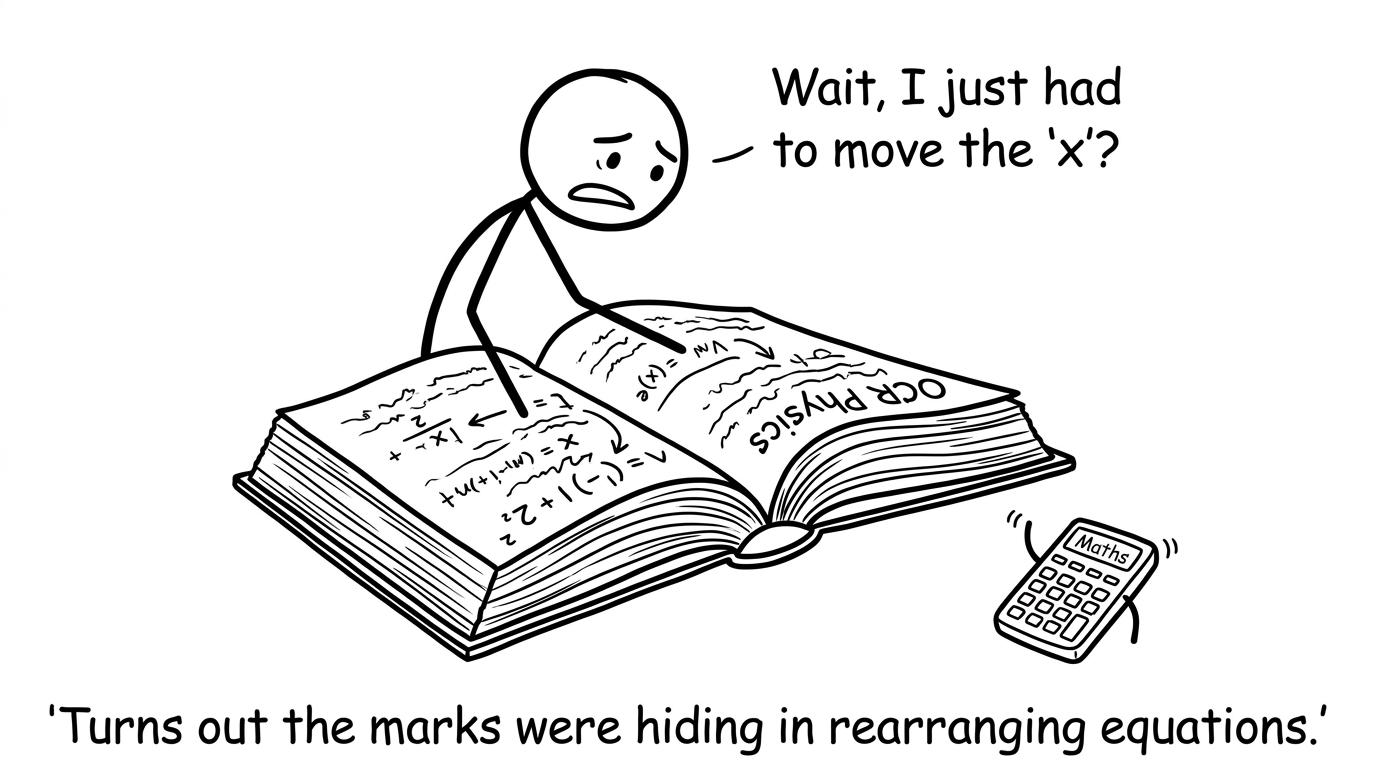 A student realises the marks were in equations
The no-waste OCR GCSE Physics revision checklist
Use this as your filter. If a revision activity doesn’t tick at least one box, it’s probably time-wasting.
- It produces marks: you’re answering exam-style questions, not rewriting notes.
- It uses OCR language: you practise the command words and the style OCR likes.
- It trains maths skills: rearranging, graphs, ratio, percentages, standard form.
- It closes gaps: you mark, diagnose, then fix one weakness at a time.
- It repeats intelligently: short, spaced sessions rather than one long “marathon”.
For the maths side, YesGenie is built for exactly this kind of GCSE revision: revision guides, question banks, mark schemes, and past papers that let you practise and then correct yourself fast.
Useful starting points:
- GCSE Past papers
- Edexcel GCSE Maths Past Papers (useful for maths practice that transfers straight into OCR Physics calculations)
- Rearranging Harder Formulae (GCSE Maths revision guide)
- Changing the Subject of a Formula (practice questions)
- Standard Form (GCSE Maths exam booklet)
Why OCR GCSE Physics rewards “maths-first” revision
There’s a quiet truth about GCSE science papers: you can understand the story of the topic and still drop marks on the mechanics of answering. OCR Physics questions often place the maths in the middle of a context, a practical, a graph, a unit conversion, a multi-step calculation, and then punish small slips.
That’s why “maths-first” revision isn’t ignoring physics content. It’s choosing the highest-return work first.
Three patterns explain most wasted time:
- Passive revision: reading and rewriting feels safe because it’s familiar, but it doesn’t train retrieval under pressure.
- Formula panic: students try to memorise everything, instead of learning how to rearrange and substitute calmly.
- Unmarked practice: doing questions without a proper check means you repeat the same mistake for weeks.
If you’re also revising GCSE Maths or A Level maths, the payoff is even bigger: the same algebra habits show up everywhere.
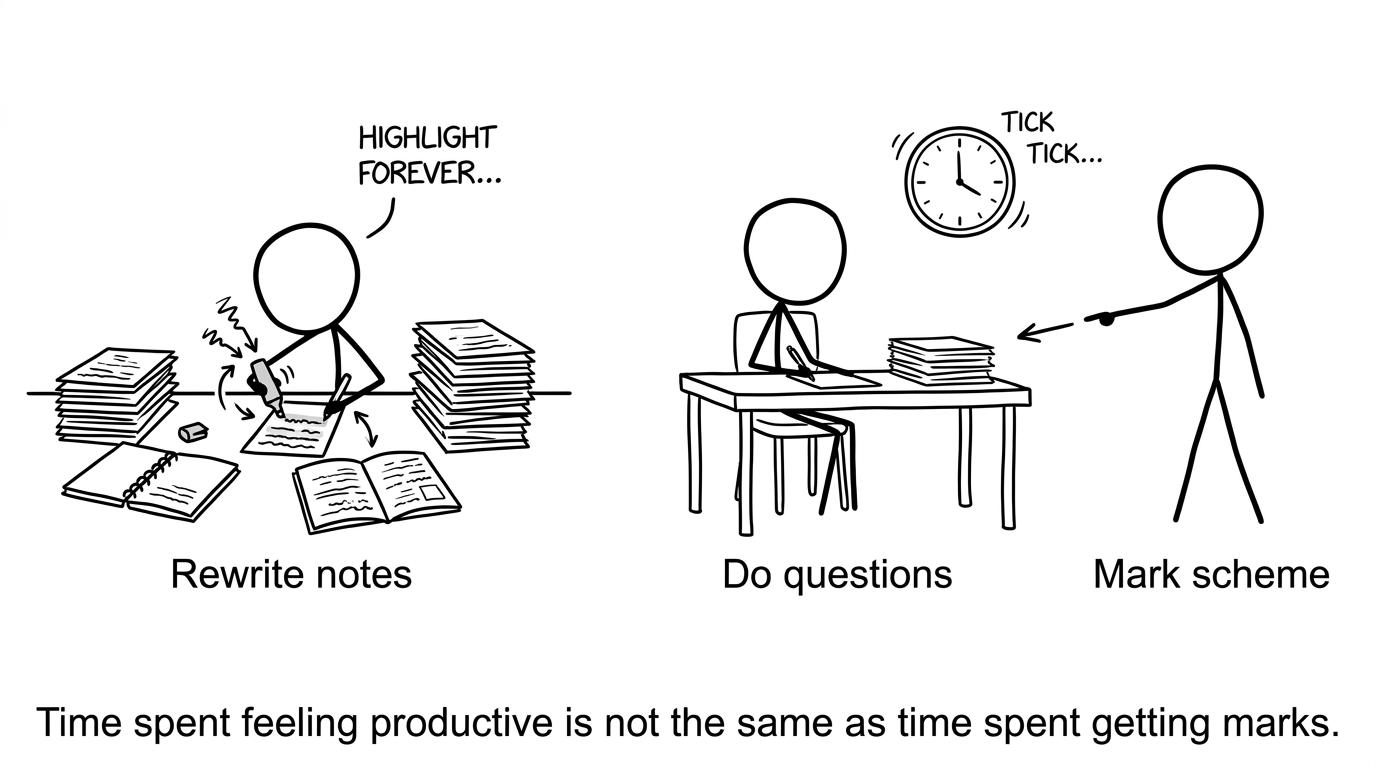 Rewrite notes vs do questions
Build your OCR GCSE Physics routine around three “mark engines”
Equation fluency (rearranging + substituting)
In OCR GCSE Physics, equations aren’t just recall. They’re decision-making: which equation fits, what needs converting, and what the question is actually asking for.
A reliable GCSE routine is:
- Write the equation.
- Rearrange (if needed) with the balance rule.
- Substitute with units.
- Convert units early.
- Round at the end.
Worked example: weight and mass (classic OCR Physics maths)
Use W=mgW=mgW=mg.
A student has mass m=72 kgm=72\text{ kg}m=72 kg. Take g=9.8 N/kgg=9.8\text{ N/kg}g=9.8 N/kg. Find weight.
W=mg=72×9.8=705.6W=mg=72\times 9.8=705.6W=mg=72×9.8=705.6So W=705.6 N≈706 NW=705.6\text{ N}\approx 706\text{ N}W=705.6 N≈706 N (to 333 significant figures).
Now the reverse, which is where GCSE marks are often lost.
A box has weight W=490 NW=490\text{ N}W=490 N on Earth. Take g=9.8 N/kgg=9.8\text{ N/kg}g=9.8 N/kg. Find mass.
W=mg⇒m=Wg=4909.8=50W=mg \Rightarrow m=\frac{W}{g}=\frac{490}{9.8}=50W=mg⇒m=gW=9.8490=50So m=50 kgm=50\text{ kg}m=50 kg.
To get sharper at this quickly, practise rearranging until it feels like moving furniture rather than solving a puzzle:
- Rearranging Harder Formulae (GCSE Maths revision guide)
- Changing the Subject of a Formula (practice questions)
Numbers in science (standard form + significant figures)
OCR GCSE Physics loves large and tiny numbers: wavelengths, energy, charge, distances. If your standard form is shaky, you leak time and marks.
Worked example: multiplying in standard form
Calculate (3.0×108)×(2.5×10−3)(3.0\times 10^8)\times (2.5\times 10^{-3})(3.0×108)×(2.5×10−3).
Multiply the front numbers and add the powers of ten:
(3.0×2.5)×108+(−3)=7.5×10⁵(3.0\times 2.5)\times 10^{8+(-3)}=7.5\times 10^5(3.0×2.5)×108+(−3)=7.5×10⁵So the answer is 7.5×1057.5\times 10^57.5×10⁵.
If OCR asks you to round to 222 significant figures, it becomes 7.5×1057.5\times 10^57.5×10⁵ already. If it were 7.46×1057.46\times 10^57.46×10⁵, it would round to 7.5×1057.5\times 10^57.5×10⁵.
Targeted practice:
Graphs (gradients, intercepts, proportionality)
Graphs are where OCR GCSE Physics blends skills: reading values, interpreting trends, and extracting a gradient as a physical constant.
Even if you “get” the topic, the graph marks require method.
Worked example: gradient as rate of change
A graph shows distance sss against time ttt. Two clear points are (2,6)(2,6)(2,6) and (8,24)(8,24)(8,24) (units omitted here, but in the exam you must include them).
The gradient is
gradient=ΔsΔt=24−68−2=186=3\text{gradient}=\frac{\Delta s}{\Delta t}=\frac{24-6}{8-2}=\frac{18}{6}=3gradient=ΔtΔs=8−224−6=618=3So the speed is 333 units per second (in OCR papers this would be something like 3 m/s3\text{ m/s}3 m/s if sss is in metres and ttt in seconds).
For straight-line graphs that pass through the origin, OCR often wants the language of direct proportion: y∝xy\propto xy∝x.
If you want extra graph fluency through maths practice, build it from question banks:
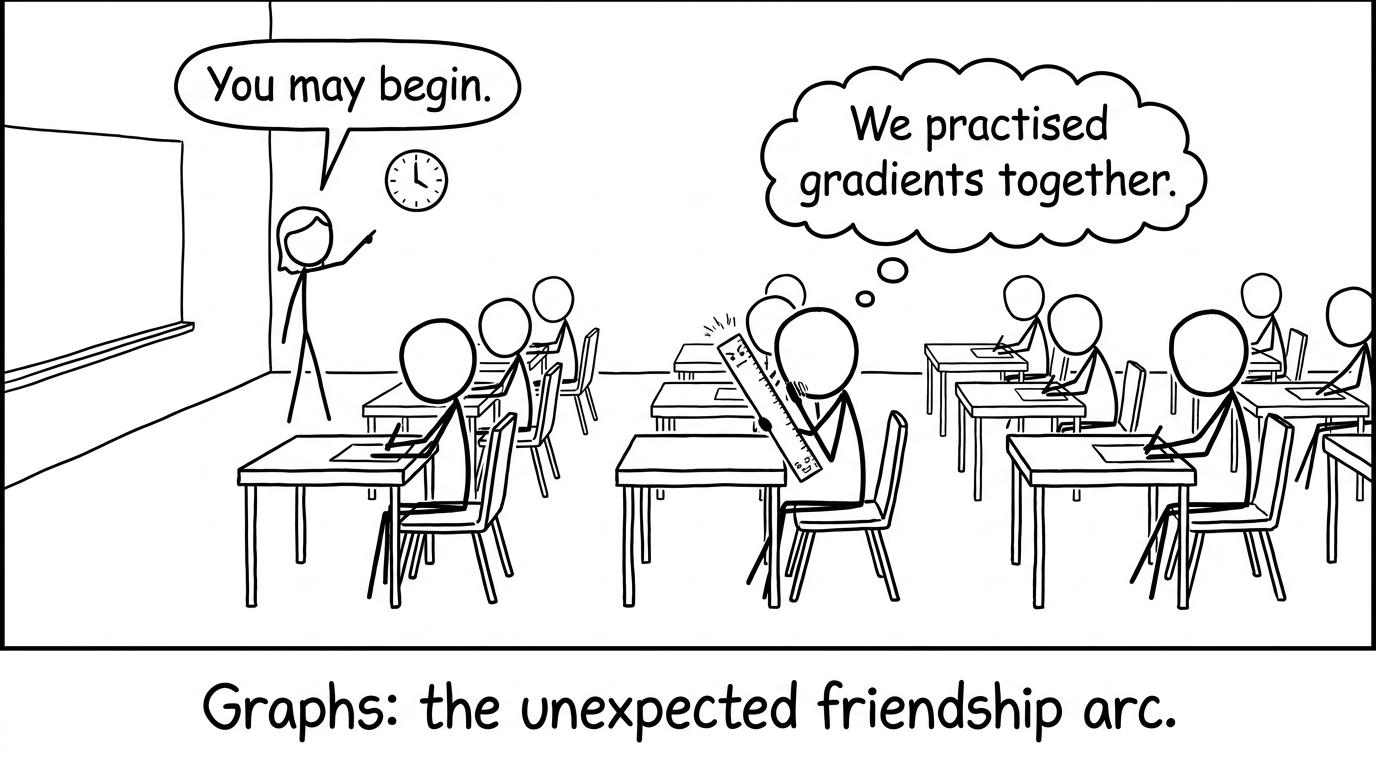 Graphs friendship arc
How to practise OCR GCSE Physics without “doing loads”
The goal isn’t quantity. It’s feedback loops.
Use a 30-minute cycle
- 10 minutes: one sub-topic recap (equations, definitions, required practical steps).
- 15 minutes: exam-style questions.
- 5 minutes: mark, correct, and write one “fix sentence” you’ll use next time.
That last part is where GCSE improvement hides. Students love the doing and skip the diagnosing.
Mark like you mean it
When you mark, don’t just tick answers. Categorise the mistake:
- Wrong equation choice
- Rearranging error
- Unit conversion error
- Rounding/significant figures
- Graph reading/gradient method
- Explanation missing key words
Then your next session starts with the category, not the topic.
For realistic exam pressure, mix in maths past papers as a training tool for accuracy and time management:
Common mistakes OCR GCSE Physics students make (and how to stop)
- Rearranging by “moving letters”: it sometimes works by luck, but OCR mark schemes reward correct algebra. Use inverse operations and the balance rule.
- Forgetting unit conversions: the method can be perfect and still lose marks. Convert cm→m\text{cm}\to\text{m}cm→m, g→kg\text{g}\to\text{kg}g→kg, minutes→s\text{minutes}\to\text{s}minutes→s before substitution.
- Rounding too early: keep full calculator accuracy, then round at the end to the required significant figures.
- Gradient method not shown: OCR often expects a clear triangle or at least ΔyΔx\frac{\Delta y}{\Delta x}ΔxΔy with two points.
- Misreading “state” vs “explain”: “state” is usually one fact; “explain” needs linked reasoning, often with a because.
- Not using given values: if the question provides ggg or another constant, use that value even if you know a common one.
A surprisingly effective fix is to practise the maths skills separately for a week, then return to OCR Physics questions. It feels indirect, but GCSE marks respond fast.
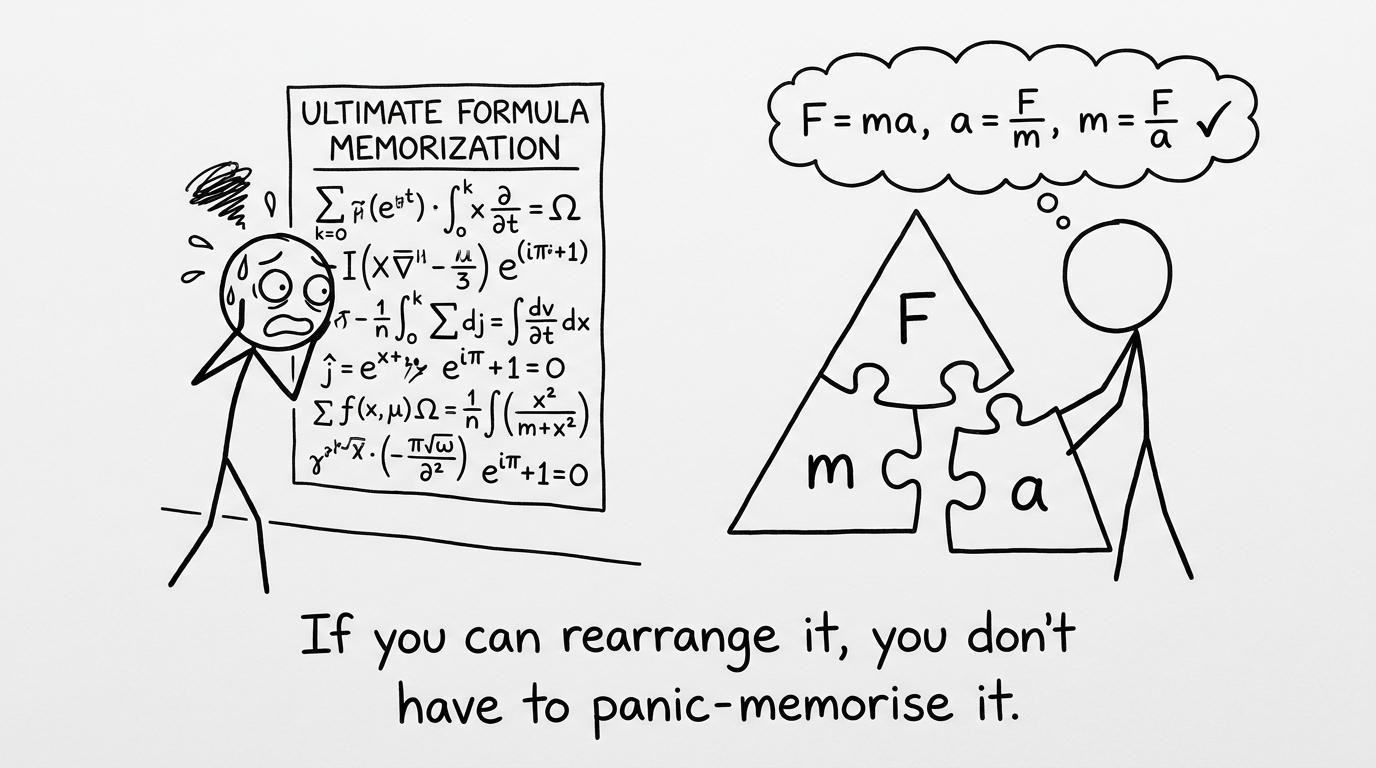 Rearranging beats panic-memorising
Bring it back to YesGenie: revise for GCSE marks, not motivation
OCR GCSE Physics revision works best when it’s honest: you don’t need perfect notes, you need repeatable methods. If you focus on the maths-heavy “mark engines”, rearranging, standard form, and graphs, you stop wasting time and start collecting marks reliably.
Build your plan around practice, feedback, and intelligent repetition using YesGenie:
- Use revision guides to learn the method quickly.
- Use practice questions and mini tests to make it stick.
- Use past papers and mark schemes to train exam timing and OCR-style accuracy.
Start here and keep it simple:
- GCSE Past papers
- Rearranging Harder Formulae (GCSE Maths revision guide)
- Changing the Subject of a Formula (practice questions)
- Standard Form (GCSE Maths exam booklet)
If you revise like this, GCSE Physics stops being an endless to-do list and becomes a small set of habits you can trust, even in the exam hall.