Perfectionism in GCSE Arabic Revision: Break the Trap
Perfectionism GCSE Arabic revision: spot hidden avoidance, practise all four skills through imperfect attempts, and protect time for GCSE maths revision.
A revision session can look impressively busy while producing almost no useful practice. You rewrite a vocabulary list. You adjust the colours in your timetable. You wait until you can give a speaking answer without hesitation. An hour passes, yet nothing has been attempted under exam conditions.
That is the central danger of perfectionism in GCSE Arabic revision: it can disguise avoidance as hard work. The solution is not to lower your ambitions. It is to replace flawless preparation with repeated attempts, honest feedback and specific corrections. If you are balancing Arabic with GCSE maths, that change also protects valuable revision time across both subjects.
A quick perfectionism checklist
Perfectionism may be interfering with your revision if you regularly:
- delay questions until you feel completely prepared;
- rewrite notes instead of testing your memory;
- avoid speaking because your pronunciation might be imperfect;
- spend too long correcting one answer;
- restart tasks after small mistakes;
- revise comfortable material while avoiding weaker skills;
- treat a disappointing mark as a verdict rather than information.
High standards are not automatically harmful. Wanting to improve can encourage persistence and careful work. The problem begins when concern about mistakes stops you attempting the tasks that create improvement.
Why perfectionism can be worse than obvious procrastination
Ordinary procrastination is usually visible. You know you are scrolling, tidying or putting the work off. Perfectionistic procrastination is quieter because it often resembles revision.
You might design a beautiful weekly plan but never test yourself. You may memorise an ideal writing response but avoid producing a new one. You might watch explanations without answering questions independently.
Research involving university students suggests that perfectionism is not one simple trait. Striving for high standards can sometimes support action, while excessive concern over mistakes is associated with avoidance, distress and academic procrastination. Findings are not identical across every study, and evidence from university samples cannot automatically be applied to every GCSE student. Still, the practical distinction is useful: standards that lead to practice help; standards that prevent practice do not.
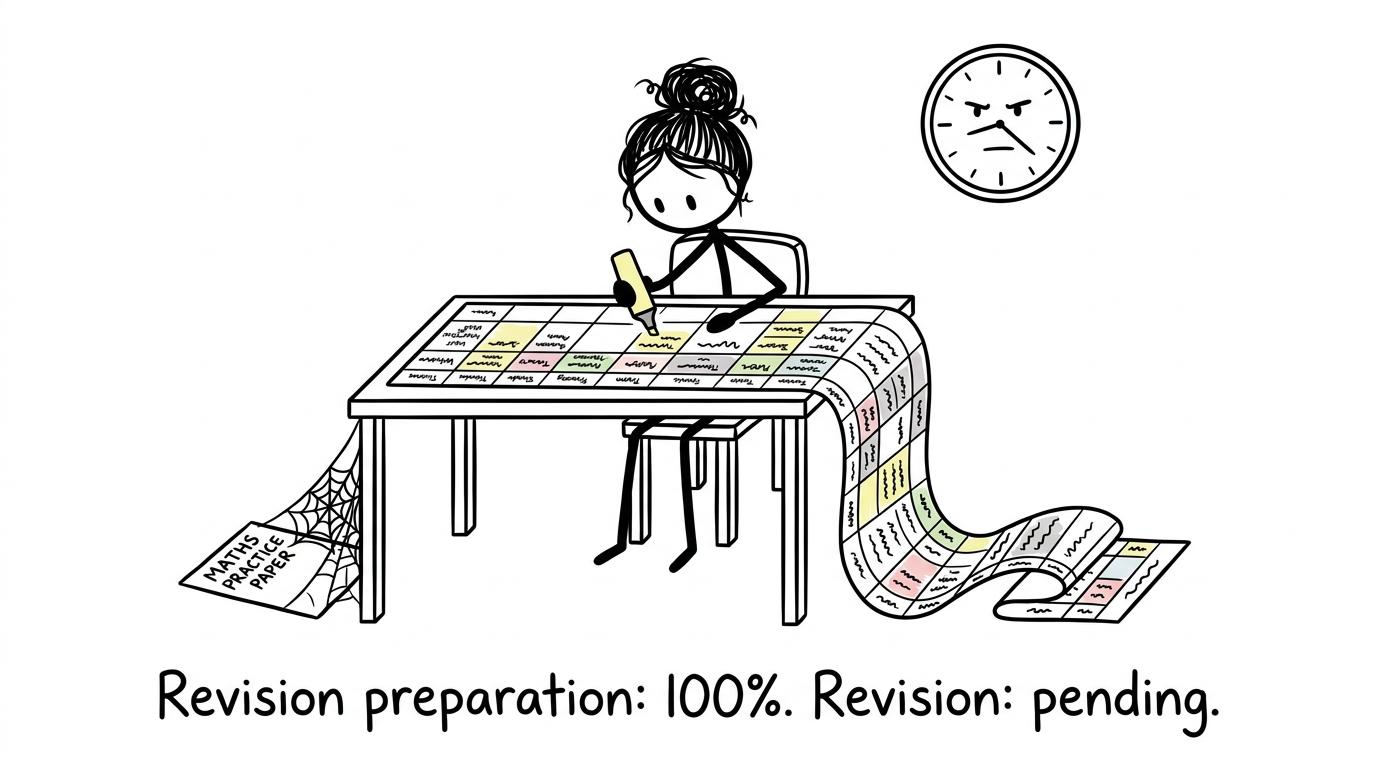 A student perfects a revision timetable while the practice paper waits
How perfectionism appears in GCSE Arabic revision
Waiting to know every word before reading or listening
A perfectionist can feel that unfamiliar vocabulary makes a text impossible. In reality, reading and listening assessments require you to identify meaning from context, recognise familiar language and continue after missing something.
Waiting for complete vocabulary knowledge removes the opportunity to practise uncertainty. A better target is to identify the main message, retrieve the details you can hear or read, and then review the gaps.
Rehearsing speaking answers until they sound scripted
Careful preparation matters, but speaking is communication rather than recital. If every answer must be flawless before you say it aloud, you do not practise recovering after a pause, adapting familiar language or responding to an unexpected prompt.
Make short recordings without restarting. Listen once and choose one improvement. That might be clearer pronunciation, a more developed opinion or more accurate verb use. Then record another response. The aim is not a perfect performance in your bedroom; it is greater flexibility in the assessment.
Copying model writing instead of producing your own
Model responses can reveal useful structures, but copying them neatly creates recognition rather than independent recall. The harder and more valuable task is closing the model and producing an answer from a prompt.
For Pearson Edexcel GCSE Arabic, listening, speaking, reading and writing each account for 25%25\%25% of the qualification. Students enter Foundation or Higher tier across the qualification, and dictionaries are not permitted in the assessments. If that is your specification, revision must therefore reach beyond polished notes and train all four skills without dictionary dependence. Always confirm the current arrangements with your teacher and official specification.
Spending the whole evening fixing one response
Corrections have diminishing returns. The first correction may fix a recurring grammar error. The tenth change to the same paragraph may simply make one answer look elegant.
Set a boundary: identify a small number of important improvements, record them, and move on to a new prompt. Breadth matters because the examination can draw on language from several themes and contexts.
The hidden cost for your GCSE maths revision
Perfectionism rarely stays inside one subject. A student who spends an unplanned evening polishing Arabic notes loses the session intended for algebra, geometry or statistics. The next day begins with guilt and an even more ambitious timetable. The cycle repeats.
Maths can trigger the same behaviour. You may avoid a GCSE maths mini test because the score might be low, or watch a solution repeatedly rather than attempt the question. Yet a mistake found during revision is cheaper than the same mistake found in the examination.
Use the MathsGenie GCSE maths revision hub to reduce decision-making. Choose your exam board, tier and one weak area rather than trying to construct the perfect collection of resources. Edexcel, AQA, OCR and Eduqas organise their papers differently, so your timed maths practice should match the specification and tier you will actually sit.
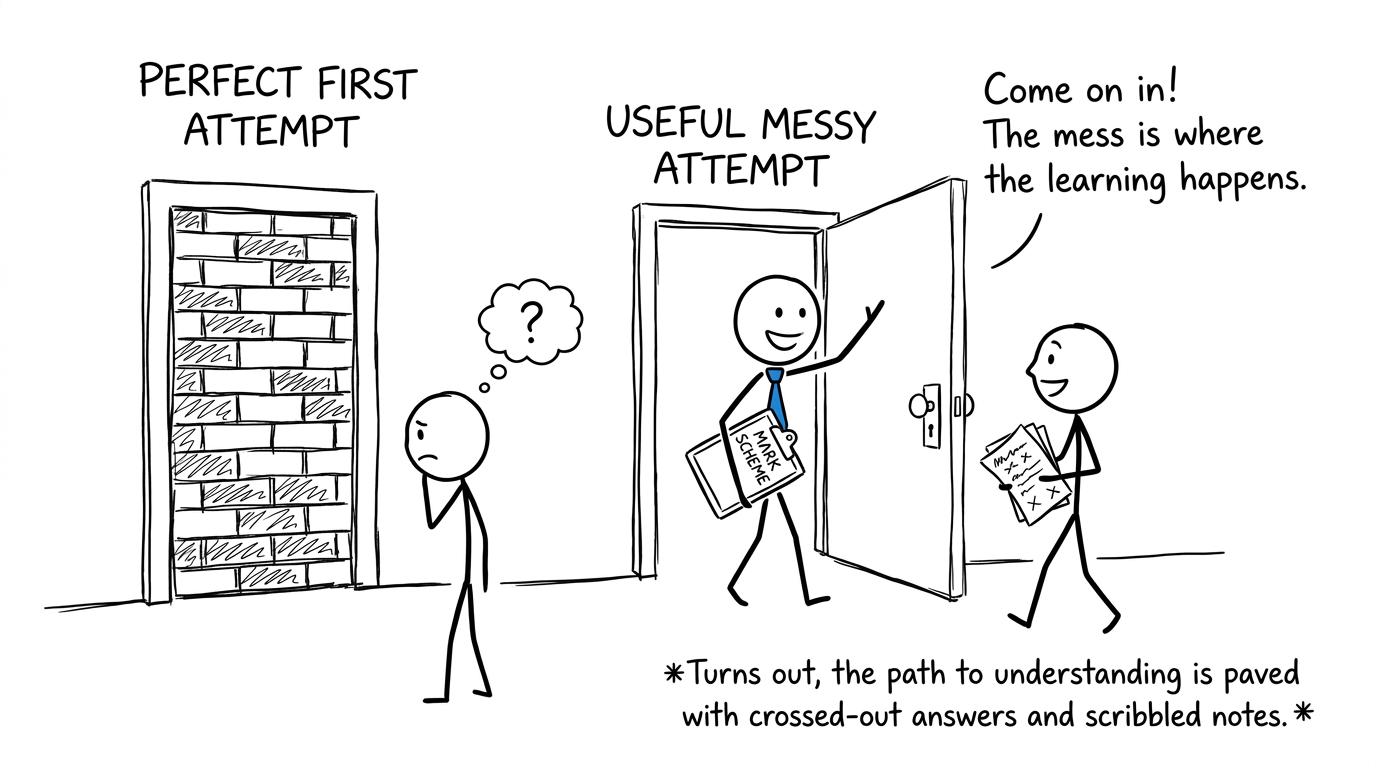 The useful messy attempt offers a way forward
Replace perfect revision with a feedback loop
The most effective response to perfectionism is not a more elaborate plan. It is a shorter distance between attempting something and receiving feedback.
Choose an observable task
“Revise Arabic” is vague. “Complete one listening extract and review the missed details” is observable. In maths, “improve algebra” is vague; completing one focused question set is clear.
A task should end with evidence: an answer, recording, score, correction or list of vocabulary to revisit.
Attempt before you feel ready
Readiness often arrives after beginning, not before it. Give yourself brief preparation, then start. Do not use notes unless the session is deliberately designed for supported practice.
A useful sequence is:
- retrieve what you know;
- attempt the task;
- check it;
- identify one recurring weakness;
- practise that weakness;
- attempt a fresh task later.
Maths students can use the same structure through the MathsGenie twenty-minute revision routine. A limited session makes it harder for perfectionism to expand a small task across the entire evening.
Separate practice from performance
Practice is supposed to contain errors. Performance is where you try to minimise them. Confusing the two makes every revision task feel like an examination.
Label sessions clearly. An untimed Arabic writing response can be a learning attempt. A later response can be completed under controlled conditions. In maths, topic questions build the method before a timed paper tests it.
Use an error log that stays small
Record only information that changes your next attempt:
- the skill or topic;
- what went wrong;
- the correction;
- when you will retest it.
Do not rewrite the entire answer. Your error log is a route back into practice, not another document to perfect.
For maths papers, the guide to using GCSE past papers properly explains how to move from a lost mark to targeted revision and retesting.
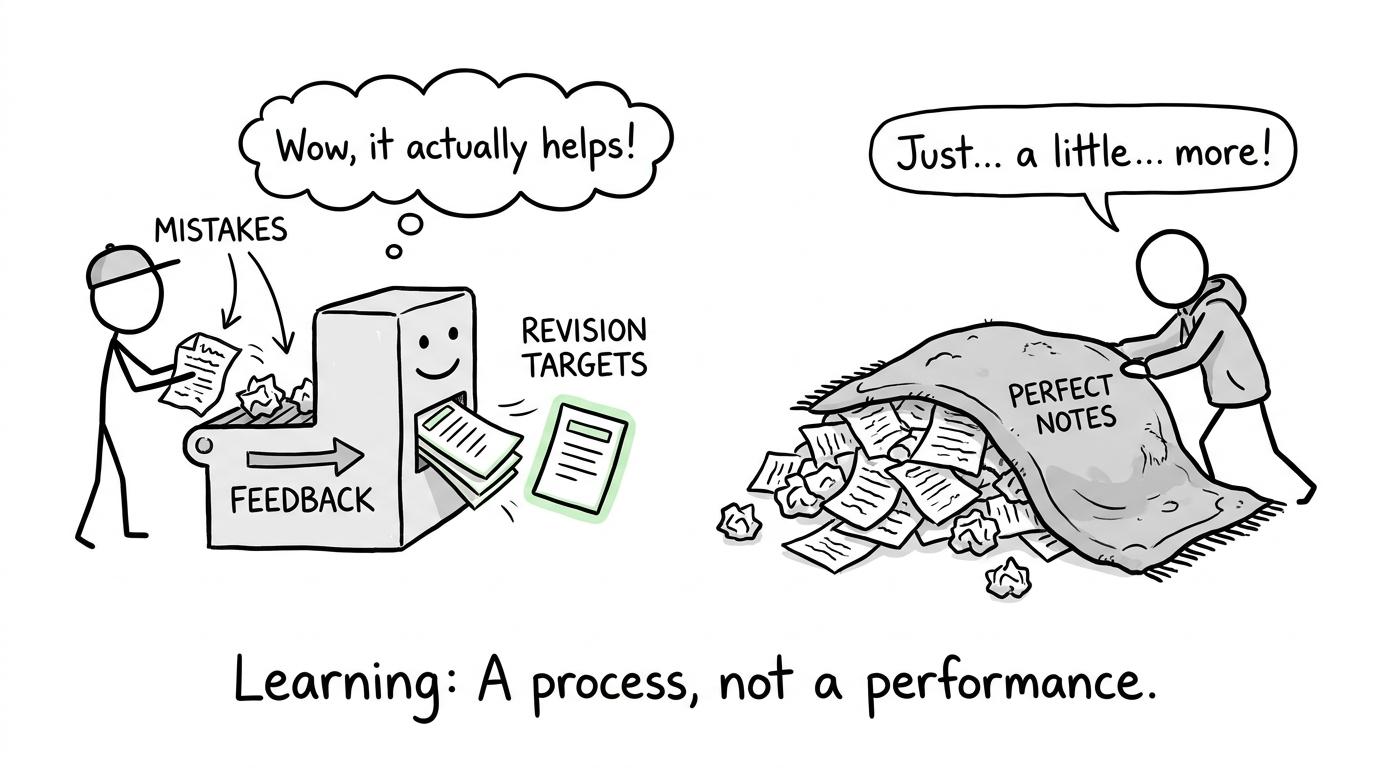 Mistakes become useful targets when they enter the feedback machine
Build a revision plan that perfectionism cannot hijack
A helpful plan limits both avoidance and overwork. Use the MathsGenie revision planner to organise your maths workload, then give Arabic clearly bounded sessions alongside it.
Each session should contain:
- one priority skill;
- one independent attempt;
- a stopping time;
- immediate checking where possible;
- one scheduled retest.
The stopping time matters. Without one, perfectionism can turn a short vocabulary review into an evening of formatting and rewriting.
Your weekly plan should also include slack. The aim is not to obey a flawless timetable. It is to return to the plan after school deadlines, tired days and interruptions. The GCSE maths revision timetable guide can help you balance focused topic sessions with timed practice and recovery time.
Common mistakes when trying to overcome perfectionism
Trying to become careless
The opposite of perfectionism is not low effort. Keep checking important details, but stop demanding certainty before every attempt. Accuracy should emerge through practice and correction.
Setting an unrealistically large daily minimum
A demanding minimum works until the first difficult day. Then missing one session feels like failure. Choose a baseline you can complete consistently and treat additional revision as optional progress.
Only practising favourite skills
Neat vocabulary work may feel safer than spontaneous speaking. Familiar number questions may feel safer than algebra. Comfort creates activity, but weak areas reveal where marks can be gained.
Marking work without acting on it
A score is not a correction. After using an Arabic mark scheme or teacher feedback, identify the next language skill to practise. After an Edexcel GCSE maths past paper, use the mark scheme and available solutions to locate the topics behind the lost marks.
Treating predicted papers as predictions of your grade
A predicted paper is a practice resource, not a verdict. Use Edexcel GCSE maths predicted papers under timed conditions, mark them carefully and return to the topics they expose. The same principle applies to any specimen or practice material used for Arabic.
Progress begins with an imperfect page
Perfectionism promises protection from failure, but often protects you from feedback instead. GCSE Arabic improves when you read unfamiliar material, speak before every sentence feels polished, write without copying and listen without expecting to catch every word. GCSE maths improves through the same willingness to attempt, mark, correct and retest.
Choose one bounded task today. Finish it without restarting. Record one useful correction, then stop.
For your maths preparation, make MathsGenie your free revision base: begin with revision lessons and practice questions, check progress through mini tests, then build exam confidence with past papers, predicted papers, mark schemes and video solutions. The goal is not a perfect revision record. It is stronger performance on the next question.