

GCSE Maths Revision Burnout: How to Avoid It
GCSE maths revision burnout: spot early signs, build a realistic routine and pace your practice so you reach May focused, rested and ready.
The difficult thing about revision is that effort can look productive long after it has stopped being useful. You sit at the desk, open another paper and promise yourself you will rest once everything feels secure. But GCSE maths contains too much material for that moment ever to arrive.
Avoiding GCSE maths revision burnout is not about caring less. It means choosing a pace you can sustain until the exams in May. Use short, focused sessions, practise rather than endlessly rereading, protect your sleep and respond early when stress begins affecting your concentration, mood or health.
The goal is not to do the most revision today. It is to arrive at the exam able to think clearly.
A quick anti-burnout checklist
A sustainable GCSE maths plan should include:
- one specific topic or task for each session;
- regular short breaks away from the desk;
- practice questions followed by marking and correction;
- lighter sessions alongside demanding paper practice;
- a clear finishing time each evening;
- enough sleep, regular meals, movement and time away from revision;
- space to catch up when life interrupts the timetable;
- support from a teacher, parent, carer or another trusted adult when stress becomes difficult to manage.
You can organise your topics and resources through the GCSE Maths revision hub. It brings together revision lessons, worksheets, exam questions, mini tests, predicted papers and past papers for boards including Edexcel, AQA, OCR and Eduqas.
What GCSE maths revision burnout can feel like
Revision burnout is a useful everyday description rather than a medical diagnosis. It usually describes a state in which prolonged pressure and insufficient recovery leave you feeling mentally or physically exhausted. The earlier you notice the pattern, the easier it is to adjust.
Changes in concentration
You may read the same question repeatedly without taking it in, make errors in methods you normally understand or struggle to begin a simple task. A worksheet that once took 303030 minutes may start consuming an entire evening.
One bad session is normal. The warning sign is a repeated decline despite spending more time at your desk.
Changes in mood and motivation
Irritability, persistent worry, low mood, hopeless thoughts or losing interest in activities you usually enjoy can all accompany excessive exam stress. You might also begin avoiding maths completely because every topic feels connected to everything you have not finished.
That avoidance is not necessarily laziness. Sometimes it is what happens when the next task is too large or unclear.
Physical warning signs
Exam stress may be accompanied by headaches, stomach discomfort, tense muscles, changes in appetite or difficulty sleeping. NHS guidance also identifies poor sleep, irritability and loss of enjoyment as signs that a young person may be struggling with stress.
These signs do not automatically mean burnout, and this article cannot diagnose their cause. If symptoms are severe, persistent or interfering with everyday life, tell a trusted adult, your school’s pastoral team or a healthcare professional. Getting support is a sensible response, not an admission that you have failed.
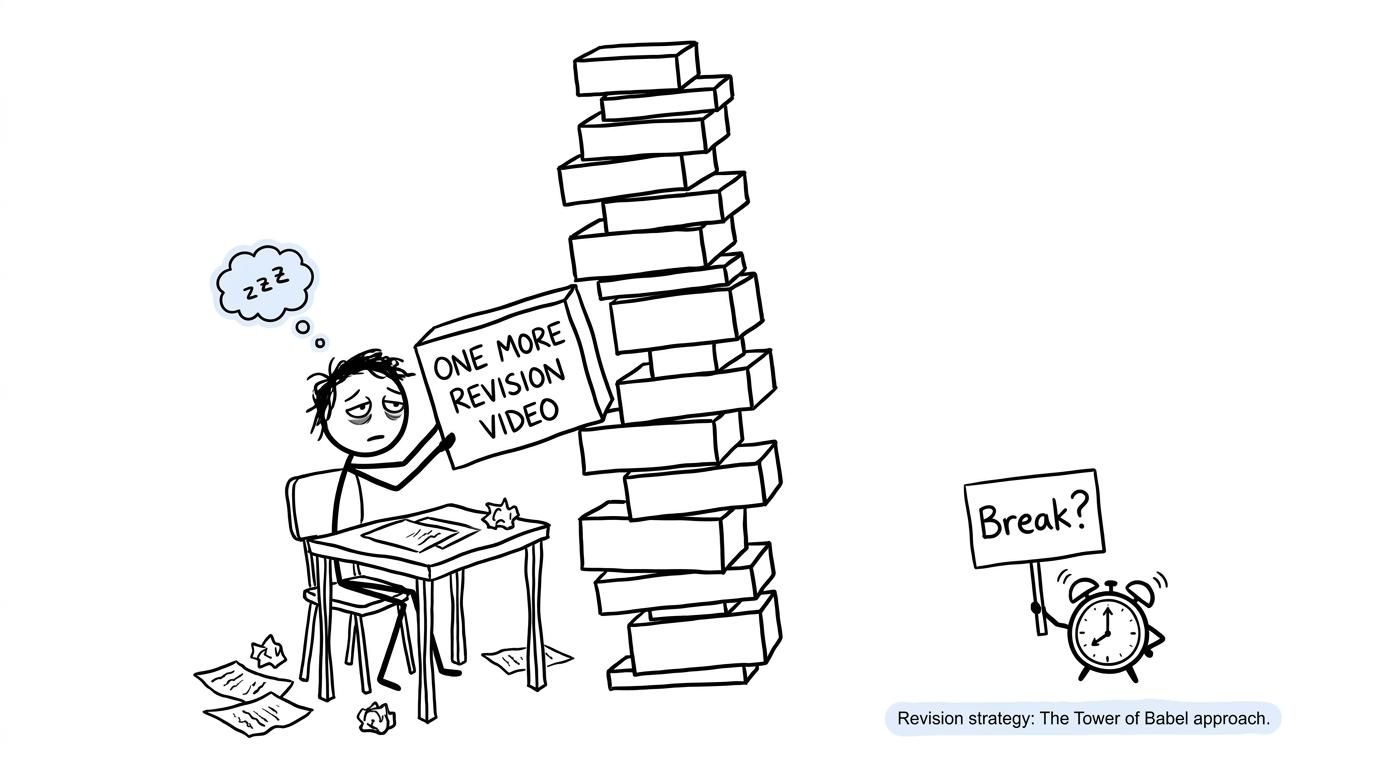 A tired student builds a tower of revision videos while an alarm clock suggests a break
Why students hit a wall before May
Burnout rarely arrives because of one difficult quadratic. It is more often the result of a revision system that asks for maximum effort every day.
A plan may look impressive because every evening is full. But if it allows no room for homework, illness, family commitments or ordinary tiredness, one missed session creates a backlog. The backlog creates guilt. Guilt encourages a longer session, which makes the next day harder.
There is another trap: measuring progress by hours rather than learning. Watching videos for three hours can feel safer than completing questions that might expose a gap. Yet exposure is the point. A short marked test can tell you more than an evening of passive review.
Use the guide to finding your weakest GCSE topics to turn a vague fear of “all of maths” into a manageable list. Your revision becomes lighter when each session has a reason.
Build a pace you can sustain
Set a minimum, a target and a ceiling
A minimum is the smallest worthwhile session you can complete on a difficult day. That might be 202020 minutes of focused questions and marking. A target is your normal planned session. A ceiling is the point at which you stop, even if anxiety tells you to continue.
The ceiling matters. Without it, revision expands into every available hour and rest begins to feel undeserved.
MathsGenie’s 20-minute maths revision routine is useful for busy or low-energy days. Completing a small cycle of recall, questions and marking preserves momentum without demanding an heroic evening.
Plan outputs, not vague hours
“Revise algebra” has no natural ending. “Complete one mini test, mark it and record two errors” does.
A focused session might contain:
- a short revision lesson for one weak skill;
- a small set of practice questions;
- immediate checking with the answers or mark scheme;
- one written note explaining the main correction;
- a date for a brief retest.
This creates a visible finish line. It also prevents you from confusing time spent with marks gained.
If you need a wider structure, adapt the GCSE maths revision timetable around your school day, other subjects and tier. Foundation and higher students need different topic choices, but both benefit from a timetable that includes rest and catch-up space.
Use breaks before concentration collapses
A break works best when it arrives before you are completely drained. After a focused block, stand up, drink water, stretch or step outside. Avoid turning every break into more exam content on your phone.
There is no universal timer that suits everyone. You could begin with 252525 to 404040 minutes of work followed by a short break, then adjust according to the difficulty of the task and your concentration. The principle is more important than the precise numbers: focus, recover and return deliberately.
Make maths revision efficient enough to be smaller
The best protection against overload is not merely reducing revision. It is making each session more informative.
Alternate learning, practice and testing
Use revision lessons when you genuinely do not understand a method. Move to practice questions as soon as possible, because retrieving and applying a method reveals whether it is available without support. Then use mini tests or short paper sections to check whether you can recognise the skill in an unfamiliar question.
Full papers are valuable, but they are demanding. You do not need to complete one every evening. The guide to starting GCSE past papers explains how to move from smaller sections towards timed papers rather than forcing exam stamina too early.
Let marking decide what happens next
A mark scheme is not simply a verdict. It is a map of where your method stopped earning marks.
After practice, sort errors into a few useful categories:
- the method was unknown;
- the method was understood but not completed;
- arithmetic or calculator accuracy caused the loss;
- the question was misread;
- working was not shown clearly enough;
- time pressure affected the attempt.
Then repair the most repeated error. This is calmer than reopening the entire specification whenever a paper goes badly.
Match the resource to your energy
Not every day should contain the hardest available task.
On a high-energy day, complete a timed paper section. On an ordinary day, work through targeted questions. On a tired day, correct previous errors, use a mini test or revisit one method. A lighter session still counts when it has a clear purpose.
Check the GCSE maths topics by exam board and tier so that your practice matches your specification and foundation or higher entry. You do not need to chase every difficult question you see online.
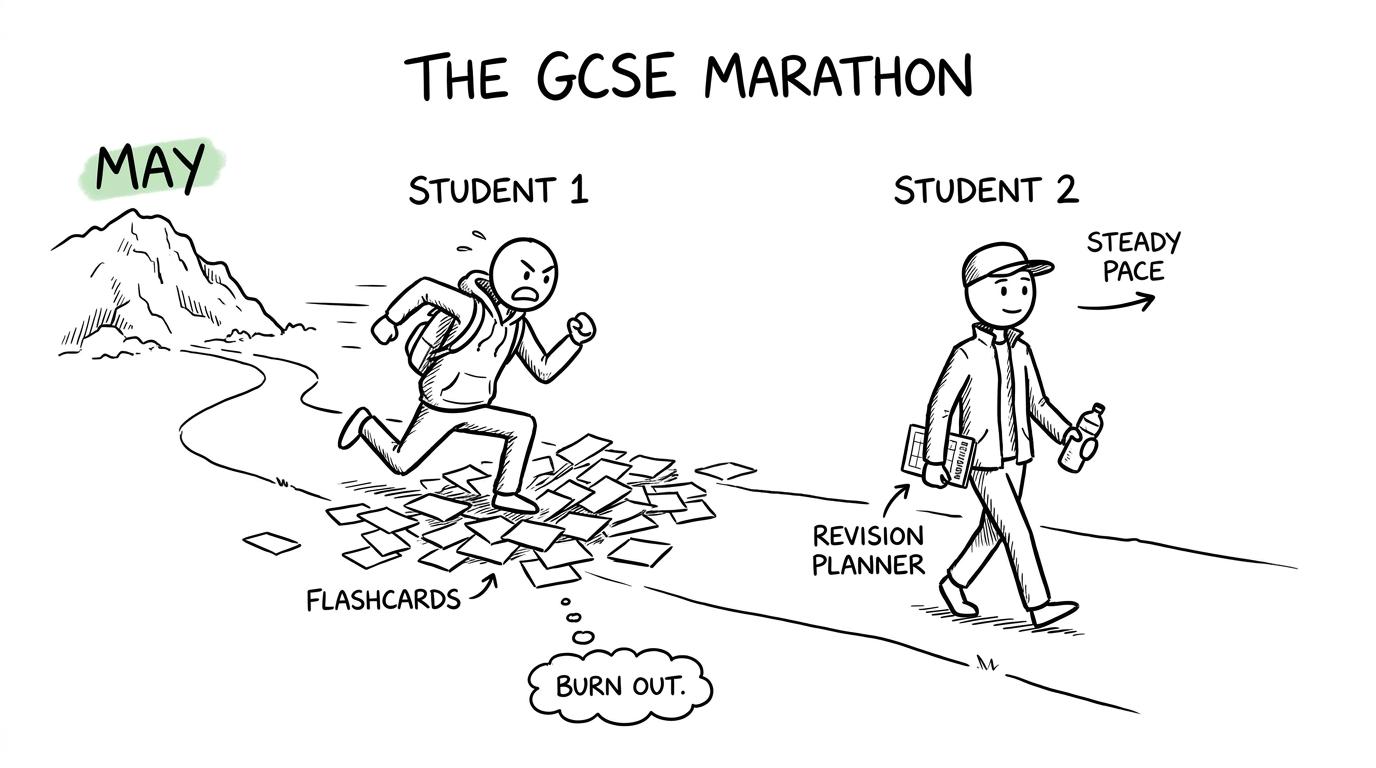 One student sprints towards May while another follows a steady revision plan
Protect the foundations that revision depends on
Sleep is not time stolen from preparation. It supports thinking and concentration, while late-night cramming can leave the next day less productive. NHS guidance states that most teenagers need around 888 to 101010 hours of sleep each night and recommends allowing time to wind down before bed.
Choose a regular stopping time. Put unfinished tasks onto tomorrow’s list rather than carrying them into bed. The GCSE maths night-before plan is especially useful near an exam, when the temptation to keep going is strongest.
Regular meals, water, movement and time with other people also matter. Exercise does not need to become another target to optimise. A walk, a sport or a few minutes outside can simply mark the boundary between revision and recovery.
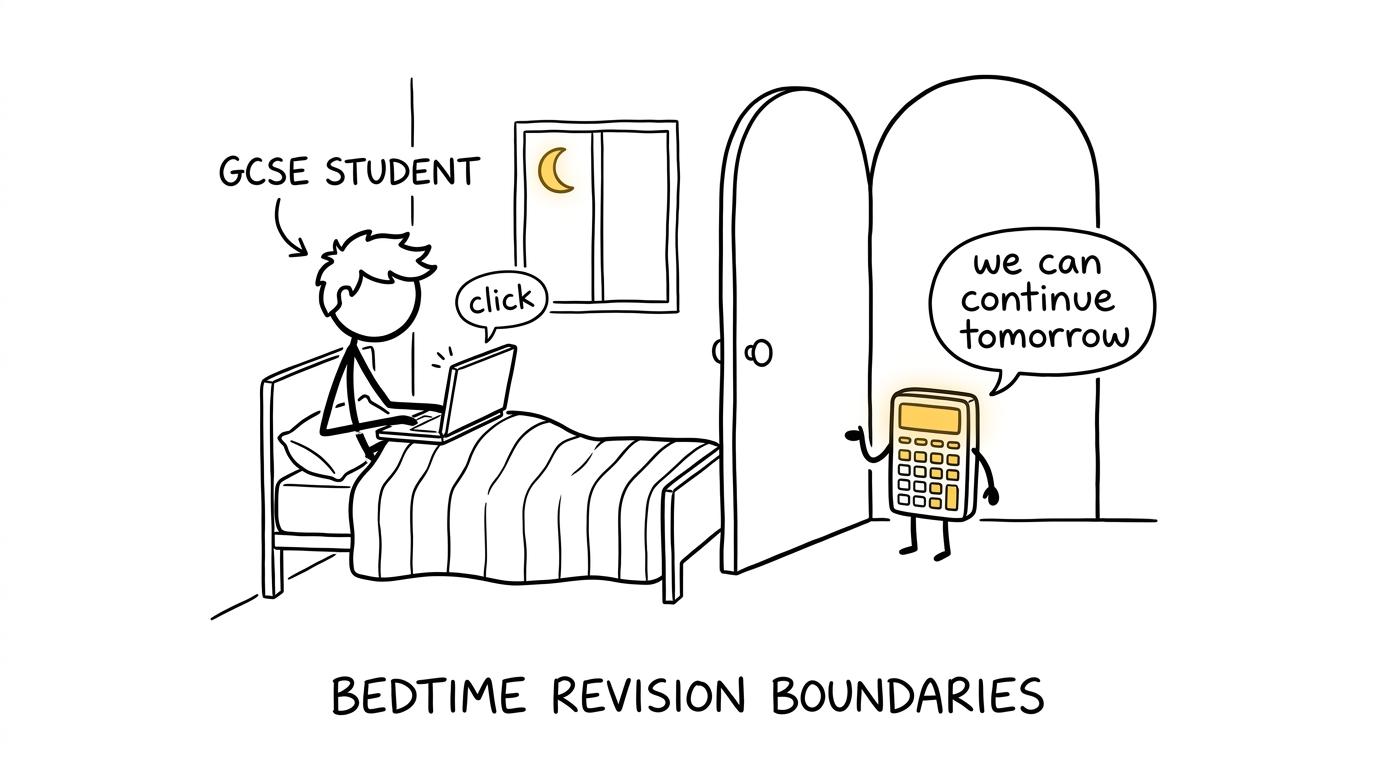 A student closes a laptop at bedtime while a calculator waits patiently outside
How to adjust your plan when warning signs appear
Do not wait for complete exhaustion before changing course.
First, reduce the next task. Replace a full paper with a short section or one weak topic. Second, remove low-value work such as rewriting neat notes you already understand. Third, restore your normal finishing time instead of using late nights to repay a revision “debt”.
Review the next seven days and identify what is genuinely essential. A realistic one-month GCSE maths revision plan can help you prioritise diagnosis, targeted practice and paper work without treating every topic as equally urgent.
Tell someone if the pressure is becoming difficult to manage. A teacher can clarify priorities, correct an unrealistic topic list or explain where your marks are most likely to improve. A parent, carer or pastoral lead can help protect time for sleep and recovery. If stress is affecting everyday life or you feel unable to cope, seek professional support promptly.
Common mistakes that increase revision burnout
Copying somebody else’s timetable
A schedule designed around another student’s grades, commitments and concentration will not automatically suit you. Build from the time and energy you actually have.
Treating missed revision as debt
Trying to squeeze every missed task into the following day makes the plan increasingly impossible. Move the most important task and delete or postpone the rest.
Completing papers without reviewing them
A paper followed immediately by another paper creates fatigue but may not repair the reasons marks were lost. Mark, diagnose, practise and retest.
Revising only comfortable topics
Comfort creates long sessions with little change. Choose one precise weakness rather than avoiding it or attempting an entire difficult chapter at once.
Sacrificing sleep near the exam
An extra late-night session can feel urgent, but tiredness may damage concentration and accuracy. Set a finishing time and trust the preparation already completed.
Believing rest must be earned
Recovery is part of a sustainable plan. You do not have to finish the whole specification before you are allowed to stop for the evening.
Reach May with something left in the tank
Revision is a long walk towards a fixed date, not a daily test of how much discomfort you can tolerate. The strongest plan is often the least dramatic: choose one weakness, practise it, mark it, record the correction and stop at the planned time.
Start with the MathsGenie GCSE Maths revision hub. Choose your exam board and tier, then combine free revision lessons and practice questions with mini tests, mark schemes and video solutions. As May approaches, add past papers and predicted papers in measured doses.
You do not need to feel ready for every possible question today. You need a routine that helps you become a little more ready, then lets you recover well enough to return tomorrow.











