GCSE: The 20-Minute Maths Revision Routine
GCSE 20-minute maths revision routine for busy school days. A simple plan using YesGenie lessons, practice questions, past papers and mark schemes.
GCSE days can feel like you’re sprinting from bell to bell, with homework, clubs, and the quiet pressure of grades 999, 111 sitting in the background. The problem isn’t usually motivation. It’s time. A GCSE maths revision plan that assumes you have two hours every evening is basically a plan to fail on a Tuesday. What you need is something you can do even when you’re tired, even when your day went sideways, and even when you only have a small gap before dinner.
This post gives you a GCSE-friendly 20-minute routine you can repeat on busy school days. It’s built around what actually moves marks: retrieval, exam-style practice, and quick feedback. And it uses the parts of YesGenie that make short revision work: lessons, question banks, mini tests, past papers, predicted papers, and mark schemes.
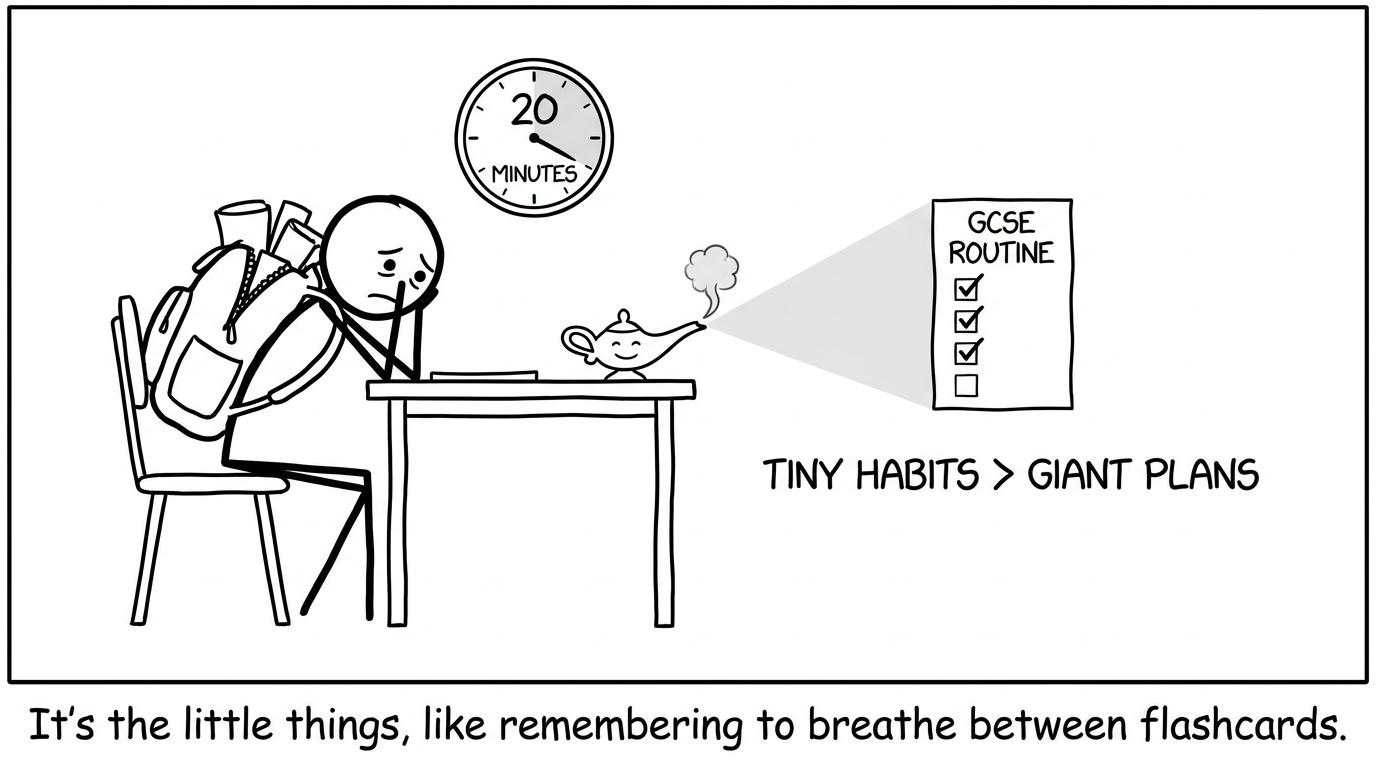 A tired student meets a 20-minute plan
The 20-minute GCSE routine (a simple checklist)
Keep this routine identical each day, so you don’t waste time deciding what to do.
- 2 minutes: set up (choose topic + open the right page)
- 6 minutes: active recall (flashcards/mental retrieval + 2 quick checks)
- 10 minutes: exam-style questions (with marks in mind)
- 2 minutes: mark, log, and pick tomorrow’s micro-topic
If you only do one thing: do the 10-minute exam-style questions. GCSE maths marks are earned in the habit of writing solutions under pressure.
Why 20 minutes of GCSE revision can beat 2 hours (when it’s done right)
There’s a trap students fall into: they wait for a “proper” revision session. The mythical evening where you feel calm, focused, and somehow immune to notifications. It rarely arrives.
The 20-minute routine works because it’s small enough to be completed on bad days. That’s the whole point. In GCSE maths, consistency compounds. Ten minutes of shaky algebra every day turns into fluent algebra by the time you hit the higher tier paper.
It also works because it uses three levers GCSE exams actually reward:
- Retrieval: remembering methods without prompts.
- Practice: answering exam-style questions, not just reading notes.
- Feedback: checking against mark schemes and fixing a specific mistake.
For resources that match this structure, start from the Resources hub, which links you to mini tests, predicted papers, and more.
Step 1 (2 minutes): set up like an exam candidate
Your only job in this step is to remove friction.
- Decide your tier and board (Edexcel, AQA, OCR, Eduqas/WJEC).
- Pick one micro-topic (not “algebra”, but “solving linear equations with brackets”).
- Open one YesGenie page and stay there.
Useful starting points:
- Edexcel GCSE Maths revision (topic pages)
- Edexcel GCSE revision guides list
- GCSE past papers by exam board
If you’re an A Level student supporting a younger sibling (or re-learning basics), you can still use this structure, then switch to your own spec pages later, such as Edexcel A Level Maths revision.
Step 2 (6 minutes): active recall that actually sticks
This is where you “wake up” the method in your head before you practise.
A reliable GCSE recall pattern:
- Say the method out loud in one sentence.
- Write two key lines you’d expect in a solution.
- Check one definition or rule you often forget.
Micro-example: inverse functions recall (higher tier)
You might be revising inverses for GCSE higher tier.
Recall sentence: “To find an inverse, set y=f(x)y=f(x)y=f(x), swap xxx and yyy, then rearrange for yyy.”
Key lines:
y=3x−5 y=3x-5 y=3x−5 x=3y−5⇒y=x+53 x=3y-5 \Rightarrow y=\frac{x+5}{3} x=3y−5⇒y=3x+5Then quickly confirm with the relevant revision guide: Inverse and composite functions (revision guide).
This step stays short because the next step is where marks are made.
Step 3 (10 minutes): exam-style questions (the mark-making block)
This is the heart of the routine. Ten minutes is enough time for:
- 3 short foundation-style questions, or
- 2 medium higher-tier questions, or
- 1 longer “show that / prove” style question.
The key rule: do not just “see” the answer. Write full lines as if the examiner is watching.
If you want quick banks and structured practice, use a topic page (which links to lessons, question banks, and solutions). Example topic page: The Sine Rule (topic hub).
Worked example 1 (GCSE): bounds that unlocks exam marks
A common GCSE higher-tier question:
A length lll is given as 28 cm28\text{ cm}28 cm correct to the nearest cm. Find the lower and upper bounds for lll.
Nearest cm means the rounding step is 1 cm1\text{ cm}1 cm, so half is 0.5 cm0.5\text{ cm}0.5 cm.
Therefore:
27.5≤l<28.5 27.5 \le l < 28.5 27.5≤l<28.5If you then needed an area like A=l2A=l^2A=l2, the lower bound area would be 27.5227.5^227.52 and the upper bound area would be 28.5228.5^228.52:
Alower=27.52=756.25 A_{\text{lower}}=27.5^2=756.25 Alower=27.52=756.25 Aupper=28.52=812.25 A_{\text{upper}}=28.5^2=812.25 Aupper=28.52=812.25So:
756.25≤A<812.25 756.25 \le A < 812.25 756.25≤A<812.25This exact thinking is explained cleanly here: Bounds (revision guide).
Worked example 2 (GCSE): probability with a ratio (foundation to higher)
A GCSE-style question:
A bag contains red and blue counters in the ratio 3:23:23:2. Find P(red)P(\text{red})P(red).
Total parts =3+2=5=3+2=5=3+2=5.
So:
P(red)=35 P(\text{red})=\frac{3}{5} P(red)=53If you had 404040 counters total, each part would be 40÷5=840 \div 5=840÷5=8, so red counters =3×8=24=3 \times 8=24=3×8=24.
This style appears often in foundation papers and is still easy marks on higher tier when students rush. For more structured reminders: Probability (revision guide).
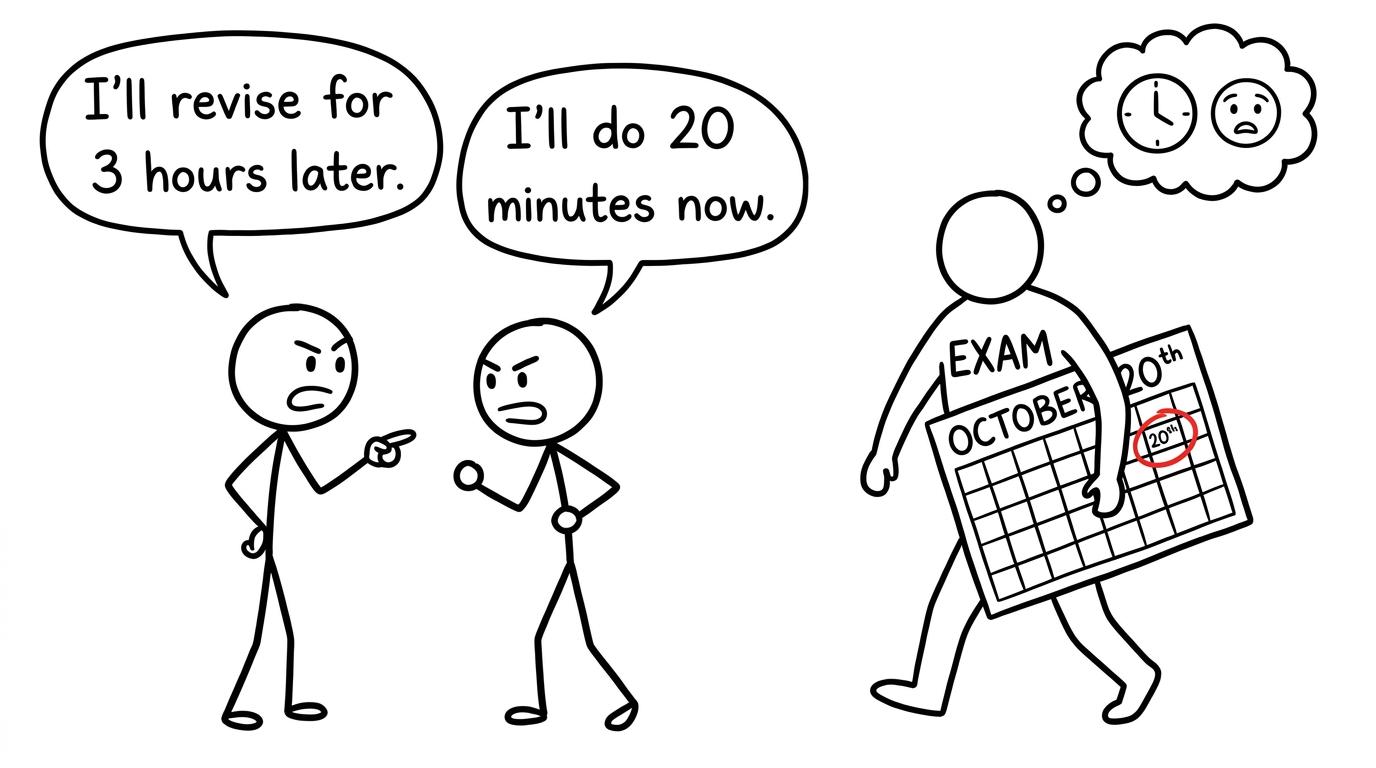 Procrastination vs 20 minutes
Step 4 (2 minutes): mark, log, and choose tomorrow
This final step is what turns practice into improvement.
- Mark using solutions/mark schemes.
- Write a one-line “error note”, such as: “Forgot to square the radius” or “Swapped bounds the wrong way in division”.
- Pick tomorrow’s micro-topic based on the error.
When you want full mark schemes and real paper practice, use GCSE past papers. When it’s closer to exam season and you want targeted practice, use Edexcel GCSE predicted papers (and choose your tier).
How to choose the right 20-minute GCSE topic each day
Busy days need low decision-making. Here are three ways.
Use your last mistake
Your book already tells you what to revise. If your last paper had a slip on Venn diagrams, tomorrow is Venn diagrams.
Helpful page: Venn diagrams (revision guide).
Use the “high-frequency marks” list
If you’re unsure, rotate through:
- algebra (rearranging, solving)
- number (fractions, percentages)
- ratio and proportion
- graphs and coordinates
- angles and basic geometry
- probability
A good example of a small, high-frequency topic is coordinates: Coordinates (revision guide).
Use a mini test when you’re mentally tired
Mini tests are perfect when you don’t want to choose. They give you a short burst of exam-style questions, and your score tells you what to fix next.
Start from Resources or jump into a paper like 2021 Mini Test 2 (Foundation).
Common GCSE revision mistakes (and the quick fix)
These are the patterns that waste the most GCSE time.
Doing “comfortable” topics on repeat
If you only do what you can already do, revision feels good but marks don’t move. Your 20-minute GCSE routine should chase one small weakness each day.
Reading solutions instead of writing solutions
GCSE maths is assessed through your written method. Even when the final answer is correct, you can lose marks for missing steps. In your 10-minute block, always write at least one complete method.
Not using mark schemes properly
A mark scheme isn’t just for the final line. It tells you what counts as method. Use GCSE past papers to practise marking like an examiner.
Mixing up calculator and non-calculator habits
On non-calculator papers, exact values matter. For example, leave π\piπ as π\piπ unless asked for a decimal, and keep fractions as fractions when you can. Build one non-calculator question into your routine at least twice a week.
Treating “workings” as optional
In GCSE, workings are often the marks. Even for a one-mark question, a line of reasoning protects you from silly slips.
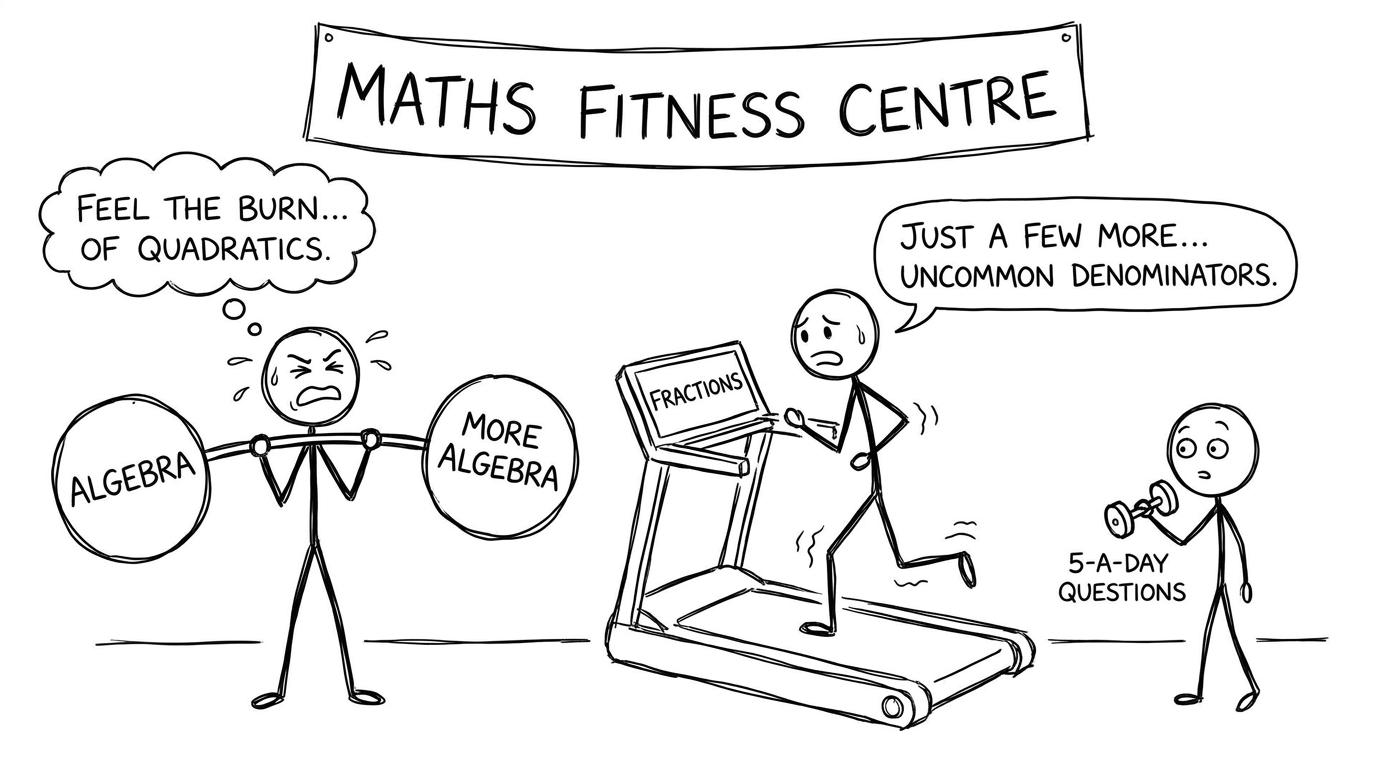 Maths revision like a workout
A 5-day 20-minute GCSE rotation (copy and repeat)
If you want a ready-made pattern:
- Monday: algebra skill + 2 exam questions
- Tuesday: number (fractions/percentages) + 2 exam questions
- Wednesday: graphs/coordinates + 2 exam questions
- Thursday: geometry/trig + 1 longer exam question
- Friday: mini test or one past paper question + mark scheme review
Where possible, keep the routine inside one YesGenie pathway, such as the Edexcel GCSE Maths revision topic pages or the GCSE past papers section.
Closing: let GCSE revision be small, and let it be daily
The best GCSE routine isn’t the one you design on a perfect Sunday. It’s the one you can still do when you get home late, when you’re tired, and when the day didn’t go to plan. Twenty minutes is not a compromise. It’s a strategy.
If you want to make this routine effortless, build it around YesGenie: use revision lessons and revision guides to learn the method, practise with topic question banks and mini tests, then pressure-test with past papers and predicted papers, marking with mark schemes and video solutions. Start today with Resources, choose your board in GCSE maths, and keep your next GCSE session small enough that you’ll actually do it tomorrow too.