GCSE History Exam Length: Your Real Sitting Time
GCSE history exam length varies by board. Check each paper's duration, total sitting time and a practical plan for managing focus, energy and revision.
The hardest part of a long exam is not always the final question. Sometimes it is the moment halfway through when your hand feels heavy, your focus slips and you realise there is still an hour left.
The GCSE history exam length depends on your exam board and specification. AQA and Eduqas students normally sit two papers of 222 hours each. Pearson Edexcel has three papers lasting 111 hour 202020 minutes, 111 hour 505050 minutes and 111 hour 303030 minutes. OCR timings depend on whether you take History A or History B.
Those figures tell you how long the official papers last. They do not tell you how the day will feel. You must also allow for arriving early, listening to instructions, completing details and leaving only when the invigilator permits it. This guide gives you both views: the official duration and the practical experience of sitting the exam.
GCSE history exam length at a glance
The following timings are based on the current specifications published by AQA, Pearson Edexcel and OCR. Eduqas students should confirm their component structure with their school because specifications and entry arrangements can change.
| Exam board | Paper lengths | Total examination time |
|---|---|---|
| AQA GCSE History | Paper 1: 222 hours; Paper 2: 222 hours | 444 hours |
| Pearson Edexcel GCSE History | Paper 1: 111 hour 202020 minutes; Paper 2: 111 hour 505050 minutes; Paper 3: 111 hour 303030 minutes | 444 hours 404040 minutes |
| OCR History A | 111 hour 454545 minutes; 111 hour; 111 hour 151515 minutes | 444 hours |
| OCR History B | 111 hour 454545 minutes; 111 hour; 111 hour 454545 minutes | 444 hours 303030 minutes |
| Eduqas GCSE History | Usually two components of 222 hours each | 444 hours |
These papers are normally scheduled on separate dates, so the total is not one continuous sitting. Your personal timetable from your school is the final authority. Check the board, specification and paper code rather than relying on a friend's timetable or an old revision video.
Pearson Edexcel timings deserve particular attention. From summer 202520252025, the board added 555 minutes to Paper 1, 555 minutes to Paper 2 and 101010 minutes to Paper 3. Older resources may therefore show the former durations of 111 hour 151515 minutes, 111 hour 454545 minutes and 111 hour 202020 minutes.
Your quick exam-day checklist
Before building a detailed plan, confirm these essentials:
- Find your exam board and specification on your school timetable.
- Write down the exact paper duration and starting time.
- Arrive at the time specified by your school, not at the published start time.
- Pack permitted equipment, including several black pens.
- Check whether you have approved access arrangements.
- Practise at least one full paper for the correct duration.
- Plan a sensible meal, water and recovery period around the paper.
- Check whether another exam is scheduled on the same day.
That final point matters. A 222-hour History paper may be manageable in isolation but feel very different after a morning GCSE Maths paper. Exam preparation is partly about knowledge and partly about protecting the attention needed to retrieve it.
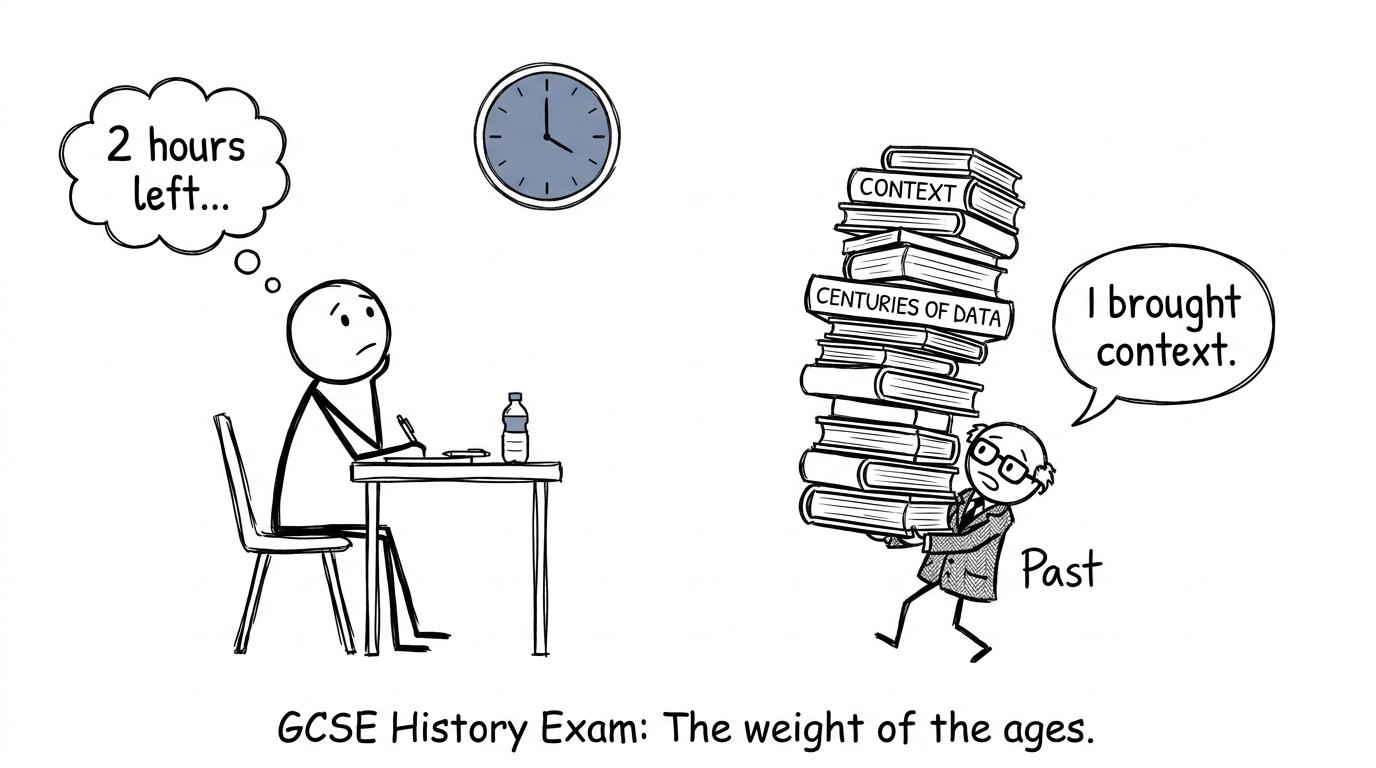 A student faces a long History exam while the past arrives carrying far too much context
What the official duration leaves out
An exam listed as 222 hours does not usually mean spending exactly 222 hours in the room.
Schools commonly ask candidates to arrive before the official start. Invigilators must seat everyone, explain the rules, distribute materials and ensure candidates complete the required details. At the end, scripts are collected and checked before students leave.
A sensible planning estimate is therefore:
time committed=arrival buffer+paper duration+release time\text{time committed}=\text{arrival buffer}+\text{paper duration}+\text{release time}time committed=arrival buffer+paper duration+release timeThe arrival buffer and release time are controlled by your centre, so ask your exams officer or teacher rather than assuming a universal figure. If you have an approved arrangement such as extra time, supervised rest breaks or a separate room, your experience may also differ from the printed paper duration.
The practical lesson is simple: keep a generous block around the exam. Do not plan to arrive at the last possible moment or expect to leave the room at the exact second the paper ends.
How long each board's History exams last
AQA GCSE History
AQA GCSE History 814581458145 has two written papers:
- Paper 1, Understanding the Modern World: 222 hours
- Paper 2, Shaping the Nation: 222 hours
Each paper is worth 50%50\%50% of the qualification and carries 848484 marks, including the specified spelling, punctuation and grammar marks. AQA therefore asks students to sustain concentration across two substantial sittings rather than three shorter papers.
Do not divide the time mechanically by the number of questions. Extended responses need more time than short questions, and the paper sections carry different demands. Use the structure taught by your History teacher and rehearse it with current papers.
Pearson Edexcel GCSE History
Pearson Edexcel GCSE History 1HI01\text{HI}01HI0 has three papers:
- Paper 1, Thematic Study and Historic Environment: 111 hour 202020 minutes
- Paper 2, Period Study and British Depth Study: 111 hour 505050 minutes
- Paper 3, Modern Depth Study: 111 hour 303030 minutes
Together, that is:
1 h 20 min+1 h 50 min+1 h 30 min=4 h 40 min1\text{ h }20\text{ min}+1\text{ h }50\text{ min}+1\text{ h }30\text{ min}=4\text{ h }40\text{ min}1 h 20 min+1 h 50 min+1 h 30 min=4 h 40 minPaper 2 is the longest individual Edexcel sitting. Pearson explains that its additional time from 202520252025 supports a split of approximately 555555 minutes for each half. That is a useful structural guide, but you should still follow the question-level timing advice given by your teacher.
OCR GCSE History
OCR offers two distinct GCSE History specifications, so saying only that you take “OCR History” is not enough.
OCR History A, Explaining the Modern World, has papers of 111 hour 454545 minutes, 111 hour and 111 hour 151515 minutes. The total is 444 hours.
OCR History B, Schools History Project, has papers of 111 hour 454545 minutes, 111 hour and 111 hour 454545 minutes. The total is 444 hours 303030 minutes.
Check whether your entry is J410 or J411. The names, component structure, weighting and duration differ, even though both qualifications come from OCR.
Eduqas GCSE History
The established Eduqas GCSE History structure uses two written components, normally lasting 222 hours each. That produces 444 hours of examination time across the qualification.
However, you should check the current specification and your centre's entry details. Qualification arrangements can evolve, and students in Wales may encounter WJEC qualifications that are not identical to Eduqas qualifications offered in England.
Plan your energy, not just your minutes
A long paper rewards steadiness. Starting at maximum speed can create the illusion of progress while making later judgement and recall harder.
Think of your attention as something to allocate deliberately:
- Before the start: settle your breathing, arrange your equipment and read instructions carefully.
- Early questions: establish a controlled writing pace rather than racing.
- Middle of the paper: check your posture, loosen your grip briefly and return to the question in front of you.
- Final section: protect enough time and mental energy for extended answers and checking.
If your mind goes blank, avoid turning one difficult question into a crisis about the whole paper. Use the permitted navigation of that paper, move on where appropriate and return later. A pause of a few seconds can be cheaper than several minutes of panicked writing.
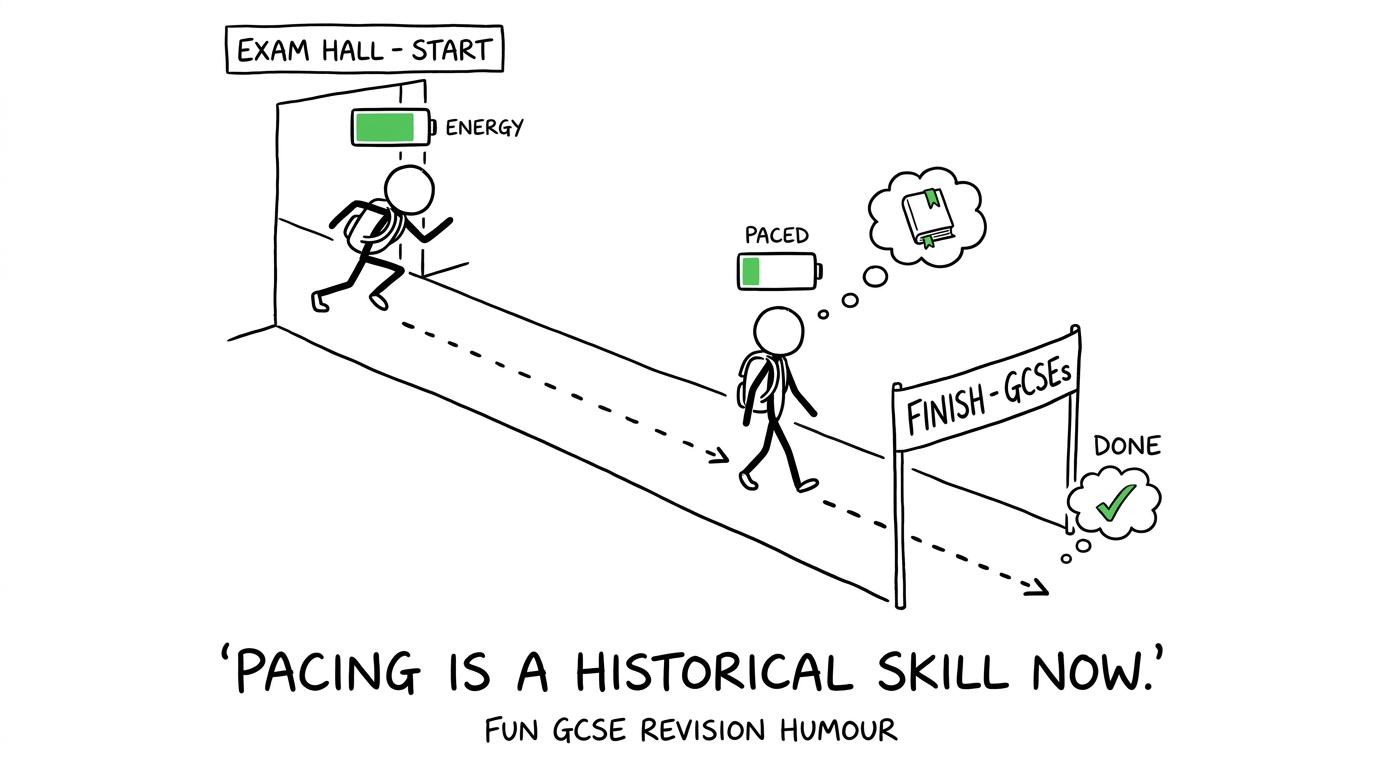 A student learns that exam pacing is closer to a steady walk than a sprint
Full-paper practice is the honest way to discover when your concentration tends to fall. The same principle applies to maths. MathsGenie's guide to starting GCSE past papers explains how to progress from short diagnostic work to timed papers instead of attempting full papers before you are ready.
Fit History around your maths revision
Although History and Maths test different skills, they draw from the same limited supply of time and concentration. If both appear close together on your timetable, revision must account for that.
Avoid scheduling an exhausting History mock immediately before a demanding maths session. A better plan alternates the type of work: History retrieval or essay planning can sit beside a shorter maths mini test, while a full History paper might be followed by marking rather than another long timed paper.
MathsGenie's one-month GCSE maths revision plan offers a manageable weekly rhythm. You can use the GCSE maths revision timetable guide to place topic sessions and timed papers around your History dates.
As the exams approach, match the resource to your energy:
- Use revision lessons and practice questions for focused skill-building.
- Use mini tests when you need useful practice without another long sitting.
- Use full papers when you are rested enough to reproduce exam conditions.
- Review mark schemes and video solutions while the mistakes are still clear.
- Add Edexcel GCSE Maths predicted papers after topic revision, not instead of it.
If several exams cluster together, the GCSE maths night-before plan helps you prioritise calm, targeted work rather than a late panic session. Predicted papers can focus final preparation, but the guide to predicted GCSE topics explains why they should support broad specification coverage rather than encourage guessing.
Practise the sitting, not only the subject
Knowing enough History and being able to express it for up to 222 hours are related but different achievements. Build endurance gradually.
Begin with one timed section. Then attempt a half-paper. Finally, complete a current full paper under realistic conditions: no phone, no pausing the clock and only the materials permitted in the real exam. Mark it afterwards and record where timing changed the quality of your answers.
The goal is not to collect as many completed papers as possible. It is to improve what happens during the next one. MathsGenie's discussion of how many GCSE past papers to complete applies here too: careful review is more valuable than rushing through paper after paper.
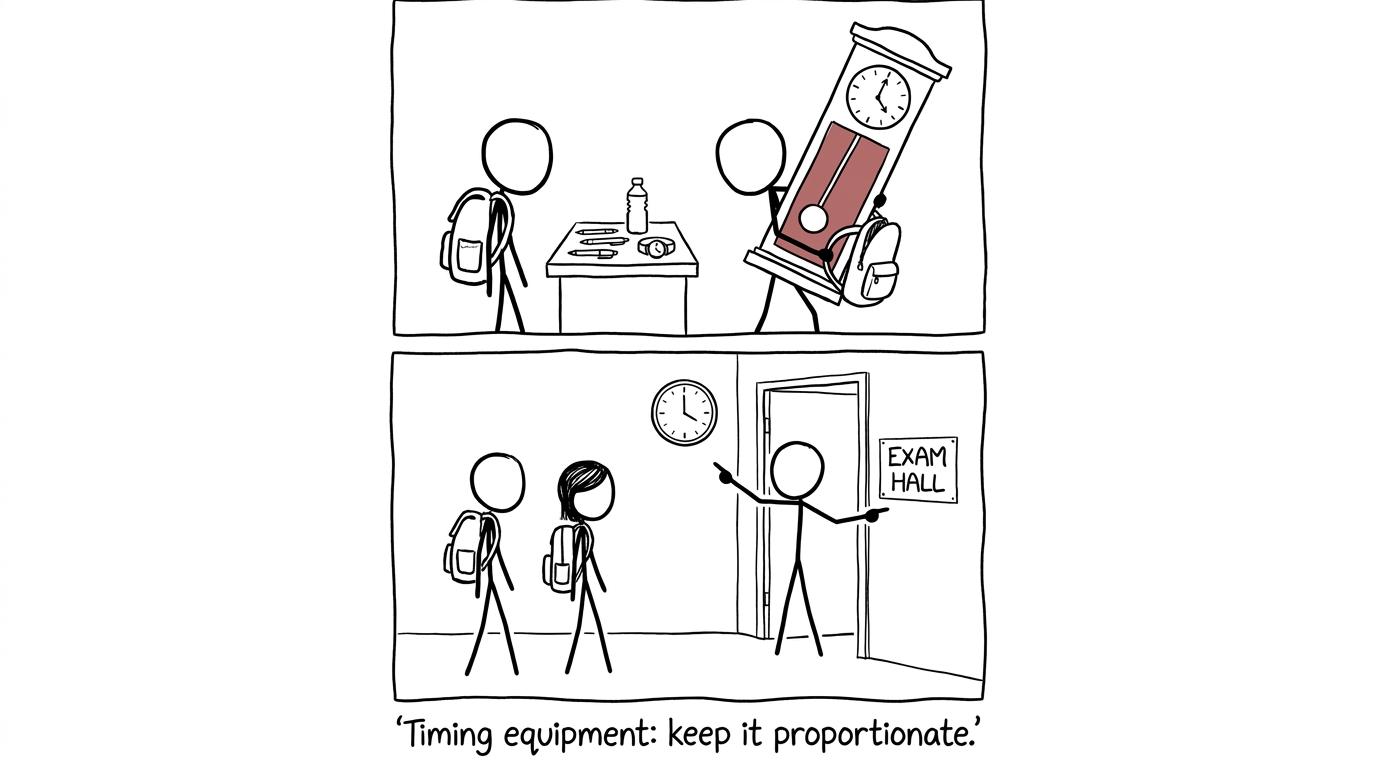 One student packs sensible exam equipment while another attempts to bring an entire grandfather clock
Common mistakes with exam timing
Using an outdated paper length
This is especially risky for Edexcel because timings changed from summer 202520252025. Use current specification information and confirm the duration shown on your personal timetable.
Knowing the board but not the specification
OCR History A and History B are different qualifications. Eduqas and WJEC should not be treated as interchangeable names. Record the exact code alongside the board.
Treating total qualification time as one sitting
The total examination time is spread across separate papers. Plan for each date individually, particularly when another subject appears on the same day.
Revising content without practising endurance
Short recall tasks help you learn facts, but they do not reveal whether your writing pace holds up in the final section. Include full-duration practice once your content knowledge is secure enough.
Spending too long on one response
A beautiful unfinished answer cannot earn marks from questions you never reach. Use your teacher's timing guidance, watch the clock at sensible checkpoints and move on when the planned time has passed.
Ignoring approved arrangements
Extra time and supervised rest breaks may change how long you remain in the room. Confirm exactly how your arrangements work with your school before exam day.
Turn the timetable into a plan
Once you know your GCSE History paper length, uncertainty becomes a schedule. Write down the board, specification, date, arrival time and duration. Practise the correct sitting length. Then protect enough energy around it for your other subjects.
For maths, make MathsGenie your free revision base. Use structured revision lessons and practice questions to repair weak topics, mini tests to sharpen recall, and past papers to build timing. Finish with mark schemes, video solutions and carefully chosen predicted papers so that a long exam feels familiar rather than mysterious.
Your next useful step is small: check your History paper code, then open the MathsGenie GCSE maths resit and revision planning guide and turn the rest of your exam timetable into focused, realistic practice.