GCSE Predicted Topics: What to Revise (Without Guessing)
GCSE predicted topics explained: what usually appears, how to revise smartly, and how to use Maths Genie predicted papers, past papers and mark schemes.
GCSE revision has a particular kind of noise. Someone says “my teacher reckons it’s all circle theorems this year”, a TikTok claims “guaranteed topics”, and suddenly you’re revising like the exam is a lottery. The problem is that your GCSE maths papers aren’t built on rumours. They’re built on a specification, a pattern of recurring skills, and question writers who love the same big ideas in slightly different outfits.
This post is about predicted GCSE maths topics in a way that actually helps. Not magic guesses, but a practical, exam-smart approach: which themes recur, what tends to appear on Paper 1 (non-calculator) versus calculator papers, and how to turn predictions into marks using Maths Genie predicted papers, past papers, mark schemes, video solutions, mini tests and revision lessons.
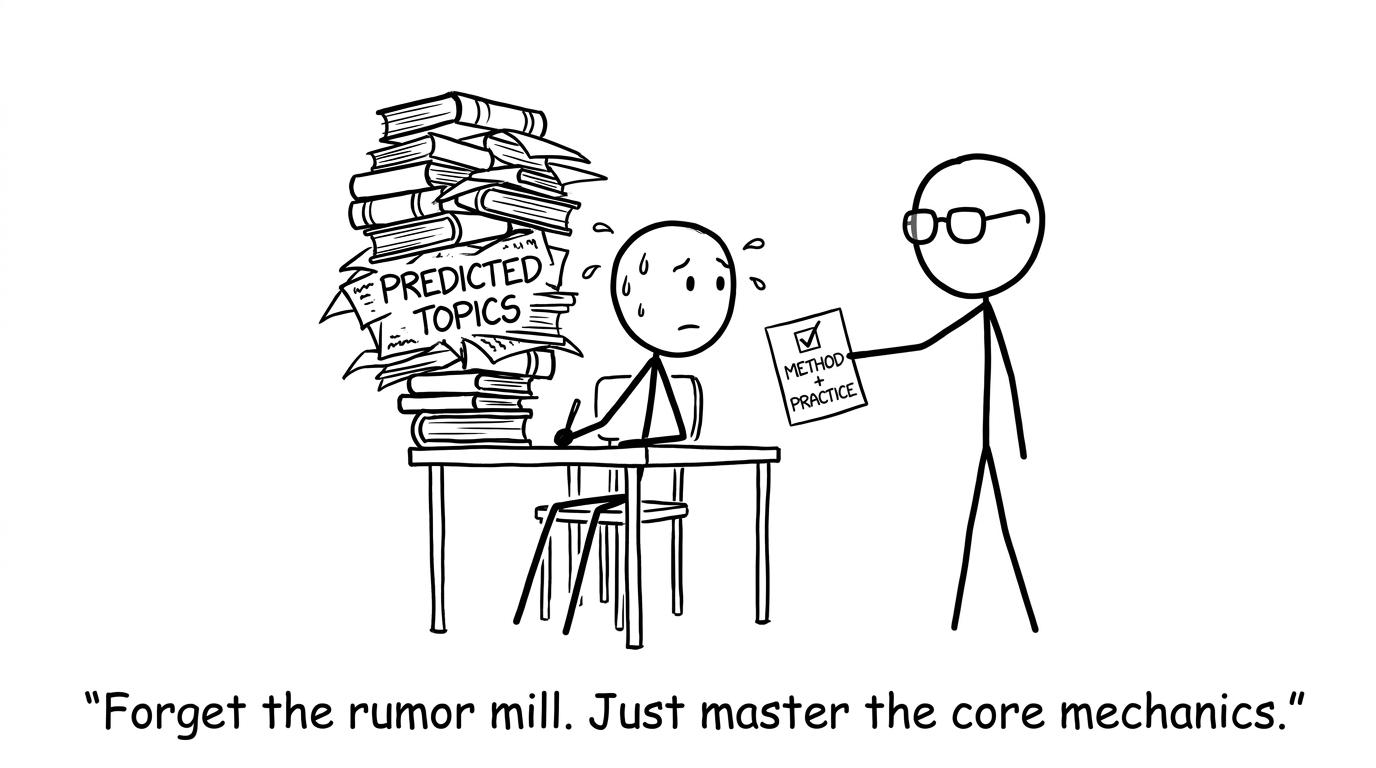 A student balancing “Predicted Topics” vs a checklist
Predicted GCSE topics, the honest way
“Predicted GCSE topics” should really mean: high-frequency skills and specification staples that are very hard for exam boards to avoid. Across Edexcel, AQA, OCR and Eduqas, the structure changes slightly, but the mathematical spine is the same.
Use this simple checklist before you revise anything “niche”:
- Can you reliably do number and percentages under time pressure?
- Can you manipulate algebra (simplify, expand, factorise, solve)?
- Can you read and use graphs (straight lines, real-life graphs, gradients)?
- Are your ratio and proportion methods consistent?
- Do you know the core geometry and measures facts (angles, area, volume, circle formulas)?
- Can you handle probability and statistics basics (tables, averages, scatter graphs)?
Then you add a second layer: topics that are common at the top end of Higher tier (and sometimes appear as a stretch question on Foundation), such as trig, similarity, vectors and quadratic reasoning.
For practice that matches the way GCSE questions are actually written, start from Maths Genie’s predicted papers and past papers:
- GCSE Predicted Papers (Edexcel)
- GCSE Maths Past Papers (AQA)
- GCSE Resources (including predicted papers)
The GCSE paper structure: where predictions really come from
Most students revise “topics”. Examiners set skills, then dress them as topics.
A typical GCSE maths set of papers (for example Edexcel 1MA1) tends to feel like this:
- Paper 1 (non-calculator) rewards fluency: fraction arithmetic, rearranging, exact values, estimation, algebraic manipulation.
- Calculator papers still include basics, but are more likely to test modelling, multi-step problem solving, iterative calculations, or awkward numbers.
So when you hear “predicted GCSE topics for Paper 1”, think: topics where a calculator doesn’t help much anyway. That’s why non-calculator revision should lean on methods, not memorised answers.
If you’re revising in timed chunks, the older Maths Genie split papers can also be useful for stamina:
Predicted GCSE topics that appear again and again
These are the “always nearby” themes. They’re not a guarantee for a particular paper, but across a full set of GCSE papers they are extremely hard to avoid.
Number and percentages (core GCSE marks)
Common predicted GCSE topics here include:
- Fractions, decimals and percentages conversions
- Percentage change and reverse percentages
- Standard form and rounding/error intervals
- Bounds and estimation
If you want a single skill that pays rent everywhere, it’s multiplicative thinking. For example, percentage increase is not “add the percentage”; it’s multiply.
Worked example (percentage change)
A jacket costs £484848. It is increased by 12%12\%12%.
New price:
48×1.12=53.76 48 \times 1.12 = 53.76 48×1.12=53.76So the jacket costs £53.7653.7653.76.
Now reverse it. If £53.7653.7653.76 is the new price after a 12%12\%12% increase, the original was:
original=53.761.12=48 \text{original} = \frac{53.76}{1.12} = 48 original=1.1253.76=48This “divide by the multiplier” idea is one of the most common high-value GCSE methods.
For targeted practice by topic (with solutions), the GCSE revision lists on Maths Genie are built for this style of improvement:
Algebra (the language GCSE uses for everything)
Predicted GCSE algebra topics usually include:
- Simplifying expressions
- Expanding and factorising
- Solving linear equations and inequalities
- Substitution and rearranging formulae
- Sequences and graphs
Worked example (rearranging a formula)
Make xxx the subject:
y=3x−7 y = 3x - 7 y=3x−7Add 777 to both sides:
y+7=3x y + 7 = 3x y+7=3xDivide by 333:
x=y+73 x = \frac{y + 7}{3} x=3y+7This is GCSE algebra at its most examinable: clear steps, no leaps.
If you ever feel stuck, it’s often because you’re trying to “do it in your head”. Write the operation you’re applying to both sides. That’s what mark schemes reward.
Ratio and proportion (where GCSE hides the harder questions)
Predicted GCSE ratio topics come up in recipes, best buys, map scales, speed/density/pressure, and proportional graphs.
Worked example (sharing in a ratio)
A prize of £848484 is shared in the ratio 2:52:52:5.
Total parts =2+5=7= 2 + 5 = 7=2+5=7.
Value of 111 part:
847=12 \frac{84}{7} = 12 784=12Shares:
- First share =2×12=24= 2 \times 12 = 24=2×12=24
- Second share =5×12=60= 5 \times 12 = 60=5×12=60
So the money is shared £242424 and £606060.
This method is a GCSE staple because it’s simple, reliable, and scales to harder contexts.
Graphs and straight lines (a predictable GCSE favourite)
Expect some combination of:
- Plotting and interpreting graphs
- Gradient and intercept
- Real-life graphs (distance-time, speed-time style interpretation)
- Solving equations using graphs
Worked example (gradient and equation)
The line passes through (2,5)(2, 5)(2,5) and (6,13)(6, 13)(6,13). Find its equation.
Gradient:
m=13−56−2=84=2 m = \frac{13 - 5}{6 - 2} = \frac{8}{4} = 2 m=6−213−5=48=2Use y=mx+cy = mx + cy=mx+c with (2,5)(2, 5)(2,5):
5=2⋅2+c⇒5=4+c⇒c=1 5 = 2\cdot 2 + c \Rightarrow 5 = 4 + c \Rightarrow c = 1 5=2⋅2+c⇒5=4+c⇒c=1So the equation is:
y=2x+1 y = 2x + 1 y=2x+1That’s the whole story: calculate gradient, then find ccc.
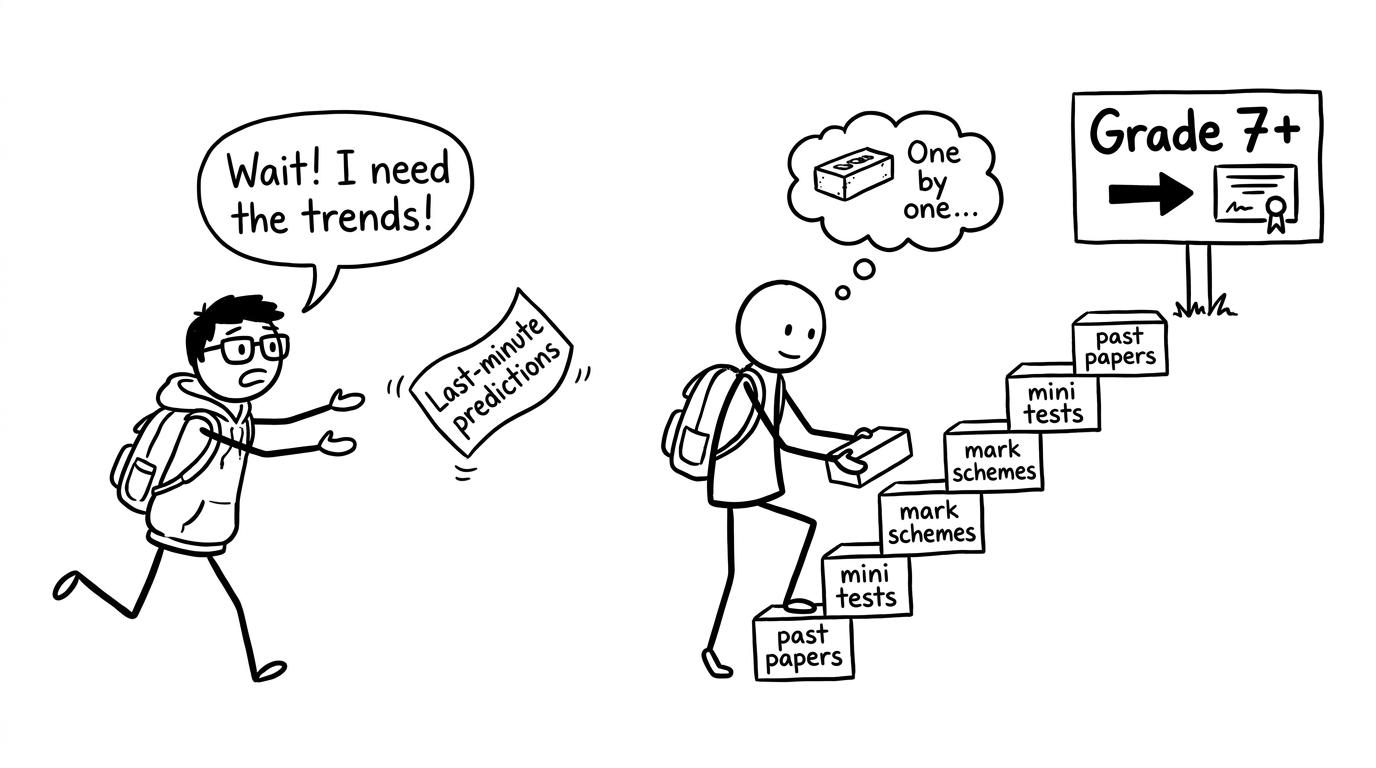 Two students: chasing predictions vs building with practice
Geometry and measures (easy marks if you know the facts)
Predicted GCSE geometry topics are often “fact + application”:
- Angle facts (parallel lines, polygons)
- Pythagoras and trigonometry (especially Higher)
- Area and volume
- Circles (circumference/area) and sometimes circle theorems (Higher)
- Transformations and congruence/similarity
Worked example (circle area and circumference)
A circle has radius r=7r = 7r=7 cm.
Circumference:
C=2πr=2π⋅7=14π cm C = 2\pi r = 2\pi \cdot 7 = 14\pi \text{ cm} C=2πr=2π⋅7=14π cmArea:
A=πr2=π⋅72=49π cm2 A = \pi r^2 = \pi \cdot 7^2 = 49\pi \text{ cm}^2 A=πr2=π⋅72=49π cm2A GCSE marker loves seeing formulas used correctly, with units, and exact values like 14π14\pi14π where appropriate.
Probability and statistics (quietly consistent GCSE topics)
Predicted GCSE probability/statistics topics include:
- Two-way tables
- Frequency tables and averages
- Scatter graphs and line of best fit
- Basic probability and probability trees
A key GCSE habit: probabilities are written as a fraction, decimal, or percentage, and the total probability of all outcomes is 111.
Worked example (two-step probability without a tree diagram)
A bag has 333 red and 222 blue counters. Two counters are taken without replacement. Find P(both red)P(\text{both red})P(both red).
First red:
35 \frac{3}{5} 53Then red again (now 222 red left out of 444 total):
24 \frac{2}{4} 42Multiply:
35×24=620=310 \frac{3}{5} \times \frac{2}{4} = \frac{6}{20} = \frac{3}{10} 53×42=206=103So P(both red)=310P(\text{both red}) = \frac{3}{10}P(both red)=103.
Using predicted GCSE papers properly (so they actually raise your grade)
Predicted papers are most powerful when you treat them as a diagnostic, not a prophecy.
A strong GCSE routine looks like this:
- Do a predicted paper under exam timing.
- Mark it using the mark scheme.
- For every lost mark, write the reason in one line (method? accuracy? misread?).
- Fix the topic lesson and then do 10-20 exam-style questions on that skill.
- Return to another paper a few days later.
Maths Genie makes this loop simple because the predicted papers sit alongside solutions and, where available, video walkthroughs:
If you’re sitting AQA, use AQA papers for style and wording, but the skills you fix transfer directly across exam boards.
Common mistakes that cost GCSE marks (even when you “know the topic”)
These are the classic ways predicted GCSE topics turn into dropped marks:
- Mixing up additive and multiplicative change: using +12%+12\%+12% as “add 12” rather than multiply by 1.121.121.12.
- Not showing algebra steps: writing the final line only. GCSE mark schemes often award method marks even if arithmetic slips.
- Forgetting units in geometry and measures: especially cm2\text{cm}^2cm2 for area and cm3\text{cm}^3cm3 for volume.
- Rounding too early: carrying rounded values through multi-step problems can lose the final accuracy mark.
- Probability totals not equal to 111: particularly when completing tables or missing outcomes.
- Using a calculator when the paper is non-calculator: it changes how you approach the numbers. Practise exact values and efficient arithmetic.
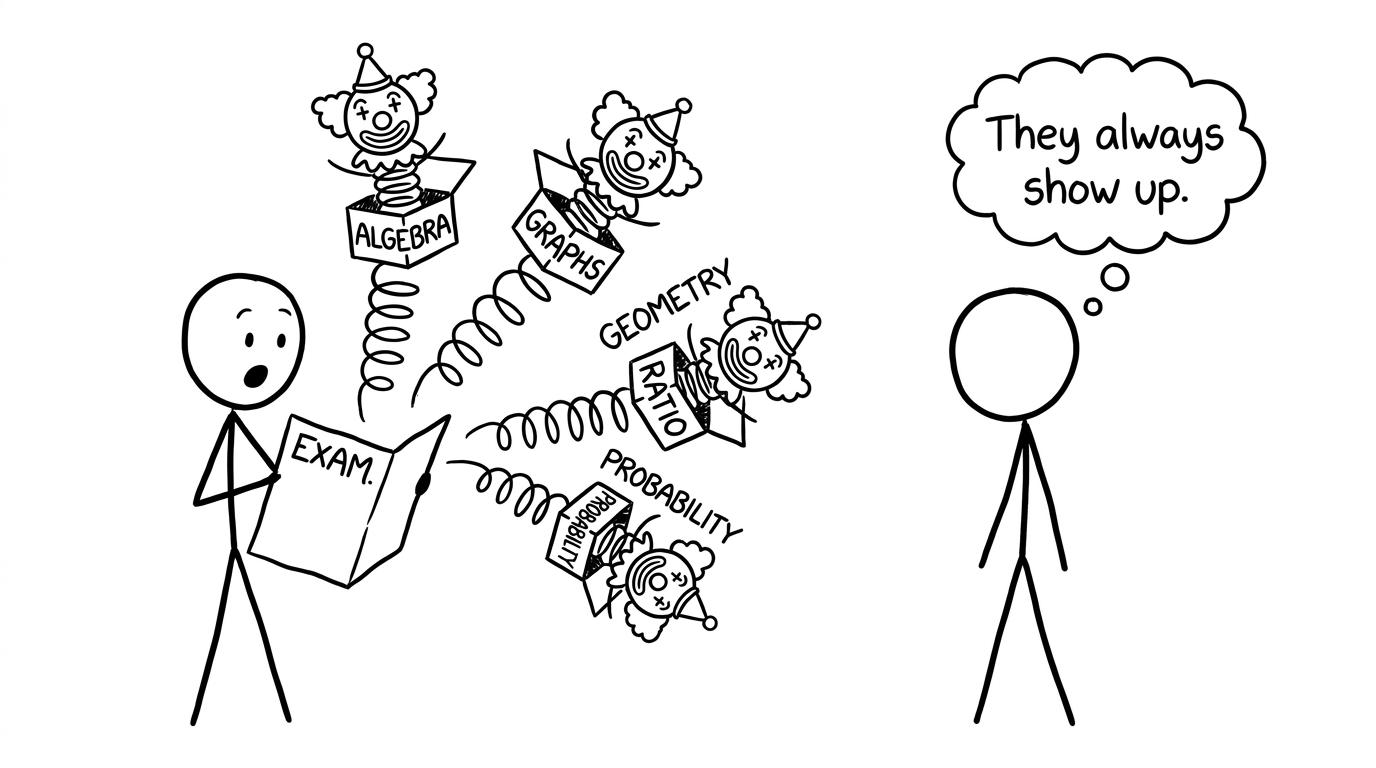 Topics popping out of an exam paper like jack-in-the-boxes
Bringing it together: predicted GCSE topics as confidence, not superstition
The best GCSE revision doesn’t feel like chasing secrets. It feels like building familiarity. You see the same mathematical ideas often enough that the exam stops being a surprise and starts being a performance.
So yes, use predicted GCSE topics. But use them properly: as a way to prioritise the high-frequency skills, practise under time, and learn directly from mark schemes.
Your next step on Maths Genie:
- Practise with GCSE Predicted Papers (Edexcel)
- Build exam stamina using GCSE Maths Past Papers (AQA) or your board’s papers
- Use the GCSE Resources Page for predicted papers, practice papers and more
- Audit gaps with the GCSE Maths Self Assessment Sheet (PDF)
If you do that loop: predicted paper, mark scheme, fix the topic, repeat; your GCSE grade doesn’t improve because you guessed right. It improves because you got good at the things the exam cannot stop asking.