

GCSE Maths Resit: Your Results Day Revision Plan
GCSE maths resit preparation made practical: build a focused revision plan after Results Day using past papers, worksheets, feedback and timed practice.

Results Day can make one number feel larger than it is. Yet a GCSE maths resit is not a return to the beginning. You already know parts of the course, you have experienced the exam, and you now have evidence about what needs to change.
The practical next step is to confirm your exam arrangements, diagnose where marks were lost and follow a short revision cycle: learn, practise, mark, fix and retest. That is more effective than reopening the whole specification and hoping that longer revision will somehow produce a different result.
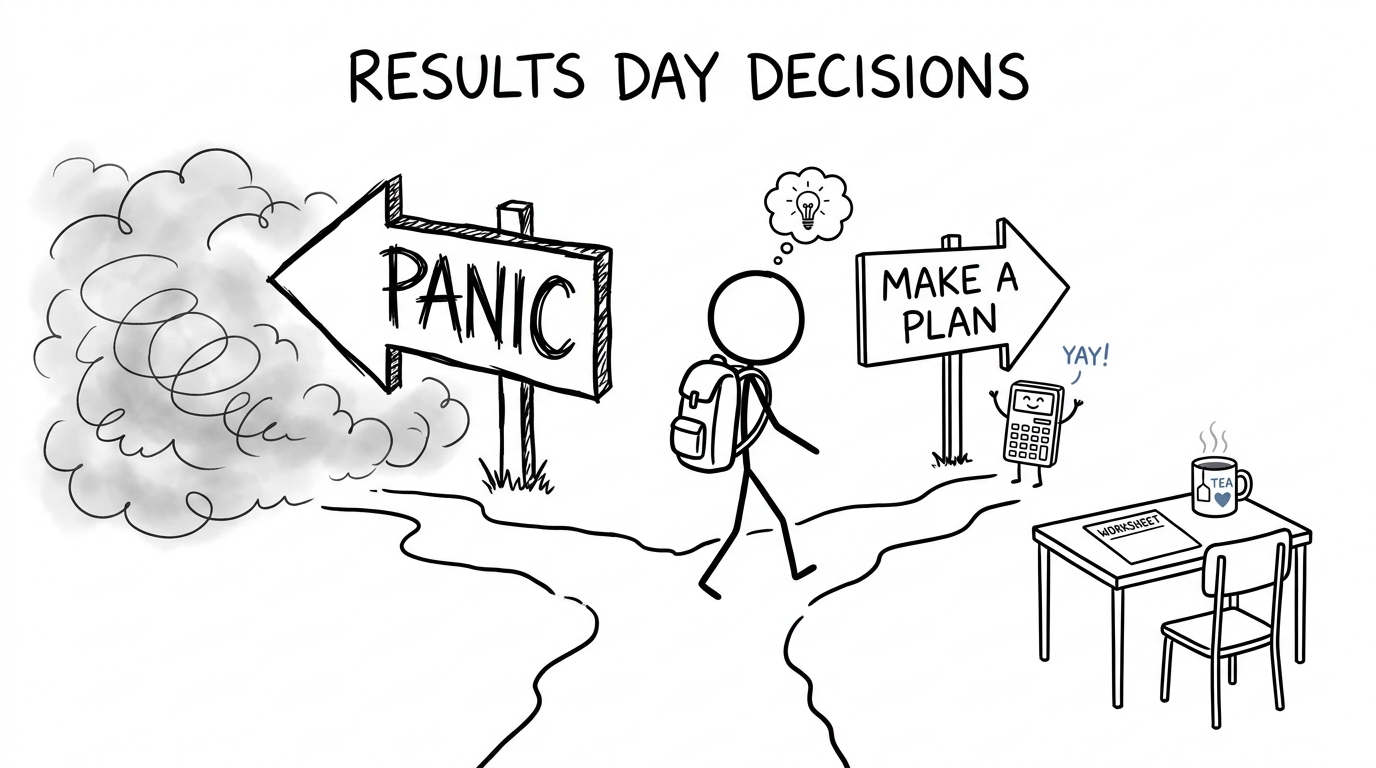 A student choosing a revision plan instead of panic after Results Day
Your GCSE maths resit checklist
Start with five decisions:
- Ask your school or college which exam series, board and tier you will take.
- Collect any available teacher feedback or exam-script information.
- Complete one diagnostic paper without revising first.
- Turn lost marks into a shortlist of weak topics.
- Schedule topic practice before moving to full timed papers.
In England, eligible students on relevant post-161616 programmes who have not achieved grade 444 or above must continue studying maths under the condition-of-funding rules. This is a study requirement, not automatic entry for the next available examination. Confirm your entry with your school, college or examination centre.
GCSE mathematics is available in the November series in England for students aged 161616 or over by the relevant August cut-off, as well as in the summer series. Arrangements can differ across the UK, particularly in Wales, so check the current rules and timetable for your nation, exam board and centre rather than relying on an old date online.
Milestone one: understand your starting point
A grade shows the overall outcome. It does not explain the cause.
Begin with a paper matching your board and tier. The GCSE maths revision hub lets you choose resources for Edexcel, AQA, OCR, Eduqas, WJEC and CCEA. If you take Edexcel, use the dedicated Edexcel GCSE maths revision pathway.
Mark the paper carefully and classify each lost mark:
- Knowledge gap: you did not know the method.
- Application gap: you knew the skill but could not recognise when to use it.
- Accuracy slip: signs, arithmetic, rounding or units went wrong.
- Exam issue: you misread the question, omitted working or ran out of time.
This distinction matters. More notes will not solve a timing problem, while more timed papers will not teach a missing algebra method.
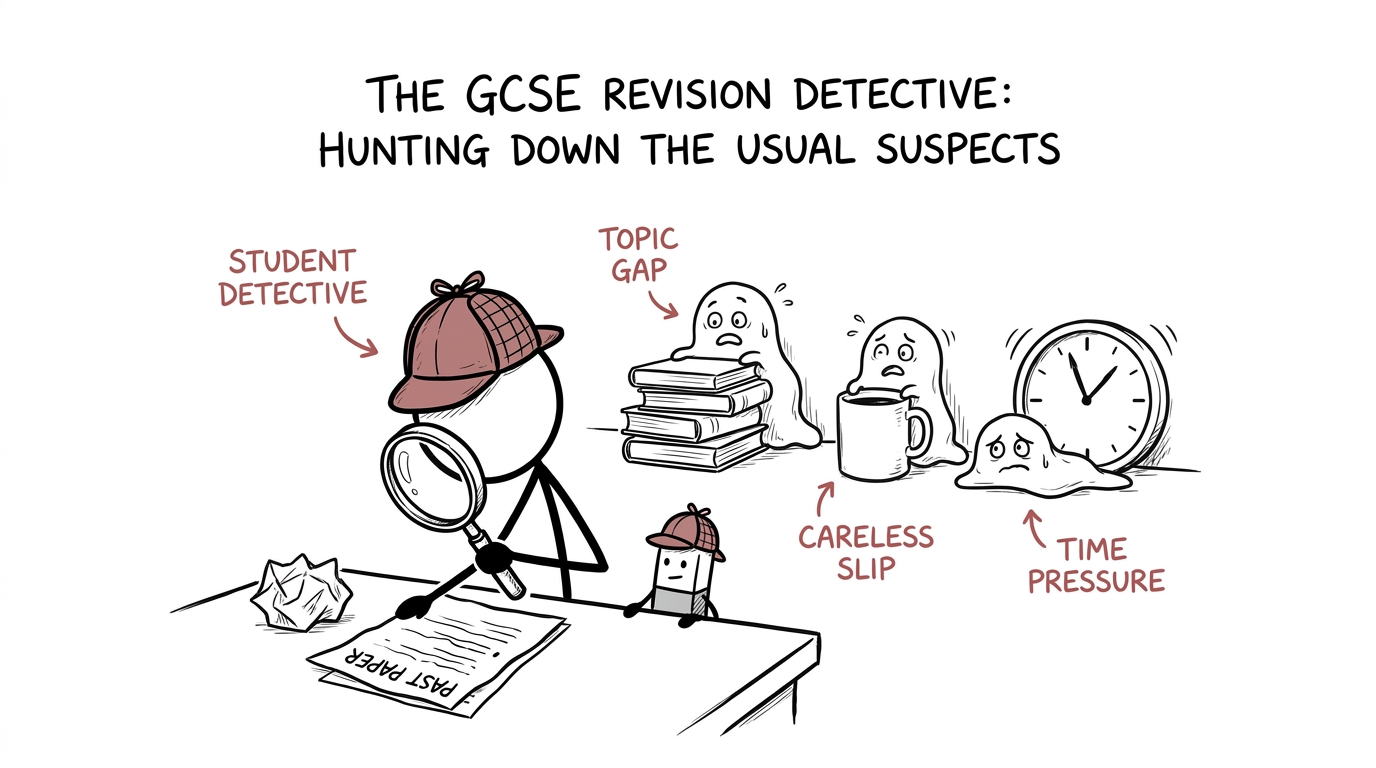 A student detective finding topic gaps, slips and time pressure in a past paper
Milestone two: build a focused topic phase
For the next few weeks, give most of your attention to the topics responsible for repeated lost marks. Keep the list manageable. Fractions, percentages, ratio, equations, graphs, area, probability and interpreting data often support questions elsewhere in the course, but your actual paper should decide your priorities.
Use a repeatable session:
- Recall the method without notes.
- Watch or read a short revision lesson if needed.
- Complete exam-style questions.
- Mark them immediately.
- Record one specific correction.
- Retest the topic on another day.
The Edexcel GCSE maths worksheets organise questions by topic and include answers. They are useful for rebuilding one skill at a time instead of repeatedly meeting the same weakness inside full papers.
Short, regular practice also reduces the effort of getting started. The twenty-minute GCSE revision routine offers a simple structure for fitting resit preparation around a college course, apprenticeship or other subjects.
Milestone three: turn practice into marks
Once your weakest topics feel less fragile, introduce mixed and timed work. Begin with mini tests or sections of papers, then progress to complete papers under the correct conditions.
For Edexcel students, GCSE maths past papers include mark schemes and worked solutions where available. The wider GCSE predicted papers and revision resources can add fresh practice, but predicted papers should supplement official past papers rather than replace them.
After every paper, calculate more than a total mark. Ask:
- Which questions could I not start?
- Where did I understand the method but lose accuracy?
- Did I show enough working to access method marks?
- Which two topics should shape my next sessions?
The useful rhythm is paper, mark, repair, retest. The guide to using GCSE past papers properly explains how to turn each paper into a practical error log.
Milestone four: prepare for the examination itself
In the final phase, practise using the same tier, calculator rules and time limit as the real papers. Check whether you are entered for foundation or higher tier rather than assuming it remains unchanged. Foundation tier awards grades 111 to 555, while higher tier awards grades 444 to 999, with a limited grade 333 available under higher-tier grading rules.
For examinations in England during 202620262026, official guidance confirms that GCSE maths candidates receive a formula sheet in the examination room. You cannot take your own copy. Even with that support, practise recognising which formula is relevant and substituting values accurately.
Train a calm first pass through each paper. Bank accessible marks, leave space when stuck and return later. Your aim is not to make every question easy. It is to prevent one difficult question from consuming time that could earn marks elsewhere.
Common GCSE maths retake revision mistakes
Revising everything equally
A resit plan should respond to evidence. Spending equal time on secure and weak topics feels organised but wastes limited revision time.
Completing papers without repairing errors
A stack of marked papers can create the appearance of progress. Improvement happens when each mistake leads to targeted practice and a later retest.
Looking at solutions too quickly
Try the question first. If you need help, study the method, close the solution and attempt a similar question independently.
Ignoring your board or tier
Edexcel, AQA, OCR and Eduqas assess broadly related GCSE content, but paper structures and specifications are not interchangeable. Use resources that match your confirmed entry.
Treating the previous grade as a prediction
Your result is a record of one examination series, not a fixed limit. Use it as diagnostic information: which marks were available, and what repeatable habits would help you collect them next time?
Make the resit a better process
Resitting GCSE maths does not require dramatic reinvention. It requires a more accurate process: diagnose the gaps, practise deliberately, mark honestly and revisit mistakes until the method becomes dependable.
Start today with the MathsGenie GCSE maths hub. Choose your board and tier, then combine free revision lessons, worksheets, practice questions and mini tests with past papers, predicted papers, mark schemes and video solutions. One diagnostic paper is enough to reveal your first milestone, and one focused worksheet is enough to begin.











