

GCSE: How Many Past Papers Should You Do?
GCSE past papers: how many should you do to boost marks? A practical plan for foundation, higher and A Level maths, with timing and review tips.
Every spring, the same question turns up on desks, group chats, and quiet walks home: how many past papers should you do for GCSE maths before the real thing? It feels like there must be a magic number. Do 333 papers and you are under-prepared. Do 303030 and you are “serious”. But revision does not work like a step counter. What matters is whether each GCSE paper you do changes what you can do next time: the method, the speed, the accuracy, the calm.
This post gives you a realistic answer you can actually use, whether you are revising for GCSE foundation or higher tier, or you are an A Level student who still needs that same skill: learning from exam-style practice.
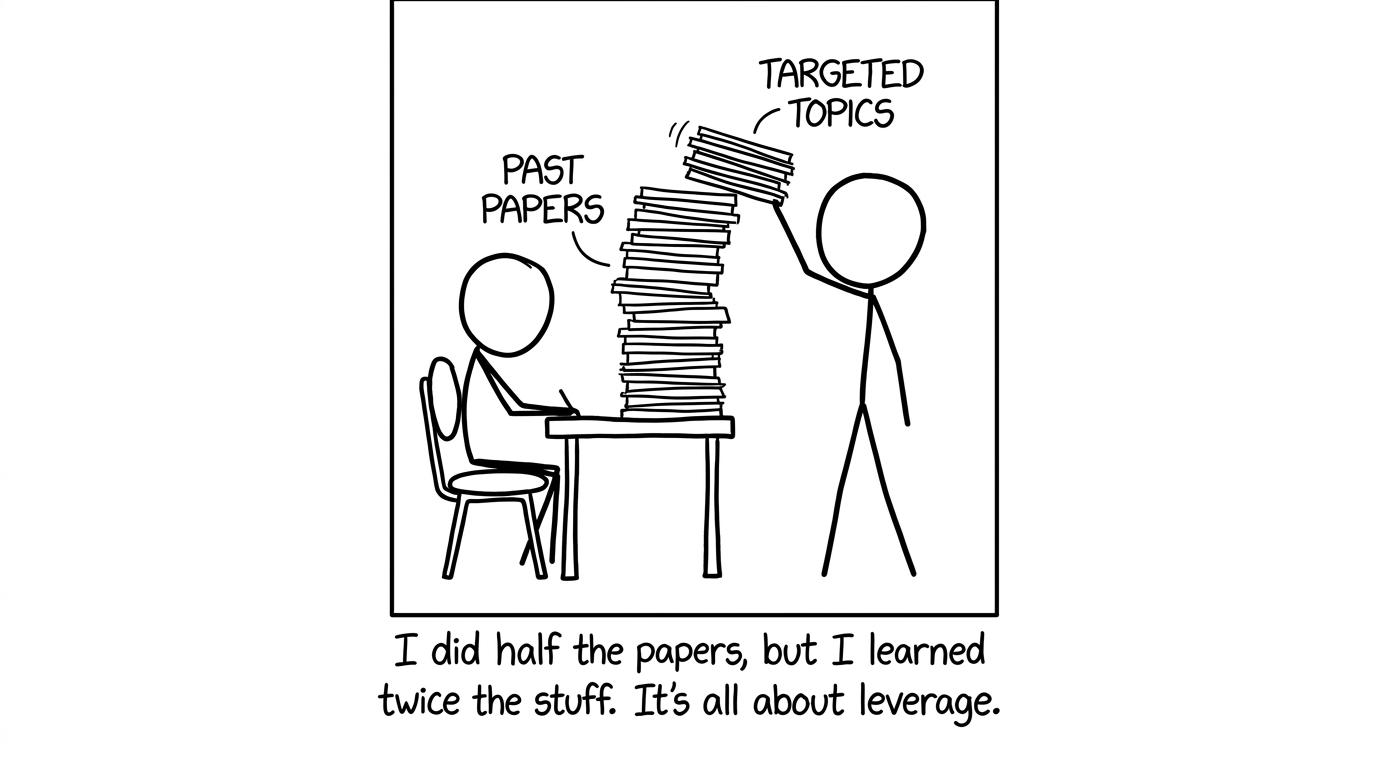 A tower of past papers vs a focused stack
The short answer (that’s still honest)
There is no perfect number of past papers for GCSE maths. A better target is:
- A minimum of 666 to 101010 full papers done properly (timed, marked, analysed, then followed by topic practice).
- More papers only if your review process is strong and you are not repeating the same mistakes.
- If time is tight, replace full papers with paper halves, mini tests, and targeted practice, because one well-reviewed GCSE paper can be worth five rushed ones.
If you want a clean starting point on Maths Genie, use:
- Edexcel GCSE Predicted Papers for realistic practice sets.
- Maths Genie Resources to find predicted papers and short tests.
- If you sit AQA, the AQA GCSE papers page is a straightforward place to practise with mark schemes.
A past paper checklist that actually improves your grade
Before counting papers, check the process. A GCSE past paper only helps if you do these steps:
- Do it like an exam: timed, quiet, no notes.
- Mark it using the mark scheme.
- Diagnose the cause of lost marks: method, accuracy, interpretation, or time.
- Fix one topic at a time using revision lessons and practice questions.
- Re-attempt the missed questions 222 to 777 days later.
That loop is the difference between “I did loads of papers” and “my marks went up”.
Why “more past papers” stops working after a point
There is a small trap that smart students fall into. Past papers feel productive because they are measurable: one more PDF, one more score. But a score is not the same as learning.
After a while, doing another GCSE paper without changing your approach becomes like jogging the same route and hoping your legs suddenly learn hills. Improvement comes from discomfort in the right place: the weak topics, the scrappy algebra, the ratio question you always misread.
A useful way to think is:
- Past papers reveal weaknesses.
- Topic practice repairs weaknesses.
- Past papers confirm the repair.
Maths Genie is built for that cycle: revision lessons, practice questions, and then past papers with mark schemes and video solutions.
A realistic guide: how many GCSE maths past papers by time left
Your timeline matters more than your ambition. Here is a practical guide for GCSE maths revision.
If you have 8-12 weeks
Aim for:
- 888 to 121212 full past papers across Paper 1 (non-calculator) and Papers 2-3 (calculator), spread out.
- Plus targeted paper halves if your timing is shaky.
A good mix is:
- 111 paper per week (timed)
- 222 to 333 short targeted sessions per week (specific topics)
If you like the idea of smaller timed chunks, the old Maths Genie Edexcel GCSE 45 Minute Tests can help you practise pacing without committing to a full sitting.
If you have 3-6 weeks
Aim for:
- 666 to 888 full papers total.
- Make sure each paper triggers at least 222 topic fix sessions.
This is where predicted papers become valuable because they focus attention. Use Maths Genie Resources to find predicted papers and revision packs.
If you have 7-14 days
Aim for:
- 333 to 555 full papers, max.
- Spend at least the same amount of time reviewing and repairing as you spend sitting papers.
In the final stretch, you are trying to remove the biggest sources of lost marks, not “complete the internet”.
Foundation vs higher: should you do the same number of papers?
The number can be similar, but the emphasis changes.
GCSE foundation tier
Foundation success is often built on reliability: calculator skills, non-calculator fluency, and not dropping straightforward method marks.
A strong plan:
- Slightly fewer full papers if stamina is an issue, but more short timed practice.
- Rehearse core topics until they feel automatic.
Mini tests are useful for this, because they are short and targeted. The older Maths Genie Foundation Mini Tests are designed exactly for building that consistency.
GCSE higher tier
Higher tier rewards depth and flexibility: unfamiliar contexts, multi-step problems, proofs and algebraic manipulation.
A strong plan:
- Similar number of full papers, but with more time reviewing the “hard” questions.
- Re-attempt the final few questions of each paper after targeted practice.
For students pushing grades 777-999, a single re-attempted problem can be worth more than another full paper.
How to review a past paper like a top student
Marking is not the end. Marking is the start.
Here is a simple review method you can repeat for every GCSE paper.
Step 1: Sort your mistakes into three piles
For each lost mark, label it:
- A (algebra/method): you did not know what to do.
- B (accuracy): you knew the method but made an error.
- C (exam technique): you misread, ran out of time, or wrote too little.
Your next revision session should be dominated by pile A, then B.
Step 2: Turn mistakes into a “fix list”
Pick 333 topics from that paper. Only 333. If you pick 121212, you will do none properly.
Use the Maths Genie journey to revise in order and fill gaps. The Edexcel GCSE Maths learning journey is especially useful when you feel like your weaknesses are scattered.
Step 3: Re-attempt the question properly
Wait at least 484848 hours, then redo the missed questions without the mark scheme.
If you can now get them right, you have actually improved. If you still cannot, you need a revision lesson and topic practice before doing another full GCSE paper.
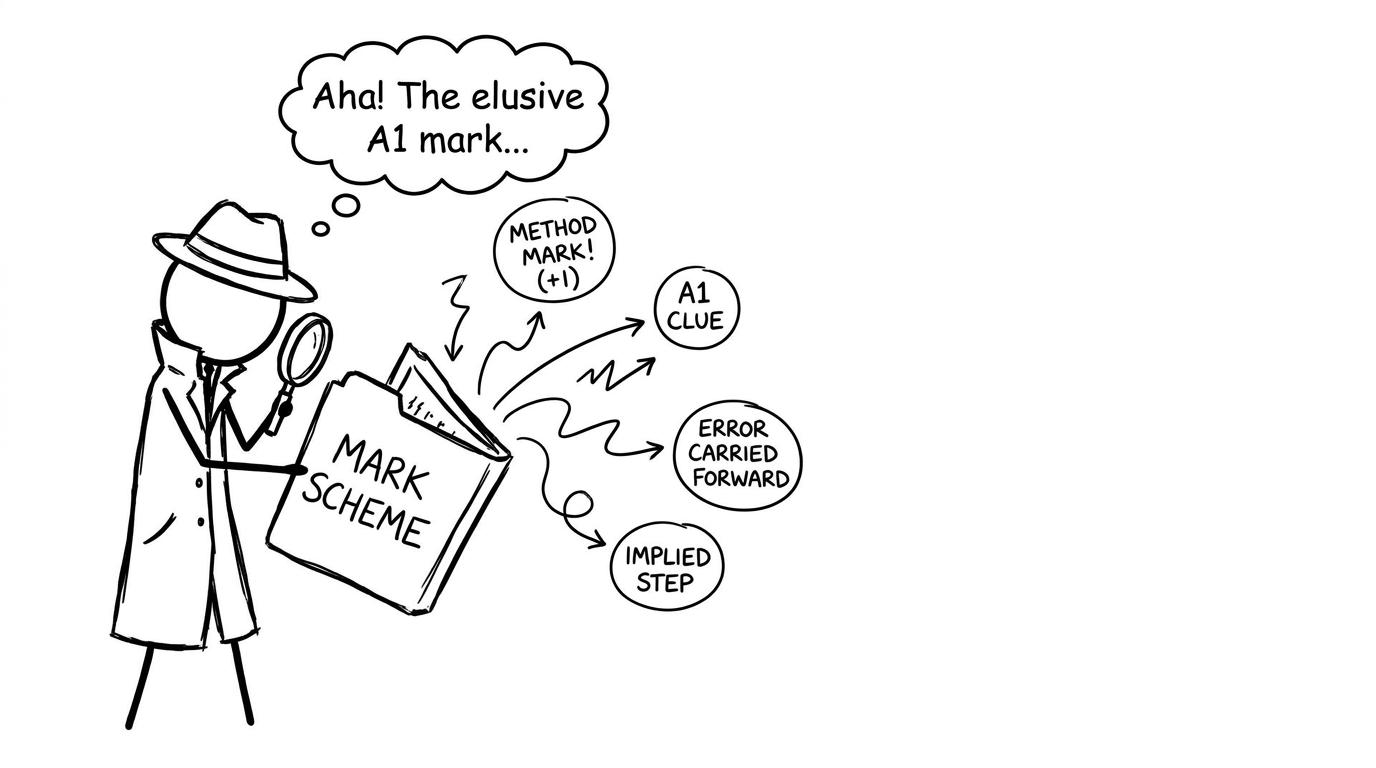 Mark scheme detective hunting method marks
Worked example: using marks to plan time (and stop rushing)
One of the simplest ways to score higher in GCSE maths is to spend time proportionally.
Suppose a paper is 808080 marks and lasts 909090 minutes.
Time per mark is:
9080=1.125 minutes per mark \frac{90}{80}=1.125\text{ minutes per mark} 8090=1.125 minutes per markThat is about 111 minute 7.57.57.5 seconds per mark.
So a 555-mark question should take about:
5×1.125=5.625 minutes 5\times 1.125=5.625\text{ minutes} 5×1.125=5.625 minutesThat is about 555 minutes 37.537.537.5 seconds.
This does not mean you must time every question. It means you stop donating 151515 minutes to a 222-mark question out of stubbornness. If you are stuck, move on, bank marks elsewhere, and come back.
Worked example: fixing an algebra slip you keep repeating
A classic GCSE paper loss is expanding brackets incorrectly.
Expand 3(2x−5)3(2x-5)3(2x−5).
Correct method:
3(2x−5)=3×2x+3×(−5)=6x−15 3(2x-5)=3\times 2x + 3\times (-5)=6x-15 3(2x−5)=3×2x+3×(−5)=6x−15A common error is writing 6x−56x-56x−5, forgetting to multiply the constant.
How to fix it:
- Circle the bracket first.
- Treat it as “multiply everything inside by 333”.
- Practise 101010 quick expansions, then return to a past paper question that uses expansion in context.
That “topic repair” step is why you do past papers in the first place.
How A Level students should think about past papers too
If you are revising for A Level maths, the question “how many past papers should I do?” is still relevant. The difference is that A Level papers are longer, and the marks are often concentrated in multi-step methods.
A Level past paper revision works best when you:
- Do fewer full papers, but do deeper review.
- Build a bank of re-attempted questions organised by topic.
- Use mark schemes to learn what counts as a “complete method”.
Maths Genie has A Level support too, including AQA AS and A Level past papers. The same principle applies: do enough papers to expose patterns, then spend most of your time fixing the patterns.
Common mistakes when doing GCSE past papers
These are the mistakes that quietly waste hours.
- Doing papers open-book, then wondering why the exam feels different.
- Marking without learning, i.e. writing the right answer in and moving on.
- Ignoring method marks: in GCSE, a correct method with one arithmetic slip can still score well.
- Only doing calculator papers because they feel easier, then panicking on non-calculator.
- Repeating the same paper too soon: you remember the questions instead of improving the skill.
- Chasing volume over insight: 202020 papers with no review is usually worse than 888 papers with good repair work.
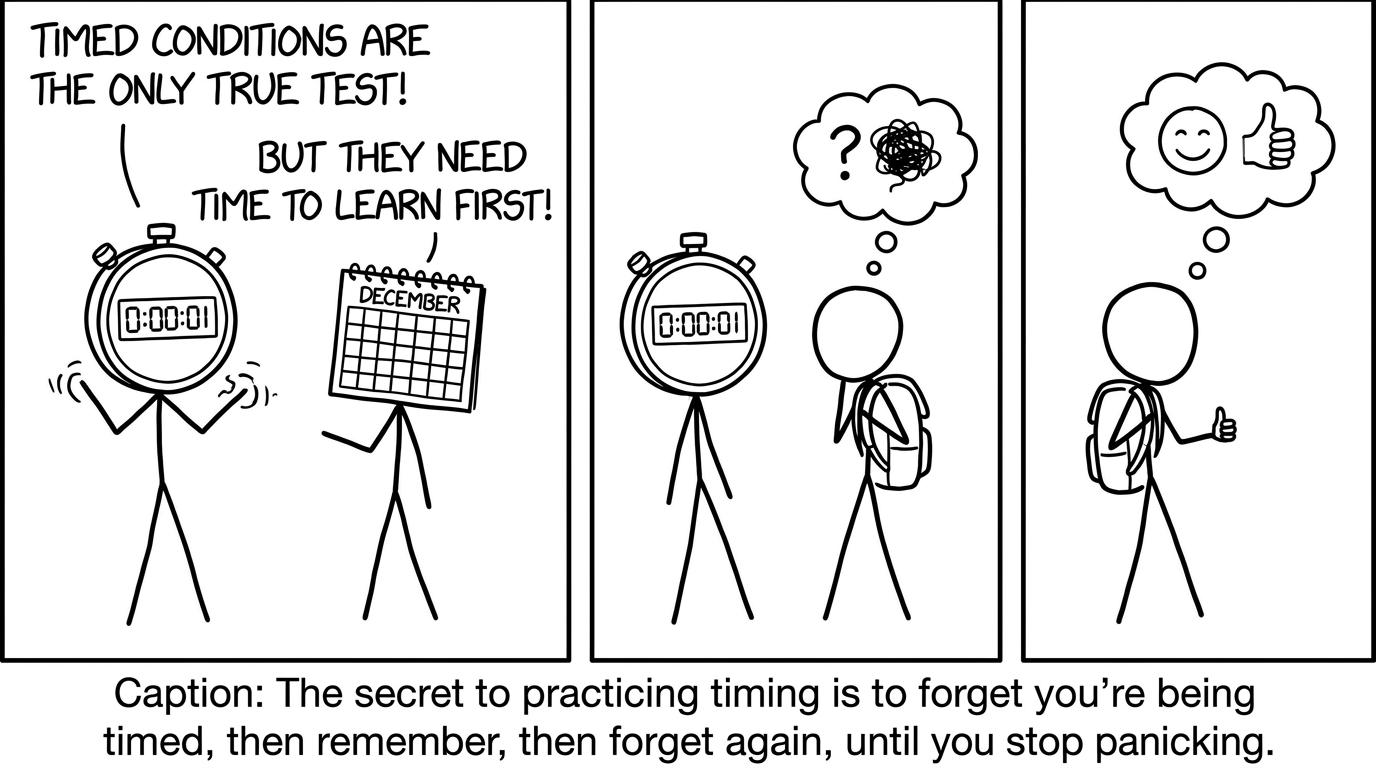 Stopwatch argues with calendar about timed practice
The best number of past papers is the number you can learn from
So, how many past papers should you do? Enough that you stop being surprised. Enough that timing feels familiar. Enough that you have met your weaknesses, named them, and repaired them.
For most students, that lands around 666 to 121212 properly reviewed GCSE past papers, supported by topic revision in between. If you are doing paper after paper but not improving, it is not a motivation problem; it is a feedback problem.
To make your next paper count, build your revision loop on Maths Genie:
- Use revision lessons to secure the method.
- Use practice questions and mini tests to make it reliable.
- Use past papers and predicted papers to make it exam-ready, with mark schemes and video solutions.
Start here and keep it simple: Maths Genie Resources and your exam board’s papers page (for example AQA GCSE papers). Then commit to the part most students skip: the review.
That is where grades are made.










