

GCSE Biology Grade 7 Meaning: A Clear Guide
GCSE biology grade 7 meaning explained: discover the ability it represents, how it compares with the old grade A and how to revise effectively.
A result can look wonderfully precise while hiding a great deal of uncertainty. You see a grade on a mock paper, but it does not tell you which facts you knew, which unfamiliar questions you handled well or where your next marks are waiting.
The short answer to the GCSE biology grade 7 meaning is this: it represents a strong performance in GCSE Biology and sits at the lower end of the highest three grades. Officially, the bottom of grade 7 is comparable with the bottom of the old grade A. It suggests that you can do considerably more than recall biological facts you can usually apply knowledge, interpret evidence and analyse unfamiliar information.
It does not mean that you answered 70%70\%70% correctly, mastered every topic or received an exact replacement for an old A. Understanding those distinctions makes the grade far more useful.
Grade 7 at a glance
A grade 7 in separate GCSE Biology generally means that:
- you have achieved a high Level 2 GCSE grade;
- your performance reached a standard anchored to the bottom of the former grade A;
- you normally took higher-tier papers, because foundation tier generally reaches grade 5;
- you showed secure knowledge across a broad specification;
- you could apply that knowledge in contexts you may not have seen before;
- you demonstrated competence in data, practical, mathematical and evaluative questions;
- you performed strongly overall, even though some topics or question types may remain weaker.
The grade is based on your total mark across the relevant papers. It is not a separate judgement of effort, potential or intelligence.
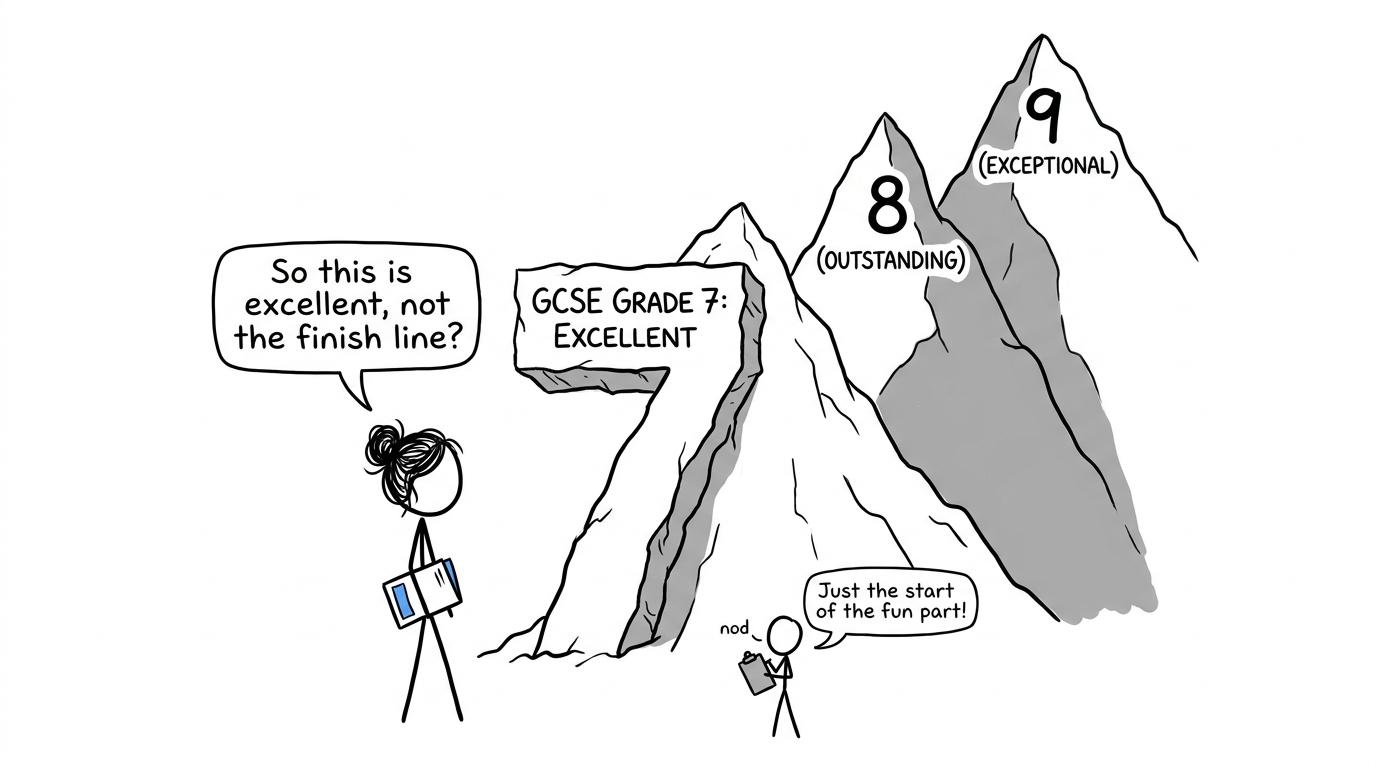 A student discovers that grade 7 is an excellent summit with further peaks beyond it
What ability does a grade 7 actually represent?
There is no universal checklist saying that every grade 7 student can answer precisely the same questions. GCSE grades summarise overall assessment performance, and two students can reach the same total through different combinations of strengths.
Still, a student working around grade 7 will usually display several recognisable abilities.
Secure biological knowledge
You should know the central ideas in areas such as cell biology, organisation, infection and response, bioenergetics, homeostasis, inheritance, evolution and ecology. Exact organisation and wording vary between Edexcel, AQA, OCR and Eduqas specifications, so your own specification remains the correct checklist.
At this level, knowledge is not merely a collection of disconnected definitions. You should be able to connect ideas: structure with function, environmental change with populations, or a biological process with its observable results.
Application in unfamiliar contexts
A high-grade question often gives you a familiar principle inside an unfamiliar situation. The organism, investigation or data may look new, but the biology underneath it comes from the specification.
Grade 7 performance therefore reflects an ability to select relevant knowledge rather than reproduce every remembered fact. This is one reason passive rereading can feel productive without reliably improving marks. The examination asks you to retrieve, choose and use knowledge.
Analysis and evaluation
GCSE Biology assessment includes more than factual recall. Across GCSE Biology specifications, assessment objectives cover knowledge and understanding, application, and the analysis and evaluation of information and evidence.
For example, the current AQA standalone Biology assessment model gives approximately $40\% of the qualification to knowledge and understanding, $40\% to application, and $20\% to analysis and evaluation. Other boards follow the nationally set assessment objectives, although paper structures and specification details differ.
A grade 7 student will therefore tend to be comfortable identifying patterns, judging conclusions, discussing limitations and suggesting improvements to experimental procedures. The wording still matters: an evaluation must be supported by the evidence provided, not by a vague statement that an investigation was “unreliable”.
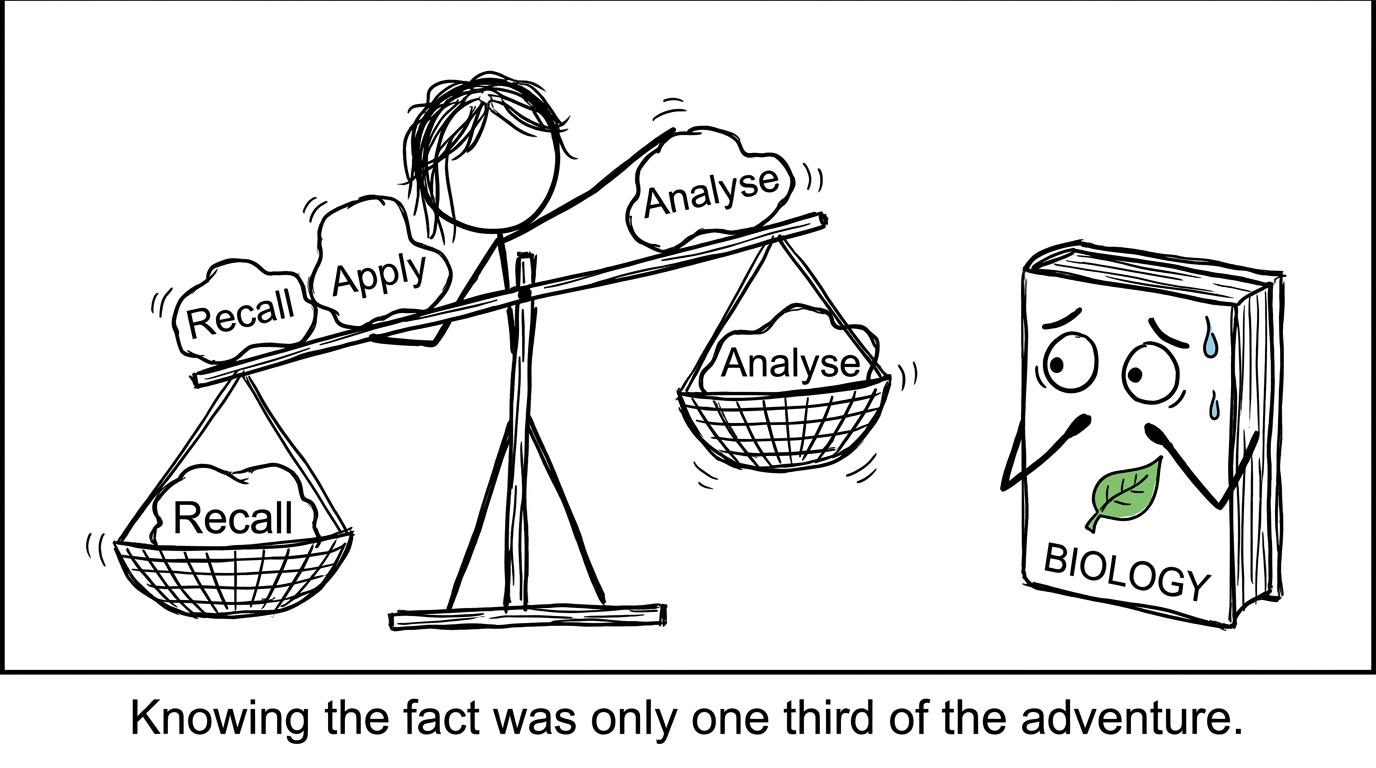 Recall, application and analysis wobble together on a revision balance
Is grade 7 the same as an old grade A?
It is close, but the careful answer matters.
The numbered scale is not a direct one-to-one conversion of every old letter grade. Ofqual’s official comparison point says that the bottom of grade 7 is comparable with the bottom of the former grade A. Grades 7, 8 and 9 collectively provide greater differentiation across the range previously occupied by A and A*.
So it is reasonable to describe grade 7 as broadly equivalent to an old A, provided you understand that this is an anchored comparison rather than an exact conversion table. Grade 9 is not simply the renamed A*, and grade 8 does not have its own precise former-letter equivalent.
This extra differentiation helps schools, colleges and employers distinguish performance at the upper end. For a student, however, the practical message is simpler: grade 7 is an excellent result, while grades 8 and 9 represent progressively stronger performances within that top range.
Does grade 7 mean getting $70\% in Biology?
No. A numbered grade is not a percentage score.
Grade boundaries are the minimum marks needed for each grade in a particular exam series. Exam boards set boundaries after the papers have been taken and marked, using evidence about the demands of the papers and established standards. Boundaries can move because papers are not identical in difficulty from year to year.
Your percentage score can be calculated as:
percentage score=marks achievedmarks available×100\text{percentage score}=\frac{\text{marks achieved}}{\text{marks available}}\times 100percentage score=marks availablemarks achieved×100But that percentage only becomes a grade when it is compared with the confirmed boundary for your board, qualification, tier and exam series. Do not transfer an AQA boundary to an Edexcel paper, or a combined science boundary to separate Biology.
You can explore how marks have varied over time in MathsGenie’s GCSE Biology grade boundaries history. Historical boundaries are useful for context, but they cannot predict a future boundary with certainty.
Separate Biology and Combined Science are different
A standalone GCSE Biology result is reported as one grade. Combined Science is worth two GCSEs and produces a pair of equal or adjacent grades, such as 7-7 or 7-6.
A 7 in separate Biology and a 7-7 in Combined Science are therefore not interchangeable labels. They come from different qualifications and assessment structures. Before interpreting a mock result, check:
- whether you take separate Biology or Combined Science;
- which exam board you follow;
- whether the paper is foundation or higher tier;
- whether the reported grade uses current or estimated boundaries;
- whether it reflects one paper or the whole qualification.
A single-paper mock grade is useful evidence, but it is not a complete forecast. Topics, practical skills and question styles differ across papers.
The maths behind grade 7 Biology
Biology is not a maths examination, but calculation and data skills can separate knowing the content from scoring the marks. Students may need to use ratios, percentages, averages, rates, graphs, standard form, unit conversions and magnification relationships.
A good starting point is the MathsGenie GCSE maths revision hub, where you can target a weak technique rather than revise number skills randomly. The wider best order for learning GCSE maths topics is also useful if your foundations in fractions, percentages, algebra or graphs feel uneven.
The method matters as much as the final number. Write down the relationship you need, substitute carefully, show each stage, include units and use sensible rounding. Graph questions also require scientific judgement: describe the pattern shown rather than the pattern you expected.
MathsGenie’s guide to finding your weakest GCSE topics offers a practical way to separate biological knowledge errors from calculation, graph and exam-technique errors.
How to move towards a grade 7
The difference between hoping for a grade and building one is feedback. A useful revision cycle is short enough to repeat:
- select one specification area;
- retrieve the key ideas without notes;
- answer exam-style questions;
- mark them strictly using the mark scheme;
- classify each lost mark;
- repair the smallest identifiable weakness;
- retry a different question after a gap.
A lost mark might come from missing knowledge, weak application, imprecise terminology, misread data, incorrect units or an unsupported conclusion. Each cause needs a different repair.
If you follow OCR, the guide to revising OCR Biology efficiently explains how to combine specification coverage, active recall and exam practice. The broader comparison of GCSE maths and science difficulty can help you plan revision across both subjects without treating them as entirely separate challenges.
As exams approach, predicted papers can help simulate an unfamiliar assessment, but they should never become a list of supposedly guaranteed topics. MathsGenie’s explanation of how to use predicted topics without guessing shows why complete specification coverage still matters.
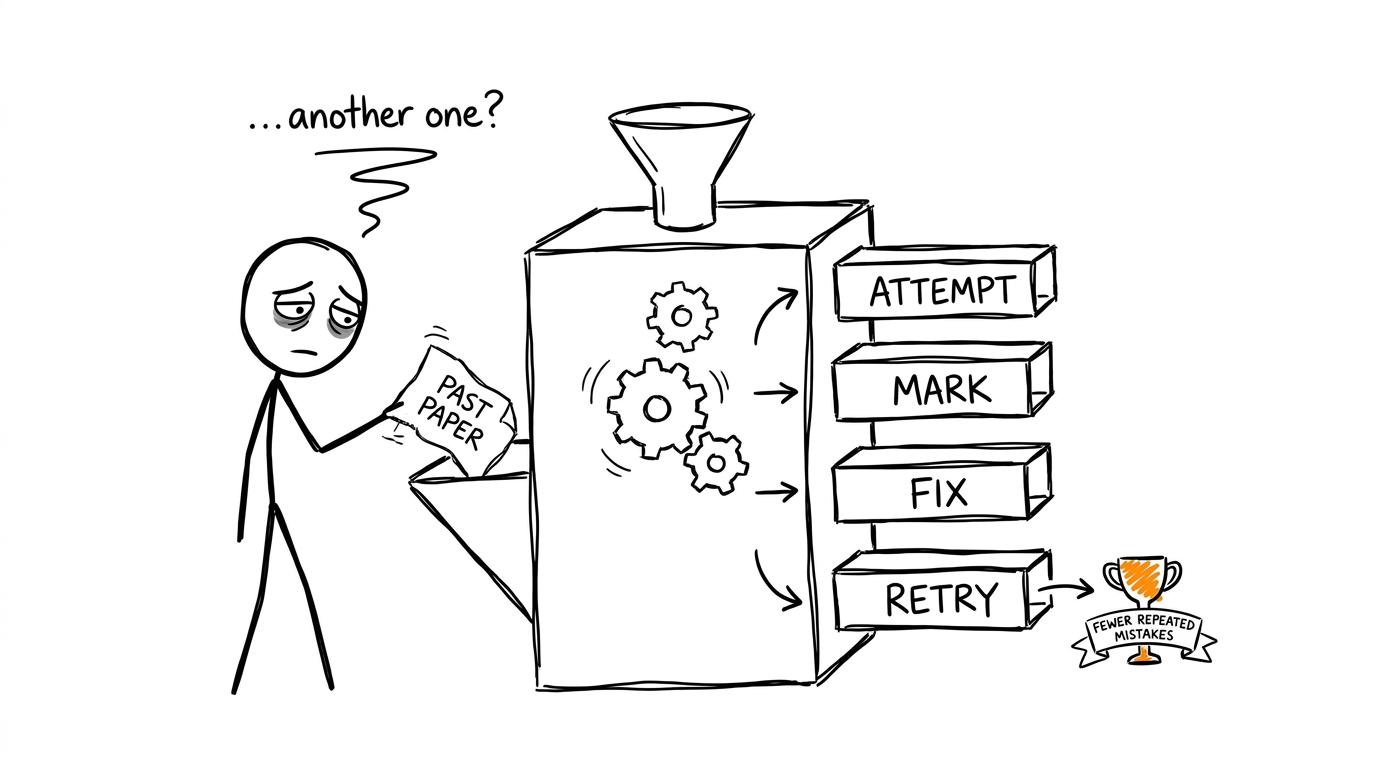 A revision machine turns an attempted paper into fewer repeated mistakes
Common mistakes when interpreting or chasing grade 7
Treating grade 7 as $70\%
The grade number and percentage mark measure different things. Always use the correct paper’s confirmed or clearly labelled provisional boundaries.
Assuming grade 7 means every topic is secure
A strong total can conceal gaps. Review lost marks by topic and skill rather than concluding that the whole subject is either “good” or “bad”.
Memorising mark schemes without understanding
Mark schemes reveal the precision expected, but memorised phrases are unreliable when the context changes. Learn why an answer earns marks and practise applying the idea elsewhere.
Ignoring mathematical presentation
Correct biology can still lose calculation marks through missing working, incorrect units or careless conversion. Short, regular maths practice is more effective than waiting until the week before the paper.
Comparing incompatible grades and boundaries
Separate Biology, Combined Science, foundation papers, higher papers and different exam boards cannot share one boundary. Check the qualification code and series before drawing conclusions.
Revising only comfortable material
Recognition feels reassuring, but improvement usually sits inside attempted questions and corrected errors. MathsGenie’s advice on using past papers properly applies beyond Physics: attempt under realistic conditions, mark honestly, repair weaknesses and retest.
Turn the grade into a plan
A grade 7 is not a personality type. It is evidence that, across a particular set of assessments, your knowledge, application and analysis reached a strong standard comparable at its lower boundary with the former grade A.
If you already have a 7, use your scripts to identify what would make that performance more consistent. If you are aiming for one, focus less on predicting a magical percentage and more on collecting evidence: correct answers under time pressure, clearer written explanations, secure calculations and fewer repeated errors.
MathsGenie can strengthen the numerical engine underneath your science marks while supporting your main maths preparation. Use the free revision lessons to relearn weak methods, practice questions and mini tests to build accuracy, and past papers or predicted papers to test performance. Then check mark schemes and video solutions, update your revision planner and repeat the cycle. The grade arrives at the end; the useful work happens one corrected mistake at a time.










