GCSE Arabic February Half-Term Revision Plan
GCSE Arabic February half-term revision: follow a focused seven-day plan for all four skills while keeping your GCSE maths preparation moving too.
February half-term can create a peculiar kind of pressure. There is enough free time to feel that you should transform every subject, yet not enough to revise everything properly. If Arabic and maths are both on your GCSE timetable, the danger is allowing one to consume the week while the other quietly slips backwards.
A sensible GCSE Arabic February half-term revision plan does something more modest and more useful: it diagnoses your weakest language skills, gives each one focused attention and protects several short maths sessions. You do not need to finish the course in a week. You need to leave the week knowing what has improved and what comes next.
Your half-term revision checklist
Keep the plan simple enough to follow:
- Confirm your Arabic specification, tier and assessment structure.
- Diagnose weaknesses across listening, speaking, reading and writing.
- Choose two or three themes that need the most attention.
- Complete one focused Arabic task in each main session.
- Keep short maths sessions in the timetable rather than postponing maths.
- Mark or review everything you attempt.
- Record specific errors, not vague judgements such as “Arabic was bad”.
- End the week with a realistic plan for the weeks ahead.
The principle is restraint. Half-term should create momentum, not exhaustion.
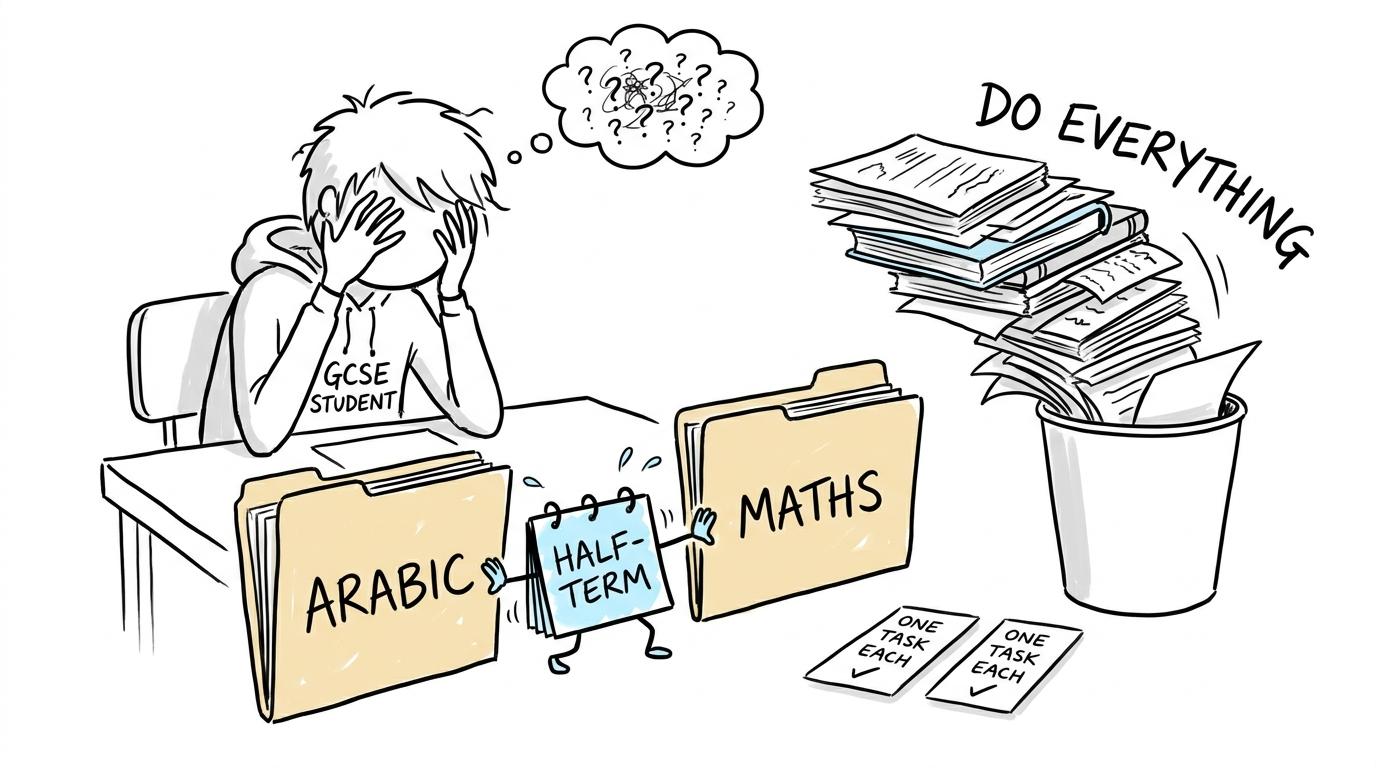 A half-term calendar refereeing between Arabic and maths revision
Start with the exam you will actually sit
Before opening a vocabulary list, check the qualification details supplied by your school or exam centre. For the current Pearson Edexcel GCSE Arabic specification, students take listening, speaking, reading and writing assessments. Each skill contributes 25%25\%25% of the qualification, and students are entered for one tier across all four papers.
That equal weighting matters. A student who spends the entire week copying vocabulary may feel busy but has not necessarily practised listening at normal speed, producing spontaneous speech or organising an extended written response.
The Pearson course assesses Modern Standard Arabic. It also includes translation, with Arabic-to-English translation appearing within reading and English-to-Arabic translation within writing. Dictionaries are not permitted in the assessments, so independent vocabulary recall matters.
Do not assume that another language’s paper format applies to Arabic. Check your official specification, teacher guidance and tier. Foundation and Higher papers differ in length and demand, while the speaking assessment includes a role play, picture-based task and conversation.
Diagnose before you build the timetable
Revision becomes inefficient when it begins with the resource that happens to be nearest. Begin instead with evidence from a recent mock, classroom assessment or exam-style task.
Divide a page into the four assessed skills. Under each heading, record precise problems:
- Listening: losing track at natural speed, missing negatives or confusing time references.
- Speaking: giving short answers, hesitating frequently or relying on memorised material that does not answer the question.
- Reading: translating every word, overlooking opinions or struggling to infer meaning from context.
- Writing: limited vocabulary, inconsistent verb forms, weak organisation or unanswered bullet points.
Then choose the two weaknesses that would benefit most from concentrated practice. This is the same evidence-led approach that works in maths. MathsGenie’s guide to finding your weakest GCSE topics explains why mistakes are more useful than feelings when deciding what to revise.
A diagnostic is not a verdict on your ability. It is a map. Without it, every road looks equally urgent.
A focused seven-day GCSE Arabic plan
This structure is deliberately adaptable. Move sessions to match family plans, school work and rest, but preserve the sequence of diagnose, practise, review and retest.
Opening weekend: diagnose and organise
Complete short samples of listening, reading and writing, then record yourself answering several speaking prompts. You are not trying to produce a final grade. You are looking for patterns.
Use the results to select two priority themes from your specification. For Pearson Edexcel, the broad themes cover identity and culture; local area, holidays and travel; school; future aspirations, study and work; and the international and global dimension.
Organise vocabulary by purpose rather than creating one enormous alphabetical list. Useful categories include opinions, reasons, comparisons, past experiences, future intentions and topic-specific nouns. That makes vocabulary easier to retrieve when you need to communicate an idea.
Monday: listening and vocabulary retrieval
Choose a listening task at the correct tier. Read the questions first, predict the type of information required and then listen without pausing if the task is designed for exam conditions.
After marking, replay difficult sections and identify why each answer was missed. Was the word unknown? Did you recognise it too slowly? Did a negative change the meaning? Your follow-up task should match the cause.
Finish with closed-book retrieval of the vocabulary that blocked understanding. Reading the same list repeatedly is easier, but recalling words without support is closer to what the examination demands.
Tuesday: speaking under light pressure
Practise each speaking component rather than polishing only a prepared topic. Use role-play prompts, picture questions and broader conversation questions drawn from your course themes.
Record your responses. Listen for clarity, relevance, pronunciation, range and whether you refer naturally to different time frames. Avoid writing a perfect script before speaking; the assessment rewards communication and interaction, not the recitation of an answer that no longer fits the question.
Keep corrections selective. Choose a few recurring problems and repeat the answers after fixing them.
Wednesday: reading and translation
Complete a reading section under quiet, timed conditions. Read for the overall message before becoming trapped by individual words. Mark evidence in the text for details, opinions, changes of time and contrasts.
Review the translation separately. Ask whether your English conveys the complete meaning rather than copying Arabic structures awkwardly. Record unfamiliar words, but also note familiar words that you failed to recognise in context.
Thursday: controlled writing practice
Choose one task appropriate to your tier and plan before writing. Check every bullet point, decide which time frames are needed and select vocabulary you can use accurately.
When reviewing, separate communication from accuracy. First ask whether every required idea is present and understandable. Then check verb forms, agreement, spelling, connectives and sentence structure. This prevents surface-level corrections from hiding a missing part of the response.
Friday: mixed retest and next steps
Return to shorter versions of the tasks attempted earlier in the week. Use new questions where possible so that you are testing the skill rather than remembering an answer.
Compare your error log with the opening diagnostic. Improvement may look small: fewer missed negatives, longer spoken answers or better coverage of writing prompts. Those specific changes are more informative than the number of hours completed.
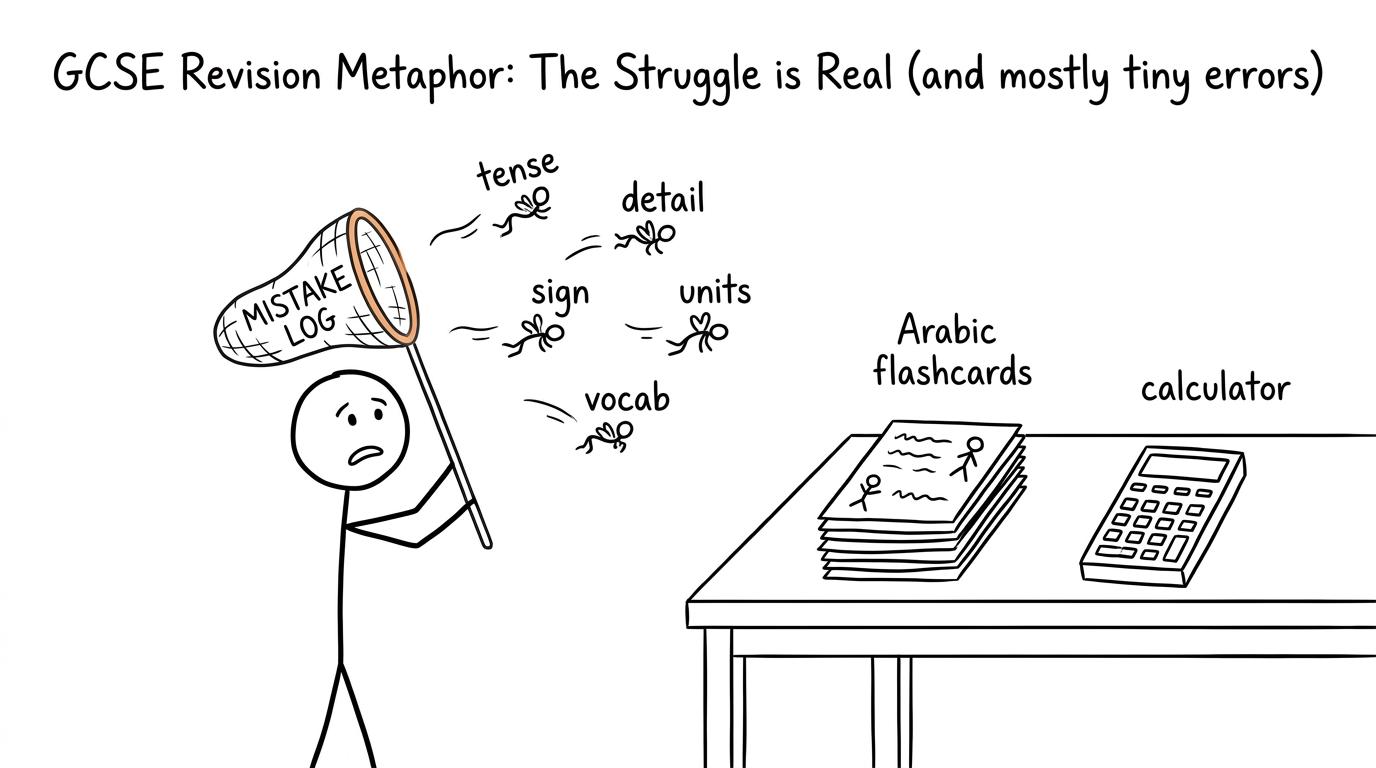 A student catching revision errors with a mistake-log net
Keep GCSE maths moving during Arabic revision
Arabic may be the half-term priority, but it should not become your only revision window. Maths skills become less secure when they are left untouched, particularly if you have recently learned a method but have not yet practised retrieving it independently.
Protect three or four short maths blocks across the week. Start at the GCSE Maths revision hub, select your exam board and confirm whether you are sitting Foundation or Higher tier. MathsGenie supports Edexcel, AQA, OCR, Eduqas and other UK boards, so your paper practice can match your course.
A short maths block can follow this pattern:
- Recall one method without notes.
- Use a revision lesson if the method is unclear.
- Complete a focused set of practice questions.
- Mark the work immediately.
- Record one correction and revisit it later.
If time is tight, use the twenty-minute GCSE maths revision routine. Edexcel students can also use GCSE maths mini tests for manageable timed practice.
Do not schedule a full maths paper every day merely because school is closed. One carefully reviewed paper is usually more useful than several rushed attempts. The Edexcel GCSE maths past papers include mark schemes and worked solutions where available, while the wider revision hub helps students locate board-appropriate resources.
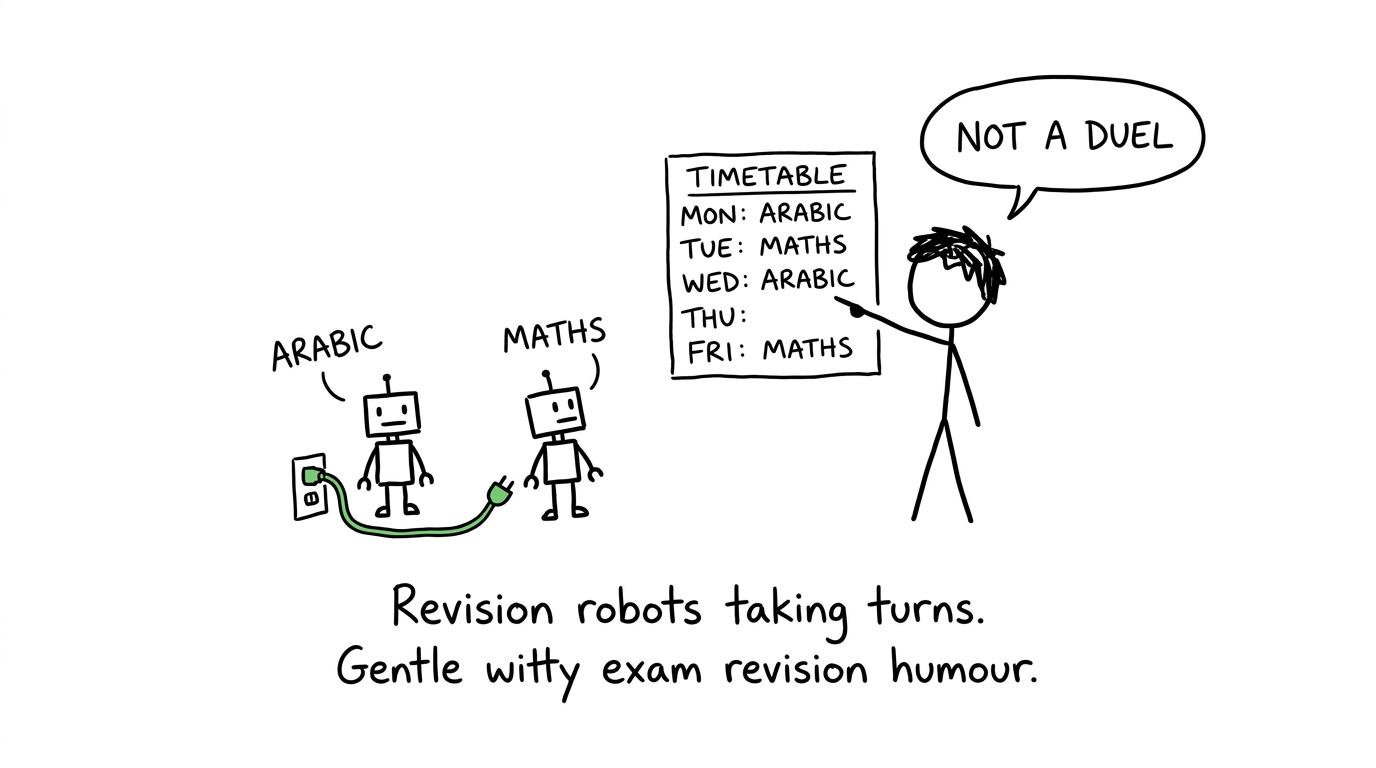 Two revision robots taking turns to recharge beside a timetable
Make the two subjects support each other
Arabic and maths appear different, but effective revision for both follows a similar cycle:
- retrieve knowledge without help;
- apply it to an unfamiliar task;
- check the result against reliable feedback;
- identify the exact cause of an error;
- revisit the skill after a gap.
In Arabic, the error might be an incorrect verb form or a missed detail in a recording. In maths, it might be choosing the wrong operation, misreading a scale or failing to show a method clearly. The subject changes. The feedback loop does not.
Build both into one revision planner rather than maintaining competing timetables. The GCSE revision timetable guide can help you create sessions that specify the task, resource and review stage instead of simply writing “Arabic” or “maths” in a box.
Common half-term revision mistakes
Trying to cover every Arabic theme
Breadth can become avoidance. Select the themes and language functions revealed by your diagnostic, while still giving all four skills some attention.
Treating fluent conversation as exam preparation
Being comfortable speaking Arabic can be a major strength, but GCSE assessment also requires accurate Modern Standard Arabic, appropriate responses and familiarity with the specified task formats. Practise what the assessment asks you to do.
Memorising scripts without practising interaction
A memorised paragraph may collapse when a question changes. Learn adaptable phrases, opinions and structures, then practise responding to varied prompts.
Counting hours instead of reviewing errors
A long session does not guarantee progress. End each task by writing what went wrong, why it happened and what you will do next.
Letting Arabic remove maths from the week
You do not need equal time for both subjects, but you do need continuity. Short maths retrieval sessions protect methods and make the return to school less abrupt.
Using predicted papers as predictions of certainty
Predicted papers can provide fresh exam-style practice, but they cannot tell you exactly what will appear. Use GCSE maths predicted papers after topic revision and alongside official past papers, not instead of them.
Continue after half-term without repeating the crunch
The most valuable outcome of February half-term is not a completed folder. It is a repeatable routine.
Keep two or three Arabic sessions in the school week: one receptive skill such as listening or reading, one productive skill such as speaking or writing, and one short retrieval session. Add regular maths topic practice and gradually introduce timed paper sections.
For maths, MathsGenie brings the cycle together: revision lessons explain methods, practice questions make you retrieve them, mini tests build speed, and past papers expose what still needs attention. Mark schemes and video solutions then turn lost marks into specific next actions. The guide to turning GCSE notes into active recall can help you carry the same habit into both subjects.
Finish half-term with direction, not exhaustion
A useful half-term does not have to feel heroic. Focus your Arabic revision on the weakest skills, practise all four assessment areas and leave yourself with a short error log that guides the next month. Meanwhile, keep maths alive through small, deliberate sessions matched to your board and tier.
When you are ready for the next maths block, open the MathsGenie GCSE hub. Choose a revision lesson, complete the practice questions and check your work carefully. Then progress to mini tests, past papers and predicted papers with their mark schemes and video solutions. Half-term is not your only chance to improve. It is the point where a calmer, more focused routine can begin.