How to Use OCR GCSE Physics Past Papers Properly
GCSE students: learn how to use OCR GCSE Physics past papers properly, avoid common traps, and turn mark schemes into a revision plan with YesGenie.
If you have ever opened an OCR paper, seen the first long question, and felt your confidence quietly leave the room, you are not alone. The weird part is that most GCSE students do plenty of past papers, yet they do not get much better. They get quicker at the bits they already know, and more anxious about the bits they do not. Using OCR GCSE Physics past papers properly is not about grinding through more pages. It is about extracting information: what OCR rewards, where you drop marks, and which maths skills you need to automate so the science can breathe.
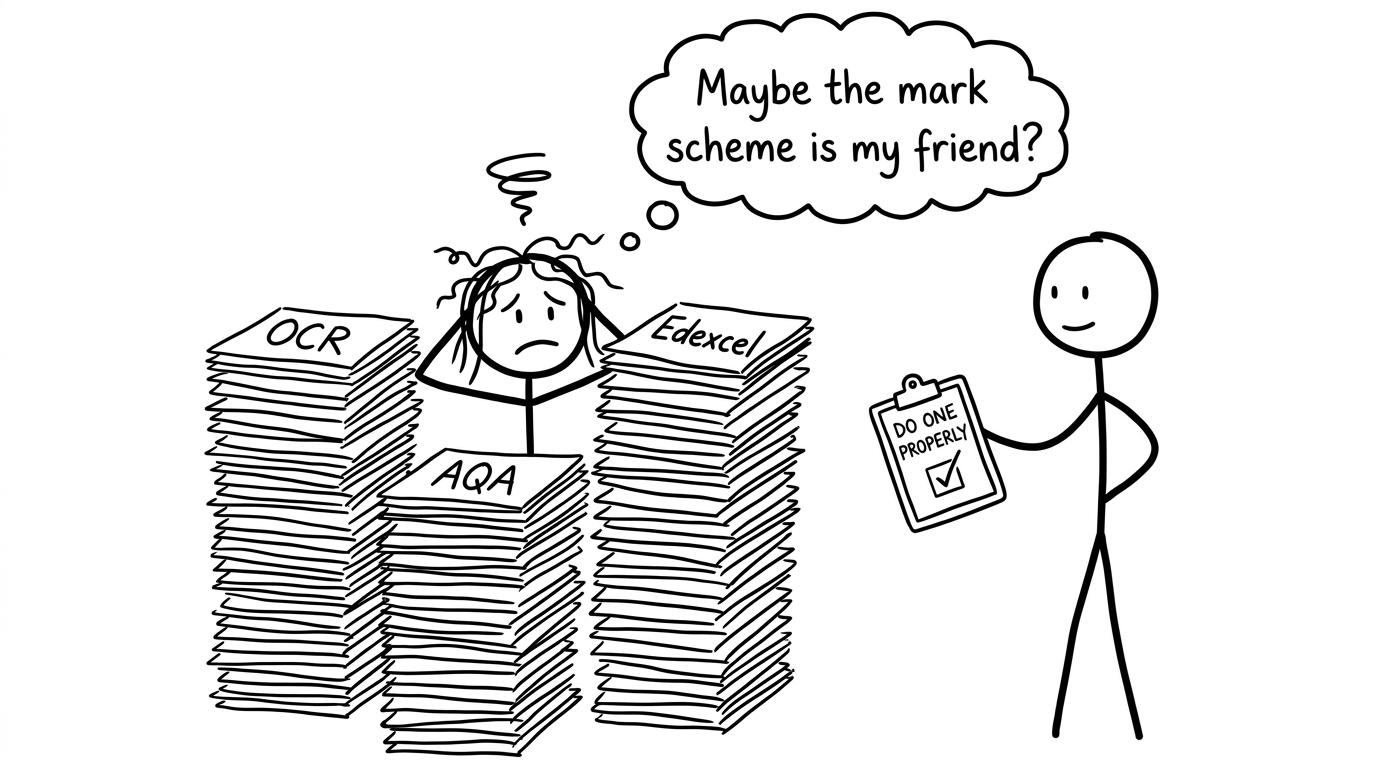 A stressed student with past paper stacks and a checklist
This matters even if you are here mainly for maths revision. GCSE Physics is quietly a maths paper with a lab coat: rearranging formulae, using standard form, gradients, areas under graphs, and percentages. When you use OCR GCSE Physics past papers properly, you are also training the same mathematical habits that lift grades across GCSE Maths and A Level Maths.
A quick checklist for using OCR past papers properly
Use this as your simple rule set before you start any OCR paper. It keeps the process calm, repeatable, and genuinely effective for GCSE revision.
- Sit the paper timed at least some of the time (even if it is just a 45-minute half-paper).
- Mark it with the mark scheme, but do not stop there: classify every lost mark.
- Build a “mistake log” with one line per error and one action per error.
- Convert weak areas into topic practice (maths skills included).
- Re-attempt only the questions you missed, then re-sit a fresh paper later.
If you want structured practice for the maths side of OCR science questions, YesGenie is designed for exactly that: revision lessons, practice questions, video solutions and mark schemes.
Useful starting points on YesGenie:
- GCSE Past papers
- GCSE Maths OCR hub
- Edexcel GCSE Maths Past Papers
- Edexcel GCSE Maths Mini Tests
- Edexcel GCSE Maths 45 Min Tests
- GCSE Maths Revision Guides (Edexcel)
- Other GCSE Resources
- Resources hub (predicted papers, mini tests)
Why OCR GCSE Physics past papers feel different
OCR questions often reward two things at once: accurate physics and tidy communication. That shows up as multi-step calculations with a written conclusion, or a graph question where the maths is straightforward but the explanation must be precise. Many GCSE students lose marks not because they cannot do the calculation, but because they do not show the step OCR expects, or they round too early, or they forget a unit.
When you use OCR GCSE Physics past papers properly, you stop treating the mark scheme as a verdict and start treating it as a blueprint. You are learning OCR’s “house style”: the words, the working, and the habits that score.
Do the paper like an experiment, not a performance
Most people sit a GCSE past paper as a performance: “Let me prove what I can do.” That mindset makes you rush, hide mistakes, and avoid the hard questions. Instead, treat it like an experiment: “Let me find out what breaks.” Experiments are allowed to fail. In fact, they are designed to.
A practical approach that works:
- First attempt: timed, exam conditions, no notes.
- Marking: honest, slow, and specific.
- Repair: targeted maths and physics practice.
- Second attempt: redo only the broken questions after a gap.
- Later: sit a different OCR paper timed to confirm the fix.
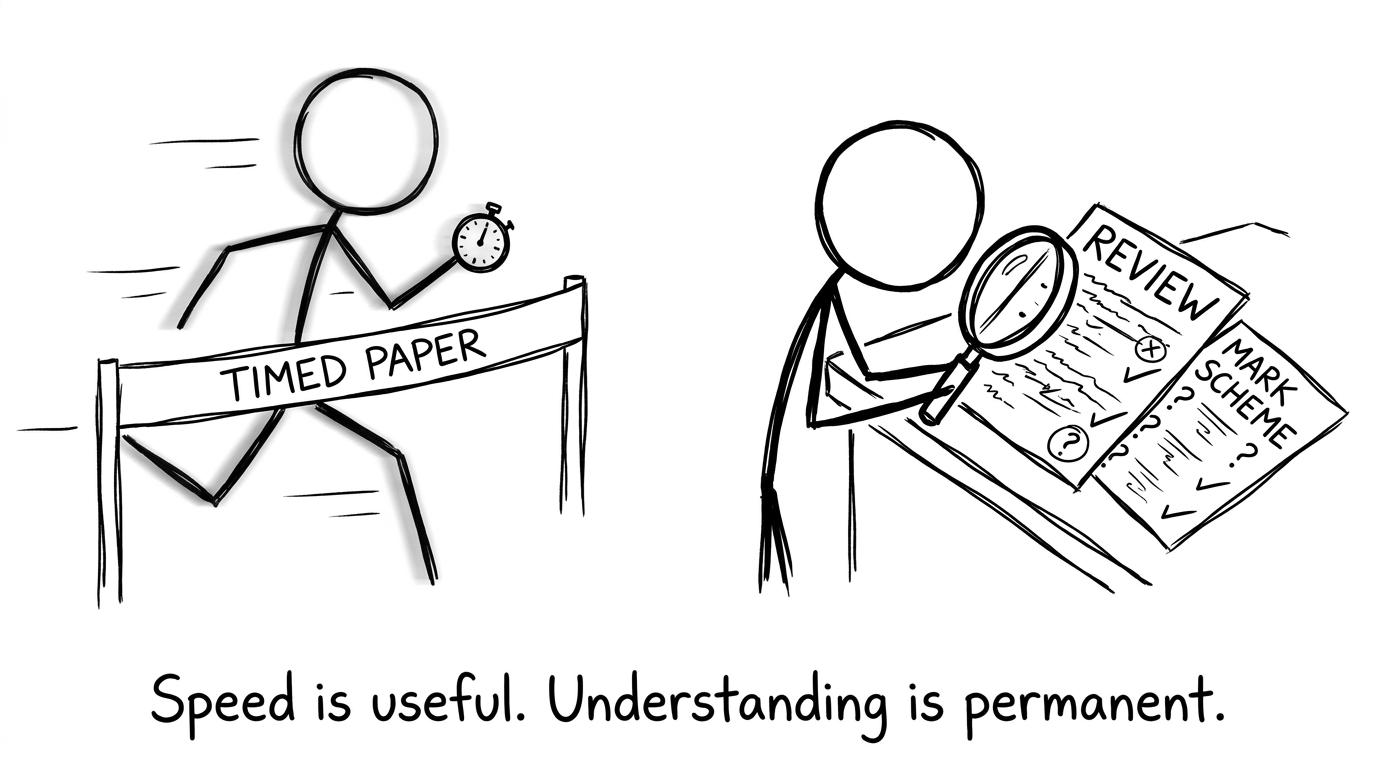 Timed sprint vs slow review detective
YesGenie’s structure helps here because it naturally breaks revision into “attempt, mark, repair”: you can move from papers to topic practice, then back to papers without losing momentum.
How to mark an OCR paper so it actually improves your GCSE grade
Marking is where most GCSE students accidentally waste the value of OCR GCSE Physics past papers. The trick is to mark in layers.
Layer 1: Score it, but do not obsess
Write your raw mark and the time taken. That is useful data, but it is not the goal. The goal is to know why the marks were lost.
Layer 2: Label every lost mark
Next to each missed question, add one label:
- Knowledge (you did not know the physics)
- Maths (you knew the idea but the calculation failed)
- Method (you used the wrong process)
- Careless (you could do it, but a slip happened)
- Exam technique (units, rounding, explanation, graph reading)
This one step turns a past paper into a revision plan.
Layer 3: Write the “one-sentence fix”
For each mistake, write one sentence that would have prevented it. Keep it small enough to repeat.
Examples:
- “Write the formula first, then rearrange, then substitute.”
- “Circle units, convert before calculating.”
- “Use 222 or 333 significant figures only at the end.”
Those sentences become your checklist for the next OCR paper.
The maths inside OCR GCSE Physics (and how to practise it)
If GCSE Physics is where your marks leak, the maths is often the hole. The good news is that maths skills are trainable quickly because methods repeat.
Below are three common OCR-style maths patterns, with worked examples you can use as a template. Then use YesGenie to practise the underlying skill until it becomes automatic.
Rearranging formulae (the quiet mark booster)
Suppose an OCR question uses the density relationship ρ=mV\rho = \frac{m}{V}ρ=Vm.
Example: A material has mass m=540 gm = 540\text{ g}m=540 g and density ρ=2.7 g/cm3\rho = 2.7\text{ g/cm}^3ρ=2.7 g/cm3. Find the volume VVV.
Start with:
ρ=mV \rho = \frac{m}{V} ρ=VmRearrange for VVV:
V=mρ V = \frac{m}{\rho} V=ρmSubstitute:
V=5402.7=200 V = \frac{540}{2.7} = 200 V=2.7540=200So V=200 cm3V = 200\text{ cm}^3V=200 cm3.
Where GCSE students lose marks is not the division, it is skipping the rearrangement step or mixing units (for example, using grams with kg/m3\text{kg/m}^3kg/m3). Build the habit: write the formula, rearrange, then substitute.
For the algebra side, practise rearranging and substitution skills using GCSE maths topic practice, then return to OCR papers: GCSE Maths OCR hub.
Standard form and powers of ten (especially for higher tier)
Example: Convert 0.0000470.0000470.000047 into standard form.
Move the decimal point 555 places to the right to get 4.74.74.7, so you need 10−510^{-5}10−5:
0.000047=4.7×10⁻⁵ 0.000047 = 4.7 \times 10^{-5} 0.000047=4.7×10⁻⁵If an OCR Physics question then asks you to calculate something like (4.7×10⁻⁵)÷(2.0×10⁻³)\left(4.7 \times 10^{-5}\right) \div \left(2.0 \times 10^{-3}\right)(4.7×10⁻⁵)÷(2.0×10⁻³), do it in two parts:
4.7×10−52.0×10−3=(4.72.0)×10−5−(−3)=2.35×10⁻² \frac{4.7 \times 10^{-5}}{2.0 \times 10^{-3}} = \left(\frac{4.7}{2.0}\right) \times 10^{-5-(-3)} = 2.35 \times 10^{-2} 2.0×10−34.7×10−5=(2.04.7)×10−5−(−3)=2.35×10⁻²That “index subtraction” step is where many GCSE answers collapse. Once you have this method, you can practise it quickly with targeted maths questions before returning to OCR past papers.
Graph maths: gradient and interpretation
OCR loves a graph where the physics story depends on a maths choice.
Example: A straight-line graph has points (2,5)(2, 5)(2,5) and (8,17)(8, 17)(8,17) (units omitted here). Find the gradient.
gradient=ΔyΔx=17−58−2=126=2 \text{gradient} = \frac{\Delta y}{\Delta x} = \frac{17 - 5}{8 - 2} = \frac{12}{6} = 2 gradient=ΔxΔy=8−217−5=612=2So the gradient is 222 (in the correct derived units for the graph).
The GCSE trap is choosing two points too close together, or reading from the drawn line instead of clear grid intersections. OCR mark schemes usually accept any correct method, but they love a clean gradient calculation with substituted values shown.
To strengthen graph skills that transfer into both GCSE Maths and OCR Physics, use topic practice and papers on YesGenie, then apply the same method again under time pressure.
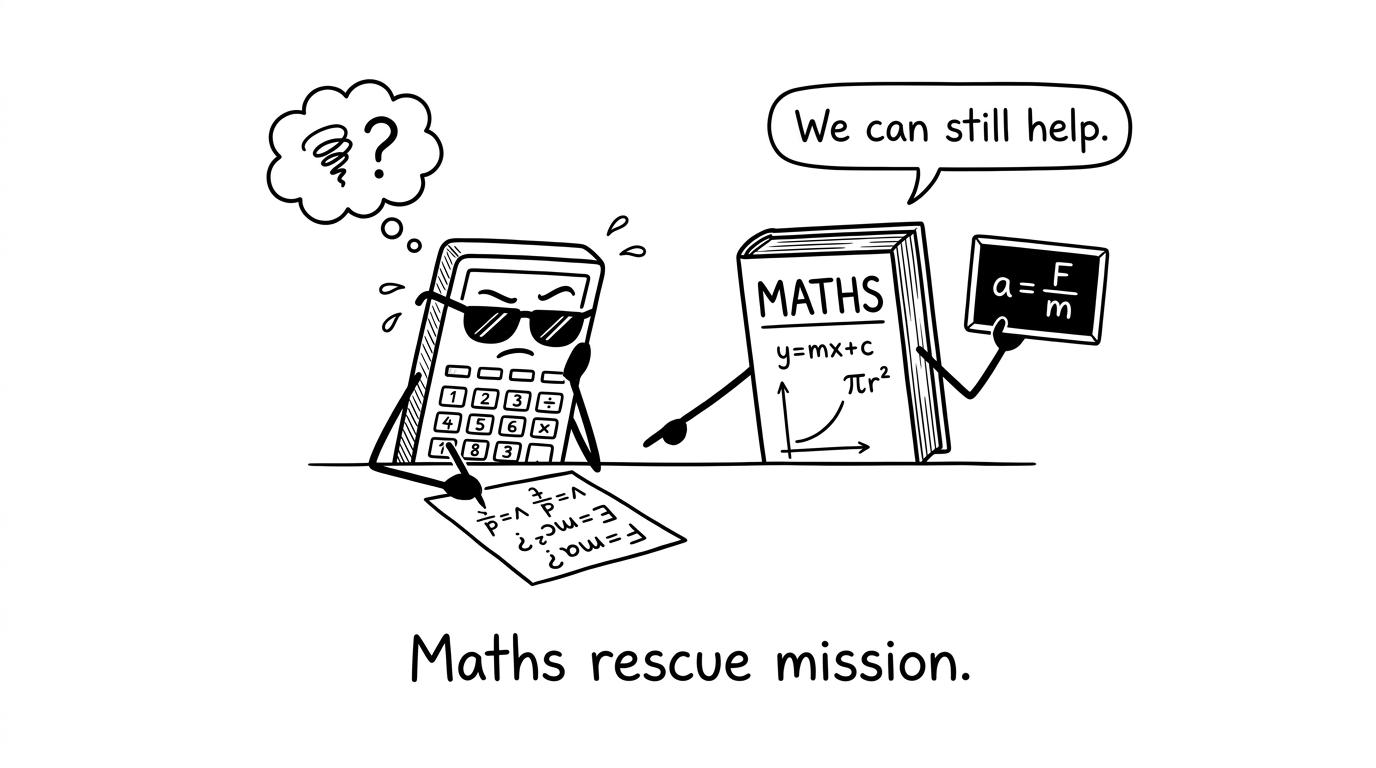 Calculator trying physics, maths book helps
How to turn one OCR paper into a week of GCSE revision
Using OCR GCSE Physics past papers properly means you do not just do the paper and move on. You squeeze it.
Day 1: Timed attempt
Sit the OCR paper in exam conditions. If you are not ready for full length, do a timed chunk and build up.
If you want shorter maths-focused exam practice alongside, YesGenie’s Edexcel GCSE Maths 45 Min Tests are a good way to practise timed technique without burning out.
Day 2: Deep marking and mistake log
Mark with the scheme and write your labels (Knowledge/Maths/Method/Careless/Exam technique). Then write the one-sentence fix.
Day 3-4: Targeted repair work
- If it is Maths, go to skills practice: algebra, standard form, graphs, percentages.
- If it is Method, redo similar questions until the steps feel obvious.
- If it is Exam technique, practise units, sig figs, and written conclusions.
For quick maths diagnostics and repeat practice, use Edexcel GCSE Maths Mini Tests and topic revision support from the Resources hub.
Day 5: Re-attempt only the broken questions
Redo just the questions you got wrong, without the mark scheme open. Your goal is not memory, it is correct method.
Day 6-7: Fresh paper to confirm
Sit a different OCR paper or a different year. Improvement only counts if it transfers.
Common mistakes when using OCR GCSE Physics past papers
- Doing papers open-book too early. This feels productive but it hides recall problems. Save open-book for the repair stage.
- Marking without analysis. A score alone does not tell you what to revise. Always label the type of lost mark.
- Rounding too early. Keep full calculator accuracy, then round at the end. If you round mid-way, errors compound.
- Dropping units. OCR often awards method marks but still expects correct units in the final answer.
- Ignoring command words. “Describe”, “explain”, “evaluate” and “calculate” demand different outputs, and OCR mark schemes reflect that.
- Not practising the maths separately. If your mistake label says “Maths” repeatedly, you need GCSE maths topic practice, not more physics papers.
Closing: make your GCSE past papers pay you back
There is a quiet confidence that arrives when you stop chasing papers and start extracting lessons from them. That is what it means to use OCR GCSE Physics past papers properly: timed attempts, honest marking, clear labels, and targeted repair. Do that consistently and your GCSE progress becomes less emotional and more predictable.
If the maths inside physics is holding you back, make YesGenie your home base. Use revision lessons to relearn methods, practise with topic questions, then return to past papers with mark schemes and video solutions. Start with the GCSE Past papers area, build your skills through the GCSE Maths OCR hub, and use the Resources hub for mini tests and targeted practice. Your next OCR paper should not just be another attempt; it should be a step forward in your GCSE grade.