GCSE: Revise OCR Biology Without Wasting Time
GCSE OCR Biology revision without wasted time: build a smart plan, use mark schemes, practise exam maths, and keep momentum with YesGenie resources.
You sit down to revise, open your OCR GCSE Biology book, and suddenly an hour disappears into colouring in diagrams, rewriting notes, and feeling… busy. Not better. If that sounds familiar, the fix isn’t more effort; it’s better feedback. GCSE success comes from doing the kinds of tasks that return marks, quickly, and then repeating the ones that don’t until they do.
This is a Biology post, but it’s written for maths students too, because your best advantage in OCR Biology is often mathematical: turning messy data, graphs, and calculations into calm method marks. And that’s exactly what efficient GCSE revision looks like: not perfect notes, but predictable results.
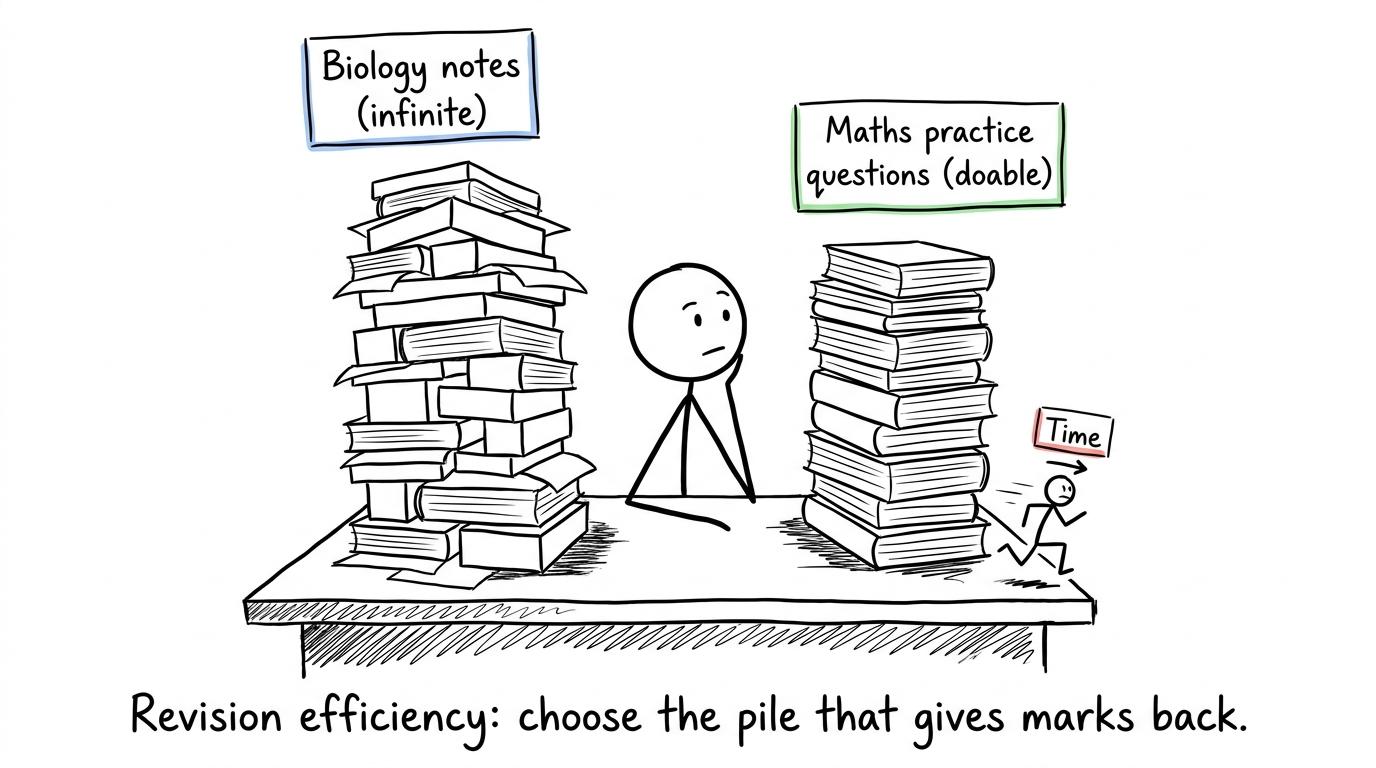 A student choosing between endless notes and practice questions
A quick checklist for time-efficient OCR GCSE Biology revision
Keep this as your default routine for OCR GCSE Biology revision:
- Start from the specification and exam style, not the textbook order.
- Do past-paper questions early, even before you “feel ready”.
- Mark with the mark scheme and write one-line “fixes” for each mistake.
- Prioritise maths-in-Biology (percentages, rates, graphs, units) because it’s repeatable.
- Use short timed blocks: 202020 to 303030 minutes questions, 101010 minutes marking, 555 minutes corrections.
- Cycle topics: revisit weak areas every 333 to 555 days.
When you want to tighten your general GCSE routine (especially for maths), build the same habits using YesGenie’s core pages: GCSE Maths Revision, GCSE Past papers, and Resources.
Why OCR GCSE Biology revision often wastes time
Most wasted time comes from confusing exposure with retrieval. Reading, highlighting, and rewriting notes feels productive because you’re looking at the right words. But OCR GCSE Biology exams reward whether you can produce those words (and the linked reasoning) under time pressure.
A good rule: if you can’t score it with a mark scheme, it probably shouldn’t be the main event in your revision.
That’s why the best GCSE strategy is:
- Question first (to expose gaps)
- Mark scheme second (to learn what “good” looks like)
- Targeted review third (to patch only what’s broken)
It’s the same logic that makes maths revision efficient: you wouldn’t “revise algebra” by rewriting formulas for an hour. You’d do questions, check steps, then do more questions. YesGenie is built around that loop via topic practice and solutions, such as the Edexcel GCSE Maths Revision Guides and the wider Resources.
Build an OCR GCSE Biology plan that behaves like maths revision
Maths students usually revise best when the plan is measurable: you either got the answer or you didn’t. You can make OCR GCSE Biology behave similarly.
Step one: sort your topics by marks, not by comfort
Create three columns:
- Green (secure): you can answer exam questions and hit mark-scheme wording most of the time.
- Amber (wobbly): you recognise the topic, but drop marks on explanations or required steps.
- Red (leaks marks): you avoid it, or you don’t know what OCR expects.
Then set your weekly pattern:
- 222 red topics
- 222 amber topics
- 111 mixed past-paper session
This stops you spending 80%80\%80% of your time polishing topics you already “like”. That’s the most common GCSE trap.
Step two: make every session end in feedback
A session that doesn’t end in marking is like doing a set of algebra questions and refusing to check the answers. In Biology, the mark scheme is your answer key.
Use the same discipline you’d use on YesGenie when you watch a method and then replicate it. For maths, that’s baked into Edexcel GCSE Maths Predicted Papers and Edexcel GCSE Maths Mini Tests.
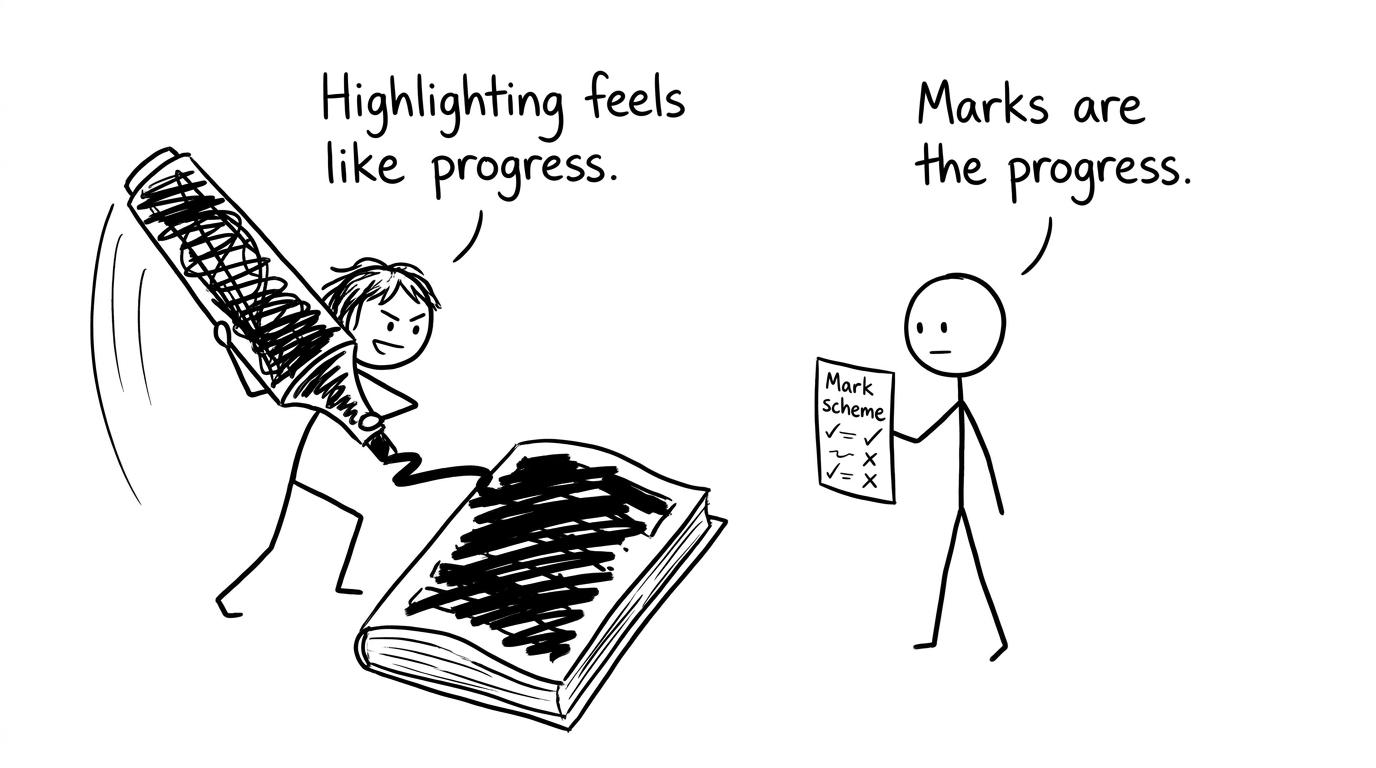 Highlighting versus mark schemes
The highest-return area: OCR Biology calculations (a worked method)
OCR GCSE Biology includes calculations that are genuinely learnable. You don’t need “talent”; you need a repeatable method and unit awareness.
Worked example: percentage change in a practical
A student measures heart rate.
- Before exercise: 727272 beats per minute
- After exercise: 909090 beats per minute
Find the percentage increase.
Method
Percentage change is:
percentage change=new−originaloriginal×100 \text{percentage change} = \frac{\text{new} - \text{original}}{\text{original}} \times 100 percentage change=originalnew−original×100Substitute:
90−7272×100=1872×100=0.25×100=25 \frac{90 - 72}{72} \times 100 = \frac{18}{72} \times 100 = 0.25 \times 100 = 25 7290−72×100=7218×100=0.25×100=25So the heart rate increased by 25%25\%25%.
Why this saves time in GCSE revision
Because once you know this structure, you can score marks on any similar OCR Biology question quickly. It’s the same reason practising percentage change in maths pays off across many topics. If you need that maths foundation, use YesGenie’s topic practice (for example, the OCR-style maths pages such as Best Buy Questions (OCR) build the same unit-rate thinking).
Worked example: rate calculation
A seedling grows from 4.2 cm4.2\text{ cm}4.2 cm to 7.8 cm7.8\text{ cm}7.8 cm in 666 days. Find the mean growth rate.
mean rate=changetime=7.8−4.26=3.66=0.6 \text{mean rate} = \frac{\text{change}}{\text{time}} = \frac{7.8 - 4.2}{6} = \frac{3.6}{6} = 0.6 mean rate=timechange=67.8−4.2=63.6=0.6Mean growth rate =0.6 cm per day= 0.6\text{ cm per day}=0.6 cm per day.
Notice how “show your working” is not decoration: it’s how you bank method marks.
How to use past papers without burning through them
Students often treat past papers like a one-off event: you “sit” a paper, feel bad, then avoid them for a week. Efficient GCSE revision uses papers as a training set.
A smarter loop for OCR GCSE Biology
- Choose one topic area (say, cells, infection, or homeostasis).
- Do 666 to 101010 questions from mixed sources.
- Mark immediately.
- Write a one-sentence correction per question.
- Re-do the same style of question 484848 hours later.
For maths, that loop is exactly what YesGenie’s ecosystem supports: GCSE Past papers, timed practice through Edexcel GCSE Maths Past Papers, and shorter rebuild sessions via Edexcel GCSE Maths Mini Tests.
Even if your main goal is OCR Biology, maintaining your maths grade with this kind of paper-loop removes pressure everywhere else in your GCSE timetable.
Turn OCR Biology extended responses into a mark-scheme game
A big time sink in OCR GCSE Biology is writing long answers that don’t land. The fix is to stop aiming for “a good explanation” and start aiming for markable points.
The 333-part structure
When a question asks you to “explain”, aim for:
- Point: a clear scientific statement
- Because: the mechanism (cause)
- Therefore: the consequence (effect)
Example prompt: “Explain why diffusion is faster at higher temperature.”
You want something like:
- Particle kinetic energy is higher.
- Particles move faster and collide more.
- Therefore particles spread out more quickly, increasing the rate of diffusion.
You can practise this structure quickly: 555 minutes planning, 555 minutes writing, 555 minutes marking. That’s how you make GCSE Biology feel less like creative writing and more like predictable marks.
Common mistakes that waste time (and marks)
These are the biggest “looks like revision” traps for OCR GCSE Biology, plus the maths-style fix.
- Rewriting notes instead of testing: swap 303030 minutes rewriting for 151515 minutes questions + 151515 minutes marking.
- Ignoring command words (“describe”, “explain”, “evaluate”): write answers to match what OCR is asking, not what you know.
- Not stating units: if the question involves cm\text{cm}cm, s\text{s}s, g\text{g}g, or dm3\text{dm}^3dm3, units are often the simplest mark.
- Rounding too early: keep calculator accuracy, round at the end.
- Graph errors: missing labels, uneven scale, or using a bar chart when a line graph is needed.
- Learning definitions without examples: OCR often tests application; attach each definition to a quick scenario.
If you want a reminder that this is the same mindset as top-end maths marks, look at how structured solutions work on YesGenie, for example Proof (Grade 8-9): marks come from visible steps, not vibes.
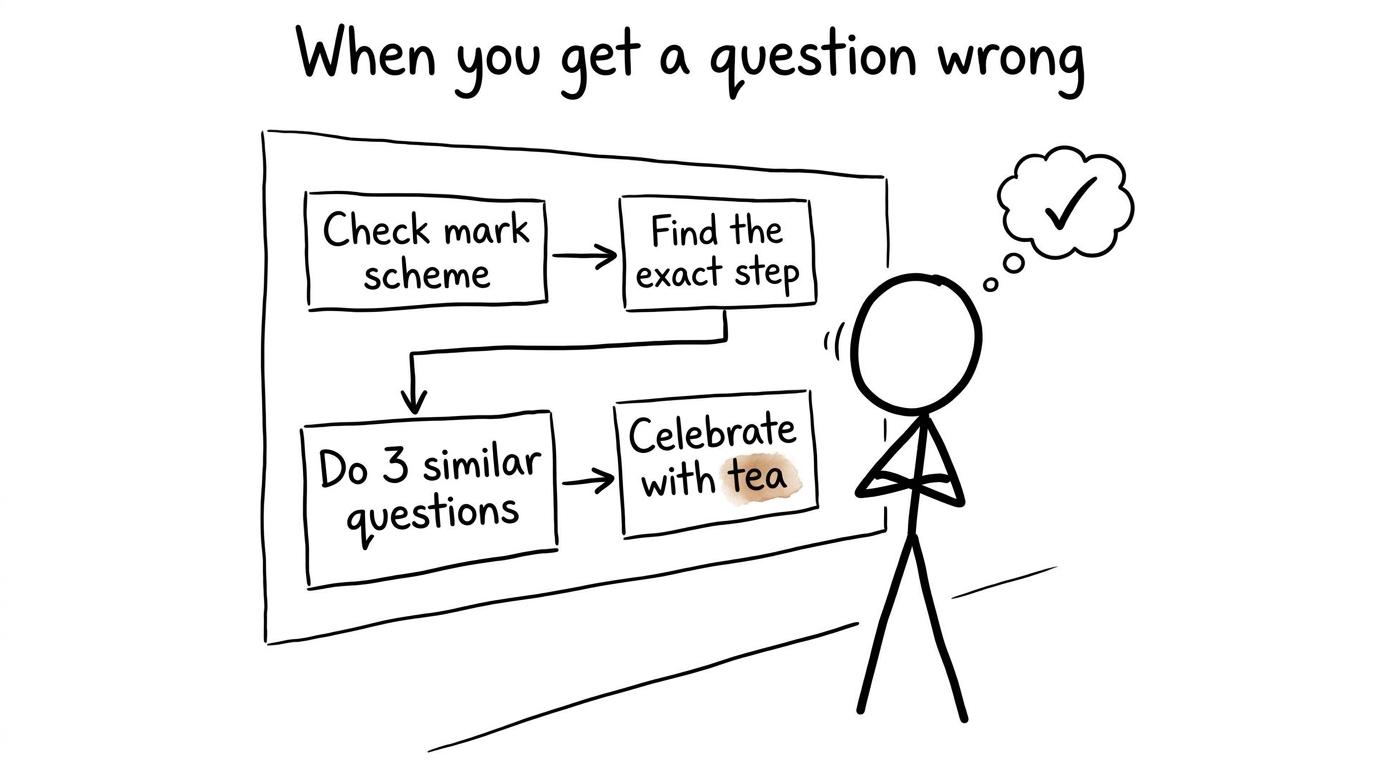 Flowchart for fixing mistakes
Bringing it together: revise OCR GCSE Biology like you revise GCSE maths
If you take one idea from this: stop revising OCR GCSE Biology in ways that can’t be marked. The fastest route to GCSE improvement is a rhythm of questions, mark schemes, and tiny corrections that compound.
YesGenie exists for exactly that style of progress. Keep your maths strong with GCSE Maths Revision, build confidence through GCSE Past papers, sharpen timing with Edexcel GCSE Maths Mini Tests, and focus your final stretch using Resources and predicted papers.
If you revise OCR Biology with that same GCSE mindset: measurable practice, honest marking, and focused repetition; you won’t just feel busy. You’ll feel ready.