GCSE Arabic Easter Holiday Revision: A Balanced Plan
GCSE Arabic Easter holiday revision: build a balanced plan for every language skill while protecting your rest and essential GCSE maths practice.
Easter can make revision feel strangely urgent. The exams are close enough to be real, yet the holiday is also one of your last chances to rest properly before the summer series. Open too many books and the break disappears. Avoid them completely and the return to school feels uncomfortable.
Effective GCSE Arabic Easter holiday revision sits between those extremes. Aim for short, regular sessions covering listening, speaking, reading and writing, while reserving separate time for maths and your other GCSE subjects. You do not need to revise Arabic all day. You need a plan that identifies weak skills, creates active practice and leaves enough space for ordinary life.
The goal is not to finish Easter exhausted. It is to return to school knowing what has improved and what still needs attention.
Your Easter revision checklist
A productive plan should include:
- your confirmed exam board, specification and tier
- one honest assessment of your four Arabic skills
- short sessions distributed across the holiday
- active recall rather than repeated rereading
- timed practice using appropriate exam materials
- an error log for vocabulary, grammar and exam technique
- protected sessions for GCSE maths and other subjects
- several genuine rest periods
- a lighter final day before school resumes
If maths is competing for attention, use the GCSE maths revision hub to choose your board and turn a vague intention to revise into a precise list of tasks.
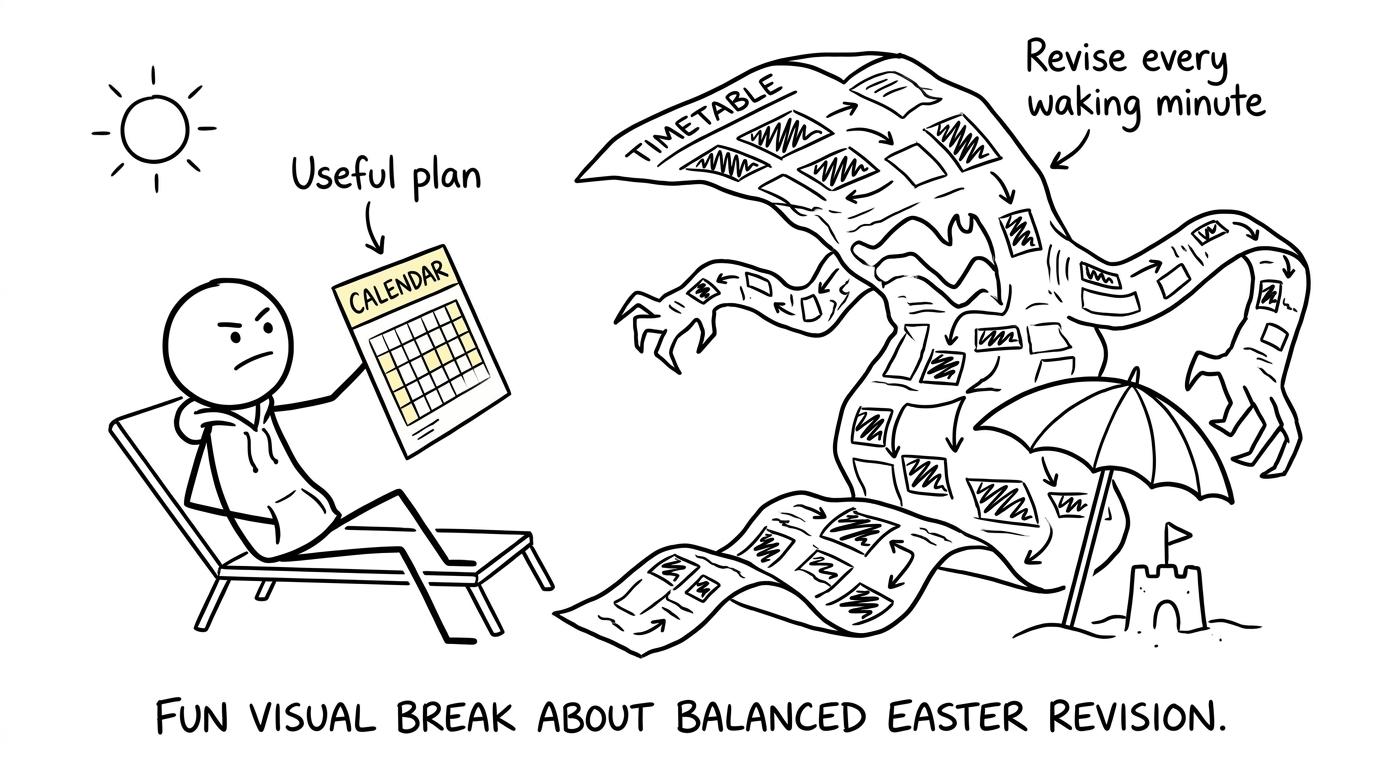 A student protects a peaceful holiday from an enormous revision timetable
Start with the GCSE Arabic assessment structure
A revision plan works better when it reflects the qualification you will actually sit. Pearson Edexcel GCSE Arabic is assessed through four skills: listening, speaking, reading and writing. Each contributes 25%25\%25% of the qualification. Students take Foundation or Higher tier across the qualification rather than choosing a different tier for each paper.
The speaking assessment is conducted by the school within the examination board's prescribed period, so it may deserve particular attention around Easter. Ask your teacher for your exact speaking date rather than relying on a general online timetable.
The assessment includes:
- Listening: understanding spoken Arabic in public and social contexts
- Speaking: a role play, a picture-based task and a conversation
- Reading: understanding different texts and translating from Arabic into English
- Writing: communicating for different purposes and translating into Arabic
Dictionaries are not permitted in the Edexcel GCSE Arabic assessments, including the preparation time for speaking. That makes retrieval important. Recognising a word when your notes are open is not the same as recalling it independently in an examination.
Confirm these details against the specification supplied by your school. Do not accidentally revise for International GCSE Arabic or assume another language qualification has an identical format.
Build the plan around weaknesses, not equal time
Four skills carry equal weighting, but that does not mean they require equal revision time from you. If reading is secure while speaking stalls whenever the question changes, dividing every hour evenly would preserve the imbalance.
Before creating a timetable, rate each skill using recent evidence:
| Skill | Evidence to check | Useful next action |
|---|---|---|
| Listening | Questions missed in recent audio tasks | Practise identifying key details and distractors |
| Speaking | Hesitation, short answers or unclear pronunciation | Record responses and improve one weakness |
| Reading | Unknown vocabulary or misunderstood instructions | Complete a short text without a dictionary |
| Writing | Grammar errors, limited detail or missed bullet points | Plan and write one focused response |
Label each area secure, developing or priority. Give priority skills more sessions, but keep brief contact with the secure ones so they do not fade.
Use the same evidence-led approach for maths. A short timed set can reveal more than an evening spent revising comfortable topics. The GCSE revision guide to finding weak topics explains how to turn mistakes into specific next actions.
Use a two-week rhythm that leaves room to breathe
A balanced Easter timetable needs boundaries. Decide when revision begins, when it ends and which days contain no formal work. A blank space in the timetable is not a failure of planning. It is part of the plan.
For many students, one Arabic block of roughly 303030 to 454545 minutes on selected days is more sustainable than an occasional marathon. Add a separate maths block rather than mixing both subjects inside the same session.
Early holiday: diagnose and rebuild
Use the first part of Easter to identify gaps and rebuild the foundations behind them.
A possible rhythm is:
- Session A: listening practice followed by careful checking
- Session B: vocabulary retrieval and a short speaking recording
- Session C: reading practice with attention to question instructions
- Session D: grammar review followed by a short writing task
- Session E: speaking practice under controlled preparation time
Do not merely complete each activity and move on. Write down the exact problem. “Speaking is bad” is too broad. “I cannot extend an answer into the past tense” gives you something useful to practise.
Research on learning broadly supports distributing practice across multiple sessions and retrieving information from memory instead of only rereading it. For Arabic, that means closing the vocabulary list, recalling what you can, checking the answers and returning to difficult words after a gap.
Later holiday: combine skills under pressure
In the second part of the break, move towards exam conditions. Use unseen reading material, timed writing, uninterrupted listening and speaking questions that are not rehearsed word for word.
Keep the workload controlled. One demanding task followed by detailed correction is usually more valuable than several rushed tasks. Your correction should answer:
- What did I misunderstand?
- Was the problem vocabulary, grammar or technique?
- What would a stronger response include?
- When will I test this again without support?
The same pattern is effective in mathematics: attempt, mark, repair and retest. MathsGenie's guide to using GCSE past papers properly can help you make paper practice diagnostic rather than mechanical.
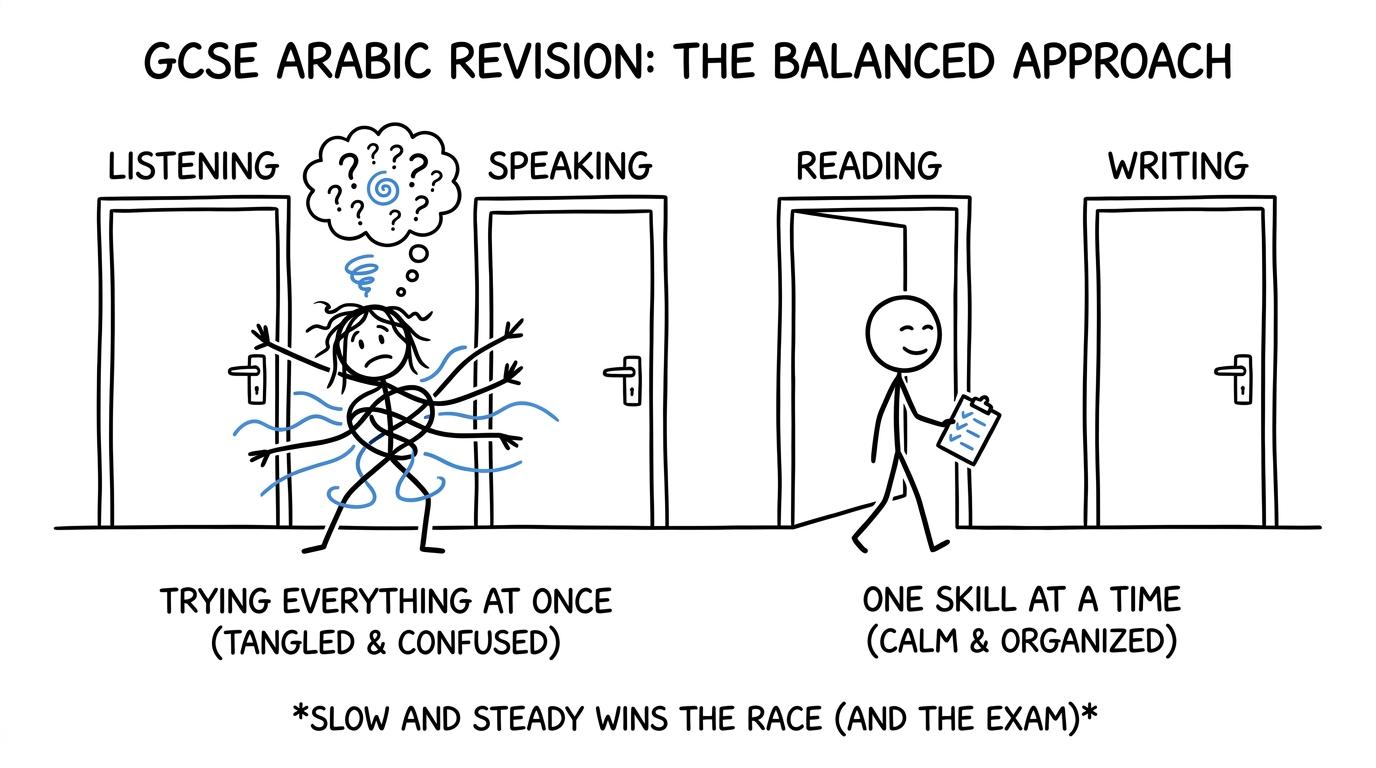 A student visits the four GCSE Arabic skill doors one at a time
Make every Arabic session active
The difference between busy revision and useful revision is often what your brain has to do.
Listening
Listen once without pausing and answer the questions under realistic conditions. On a second listen, note where the meaning became unclear. Then check any available transcript or teacher-provided answers.
Focus on the language that changed your interpretation: negatives, time references, opinions, quantities and contrasting statements. Avoid trying to translate every word while the recording continues.
Speaking
Practise responding aloud rather than silently planning good answers. Record yourself and check whether you answer the question directly, develop ideas and use understandable pronunciation.
Avoid memorising one long script as your entire strategy. A changed prompt can make a fixed script difficult to adapt. Instead, build flexible sentence patterns, accurate time frames and topic vocabulary. Your teacher can give the most reliable feedback on pronunciation and suitability.
Reading
Read the question before searching the text for evidence. Pay attention to whether the response must be in English or Arabic. Translation practice should preserve meaning rather than imitate Arabic word order mechanically.
Keep a small vocabulary list drawn from actual mistakes. A list of 151515 repeatedly missed words is more useful than copying 150150150 familiar ones.
Writing
Plan around every bullet point before beginning. Leave enough time to check agreements, verb forms, spelling and whether you have communicated the intended message.
Complete some writing without a dictionary because that reflects the Edexcel assessment conditions. Afterwards, use feedback to improve the response rather than simply starting another one.
Balance Arabic with GCSE maths
Arabic may need concentrated language practice, but maths needs continued contact too. Skills can feel secure during a lesson and less accessible after a long gap. Easter is therefore a good time for maintenance as well as repair.
Separate your subjects clearly. For example, complete Arabic in the morning and maths later in the day, with a proper break between them. A maths session might contain:
- a short revision lesson on one weak topic
- several practice questions
- immediate checking with solutions or a mark scheme
- one recorded correction
- a later retest
Choose resources matching your board and tier. MathsGenie provides dedicated hubs for AQA GCSE Maths revision, OCR GCSE Maths revision and Eduqas GCSE Maths revision, alongside Edexcel resources.
If a full paper feels too large for the holiday, use Edexcel GCSE Maths mini tests for shorter timed practice. Save an Edexcel GCSE Maths predicted paper for a controlled rehearsal once you have repaired the main topic gaps.
Protect concentration and rest
A timetable becomes unrealistic when it assumes every day will be equally productive. Family plans change. Religious commitments, travel, celebrations and tiredness are real. Build spare sessions into the plan so one disrupted afternoon does not create panic.
During a revision block, remove avoidable interruptions. Put your phone somewhere inconvenient, open only the materials needed and define the finish line before starting. “Practise two speaking prompts and review the recording” is better than “do Arabic”.
Then stop when the planned work is complete. Rest should not feel like revision you have failed to do.
 A phone takes a dramatic holiday during a short focused revision session
Common mistakes in Easter revision
Planning every hour
A crowded timetable looks committed but leaves no capacity for delays or tiredness. Plan repeatable blocks and preserve unscheduled time.
Revising only comfortable skills
Vocabulary copying and familiar reading passages can feel reassuring. Let marked work decide what needs attention, especially if speaking or listening is being avoided.
Treating recognition as recall
Seeing an Arabic word and thinking “I knew that” is not retrieval. Close the resource and produce the meaning, spelling or phrase independently.
Memorising answers without flexibility
Prepared language can provide useful building blocks, but answers must respond to the actual task. Practise adapting tense, detail and opinion when a prompt changes.
Completing work without checking it
Unmarked practice can reinforce the same error. Use teacher feedback, approved answers and mark schemes, then redo the difficult part after a gap.
Letting one subject consume the break
GCSE Arabic matters, but so do maths and your remaining subjects. Allocate time according to evidence, deadlines and assessment dates rather than whichever subject currently feels most worrying.
Finish Easter with a smaller, clearer list
Good holiday revision does not remove every weakness. It turns a large, anxious problem into a manageable set of next steps.
By the end of Easter, aim to know which Arabic skill needs the most attention, which vocabulary and grammar errors recur, and what you will ask your teacher when school resumes. Keep the final day light: review the error log, organise materials and prepare for the school routine.
For maths, let MathsGenie remove the friction of deciding what to do next. Start with the free revision lessons, move into practice questions and mini tests, and then use past papers, predicted papers, mark schemes and video solutions to check whether the learning holds under pressure. A balanced plan is not the one that fills the most hours. It is the one you can follow, learn from and finish without losing the entire holiday.