

Is GCSE Maths Harder Than Science? Honest Revision Guide
GCSE maths vs science: which is harder, and why? Learn what examiners reward, common traps, and how to revise smarter with Maths Genie.
The question every tired student asks
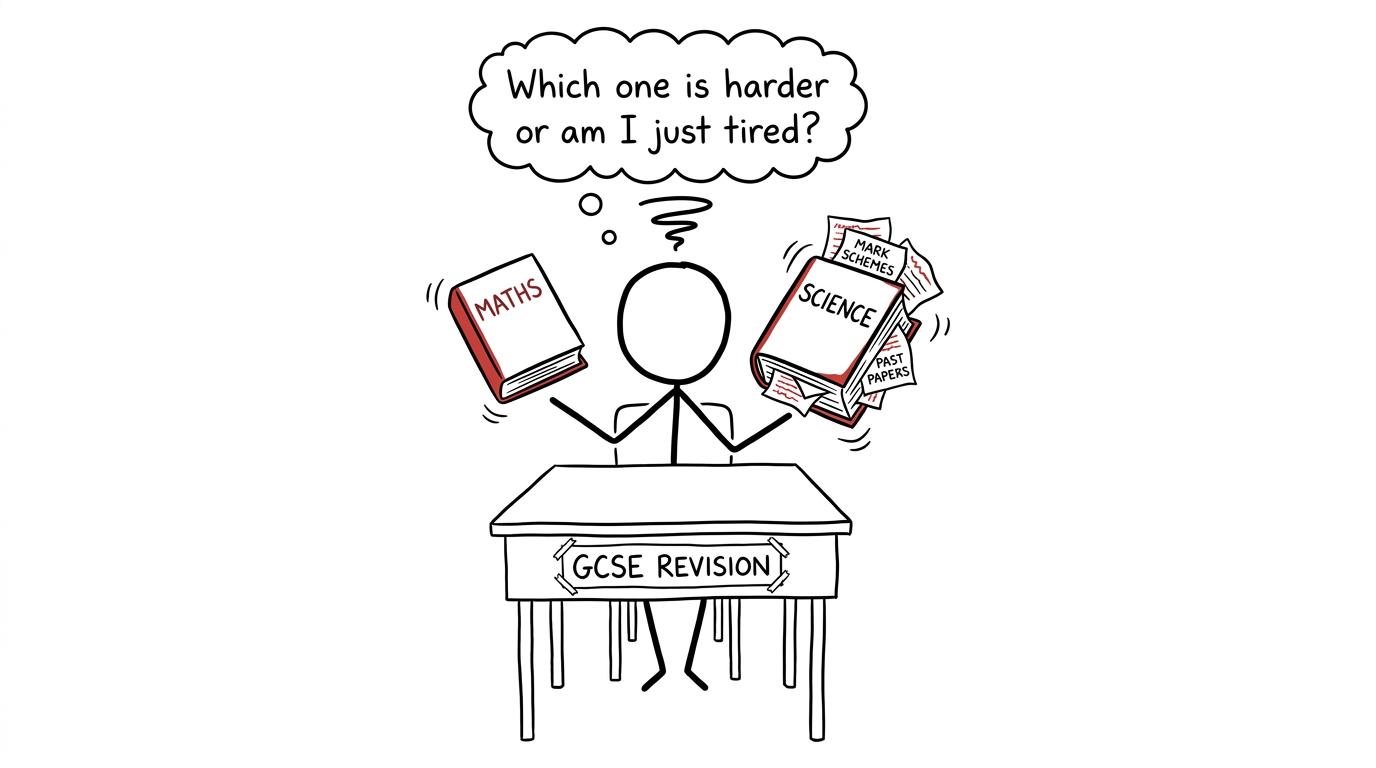
Somewhere between your second mock paper and your third late-night “I’ll just do one more topic” promise, you end up asking the same thing: is GCSE maths harder than science? It’s a fair question, because GCSE pressure doesn’t feel evenly spread. Maths can feel brutally precise. Science can feel like a memory marathon with practical skills thrown in. And when you’re chasing grades 999 to 111 (or just trying to secure a pass), it’s natural to want to know which subject is the bigger hill.
The truth is quieter than the argument. GCSE maths and GCSE science are hard in different ways but and the one that feels harder is usually the one you’re revising less effectively.
 Student juggling maths and science revision
Quick answer checklist
If you want the quick version before we go deeper, use this:
- Maths feels harder if you struggle to choose methods under pressure, or you lose marks for tiny errors.
- Science feels harder if you find it tough to remember definitions, required practicals, or explain ideas clearly.
- Higher tier maths often feels harder because questions are less familiar and more about linking topics.
- Science papers often feel harder because you must combine knowledge + maths + extended writing.
- The most important difference: maths skills compound. Fix one gap and lots of topics improve.
For focused maths revision that actually builds that compounding effect, use Maths Genie’s topic lessons + exam questions + mark schemes and keep your practice exam-style.
Helpful starting points:
- GCSE Maths Predicted Papers (Edexcel)
- AQA GCSE Maths Past Papers (GCSE Maths page)
- GCSE Revision Resources
What “hard” really means in GCSE
When students say a GCSE is “hard”, they usually mean one of three things:
It’s hard to start
Science can feel like this because you face a blank page and think, “What do I even write?” Maths can feel like this when you don’t recognise the topic.
It’s hard to finish accurately
Maths often lives here. You can know the method and still drop marks through arithmetic, algebra slips, or not showing enough working for the mark scheme.
It’s hard to revise efficiently
Science revision can feel endless because there’s always another page of content. Maths revision can feel endless if you jump around without fixing weak foundations.
So the better question becomes: which one is hard for you, and why? That’s the lever you can pull.
GCSE maths vs science: the real differences
GCSE maths is “method marks in disguise”
In GCSE maths (Edexcel, AQA, OCR, Eduqas), the mark scheme rewards method, not vibes. If you can set up the correct approach, you can often earn marks even when the final number is wrong.
That’s why practising from exam-style questions matters. It trains you to spot structure: “This is ratio”, “This is a quadratic”, “This is a probability tree”, and so on.
Maths Genie makes this simple because each topic has a lesson and then exam questions with solutions. For example:
GCSE science is “explain it like an examiner”
In science, you often know the idea but lose marks because your explanation is incomplete, your keywords are missing, or you’ve not linked cause and effect.
Also, science includes maths. That means weak maths can make GCSE science feel harder than it needs to be: rearranging formulae, drawing graphs, using standard form, calculating density, and handling units.
So sometimes the “science is harder” feeling is actually “my maths is wobbling under scientific language”.
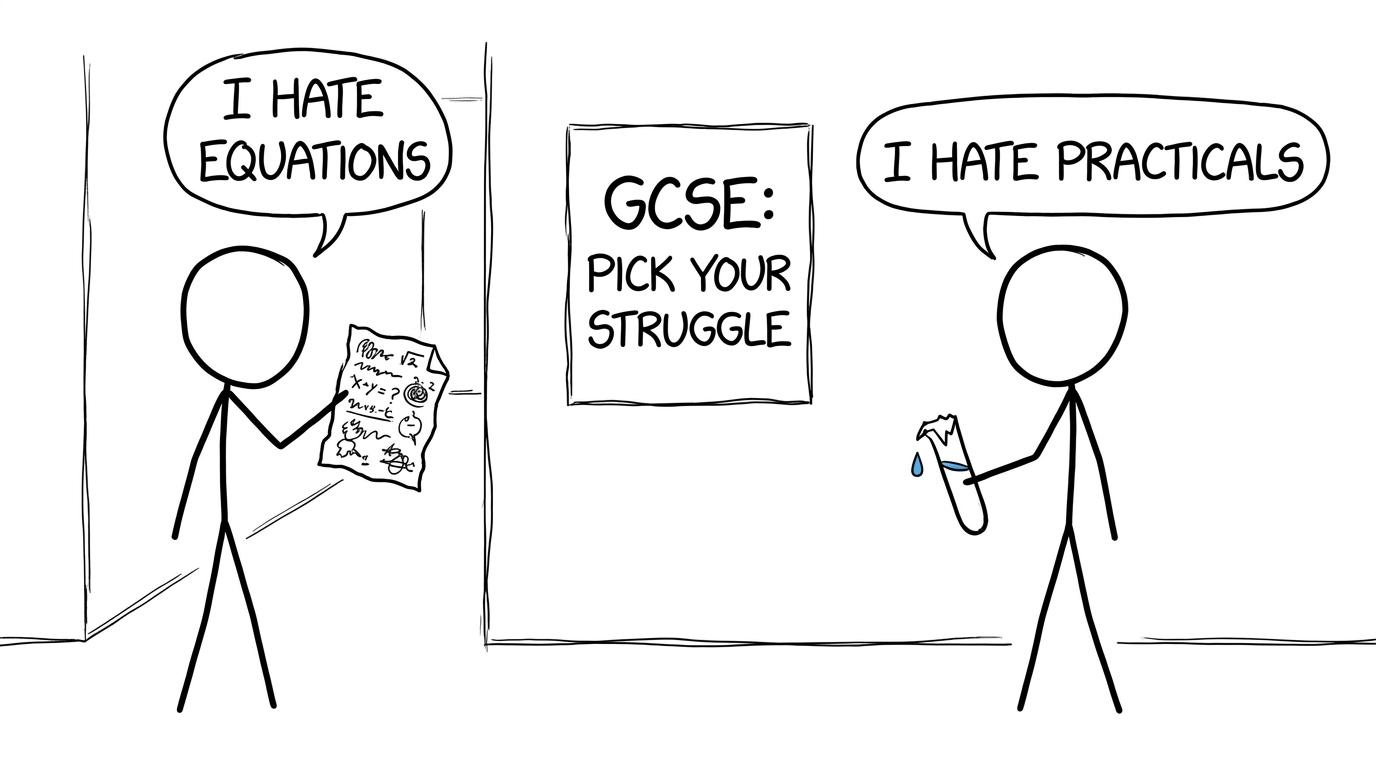 Two students comparing struggles: equations vs practicals
Why GCSE maths can feel harder (and what to do)
You can’t revise maths by reading
Reading solutions is comforting. It also lies to you.
You only discover what you know in GCSE maths when you try a question cold, make a mistake, and then fix it. That’s the whole game.
A good rhythm is:
- Learn the method (short lesson)
- Do exam-style questions
- Check the mark scheme
- Repeat the same skill tomorrow
If you like smaller chunks, use:
Maths punishes small errors, but you can build “error-proofing”
In science, if you misspell a word you might still get the mark. In maths, 777 is not “basically 888”.
That’s why you should train a habit: always check.
For example, after solving an equation, substitute back in. After a percentage change, sanity-check whether the answer is bigger or smaller.
Worked example: the kind of maths that boosts both GCSE maths and science
A lot of GCSE science calculation questions reduce to three maths skills: rearranging, substituting, and unit awareness.
Example 1: Rearranging a formula
A common science formula is density:
ρ=mV \rho = \frac{m}{V} ρ=VmSuppose a question gives ρ=2.7 g/cm3\rho = 2.7\,\text{g/cm}^3ρ=2.7g/cm3 and V=15 cm3V = 15\,\text{cm}^3V=15cm3, and asks for mass mmm.
Rearrange:
ρ=mV⇒m=ρV \rho = \frac{m}{V} \Rightarrow m = \rho V ρ=Vm⇒m=ρVSubstitute:
m=2.7×15=40.5 m = 2.7 \times 15 = 40.5 m=2.7×15=40.5So:
m=40.5 g m = 40.5\,\text{g} m=40.5gThis is “science maths”, but the marks are really GCSE maths marks: rearrange correctly, substitute carefully, keep units.
Example 2: Percentage change (everywhere in GCSE)
A value increases from £808080 to £929292.
Increase:
92−80=12 92 - 80 = 12 92−80=12Percentage increase:
1280×100=15 \frac{12}{80} \times 100 = 15 8012×100=15So the percentage increase is 15%15\%15%.
If percentage change is a weak spot, practise it properly:
Why GCSE science can feel harder (and what to do)
There’s more content, but less “method transfer”
In GCSE maths, learning how to solve linear equations helps in algebra, graphs, ratio, and more. In science, learning one topic doesn’t always unlock five others.
So science revision needs a different strategy: frequent recall, short notes, required practical summaries, and lots of exam questions.
Science mark schemes reward precision in language
Science has a specific kind of strictness. It’s not arithmetic strictness, it’s wording strictness. Examiners want clear statements: what happens, why it happens, and sometimes the limitation or control variable.
If you’re strong at maths but find science hard, it’s rarely “science is harder”. It’s usually “I haven’t trained the response style.”
The hidden link: better GCSE maths makes GCSE science easier
This is the part most students underestimate.
If you improve your GCSE maths, you often get a double benefit:
- You interpret graphs more confidently
- You handle standard form without panic
- You rearrange formulae faster
- You avoid unit slips
- You gain time in science papers because calculations stop being time-sinks
If you want to broaden into data handling too, Maths Genie also has:
A practical revision plan if you’re juggling maths and science
Use a “two-layer” approach
Layer 1 is your weak foundations. Layer 2 is exam performance.
For GCSE maths, Layer 1 might be fractions, algebra basics, and ratio. Layer 2 is past papers and predicted papers.
To organise your practice, Maths Genie’s GCSE pages and resources make it easy to move from topic to paper:
- GCSE Revision Resources
- GCSE Maths Predicted Papers (Edexcel)
- AQA GCSE Maths Past Papers (GCSE Maths page)
Don’t avoid the hard subject: measure it
Fear thrives in vagueness. Confidence thrives in numbers.
Try this: do one timed set of exam questions for GCSE maths (say 303030 minutes) and one timed set for science revision (say 303030 minutes of past paper questions). Then mark both.
Whichever one has the bigger “easy marks missed” gap is the one you should prioritise first.
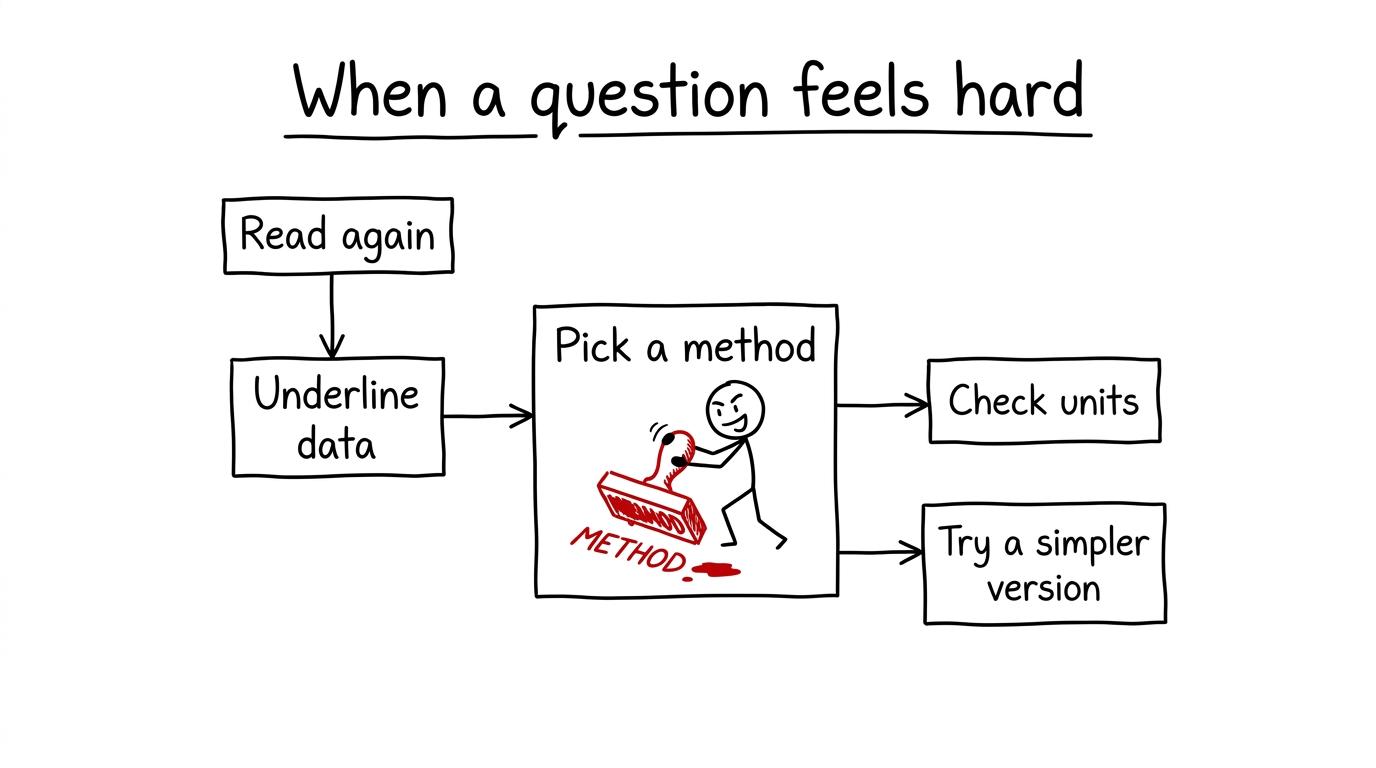 Flowchart about what to do when a question feels hard
Common mistakes that make GCSE maths feel harder than it is
- Doing only full papers too early. If you don’t know the methods, papers become demoralising rather than useful.
- Not learning from the mark scheme. In GCSE maths, your working earns marks. If you skip the “how”, you repeat the same losses.
- Dropping negative signs in algebra. For example, −(x−3)-(x-3)−(x−3) becomes −x+3-x+3−x+3, not −x−3-x-3−x−3.
- Rounding too early. Keep exact values until the final step unless the question tells you otherwise.
- Units drifting in calculation questions. If you’re doing speed, density, pressure, or energy-style maths, write units every line.
- Assuming Higher tier means “harder versions of the same questions”. Higher tier GCSE maths often tests connections between topics, not just bigger numbers.
Bringing it home: which GCSE is harder?
GCSE maths isn’t inherently harder than science. It’s just more honest. It shows you, immediately, what you can and can’t do under exam conditions.
And that’s good news, because honesty is actionable.
If maths feels harder right now, you don’t need a new personality. You need a tighter method: learn the skill, practise the exam questions, mark it, repeat. If science feels harder, you don’t need to “revise more”. You need to revise differently: recall, required practicals, and examiner-style explanations.
Your next step can be simple: pick one weak maths topic today and fix it properly using Maths Genie revision lessons and exam questions, then finish with a short paper section.
Use these to get started:
- GCSE Revision Resources
- GCSE Maths Predicted Papers (Edexcel)
- AQA GCSE Maths Past Papers (GCSE Maths page)
- Fractions, Decimals and Percentages (GCSE topic)
- Percentages (practice and exam questions)
- GCSE Statistics Revision
If you want your revision to feel calmer, make it measurable. Maths Genie gives you the structure: lessons, practice questions, past papers, predicted papers, mark schemes, and video solutions, all free. Keep showing up, keep correcting, and the “hard” feeling starts to shrink into something much more manageable: a method you can trust.










