GCSE Arabic Christmas Holiday Revision: A Calm Plan
GCSE Arabic Christmas holiday revision made manageable: plan short, balanced sessions across four skills while protecting rest, family time and GCSE maths.
The Christmas holiday creates a peculiar kind of pressure. You finally have time away from school, yet every subject seems to make a claim on it. Arabic vocabulary needs attention. Maths topics feel unfinished. Mock examinations may be waiting in January.
A reasonable GCSE Arabic Christmas holiday revision plan should not consume the whole break. For most students, 444 to 666 focused Arabic sessions of between 303030 and 454545 minutes across the holiday will provide useful continuity. Add brief vocabulary recall on a few other days if it helps. The exact amount should reflect your mock dates, teacher guidance and current weaknesses, not somebody else's timetable.
The aim is simple: return to school rested, with your Arabic still active and a clearer idea of what needs work next.
Your Christmas revision checklist
Before building a detailed timetable, make these decisions:
- Confirm your exact Arabic qualification, tier and mock arrangements.
- Choose no more than 222 priority weaknesses in Arabic.
- Plan 444 to 666 short, active sessions rather than daily marathons.
- Include listening, speaking, reading and writing across the break.
- Reserve separate time for GCSE maths and other subjects.
- Protect family events, celebrations, sleep and genuinely free days.
- Mark or review every substantial task so that mistakes guide the next session.
This is a framework, not an official requirement. If your teacher has set compulsory holiday work, place that into the plan first.
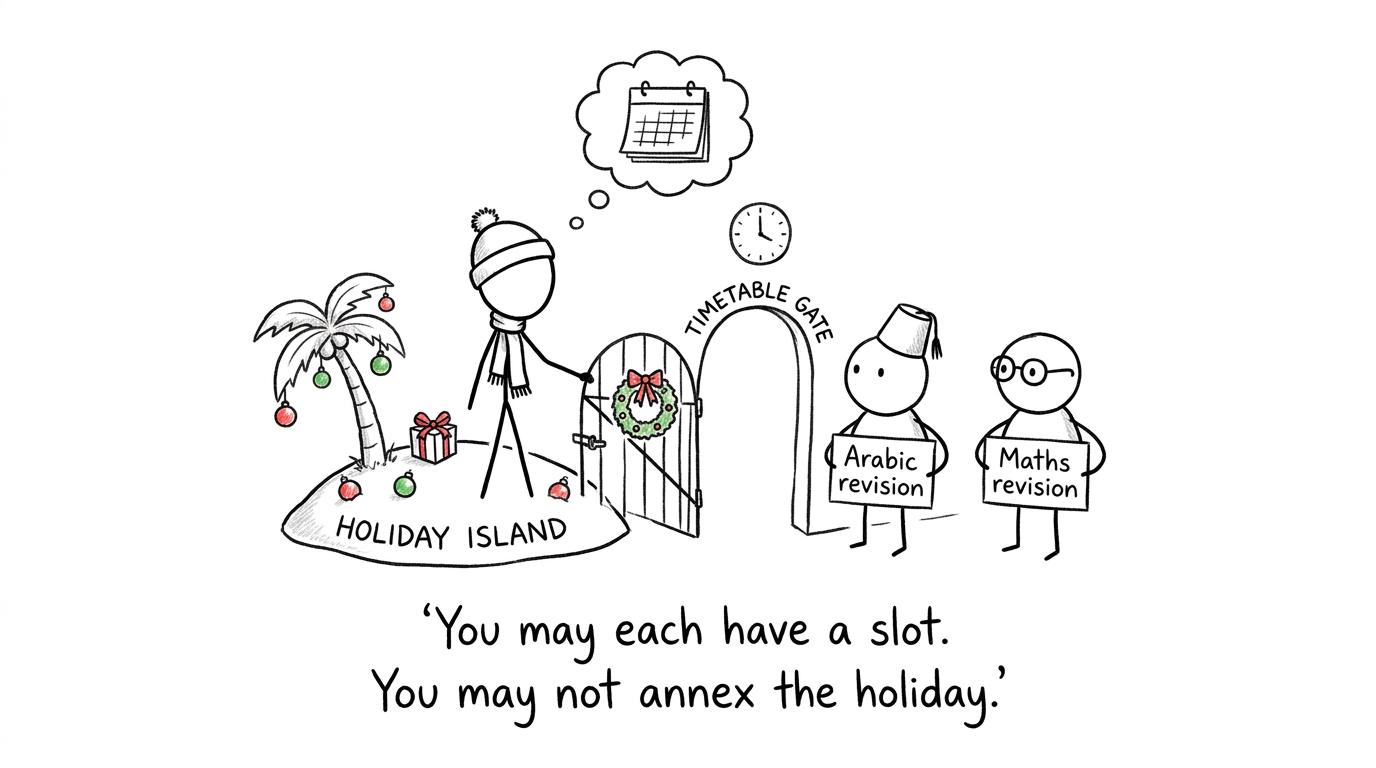 A student gives Arabic and maths revision a timetable slot without surrendering the holiday
How much GCSE Arabic revision is reasonable?
Reasonable revision is work you can complete consistently without sacrificing the purpose of the holiday. A useful starting range is:
| Your situation | A sensible starting point |
|---|---|
| Arabic is secure and mocks are not immediate | 333 or 444 sessions of about 303030 minutes |
| You have ordinary January mocks or several weak areas | 444 to 666 sessions of between 303030 and 454545 minutes |
| A speaking assessment or important mock is approaching | 666 to 888 targeted sessions, agreed with your teacher where possible |
| You are exhausted or struggling with wellbeing | Reduce the load, prioritise rest and speak to a trusted adult or teacher |
These ranges are practical suggestions, not rules from an exam board. More time is not automatically better. An unfocused afternoon spent highlighting vocabulary may achieve less than 353535 minutes of retrieval, speaking and correction.
Start by blocking out the days that already belong to family, travel or rest. Revision fits around life during the holiday; life should not be squeezed into the gaps left by revision.
Check what your Arabic course actually assesses
For the current Pearson Edexcel GCSE Arabic qualification, students are assessed through listening, speaking, reading and writing. Each skill contributes 25%25\%25% of the qualification. Papers are available at foundation and higher tier, and students enter the same tier across all four papers.
That equal weighting matters. A student who only memorises vocabulary and writes paragraphs may feel busy while neglecting half the qualification. Your holiday plan should touch all four skills, although it can give extra attention to the weakest one.
Do not assume that every qualification follows exactly the same format. Some schools or international centres may use a different Arabic qualification. Check the specification named by your school, your tier and the instructions for your mock. Edexcel, AQA, OCR and Eduqas are familiar names in GCSE examinations, but your maths exam board is not necessarily your Arabic awarding organisation.
Build a balanced Arabic revision cycle
A short session works best when it has one visible outcome. “Revise Arabic” is too vague. “Recall vocabulary for school, answer a short listening task and record three errors” is a plan.
Vocabulary and grammar
Use active recall rather than repeatedly reading a list. Cover the answer, retrieve it, check it and revisit words you missed. Group vocabulary by the themes in your own specification and class materials.
Grammar revision should also lead to production. Practise forming accurate phrases in different time frames, using opinions and adding reasons. Keep a small correction list for errors involving agreement, verb forms, spelling or sentence structure.
Listening
Listening needs regular exposure because understanding spoken language is different from recognising words on a page. Use recordings supplied by your school or awarding organisation. Listen first for the general meaning, then for precise details such as opinions, times, reasons and changes of tense.
Do not turn every listening task into background noise. One short recording, checked carefully, can be more valuable than an hour of passive exposure.
Speaking
Speaking can be revised without arranging a formal lesson. Read prompts aloud, answer likely questions without a script and record yourself where practical. Listen back for hesitation, unclear pronunciation and answers that stop before giving a reason or detail.
A useful session might focus on one role-play skill, one picture-based response or one conversation theme, depending on the format of your qualification. Use your school's approved materials rather than guessing what will appear.
Reading and writing
For reading, practise locating evidence rather than translating every word. Notice negatives, connectives, opinions and time markers. Check why an answer is correct and why an attractive alternative is wrong.
For writing, plan before producing a response. Afterwards, check whether you answered every bullet point, communicated clearly and used language you can control accurately. The purpose of Christmas practice is not to write the longest possible answer. It is to identify patterns that your next piece can improve.
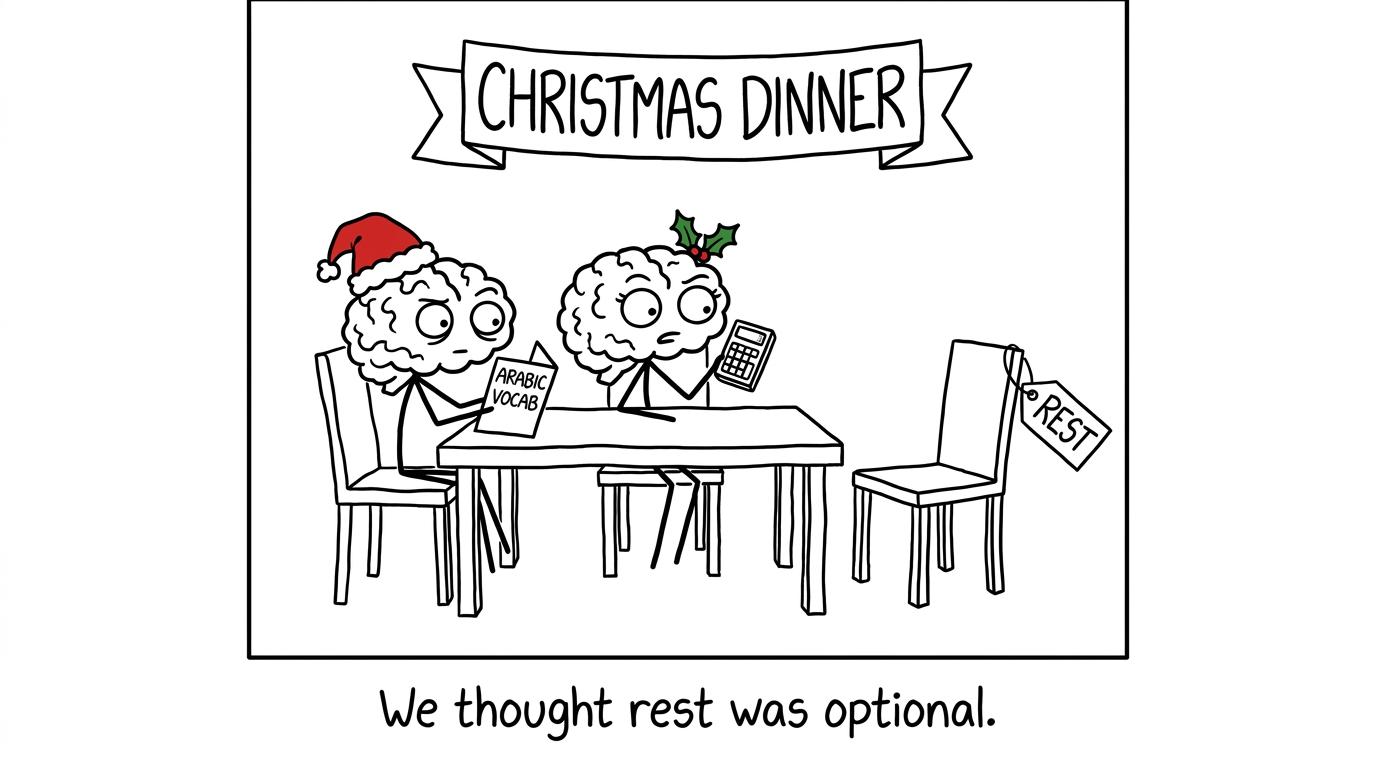 Brain cells discover that rest deserves a place beside vocabulary and calculator practice
Fit Arabic around GCSE maths and other subjects
The difficult part is rarely finding one free hour. It is deciding how Arabic shares the holiday with maths, English, science and everything else.
Begin with a subject overview. For maths, the free GCSE Maths revision hub lets you choose resources for boards including Edexcel, AQA, OCR and Eduqas. Use the GCSE self-assessment resources to identify genuine gaps instead of revising comfortable topics.
Then alternate demanding tasks. Avoid placing an Arabic writing task immediately beside a full maths paper if both require sustained concentration. A lighter vocabulary session can sit beside a maths topic lesson; a longer Arabic listening and writing session may deserve its own day.
A balanced holiday might contain:
- 222 Arabic sessions before Christmas and 222 to 444 afterwards;
- 333 genuinely revision-free days, or more if family plans require them;
- short maths topic sessions built around identified weaknesses;
- one maths mini test or paper section, followed by careful marking;
- spare time for unfinished school work and unexpected changes.
If you need a repeatable maths structure, the GCSE 202020-minute maths revision routine is easier to place beside language revision than an ambitious daily timetable. The broader guide to a GCSE maths revision timetable can help you plan beyond Christmas too.
Make each session active and finite
Every session should have a finish line. Try this structure:
- Recall: retrieve vocabulary, grammar or a speaking response without notes.
- Apply: complete one focused task using the relevant skill.
- Check: use teacher feedback, answers or an authorised mark scheme where available.
- Record: write down no more than 333 specific errors.
- Retest: return to those errors in a later session.
The same pattern works for maths. MathsGenie's guide to finding your weakest maths topics turns lost marks into a manageable action list. When you are ready for exam practice, use Edexcel GCSE Maths past papers or select the appropriate board from the main revision hub.
Nearer the examinations, Edexcel GCSE Maths predicted papers can provide fresh practice. Predicted papers should supplement official past papers, not replace them.
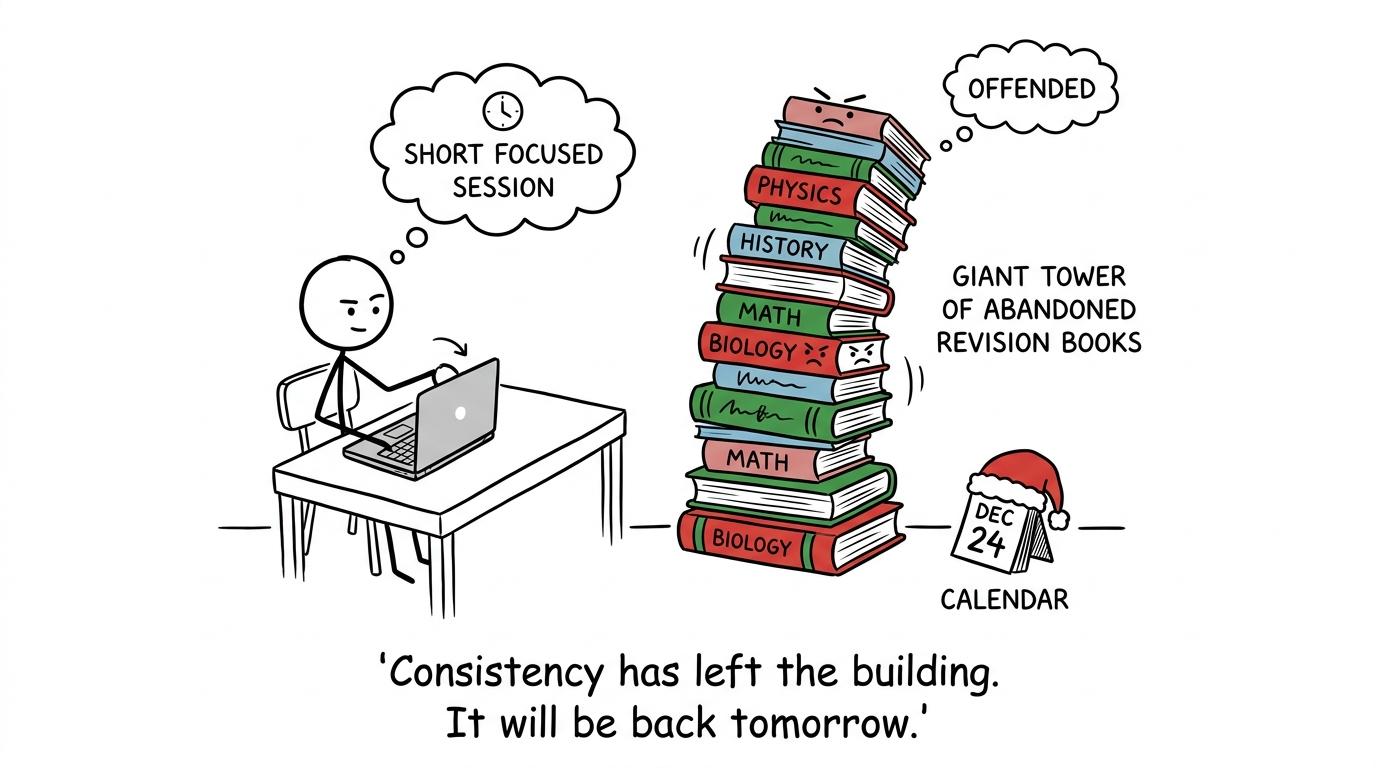 A short revision session ends while an unnecessarily huge book tower looks offended
Protect rest without feeling guilty
Rest is not a prize awarded after every subject is complete. GCSE revision is never completely finished, so that bargain would remove the holiday altogether.
Sleep supports health, mood and the ability to learn. Government health education guidance explicitly recognises that insufficient sleep can affect learning. Keep a reasonably steady sleep routine, stop revision at an agreed time and avoid using late-night work to compensate for an unrealistic daytime plan.
Also distinguish deliberate rest from anxious avoidance. A free afternoon chosen in advance feels restorative. An afternoon spent worrying about unopened books does not. A small timetable helps because it tells you both when to work and when you are finished.
Common mistakes with Christmas revision
Planning every day
A timetable with no spare days breaks as soon as a family event changes or you feel unwell. Leave buffer space and accept that Christmas Day or other important occasions can remain completely revision-free.
Measuring effort only in hours
Time at a desk is not the same as learning. Track completed tasks, corrected errors and successful retests instead.
Revising only vocabulary
Vocabulary matters, but GCSE Arabic also requires students to understand and communicate through several skills. Include listening, speaking, reading and writing in proportions that reflect your qualification and weaknesses.
Completing papers without reviewing them
A paper reveals weaknesses; it does not repair them by itself. This applies to Arabic and maths. The useful sequence is attempt, mark, diagnose, practise and retest. MathsGenie's guide to using Edexcel past papers properly explains how to turn mistakes into targeted maths work.
Copying somebody else's schedule
One student may have a January speaking mock, while another is secure in Arabic but struggling with higher-tier maths. Their reasonable workloads will differ. Use teacher feedback, mock dates and your own error patterns.
A holiday that still feels like a holiday
Good Christmas revision is modest enough to begin and focused enough to matter. Choose a small number of Arabic priorities, cover all four assessed skills over time and stop each session when its purpose has been achieved. Then step away without guilt.
For the maths part of your plan, make MathsGenie your free revision base. Start with revision lessons and practice questions, check progress through mini tests, and build towards past papers and predicted papers. Use mark schemes and video solutions to understand exactly where methods need repairing.
Open the GCSE Maths revision hub, choose your exam board and one weak topic, then schedule your first short session. A sustainable plan will still be working when school restarts, and your holiday will still have belonged to you.